
Anyone looking into auto transport often hears this: the shorter the route, the cheaper the door to door price. That sounds logical, but it often produces the wrong expectation. A short regional move can cost more per mile than a long-distance shipment because dispatching, loading, insurance handling, and carrier positioning still require real work, even when the vehicle travels a modest distance.
The right question isn't only, “How many miles is the move?” Ask instead, what will the carrier have to do to reach the vehicle, load it, move it, and complete delivery without avoidable handling? That answer determines whether a quote is genuinely competitive or merely cheap at first glance.
Table of Contents
- The Real Math Behind Your Auto Transport Quote
- Key Variables That Drive Shipping Costs
- Door to Door vs Terminal to Terminal Shipping
- Navigating Puerto Rico Vehicle Transport Logistics
- The Value of Flat-Rate Pricing and Expert Agents
- Actionable Steps to Secure the Best Transport Rate
The Real Math Behind Your Auto Transport Quote
Auto transport pricing doesn't behave like a simple taxi meter. A carrier doesn't incur costs only while the truck is moving. Dispatch coordination, loading, inspection, insurance administration, equipment positioning, and the search for a suitable carrier all affect the quote before the vehicle travels very far.
That fixed work gets spread across the route mileage. On a long haul, the operational cost is distributed across many miles. On a short haul, the same categories of work are concentrated into a smaller trip, which pushes the per-mile figure upward. Shorter doesn't automatically mean better value.
Why short routes can look expensive
Recent market data places short-trip pricing at $2.04 per mile for routes under 500 miles, compared with $0.55 per mile for routes above 2,500 miles, because fixed costs such as dispatch and loading are spread across fewer miles on shorter moves, as reported in this 2026 auto transport market analysis. The total bill may still be lower on the short route, but the mileage rate can be dramatically higher.
That explains why a regional relocation, dealership transfer, college move, or snowbird trip can feel surprisingly expensive. Carrier availability also matters. If few trucks are already serving the lane, a carrier may need to reposition or accept a less efficient schedule, and the customer pays for that logistical friction.
For a broader planning reference, review this guide to car shipping cost factors. Use it to understand the categories behind a quote, not as a promise that every vehicle or route will receive the same rate.
Practical rule: Judge the total service and the conditions attached to the quote. Don't judge value by the per-mile number alone.
What true door-to-door service includes
A legitimate door-to-door shipment means the carrier collects the vehicle as close as safely possible to the requested origin and delivers it as close as safely possible to the requested destination. It doesn't mean a tractor-trailer can enter every residential driveway or stop on every narrow city street. If access is unsafe or restricted, the driver may arrange a nearby meeting point.
A professional quote should identify the origin, destination, vehicle condition, transport type, pickup expectations, delivery method, and fees that could change the final total. That level of detail matters whether you're moving a sedan between Los Angeles and Phoenix, relocating an SUV from Chicago to Memphis, or sending a vehicle from Atlanta toward Detroit. Distance is part of the calculation, but it isn't the calculation.
Key Variables That Drive Shipping Costs
The per-mile rate can mislead you. A short move may cost more per mile than a cross-country haul because the carrier still absorbs loading time, scheduling work, repositioning, and access delays. A running sedan on a busy interstate is cheaper to place on a truck than a modified SUV that needs special loading near a restricted residential street.
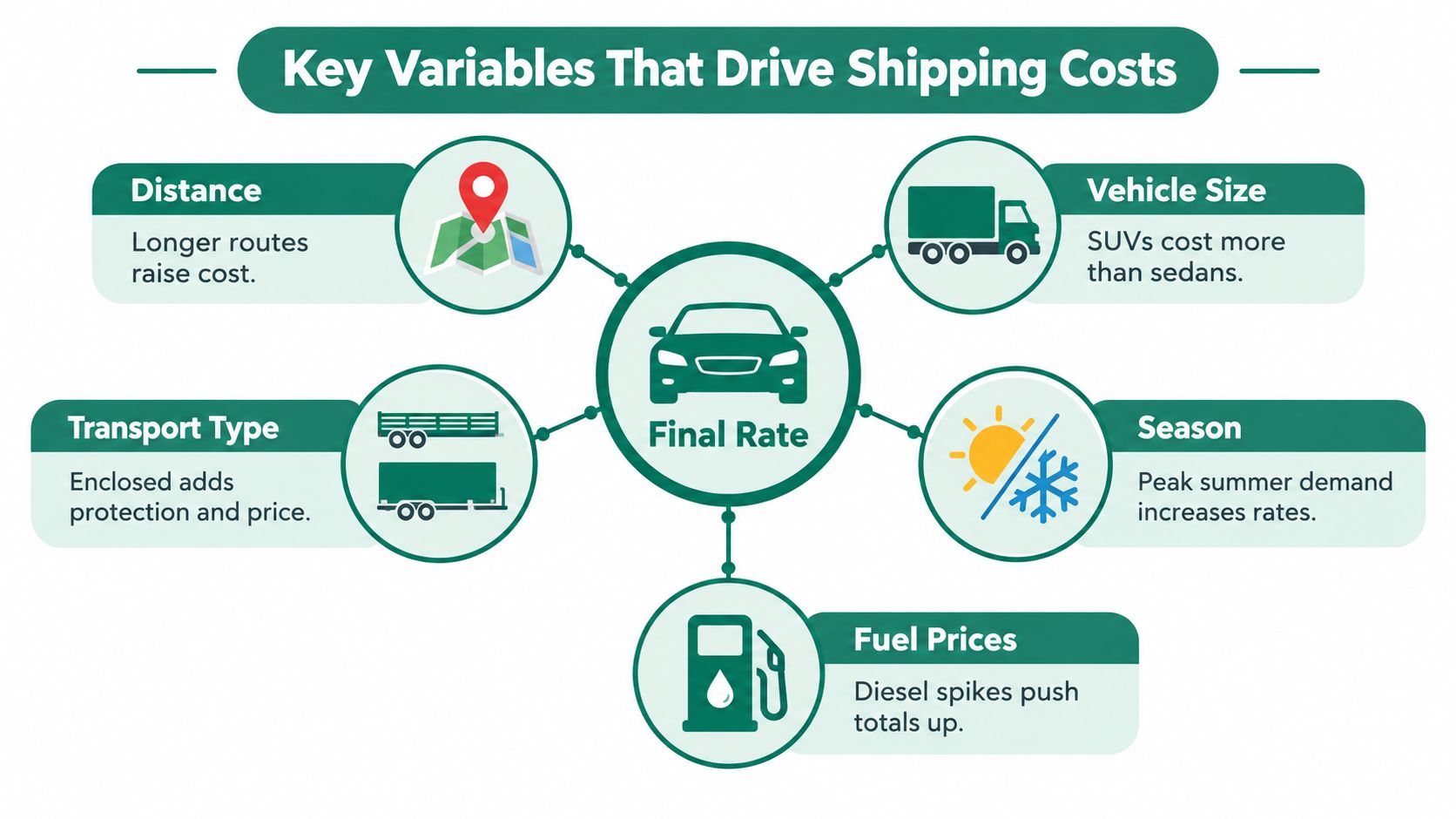
A carrier builds the quote around access, equipment, demand, and risk, not mileage alone. These variables explain why two vehicles traveling similar distances can receive very different prices.
Route density and access
Carrier supply is strongest on familiar corridors. Major interstate routes such as I-95 and I-10 often price more competitively because trucks run those lanes frequently, creating more chances to accept a shipment, as explained in this guide to route density and door-to-door transport. A location beyond 30 miles from a major highway can add an access surcharge of about $50 to $150 when the driver must spend extra time reaching the address and returning to the main route.
Dense urban areas create different access problems. Low-clearance streets, traffic restrictions, limited stopping space, and tight turns can force a driver to meet the customer elsewhere. A large commercial parking area, dealership, or other safe loading point often reduces that friction. Confirm the location before booking. Door-to-door service cannot override physical access limits.
Vehicle and equipment choices
Vehicle size determines how much trailer space the shipment uses. A compact sedan usually loads more efficiently than a large SUV, pickup, modified vehicle, or oversized recreational vehicle. An inoperable car costs more to handle because the driver may need extra labor or equipment to move it onto the trailer.
Open transport is the practical choice for most everyday vehicles. Enclosed transport costs more, but it provides added protection from road exposure and suits classic, luxury, collectible, or highly finished vehicles. Review the enclosed auto transport option before requesting quotes if protecting the vehicle's finish matters more than minimizing the initial price.
Seasonal demand and fuel conditions also influence carrier availability. Snowbird routes, military relocation periods, dealership volume, and weather-related disruptions can tighten capacity. Provide accurate vehicle and location details early, then keep the pickup window reasonably flexible. That combination gives carriers fewer reasons to add a premium.
Door to Door vs Terminal to Terminal Shipping
Terminal shipping can look cheaper because the advertised transport portion excludes some of the work required to reach a residence. That doesn't make it a bad service, but it does mean you need to calculate the total move, not compare a door-to-door quote with only the first line of a terminal estimate.
Door-to-door service normally saves the customer from arranging a separate transfer to a terminal, retrieving the vehicle from a storage location, and coordinating local transportation around the terminal schedule. It also reduces the number of handoffs. Every extra transfer creates another appointment, another inspection point, and another opportunity for confusion.
The premium versus the practical cost
Door-to-door shipping typically costs about 5% to 15% more than terminal shipping, while saving customers local transfer and extra handling costs. The nationwide average cost to ship a car is about $1,215 in 2026, based on the cited market summary from A1 Auto Transport's door-to-door shipping overview. Your route, vehicle, access conditions, and carrier availability still determine the actual quote.
Terminal service may make sense if you live near a reliable facility, can deliver and collect the vehicle easily, and value a specific terminal schedule. It makes less sense when the terminal is inconvenient, the vehicle sits for an extended period, or you must pay for rides, local towing, storage, or time away from work.
| Feature | Door to Door Service | Terminal to Terminal |
|---|---|---|
| Pickup | Carrier collects near the requested address or an agreed safe meeting point | Customer takes the vehicle to a terminal |
| Delivery | Carrier delivers near the destination address or meeting point | Customer retrieves the vehicle from a terminal |
| Handling | Fewer customer-arranged transfers | More local coordination and possible handoffs |
| Convenience | Strong choice for relocations, families, students, and businesses | Useful when both parties have easy terminal access |
| Price structure | Usually includes more direct coordination | May appear lower before local costs are added |
| Access limits | Street restrictions can require a nearby meeting point | Terminal access is predetermined |
A lower terminal quote isn't automatically a lower transportation cost. Add every local transfer and handling expense before choosing it.
For individuals, military families, students, and snowbirds, direct delivery usually earns its premium through simplicity. Dealerships and businesses should also consider the labor involved in moving vehicles between lots. A quote that saves money on paper can consume staff time and create scheduling problems that never appear in the advertised rate.
Navigating Puerto Rico Vehicle Transport Logistics
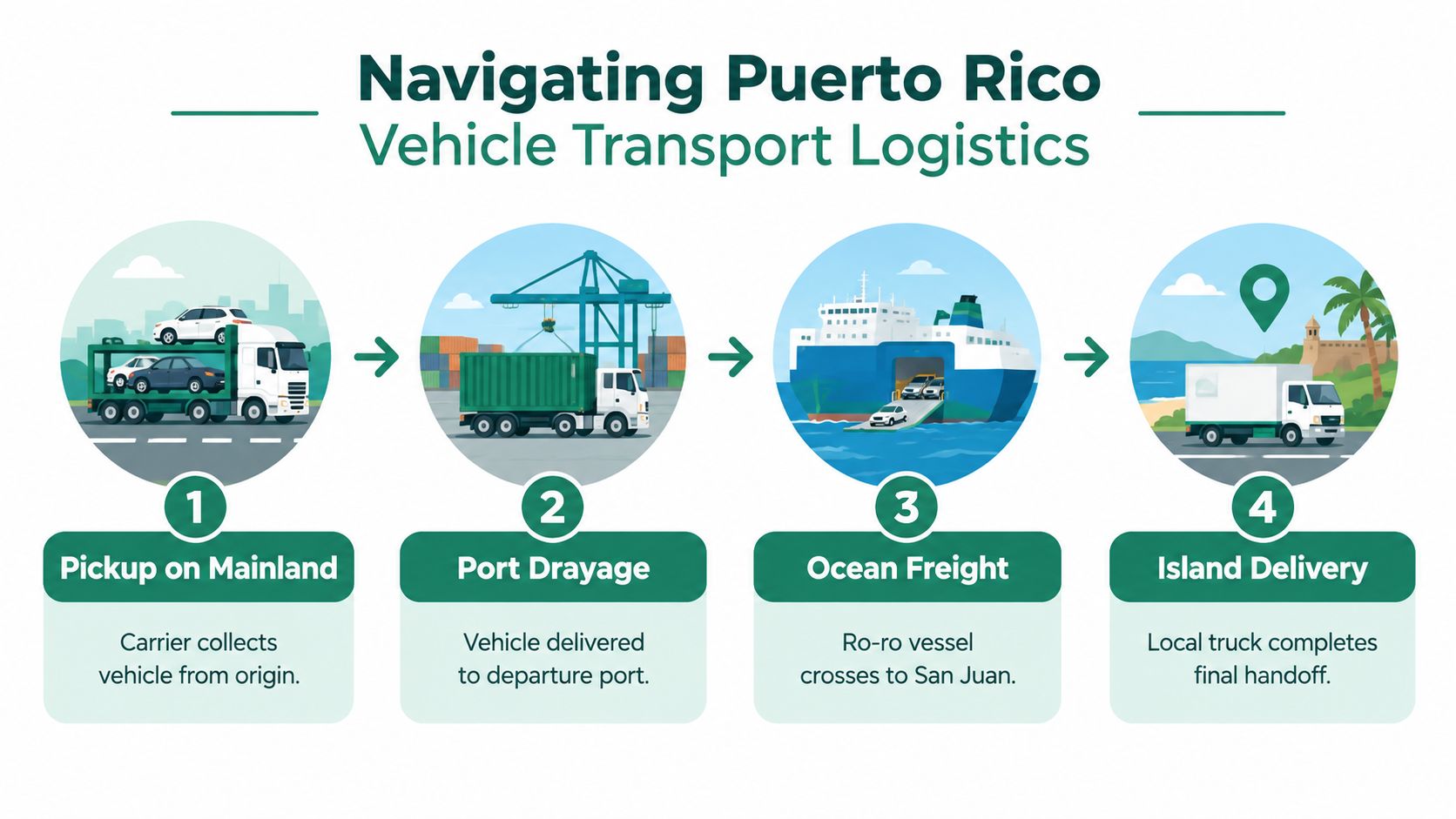
Puerto Rico vehicle shipping isn't a standard mainland trucking job. The vehicle must travel overland from its origin to a mainland port, move by ocean freight to San Juan, and then continue through island-side delivery. In many cases, the mainland port is Jacksonville, Florida, followed by ocean transport to San Juan, as explained in this Puerto Rico vehicle shipping overview.
That multi-modal structure changes how you should evaluate a door to door price. You're paying for coordinated trucking, port handling, ocean movement, documentation, and final delivery. A quote that separates each leg without explaining the total can leave you responsible for charges you assumed were included.
The process from mainland pickup to San Juan
The practical sequence is straightforward, but every step needs coordination:
- Mainland pickup: A truck carrier collects the vehicle from the origin or an agreed safe location.
- Port drayage: The vehicle moves to the departure port, where staff process it for ocean transport.
- Ocean freight: The vehicle travels to San Juan through roll-on/roll-off or container service, depending on the shipment arrangement.
- Island delivery: A local carrier completes the handoff at the destination or an agreed meeting point.
Customers should prepare documents before the vehicle reaches the port. A Crowley guide states that the vehicle needs a legible VIN, proof of ownership, and registration. In some situations, a notarized authorization is also required. The same guidance identifies a $10 voucher and a $2 voucher as part of the process, and says unsafe vehicles, cracked windshields, and non-running vehicles may be refused, according to this Puerto Rico vehicle shipping documentation guide.
Port paperwork is part of the shipment, not an administrative afterthought. A missing document can delay acceptance even when the truck arrives on time.
For mainland residents sending a car to San Juan, Puerto Rico dealerships receiving inventory, military families relocating, and snowbirds moving between homes, ask whether the quote includes mainland trucking, ocean freight, port handling, and island-side delivery. Puerto Rico car shipping service should be evaluated by its complete scope, not by a mainland mileage comparison that ignores the ocean leg.
The Value of Flat-Rate Pricing and Expert Agents
A low estimate is useful only if the carrier can secure the shipment at that figure. In auto transport, a quote can change when the dispatcher discovers the vehicle is oversized, the address is difficult to access, the car doesn't run, or the original price was never realistic for the lane.
Flat-rate pricing works when the scope is clear. The provider should know the vehicle type, condition, origin, destination, requested dates, and transport method before presenting the rate. You should also know which circumstances could require a revised quote, rather than discovering a new charge after the vehicle is ready.

National Car Transport offers door-to-door transport through a network of 25,000+ vetted, licensed, and bonded carriers, backed by 25+ years of experience and an A+ BBB rating, according to the company's publisher information. Its stated model includes transparent flat-rate pricing and no upfront charge until a carrier is matched, with open and enclosed transport plus container and ocean options for island routes.
Why an experienced agent matters
An agent does more than pass along a number. A capable logistics contact checks whether the address works for the equipment, confirms whether the vehicle runs, explains open versus enclosed service, coordinates pickup expectations, and keeps the customer informed when a route changes.
National Car Transport also has bilingual English and Spanish agents based in the United States, with agents who have over 20 years of experience in auto transport logistics service, according to the publisher information. That matters for customers who prefer to discuss documentation, vehicle condition, port requirements, and delivery arrangements in the language they use most comfortably.
The service is relevant to individuals, snowbirds, military families, students, dealerships, online vehicle buyers, and businesses moving fleets or auction purchases. Not one vehicle transport is alike. Having an agent guide the shipment and make the process simple and quick is where a structured service can provide value, without relying on a vague online estimate.
A quote should leave you with a clear answer to four questions:
- What is included: Confirm pickup, delivery, carrier type, insurance handling, and any port-related services.
- What can change the rate: Ask specifically about access problems, vehicle condition, modifications, and schedule changes.
- Who is responsible: Identify the person monitoring the shipment and the process for resolving a delay.
- When payment occurs: Verify whether any payment is due before a carrier is matched and under what terms.
For a visual explanation of the quoting and transport process, review the following customer-facing video.
Actionable Steps to Secure the Best Transport Rate
The best rate comes from giving the carrier accurate information and reducing avoidable route friction. You can't control every market condition, but you can prevent the common errors that create revised quotes, missed pickups, and unnecessary access charges.
Prepare the shipment before requesting quotes
Start with the vehicle itself. Give the year, make, model, body style, and running condition. Mention lifted suspension, lowered clearance, oversized tires, roof racks, spoilers, disabled brakes, or any modification that affects loading. If the vehicle doesn't operate under its own power, say so before the quote is issued.
Measure carefully when the vehicle has nonstandard dimensions. A carrier planning around a standard sedan can face a problem when an undisclosed modification takes additional deck space. That problem usually reaches the customer through a delayed pickup or a revised price.
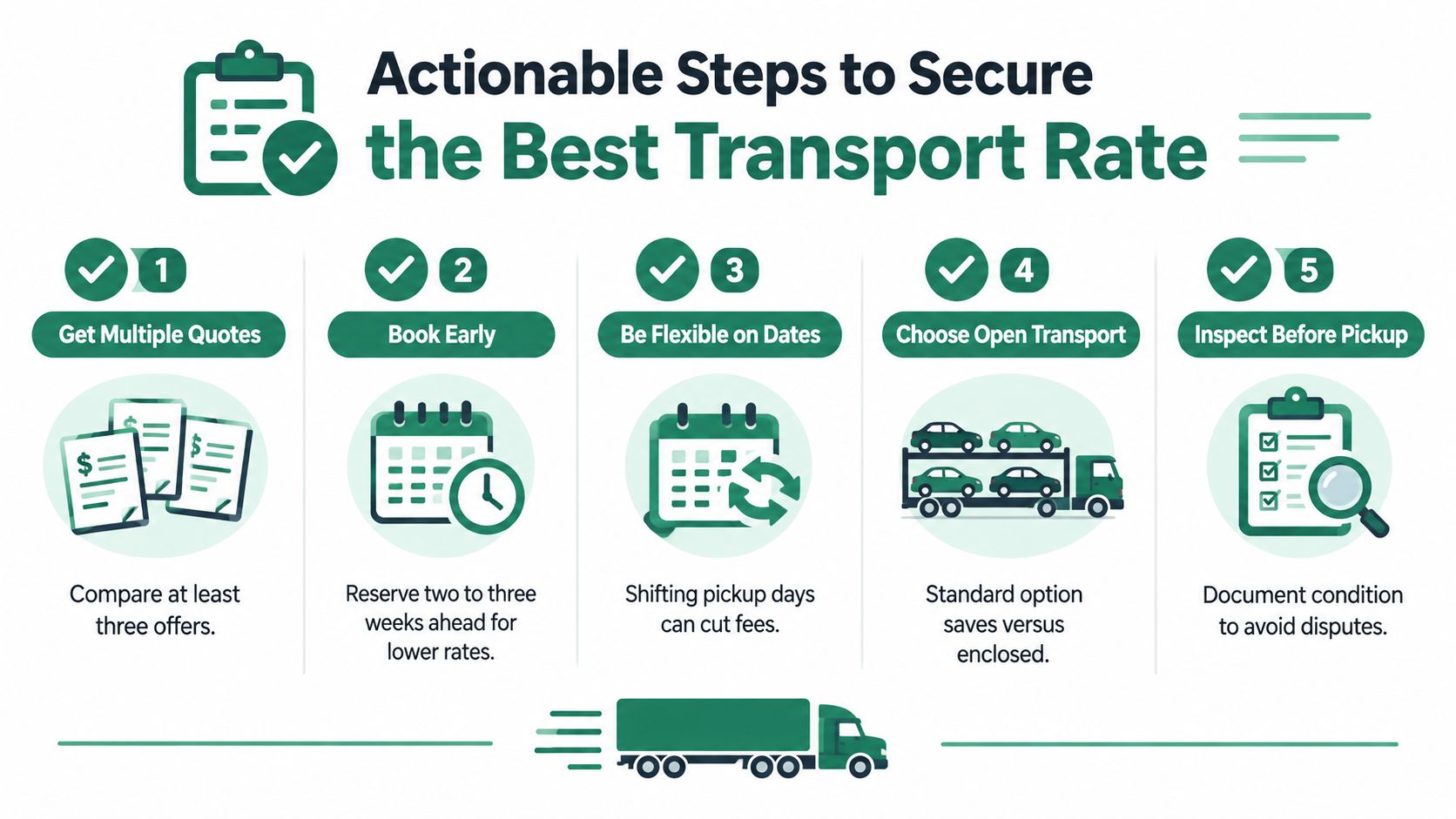
Use this preparation checklist:
- Confirm both addresses: Identify whether the carrier can safely approach each location and whether a nearby commercial meeting point is more practical.
- Describe the vehicle accurately: Include size, modifications, operability, and any special loading needs.
- Clarify the service type: Decide whether open, enclosed, container, or ocean-supported transport fits the vehicle and route.
- Set a workable pickup window: Flexible scheduling can give the dispatcher more opportunities to match the vehicle with an available carrier.
- Document existing condition: Photograph the exterior and interior before pickup, and compare the inspection record with the vehicle at delivery.
Read the quote like a logistics document
Don't compare five headline prices without comparing scope. Ask every provider whether the quoted total includes residential access, carrier assignment, delivery coordination, and any known port or terminal handling. For Puerto Rico shipments, request a clear explanation of the mainland, ocean, and island portions rather than accepting a mainland-style mileage estimate.
Look for a written flat-rate commitment and a list of exceptions. Rural access, oversized vehicles, inoperable cars, and restricted streets deserve direct answers before booking. If a quote avoids those questions, its low price isn't meaningful.
Open transport is generally the sensible value choice for ordinary daily drivers. Enclosed service is worth considering for a classic, luxury, collectible, or otherwise high-value vehicle where additional protection matters more than the lowest possible rate.
Don't select a provider solely because its first number is the smallest. Select the quote that explains the service, identifies the carrier conditions, and gives you a real person to contact. That approach protects your budget and makes the delivery easier to manage for a family, a dealership, or a business fleet.
National Car Transport offers transparent flat-rate quotes for door-to-door mainland shipping, along with enclosed transport and coordinated Puerto Rico trucking, ocean freight, and delivery options. Visit National Car Transport to request a quote and speak with a bilingual U.S.-based agent about the vehicle, route, access conditions, and complete transport scope.