
You're probably doing this right now. You need to ship a vehicle for a move, a military transfer, a snowbird season, a college run, a dealership delivery, or a Puerto Rico route, and every review you read seems to say something different. One company looks flawless until you find a thread full of complaints. Another has bad stars but a few detailed reviews that sound honest and useful.
That confusion is normal. Door to door auto transport reviews are messy because the service itself is messy. Trucks run late. Streets are too tight. Brokers and carriers share responsibility. Customers leave glowing reviews when communication is good, and they leave furious ones when nobody answers the phone.
I've seen people make the same mistake over and over. They shop by star rating, grab the lowest quote, and assume “door-to-door” means a full-size carrier can always pull right up to the house. Then the friction starts.
A better approach is simple. Don't ask, “Who has the highest rating?” Ask, “What are these reviews telling me about how this company operates when things get inconvenient?” That question gets you much closer to a safe booking, whether you're shipping between major mainland cities, moving a car to San Juan, or arranging a port-connected Puerto Rico shipment.
Table of Contents
- Why Choosing a Car Shipper Feels Overwhelming
- Decoding Reviews What Shippers Praise and Complain About
- Finding Trusted Review Sources and How to Vet Them
- Reading Between the Lines of Customer Feedback
- Red Flags to Watch For in Auto Transport Companies
- Your Pre-Booking Checklist for Choosing a Carrier
- Frequently Asked Questions About Door to Door Transport
Why Choosing a Car Shipper Feels Overwhelming
Individuals book auto transport a handful of times in their life, if that. They don't have a system for judging shipping companies, so they do what everyone does first. They search, compare ratings, skim complaints, and hope they can spot the truth in ten minutes.
That usually fails because auto transport reviews don't behave like reviews for a restaurant or a hotel. A vehicle shipment involves dispatch, route planning, truck access, weather, driver timing, customer availability, and sometimes ocean logistics if Puerto Rico is involved. One weak link can ruin the whole experience, even if the vehicle arrives fine.
The review problem isn't just fake praise
A lot of reviews are real and still misleading. A happy customer may rave about a fast pickup on an easy city-to-city route. That doesn't tell you much if you're shipping from a narrow residential street in Boston, a rural address in Montana, or coordinating a vehicle from Miami to San Juan.
Negative reviews can mislead too. Some customers expect exact appointment-style timing when the industry works in pickup and delivery windows. Others blame the wrong party because they never understood whether they hired a broker, a carrier, or a company coordinating multiple legs.
Practical rule: Reviews matter most when they describe how the company handled a problem, not when everything went smoothly.
Why stress spikes on Puerto Rico and long-haul moves
Mainland routes across the lower 48 already require coordination. Puerto Rico adds another layer. You're not just judging whether a truck can show up. You're judging whether the company can manage handoffs, paperwork, scheduling, and communication across a more complex route.
That's why experienced guidance matters. A company with seasoned U.S.-based agents who know domestic and Puerto Rico auto transport can save you from common mistakes before pickup day. That includes explaining when “door-to-door” really means a nearby safe meeting point, what to expect on urban routes, and how to plan around port timing without creating false expectations.
Here's the blunt truth. If a shipper can't explain the process clearly before you book, the reviews won't save you later.
Decoding Reviews What Shippers Praise and Complain About
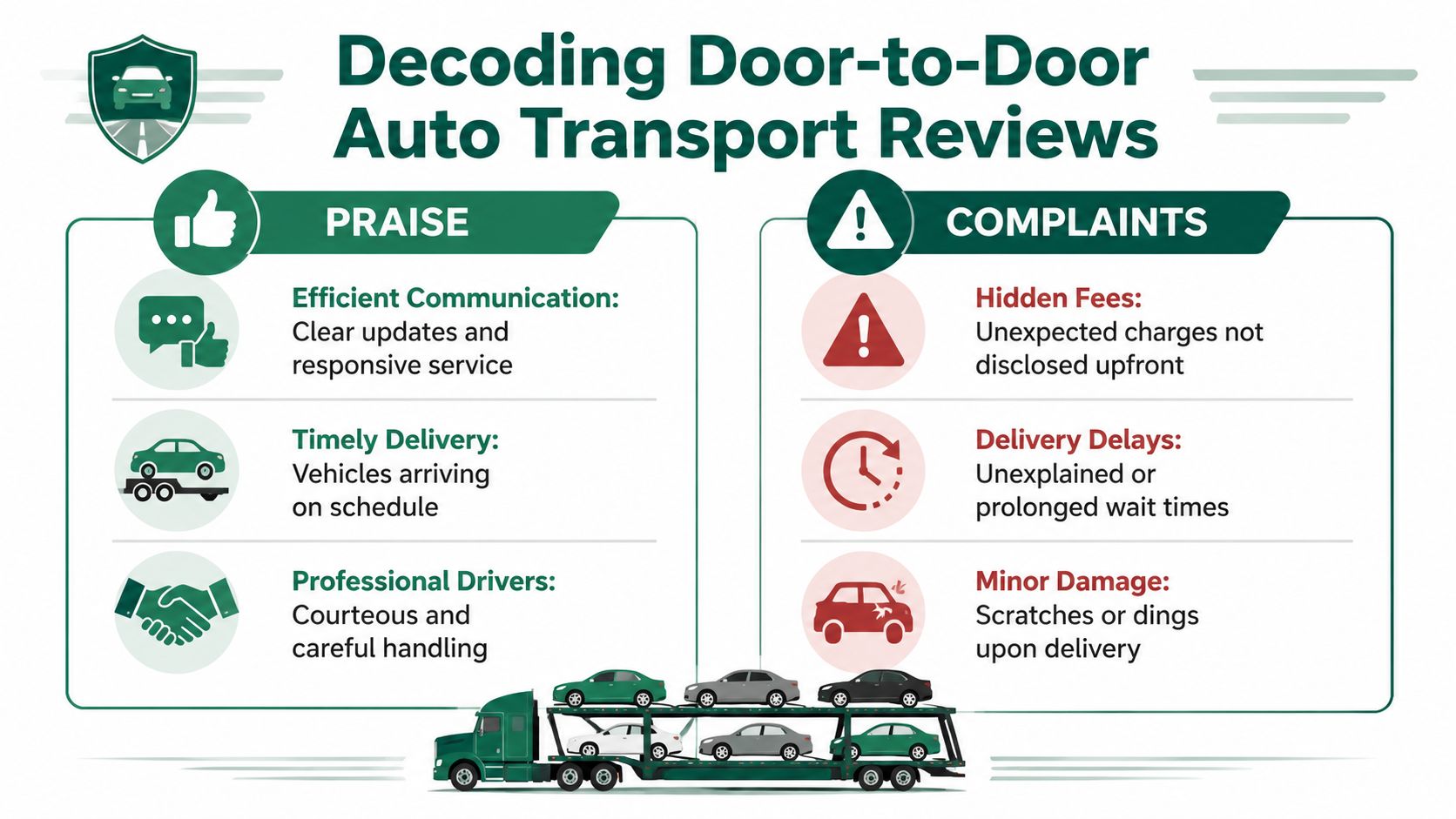
Most door to door auto transport reviews boil down to one issue. Did the company keep the customer informed while moving the car from one address to another without chaos? That matters more than polished marketing.
J.D. Power notes that major carriers commonly offer door-to-door transport alongside open, enclosed, and expedited options, and that reviews often focus on communication quality, pickup timing, and exception handling more than the shipment itself because those signals show whether a carrier can execute the service well in its car shipping guide.
What strong reviews usually praise
When a review feels credible, it usually praises specific operational behavior, not vague friendliness.
- Clear updates: Customers remember who called back, who confirmed pickup windows, and who explained delays before the customer had to chase them.
- Smooth pickup logistics: Good reviews often mention that the driver or dispatcher handled address coordination well.
- Professional delivery process: Honest positive reviews tend to mention inspection, paperwork, and a driver who didn't rush the handoff.
- No pricing games: Customers notice when the final amount matches what they were told.
That last point matters a lot on coast-to-coast moves and Puerto Rico-related bookings, where customers are already nervous about timing and handoffs.
What bad reviews usually reveal
Bad reviews also follow patterns. Some complaints are emotional noise. Others are useful warnings.
Here are the complaints I take seriously:
| Review theme | What it usually means |
|---|---|
| Silence after booking | Dispatch or support is disorganized |
| Pickup kept getting pushed | The company may have quoted aggressively without securing reliable capacity |
| “Door-to-door” changed late | Access problems weren't explained upfront |
| Final price changed | Quote discipline is weak or the agreement was vague |
| Broker blamed carrier, carrier blamed broker | Nobody owned the shipment end to end |
The complaint that matters most
Minor transit delays happen in this business. What separates a competent shipper from a bad one is whether they explain the delay, adjust the plan, and stay reachable.
The worst review pattern isn't “my truck was late.” It's “nobody told me what was going on.”
That's why I tell people to read detailed reviews first, not the highest-rated ones first. If ten reviews say the company answered the phone, set realistic expectations, and managed exceptions well, that's meaningful. If ten glowing reviews just say “great service,” that tells you very little.
Finding Trusted Review Sources and How to Vet Them
Start with records that create accountability. Star ratings alone are weak evidence in auto transport because they flatten very different problems into one number. A late pickup, a rude dispatcher, a billing dispute, and actual vehicle damage should never carry the same weight. Your job is to separate inconvenience from operational risk.

Use each review source for a specific purpose
BBB, Google, Yelp, and transport review sites do different jobs. Treating them as interchangeable is sloppy.
A Yelp listing for one door-to-door transport company shows a large pool of unhappy reviewers, which makes it useful for spotting repeated service failures on this Yelp business listing. Google is better for recency and volume. BBB is better for formal complaint history and whether the company responds with facts or canned excuses. Niche transport sites can help, but only if they show licensing details, company history, and enough written feedback to inspect.
That same filtering mindset matters in other review-heavy industries. The habits that help with spotting ceramic coating hype also help here. Ignore glossy claims. Look for specifics, consistency, and proof that the business handles problems in public.
Vet the source before you vet the shipper
Some review pages exist to rank companies, not to inform you. If a site hides how it scores businesses, recycles generic company descriptions, or pushes every reader toward the same quote form, treat it as a lead generator first and a review source second.
I trust sources more when they show enough raw material to verify what I am reading. That means reviewer dates, response history, complaint details, and business identity that matches the company's DOT or MC records. If the company name shifts across platforms, stop and confirm you are researching the right operator.
A vetting routine that catches the problems early
Use this order every time:
- Confirm FMCSA registration and authority. If an interstate shipper cannot be verified, cross it off.
- Match the business name across review sites and government records. Review profiles tied to the wrong company waste your time.
- Check BBB for complaint type and response quality. A polished rating means less than how the company handles disputes.
- Use Google and Yelp to spot repeated patterns. You are looking for clusters, not isolated outbursts.
- Separate mainland moves from Puerto Rico moves. Puerto Rico shipments involve port handling, extra handoffs, and schedule friction that standard domestic reviews often miss.
- Call with route-specific questions. Ask who handles pickup, who handles the port process if Puerto Rico is involved, and what changes the final delivery method.
Puerto Rico is where weak review reading hurts people most. A company can look fine on domestic moves and still struggle with port coordination, container timing, document handling, or handoffs once the vehicle leaves the mainland. If Puerto Rico is your route, hunt for reviews that mention San Juan, port delays, missing updates after drop-off, and confusion over who had custody of the car at each stage.
National Car Transport is one company readers may see mentioned elsewhere in this article. Use that kind of company as a benchmark for what to verify, not as a substitute for verification. Check whether the operating history, quoting style, support claims, and public complaint patterns line up across independent sources.
Reading Between the Lines of Customer Feedback
The biggest mistake people make is treating all reviews as equal. They're not. A one-line rave and a one-line attack usually have the same problem. Neither tells you enough to judge what happened.
The most useful reviews tend to be the ones that describe timing, communication, and how the company handled friction. That's why I pay close attention to middle-of-the-road reviews. They often come from customers who weren't trying to praise or punish. They were trying to report what happened.
Patterns matter more than isolated complaints
One complaint about a delay doesn't bother me. A pattern of complaints about delay, vague updates, and support that disappears after booking does.
That distinction matters because complaint volume and review volume are different signals. One BBB profile for a door-to-door transport company shows 14 complaints, including pickup delay issues, even though the company also has positive ratings elsewhere on its BBB complaints page. That's a strong reminder to inspect formal complaints, not just star scores.
Read review tone like an investigator
Ask these questions while reading:
- Does the reviewer describe a real sequence of events? Specific pickup windows, communication attempts, and delivery details are more useful than generic anger.
- Is the complaint about timing or damage? In this industry, timing and communication complaints often tell you more about daily operations.
- Did the company reply with facts? A calm response that addresses the issue is a positive signal.
- Does the review match your own risk profile? If you're shipping to or from Puerto Rico, generic domestic reviews won't answer every question you have.
A review is valuable when it gives you a timeline, a problem, and the company's response.
This kind of reading discipline matters in other industries too. If you've ever looked at spotting ceramic coating hype, you already know how easy it is for flashy claims and selective praise to distort reality. Auto transport reviews work the same way. You have to separate emotion, marketing, and actual service performance.
How to weigh a company response
A defensive canned response tells me very little. A response that explains what happened, without attacking the customer, is more credible. Even better is a pattern of replies that show the company is trying to fix issues rather than bury them.
Don't expect perfection. Expect accountability.
Red Flags to Watch For in Auto Transport Companies
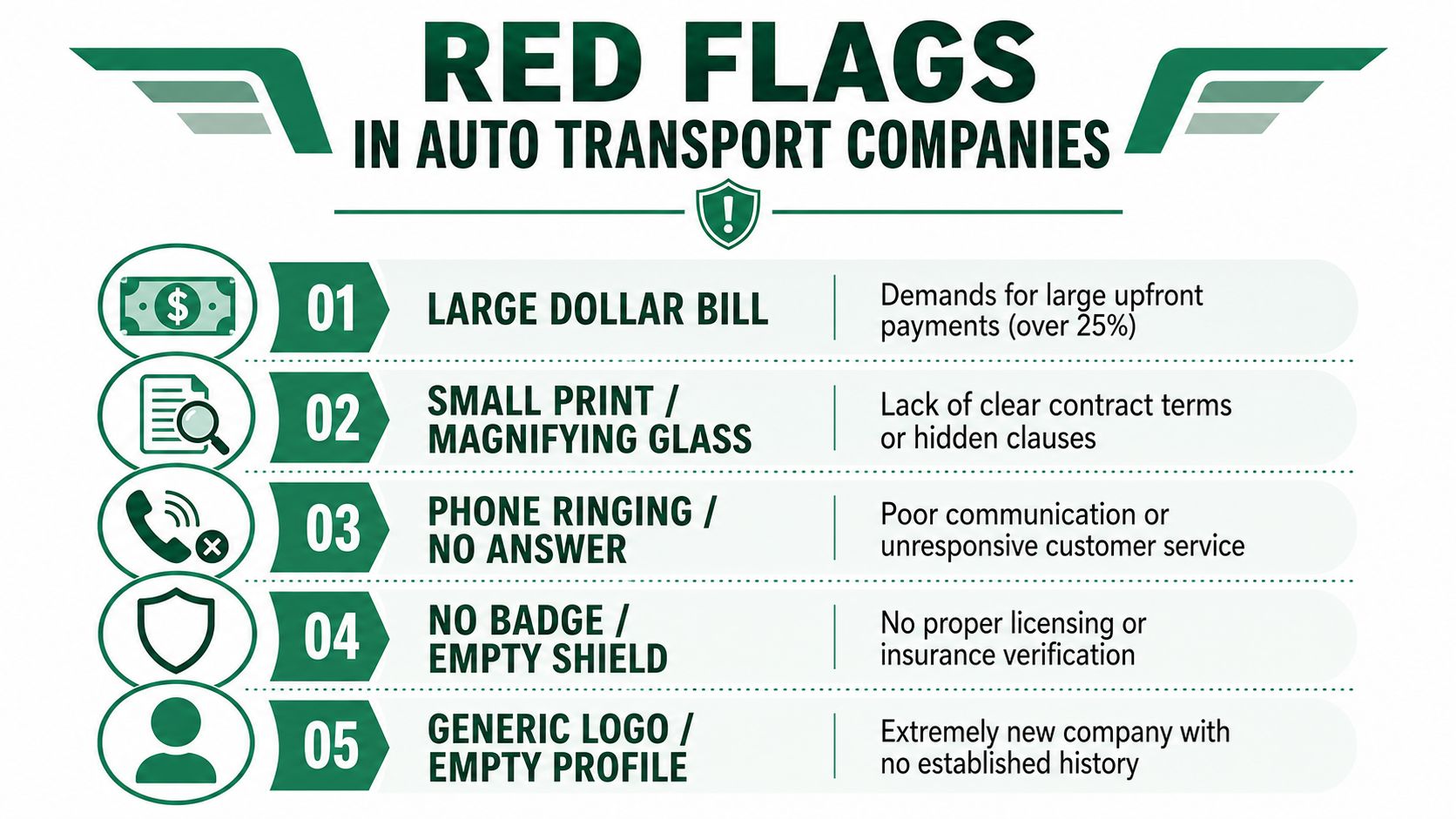
Some red flags show up in reviews. Others show up before you even book. If you know what to look for, you can avoid most bad experiences before your vehicle ever gets assigned.
The quote sounds amazing because it isn't real
Lowball pricing is still one of the oldest tricks in this industry. A company throws out a tempting number, gets your attention, then starts adjusting expectations when dispatch gets difficult.
You don't need a spreadsheet to spot this. If one quote is dramatically lower than the field and the representative can't explain why, assume the price is bait.
The company gets slippery when you ask basic questions
Ask direct questions and listen for direct answers.
- What happens if the truck can't access my street? A serious company answers this clearly.
- When do I pay a deposit, if any? Vague payment language is a warning.
- Who updates me during dispatch and transit? If nobody owns communication, expect confusion.
- Is the quote flat or subject to change? If the answer wanders, walk away.
One of the most under-explained realities in door-to-door transport is access. Easy Car Shipping points out that rural or hard-to-reach addresses can change both price and logistics, and that an inaccessible street may require a nearby meeting point in its door-to-door auto transport explanation. That's not a failure of the service. It's a planning issue. A trustworthy company explains it early.
Review language that should put you on alert
Here's the wording I take seriously when I see it repeatedly:
| Red flag phrase in reviews | What I infer |
|---|---|
| “Could never reach anyone” | Weak support structure |
| “Price changed at the last minute” | Poor quote integrity |
| “Driver never came when promised” | Dispatch overpromised |
| “Had to meet in a parking lot and no one told me” | Access rules were never explained |
| “They disappeared after payment” | Accountability problem |
Hard truth: “Door-to-door” is a convenience model, not a guarantee that a large carrier can reach every driveway.
What better practice looks like
You want a shipper that spells out the route, the access limits, the support process, and the billing structure before you commit. Flat-rate pricing is a good sign because it reduces post-booking surprises. So is a policy of not charging an upfront deposit until a carrier is dispatched.
That's one reason some buyers prefer providers that state those terms plainly. It protects the customer from the oldest problems in this business, especially on long-distance routes and complicated moves involving ports, handoffs, or tight scheduling.
Your Pre-Booking Checklist for Choosing a Carrier
Once you've read enough reviews, stop browsing and start verifying. A good booking decision comes from a short checklist, not endless scrolling.
Ask these questions before you sign anything
Use this list as your filter.
- Verify authority: Confirm the company handles legitimate interstate transport with proper registration and insurance documentation.
- Match the service to the route: Ask whether your shipment is straightforward mainland transport, port-connected Puerto Rico shipping, enclosed service, or a route that may need special access planning.
- Clarify pickup and delivery reality: Don't ask, “Is it door-to-door?” Ask, “Can your truck reach both addresses, and what's the backup meeting plan if it can't?”
- Confirm pricing terms: Get the full quote in writing and ask whether the amount is flat-rate or subject to change.
- Know who manages communication: You want one point of contact who can explain dispatch, pickup, transit, and delivery without passing you around.
Pay special attention to Puerto Rico shipments
Puerto Rico bookings deserve extra scrutiny because they involve more than a truck route. You need someone who understands the mainland leg, the ocean leg if required, the timing between those legs, and the handoff process on arrival.
If a company talks about Puerto Rico shipping the same way it talks about Chicago to Orlando, that's a warning. It means they may be oversimplifying a route that needs tighter coordination.
The support test most people forget
Call before you book. Don't just request a quote online and judge the email.
Ask a real-world question about your route. If the representative gives a crisp answer, explains the likely access issues, and doesn't dodge operational details, that's useful. If they stay generic, they probably stay generic when a shipment gets complicated too.
For people who want that advisor-style support, especially on mainland-to-island routes or multi-state moves, working with a company that provides U.S.-based bilingual agents with deep auto transport experience can make the process much simpler. That matters for English- and Spanish-speaking customers alike, and it matters even more when no two shipments work exactly the same way.
Keep your own records
Before pickup, do your part.
- Photograph the vehicle clearly
- Remove personal items
- Confirm both contact numbers
- Review pickup and delivery instructions
- Save every email and text
A careful customer and a competent shipper make a much better combination than a careful customer and a chaotic one.
Frequently Asked Questions About Door to Door Transport
Is it better to use a broker or a carrier
Start with the route. Then judge the company.
A carrier owns the truck and handles the move directly. A broker arranges the shipment through its carrier network. For standard routes, either can work. For long-distance moves, rural pickups, and Puerto Rico shipments, a competent broker often gives you better coverage because it has more dispatch options and can coordinate handoffs that a single-truck operation cannot.
Reviews tell you which model works in practice. If customers praise communication but complain about late carrier assignment, you are likely looking at a broker with weak dispatch control. If reviews mention damaged vehicles, poor inspection reports, or a driver who went silent after pickup, that points more toward carrier execution problems.
Use registration as a basic filter, not a gold star. Interstate auto transport companies should have active FMCSA registration. Then read reviews to see whether the company manages pickups, updates, claims, and delivery windows like a professional operation.
How is Puerto Rico car shipping different
Puerto Rico moves need a different reading of reviews.
A mainland shipment usually rises or falls on dispatch and timing. A Puerto Rico shipment adds port paperwork, vessel scheduling, storage timing, and a second handoff. That means a review complaining about a short delay is not the same as a review describing missing documents, unclear port instructions, or confusion about who had custody of the car. The first is common. The second is a real warning.
Good Puerto Rico reviews usually mention clear instructions, accurate document requests, and consistent updates across each phase of the move. Bad ones often reveal a company that sells the route before it has operational control over it.
Bilingual support also matters more here than on a basic state-to-state move. Customers shipping to or from San Juan and other Puerto Rico destinations often need quick answers in English or Spanish during time-sensitive moves tied to relocation, military orders, school calendars, or dealership transfers.
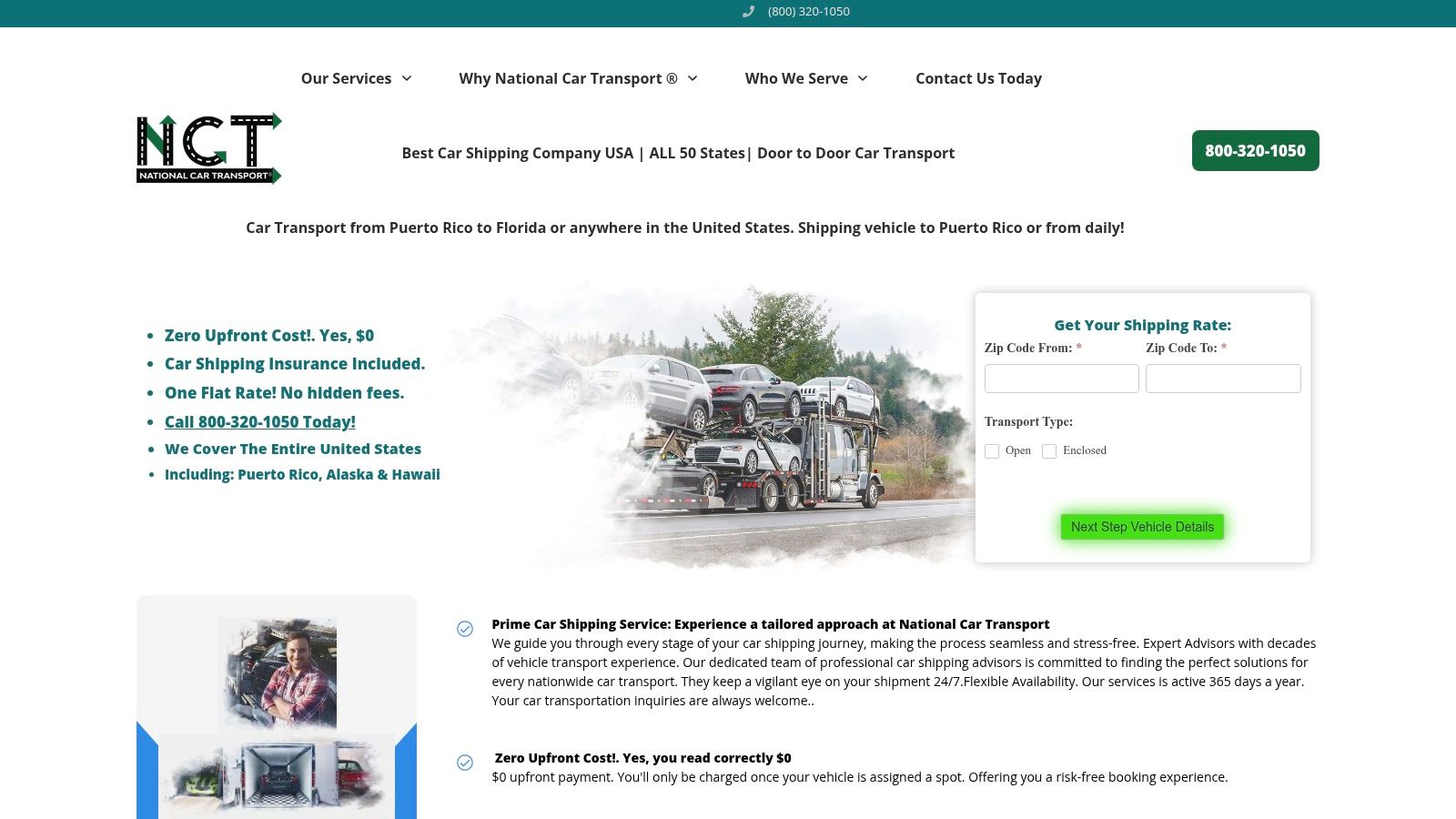
Here's a quick visual overview if you want to see how one provider presents these services online.
What does door-to-door really mean in practice
It means the truck gets as close to your addresses as safety, size limits, and local access rules allow.
That may be your driveway. It may be a wider nearby road, retail lot, or agreed meeting point if your street is too tight, too steep, or restricted for a commercial hauler. Reviews are useful here because they show whether a company explained that early or dumped the surprise on the customer the day of pickup.
Read complaints carefully. “Driver met me two blocks away” is usually normal. “Nobody told me until the truck was already in town” is poor planning. The difference matters.
If you want a second set of eyes on quotes, reviews, or a mainland-to-Puerto Rico route, talk with National Car Transport. They handle domestic and island vehicle shipping with flat-rate pricing, no upfront charge until a carrier is assigned, and U.S.-based bilingual agents who help customers work through the logistics before pickup day.