
You're usually looking for motorcycle shipping at a moment when life is already in motion. Maybe you bought a bike from across the country, you're relocating for work, you spend part of the year in a warmer state, or you need a tougher route handled cleanly, like Puerto Rico. In all of those situations, the goal is the same. Deliver a motorcycle safely, on schedule, and without turning the process into a second job.
The good news is that motorcycle transport is predictable when the basics are handled correctly. The problems almost always come from a bad fit between the bike and the carrier, weak preparation, incomplete paperwork, or unclear pickup and delivery expectations. Get those right, and the job gets much easier.
Table of Contents
- Planning Your Motorcycle Shipment Journey
- Choosing Your Transport Method and Getting Quotes
- How to Prepare Your Motorcycle for Safe Transport
- Navigating Paperwork and Insurance Requirements
- Shipping a Motorcycle to or from Puerto Rico
- What to Expect on Pickup and Delivery Day
Planning Your Motorcycle Shipment Journey
The first decision isn't open or enclosed. It's whether this should be a professional shipment at all. If you're moving a bike across several states, coordinating a sale, avoiding weather exposure, or trying to handle a port move to San Juan, professional transport is usually the cleaner option.
When professional shipping makes sense
A lot of customers start with the same thought. “Maybe I'll just ride it.” That can work for a short trip with flexible timing. It stops making sense when the route is long, the weather is uncertain, the bike is newly purchased, or the delivery window matters.
Professional transport also helps when the move involves more than one life event at once. Military families, students, seasonal residents, dealerships, and businesses usually aren't just moving a bike. They're juggling housing, schedules, paperwork, and handoff timing in different cities.
A practical planning list looks like this:
- Know your exact route: Give real pickup and delivery locations, not just states. A shipment from Miami to San Juan is planned differently than one from Denver to Orlando.
- Decide how much protection you want: A standard commuter bike and a custom show bike don't belong in the same decision tree.
- Build around real dates: If you have a flight, closing date, school move-in, or military report date, say that upfront.
- Think about access: Some city locations don't work well for larger transport equipment, so alternate meeting points may be smarter.
- Gather ownership documents early: This becomes even more important on island routes.
Practical rule: The earlier you identify the route, access limits, and date range, the easier it is to match the right carrier the first time.
What changes on Puerto Rico routes
Domestic motorcycle shipping in the lower 48 is straightforward compared with Puerto Rico. Once ocean freight enters the picture, timing, documents, port procedures, and handoffs matter more. The move isn't just “pickup and delivery” anymore. It's pickup, inland transit, port processing, vessel scheduling, arrival procedures, and final release or delivery.
That's why Puerto Rico moves reward close coordination more than simple price shopping. If you only compare the number on a quote and ignore the handoff details, you can create delays that weren't necessary.
This same planning mindset also applies across broader vehicle shipping needs. Many households moving a motorcycle are also moving a car, truck, or SUV between major U.S. cities in the 48 states or between the mainland and San Juan. That's especially common for snowbirds, students, families in relocation, and dealerships balancing inventory across regions.
Choosing Your Transport Method and Getting Quotes
You might be shipping a standard commuter bike from Florida to Georgia, or trying to get a custom Harley from Texas to San Juan without a missed vessel cutoff. Those are two very different jobs, and the transport method should reflect that from the start.
For mainland routes, the usual choice is open or enclosed transport. For Puerto Rico, that decision sits inside a bigger chain that can include inland pickup, port handling, ocean transit, release scheduling, and final delivery. Pricing and transit times vary by lane and season, but broad industry ranges for domestic motorcycle shipping support the basic rule: open service costs less, enclosed service buys more protection, and cross-country moves take longer than regional ones, as summarized by Montway's motorcycle shipping guide.
Open or enclosed depends on what you're protecting
Open transport works well for many daily riders and standard motorcycles. It is usually the practical choice when the bike is replaceable, the route is domestic, and the shipment is budget-driven.
Enclosed transport makes more sense for collector bikes, high-end touring models, customs, and motorcycles with paint or parts that are expensive to repair. It also deserves stronger consideration on long routes, winter lanes, and Puerto Rico shipments where the bike may pass through more than one handoff point before final delivery.
Start with the bike's replacement cost, cosmetic sensitivity, and route complexity. Then choose the trailer type.
For shippers comparing equipment styles, it helps to see how protected trailer setups are built for lower exposure and safer loading. A useful reference is secure equipment transport solutions.
Open vs. Enclosed Motorcycle Transport
| Feature | Open Carrier | Enclosed Carrier |
|---|---|---|
| Weather exposure | Exposed to normal road and weather conditions | Protected from weather and road debris |
| Cost | Usually lower for domestic service | Usually higher for domestic service |
| Typical timing | Depends on lane demand, distance, and scheduling | Can be similar, but enclosed capacity is often tighter |
| Best fit | Standard bikes, daily riders, budget-focused moves | Classics, customs, premium bikes, collector units |
| Main advantage | Lower price | Better protection |
| Main trade-off | More exposure | Higher price |
What a serious quote should include
A good quote starts with exact shipment details. Loose information produces loose pricing, and that is where first-time shippers get surprised later.
Provide the pickup and delivery ZIP codes, year, make, model, running condition, and your date window. For Puerto Rico, also say whether the bike is going to or from a port, whether you need help coordinating the port side, and whether you want door-to-port, port-to-door, or a full-service move managed through one point of contact.
These details affect the actual plan:
- Access at both ends: Large transport equipment may not fit downtown streets, condo lots, military housing, or some neighborhood roads.
- Bike dimensions and modifications: A lowered bike, wide handlebars, saddlebags, or a crate requirement can change equipment needs.
- Running condition: Non-running motorcycles need different loading arrangements and often cost more.
- Trailer choice: Open and enclosed quotes should be compared separately, not blended together.
- Route type: A lower-48 move is one job. A Puerto Rico move is a series of coordinated steps.
The best quotes also explain what is included. Ask whether the price covers fuel surcharges, port fees if applicable, storage risk, delivery within a set radius, and who is handling each handoff. On Puerto Rico shipments, a dedicated agent matters because one person tracking the inland leg, port timeline, and release process usually prevents the confusion that happens when the shipper has to chase updates from multiple parties.
How to Prepare Your Motorcycle for Safe Transport
Preparation is where preventable damage gets prevented. A bike that's clean, documented, stripped of loose items, and ready for loading gives the carrier a fair shot at doing the job right. A bike that shows up dirty, half-packed, and covered in accessories creates confusion fast.
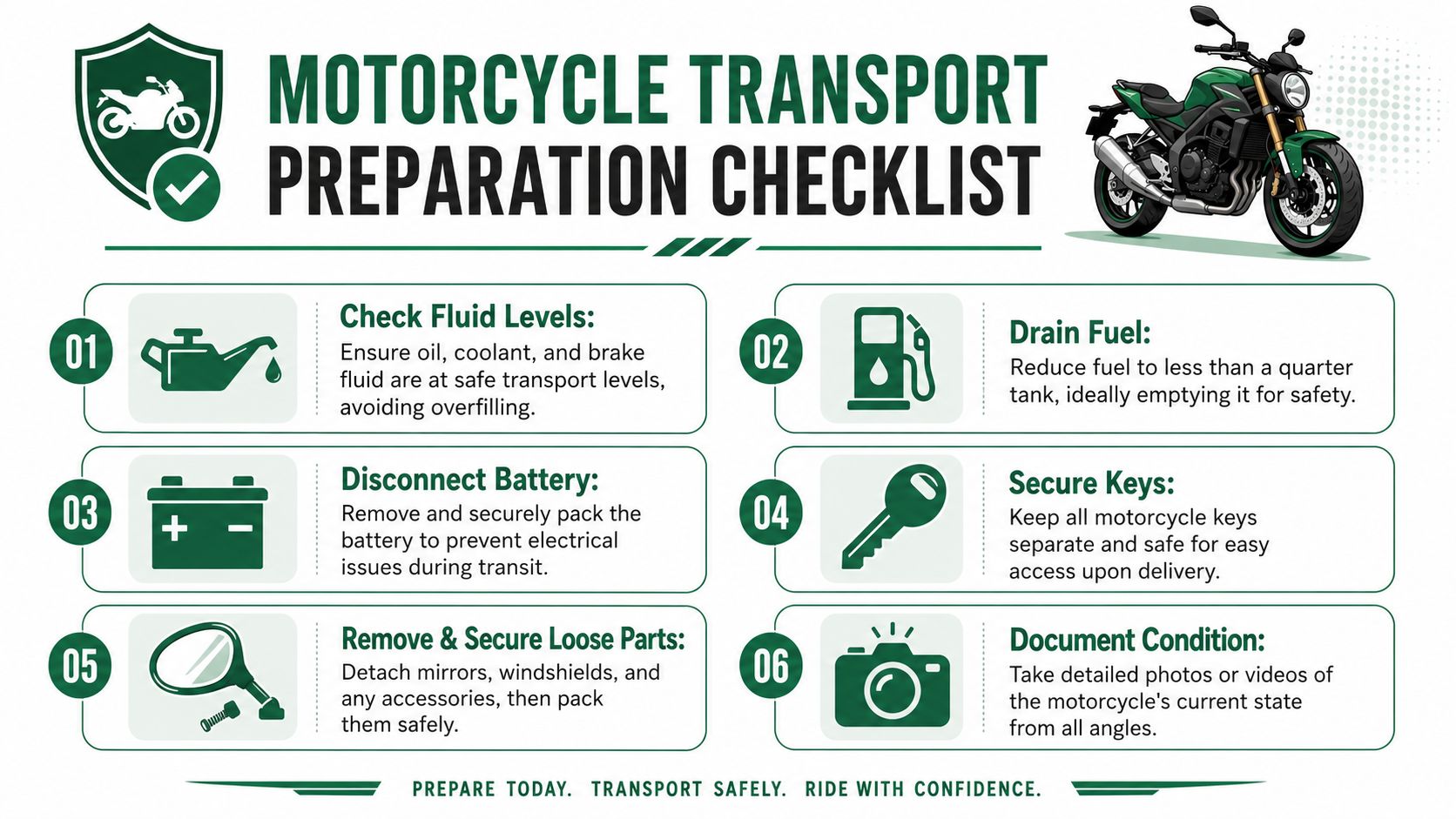
Near the start of prep, use a checklist instead of memory.
The preparation steps that matter most
The most useful benchmark here is simple. A strict seven-step preparation checklist, including cleaning, photos, removing loose items, reducing fuel to 25%, disconnecting the battery, checking tires, and providing keys, correlates with a 90% success rate. Skipping the photo documentation step alone leads to a 70% denial rate for damage claims based on this motorcycle shipping preparation guide.
That tells you two important things. First, prep work isn't cosmetic. Second, photo documentation is not optional.
Use this order:
- Wash the bike fully. Dirt hides scratches, chips, leaks, and existing wear.
- Take clear photos from all sides. Include close-ups of any existing marks.
- Remove loose accessories and personal items. Saddlebags, detachable mounts, toll tags, and small add-ons are common trouble spots.
- Lower fuel to about a quarter tank. That keeps the bike movable without carrying excess fuel.
- Handle the battery as instructed. Some carriers want it disconnected.
- Check tire condition and inflation. The bike needs to roll and stand correctly during loading.
- Provide keys and any alarm instructions. Delays often start with a bike that can't be moved cleanly.
Here's a visual walkthrough many first-time shippers find helpful before handoff:
Clean bikes inspect better. Documented bikes defend claims better. Stripped bikes travel better.
How carriers secure a bike correctly
Once the motorcycle is ready, the loading method matters. The industry-standard approach is the four-point tie-down method. It uses at least four quality ratchet straps attached to solid structural points such as the lower triple tree or fork assembly, not the handlebars, with the straps pulled tight at a 45-degree angle downward. A shake test should follow, and straps should be rechecked after a short distance, according to Rhino USA's motorcycle transport guidance.
That same guidance warns against a few common mistakes:
- Don't use the kickstand for transit support: It can damage the stand or the floor.
- Don't strap to handlebars: That risks bending.
- Don't wrap around brake lines or wiring: That can cause hidden damage.
- Do center the bike with a wheel chock if used: Stable placement makes tie-downs work better.
A careful shipper should ask how the carrier secures motorcycles. You're not looking for flashy language. You're listening for specifics like tie-down points, wheel chock use, and inspection after loading.
Navigating Paperwork and Insurance Requirements
Paperwork feels tedious until a delivery goes sideways. Then it becomes the whole story. If you want to deliver a motorcycle without disputes, you need to know which documents matter and what each one does.
The documents that actually matter
The main document is the Bill of Lading, often shortened to BOL. It works as the shipment contract and the condition report. At pickup, the driver and the customer inspect the bike together and note visible condition. At delivery, that same document is used again to compare the arrival condition with the pickup record.
You should also expect to provide proof that you have the right to ship the motorcycle. That usually means title, registration, or another ownership-related document. On dealership, auction, and business moves, authorization paperwork may also be part of the file.
A practical document stack often includes:
- Bill of Lading: Records condition at pickup and delivery.
- Proof of ownership or authority to ship: Helps avoid release issues.
- Photo ID: Confirms who is handing over or receiving the bike.
- Special authorizations when needed: Common if someone else is acting on your behalf.
For readers dealing with cross-border vehicle buying more broadly, guides on import process can help frame the paperwork mindset. One useful example is jak importować samochody z USA, which shows how document discipline affects vehicle moves beyond standard domestic transport.
How to think about insurance without guessing
Cargo insurance and personal motorcycle insurance are not the same thing. The carrier's cargo policy is tied to what happens during transport. Your own policy may address other circumstances depending on your coverage. That's why the smart move is to ask for the carrier's insurance details before pickup and then review your own policy separately.
Important check: If existing damage isn't listed on the pickup inspection, you've made the delivery inspection harder than it needs to be.
Insurance questions should be practical, not abstract. Ask what the carrier's policy covers during transit, how claims are documented, and what the inspection process requires. Then keep your own photos, signed paperwork, and delivery notes in one place until the shipment is fully complete.
Shipping a Motorcycle to or from Puerto Rico
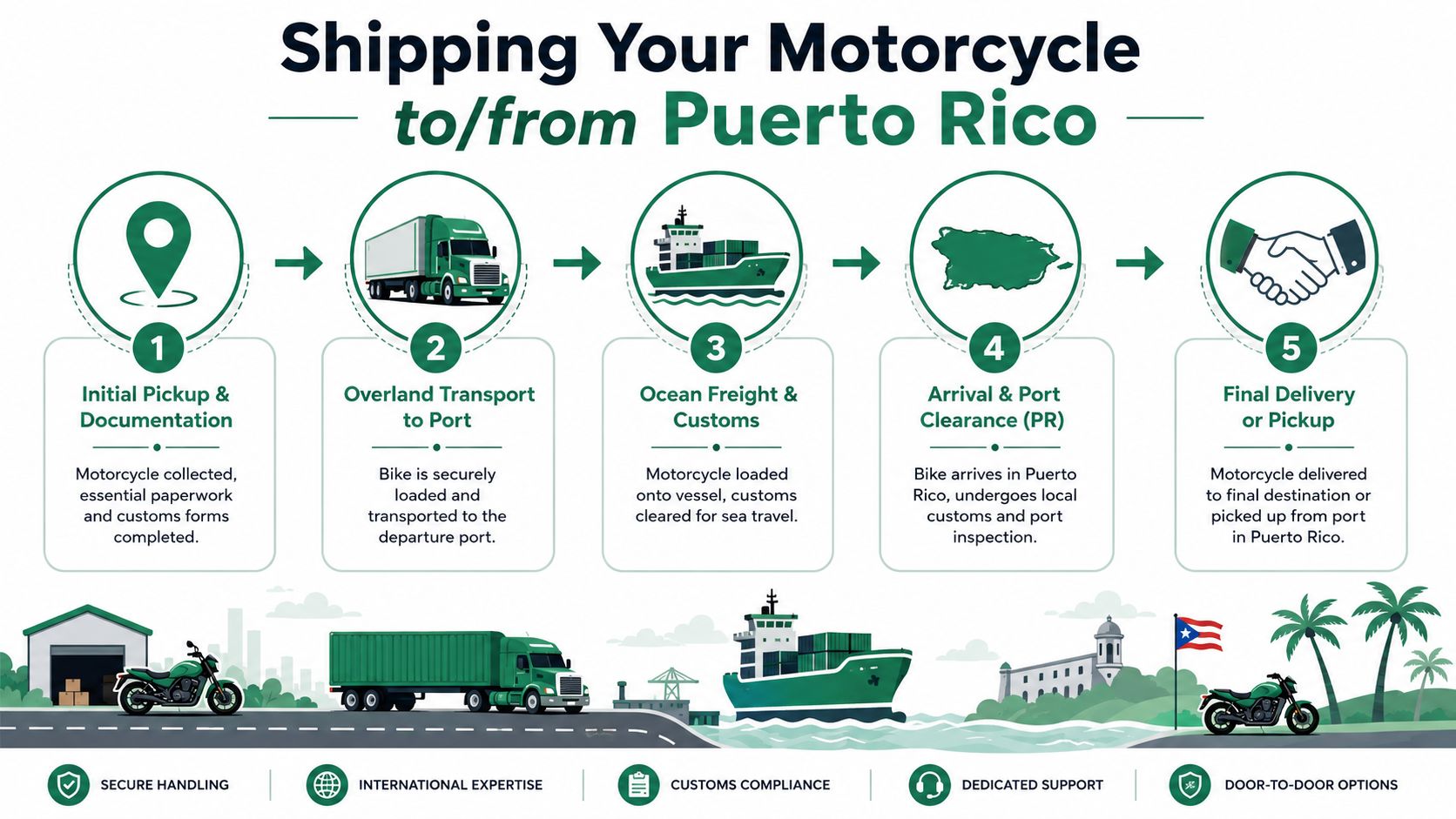
A first-time Puerto Rico shipment usually looks simple on paper. The bike gets picked up, heads to a mainland port, sails to San Juan, and gets released on the island. In practice, that route has more handoffs, more timing pressure, and more paperwork checks than a standard mainland move. That is why I treat Puerto Rico as a coordinated chain, not a single shipment.
How the route usually works
Most U.S. to Puerto Rico motorcycle shipments start with inland transport to a port, often in Florida. From there, the bike is booked onto vessel service bound for San Juan. After arrival, the shipment still has to clear port release steps before the owner or a local contact can take possession.
That extra layer is what catches first-time shippers. Domestic motorcycle transport is usually truck scheduling plus delivery coordination. Puerto Rico adds port cutoff times, ocean booking windows, terminal handling, and local release requirements. If one piece is off, the whole schedule can slip.
The broader vehicle market helps show why port details matter. Shipping a car to Puerto Rico typically costs between $1,200 and $3,000, and vehicles shipped from Jacksonville must not exceed 82 inches in width for standard rates, according to this Puerto Rico vehicle shipping overview. Those figures apply to cars, not motorcycles, but the lesson carries over. Size, port rules, and route setup affect price and timing on island moves.
A Puerto Rico motorcycle shipment usually needs close attention in five places:
- Mainland pickup timing: The bike has to arrive at the port before the vessel cutoff.
- Port documentation: Names, ownership records, and release details need to match exactly.
- Ocean booking: Space is tied to sailing schedules, not just driver availability.
- Arrival handling in San Juan: Release instructions need to be clear before the bike lands.
- Final delivery or customer pickup: The last leg should be confirmed early, not sorted out after arrival.
Where first-time shippers run into trouble
The common problems are avoidable. A shipper assumes vessel departures work like open carrier dispatch on the mainland. A family member shows up at the port without the right authorization. The motorcycle reaches the terminal, but a document mismatch holds up release.
Puerto Rico also has local compliance steps after arrival. After a vehicle clears customs, the owner has three days to register it with Puerto Rican plates, according to this Puerto Rico registration guide. That guidance applies broadly to arriving vehicles and is a good reminder that island moves do not end when the vessel docks.
For mainland routes, a missed call or a one-day delay is often manageable. For Puerto Rico, a missed port cutoff can push the shipment to the next sailing. That is a real trade-off on this route. Lower-cost options can work, but they usually leave less room for timing mistakes. A dedicated agent helps by tracking the inland leg, confirming port paperwork, and making sure the handoff in Puerto Rico is already set before the bike leaves the mainland.
If your move includes other vehicles from Orlando, Houston, Jacksonville, New York, Chicago, Atlanta, Phoenix, Los Angeles, or another major U.S. city, the same rule applies. Treat the pickup, port, vessel, and island release as one coordinated job. That approach prevents the small errors that turn Puerto Rico shipping into a long delay.
What to Expect on Pickup and Delivery Day
By the time pickup day arrives, most of the primary work should already be done. The bike is prepared. The documents are ready. The route and method are set. Now the job is to inspect carefully, sign accurately, and avoid rushing the handoff.
What happens at pickup
At pickup, you or your designated contact will meet the driver and review the motorcycle together. This is when the Bill of Lading is filled out or confirmed as the condition record. Walk around the bike slowly and compare what you see with the photos you already took during prep.
Don't treat this as a casual glance. Check visible paint, fairings, bags, mirrors, controls, wheels, and anything that was previously noted. If the bike has quirks, like an alarm sequence, a sticky ignition, or a nonstandard key situation, explain that before loading starts.
A solid pickup handoff usually follows this pattern:
- Identity confirmed: Driver and shipper details match the order.
- Condition inspection completed: Existing marks are noted.
- Keys and instructions handed over: No guesswork for loading.
- Pickup document signed: Both sides leave with a clear record.
A rushed pickup often creates a messy delivery. Slow down for the inspection and get the paperwork right.
What happens at delivery
Delivery should mirror pickup. Meet the driver, inspect the motorcycle before signing the final release, and compare its condition to the original BOL notes. Use your phone photos if you need a closer reference.
If there's an issue, note it on the delivery paperwork before signing off. Don't rely on memory or a later email to reconstruct what happened on site. The documentation chain matters most when it's immediate.
For first-time customers, the delivery day experience is often simpler than they expected. The key is that the simplicity comes from preparation, not luck. When the route was quoted correctly, the bike was prepared correctly, and the paperwork was handled correctly, the final handoff is usually straightforward.
If you need help to deliver a motorcycle across the mainland or on a more complex Puerto Rico route, National Car Transport is a practical option to compare. They handle vehicle shipping across the United States, including major cities in all 48 states and San Juan, Puerto Rico, with 25+ years of experience, an A+ BBB rating, transparent flat-rate pricing, and a network of 25,000+ vetted carriers. Their U.S.-based bilingual agents in English and Spanish have over 20 years of experience focused on auto transport logistics, which helps when a move involves more than a simple point-to-point handoff. No two vehicle shipments are alike, and having one dedicated agent to guide the process, answer questions, and keep things moving is often what makes the job feel simple.