

Shipping a car 2,000 miles in 2026 usually costs about $1,100 to $1,900 on an open carrier and about $1,600 to $2,400 on an enclosed carrier. That's the right starting range for most long-distance moves, but it's only a baseline because the route, vehicle, timing, and whether Puerto Rico is involved can quickly change the final quote.
Many drivers looking up the cost to ship a car 2000 miles are already in motion. You may be relocating for work, sending a student's car across the country, moving after military orders, heading south for the season, buying a vehicle online, or trying to coordinate a shipment to or from San Juan without getting buried in paperwork. At this distance, the wrong quote usually looks attractive at first and frustrating later.
Long-haul auto transport is simple when the lane is common, the dates are flexible, and the vehicle is standard. It gets more technical when the pickup is rural, the car doesn't run, the shipment needs enclosed protection, or the route includes ocean transport to Puerto Rico. Those are the jobs where details matter more than headline pricing.
A fair quote should tell you what you're paying for, what can change the number, and what won't. It should also match the lane you're shipping on, not a generic national average.
Table of Contents
- Your Guide to 2000-Mile Car Shipping Costs
- Example 2000-Mile Shipping Costs for 2026
- The 7 Key Factors That Determine Your Final Quote
- Spotlight on Shipping To and From Puerto Rico
- Smart Tips for Reducing Your Car Shipping Cost
- How to Get an Accurate Quote and Book Your Shipment
- Frequently Asked Questions About Long-Distance Shipping
Your Guide to 2000-Mile Car Shipping Costs
You get a quote to move your car about 2,000 miles, and the first reaction is usually the same. The total feels high until you look at what the job includes. A carrier has to reserve trailer space, build your vehicle into a route that makes operational sense, and hit pickup and delivery windows without losing money on the lane.
That is why a 2,000-mile shipment often has two pricing truths at once. The full bill is substantial, but the per-mile cost is often better than it is on shorter moves.
For planning purposes, 2,000 miles sits in the long-haul category. Pricing usually settles into a broad range, then moves up or down based on the lane, the vehicle, the pickup window, and how easy the shipment is to dispatch. A clean metro-to-metro order is one thing. A rural pickup, oversized SUV, or fixed port deadline is another.
At National Car Transport, we tell customers to judge a quote by how well it matches the actual move. A fair number should reflect more than mileage. It should reflect where the car is going, what equipment it needs, and how much flexibility the carrier has.
That matters even more on Puerto Rico shipments. A mainland route may be mostly a trucking job. A Puerto Rico route can involve inland transport, port scheduling, vessel cutoff times, title or registration documents, and release procedures at the destination. If the agent handling the file is not experienced, and if communication breaks down between English and Spanish at any point, delays and added costs become much more likely.
What a baseline quote should tell you
A usable estimate should explain the core parts of the job:
- Carrier type: Open transport is the standard choice for everyday vehicles. Enclosed transport costs more and is usually reserved for higher-value, classic, or specialty vehicles.
- Route setup: Major-city lanes usually price more cleanly than remote areas because trucks run those corridors more often.
- Vehicle profile: Size, weight, ground clearance, and whether the car runs all affect how easily a carrier can load it.
- Scheduling: Flexible pickup windows usually help keep pricing in line. Urgent requests often cost more because dispatch has fewer options.
What customers often misunderstand
The biggest misunderstanding is assuming two quotes cover the same service just because the totals are close. They often do not.
One quote may assume standard open transport, flexible timing, and easy access for a full-size carrier. Another may be accounting for a tight pickup window, a difficult neighborhood, a larger vehicle, or a shipment tied to port paperwork. Puerto Rico moves add another layer because the inland leg and the ocean leg have to line up correctly, and the documents have to be right before the vehicle is released.
A reliable 2,000-mile quote should make those trade-offs clear from the start. That is how you avoid surprises and book with confidence.
Example 2000-Mile Shipping Costs for 2026
A customer shipping a sedan from the Northeast to Texas usually has a different price outcome than someone sending a lifted pickup on a tighter schedule over roughly the same distance. At 2,000 miles, the quote starts with the lane, but the vehicle and service level still move the number in a meaningful way.
Estimated 2026 Cost to Ship a Car 2000 Miles
| Vehicle Type | Open Carrier (Est. Cost) | Enclosed Carrier (Est. Cost) |
|---|---|---|
| Sedan | $1,100 to $1,600 | $1,600 to $2,400 |
| SUV | $1,100 to $1,900 | $1,600 to $2,400 |
| Pickup truck | $1,100 to $1,900 | $1,600 to $2,400 |
Use these as budgeting ranges for a standard mainland shipment. They reflect the same broad long-haul pricing brackets noted earlier, not a guaranteed rate for every route or every vehicle setup.
How to read the table
A sedan on open transport usually lands at the cleaner end of the range because it is easier to place on a carrier and easier to route through common long-distance lanes. That gives dispatch more options.
SUVs and pickup trucks often price higher within the same band. The reason is practical. Taller, heavier, or longer vehicles can limit where a carrier loads them, and every position on a trailer has revenue value.
Enclosed transport is a different purchase decision. The higher cost comes from lower-capacity equipment and handling standards built for vehicles that need more protection in transit.
Open transport fits most daily drivers. Enclosed transport makes more sense for vehicles where added protection justifies the extra cost.
Which option fits the job
Open transport works well for commuter cars, family vehicles, college moves, and standard relocations where the goal is solid service at a fair rate.
Enclosed is usually the better fit for:
- Collector cars: More protection over a long haul
- Luxury or exotic vehicles: Higher-value units that need more careful handling
- Fresh restorations or custom paint: Less exposure during transit
Customers who already compare New York auto insurance rates before a move should use the same habit here. Look past the total and ask what service level, vehicle fit, and route assumptions are built into that number.
Puerto Rico shipments need one more layer of planning. A 2,000-mile budget frame still helps on the inland side, but the full move also depends on port handling, release paperwork, and correct documentation in English and Spanish. That is one reason an experienced bilingual agent matters on these routes.
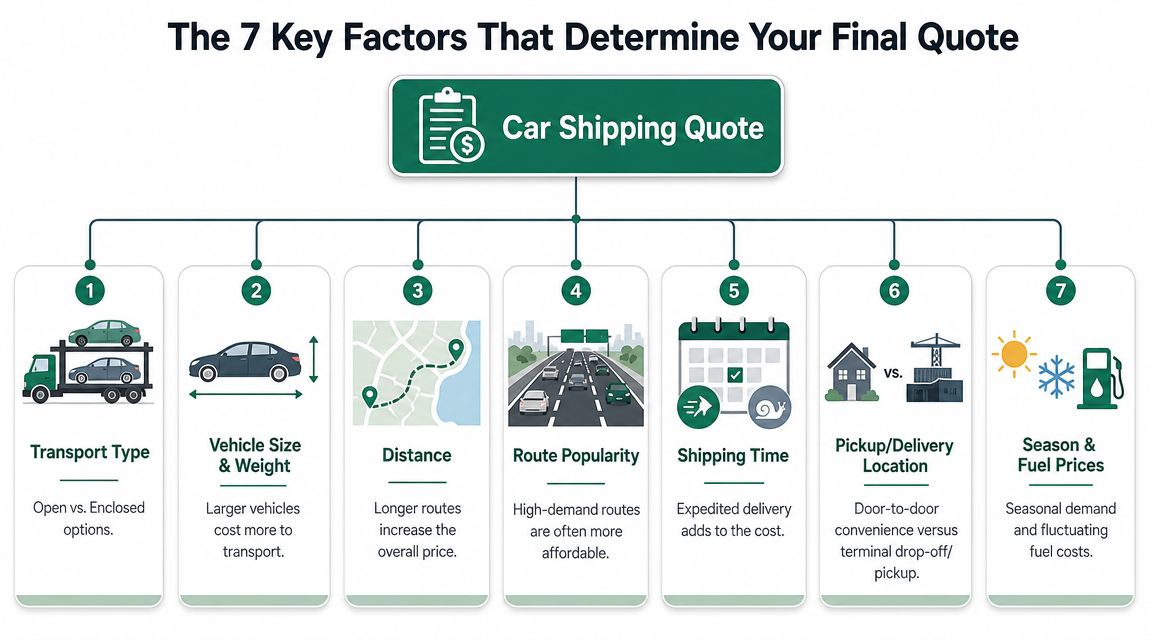
The 7 Key Factors That Determine Your Final Quote
Pricing works like a recipe. Distance is one ingredient, but it's not the whole meal. Two shipments with the same mileage can produce very different quotes because the carrier is pricing lane efficiency, equipment fit, and scheduling risk all at once.
Why distance helps your per-mile cost
One of the most important long-haul pricing patterns is that the per-mile rate usually falls as distance increases. Verified market references collected by FreightWaves on car shipping cost show that car shipping generally runs about $0.61 to $2.00 per mile, and long-haul 2,000-mile trips can drop into the $0.50 to $1.00 per mile range.
That doesn't make the shipment cheap in total. It means the fixed costs are spread across more loaded miles. Dispatching, loading, admin work, insurance handling, and coordination don't double just because the route gets longer.
If you already compare New York auto insurance rates when budgeting a move, use the same mindset with transport. The sticker price matters, but the variables behind it matter more.
What changes the quote in real bookings
Here are the seven factors that move the number most often:
Transport type
Open is the baseline. Enclosed costs more because the equipment carries fewer vehicles and serves a narrower category of shipments.Vehicle size and weight
A compact sedan is easier to place than a heavy SUV or pickup. Larger vehicles reduce how a carrier can balance the trailer.Distance
The trip still gets more expensive as it gets longer. The key is that the cost curve isn't perfectly linear.Route popularity
Busy corridors tend to price better because carriers already run them. A major city lane is easier to cover than a remote detour.Shipping time
Flexible schedules help dispatch. Urgent pickup asks the carrier to solve your timing problem immediately, and that usually raises the quote.Pickup and delivery access
Door-to-door sounds simple, but some neighborhoods, apartment areas, rural roads, and gated properties are hard for a large truck to enter.Season and fuel conditions
Timing still affects the market. So do broader operating costs.
A fair quote is built around carrier efficiency. Anything that makes the truck easier to fill and route usually helps the customer too.
For shoppers who want one flat number rather than vague ranges, some brokers and coordinators structure quotes as flat-rate pricing and confirm payment timing only after dispatch is secured. National Car Transport follows that model, with no upfront charge until the vehicle is dispatched, which helps reduce the common problem of low teaser quotes that change later.
Spotlight on Shipping To and From Puerto Rico
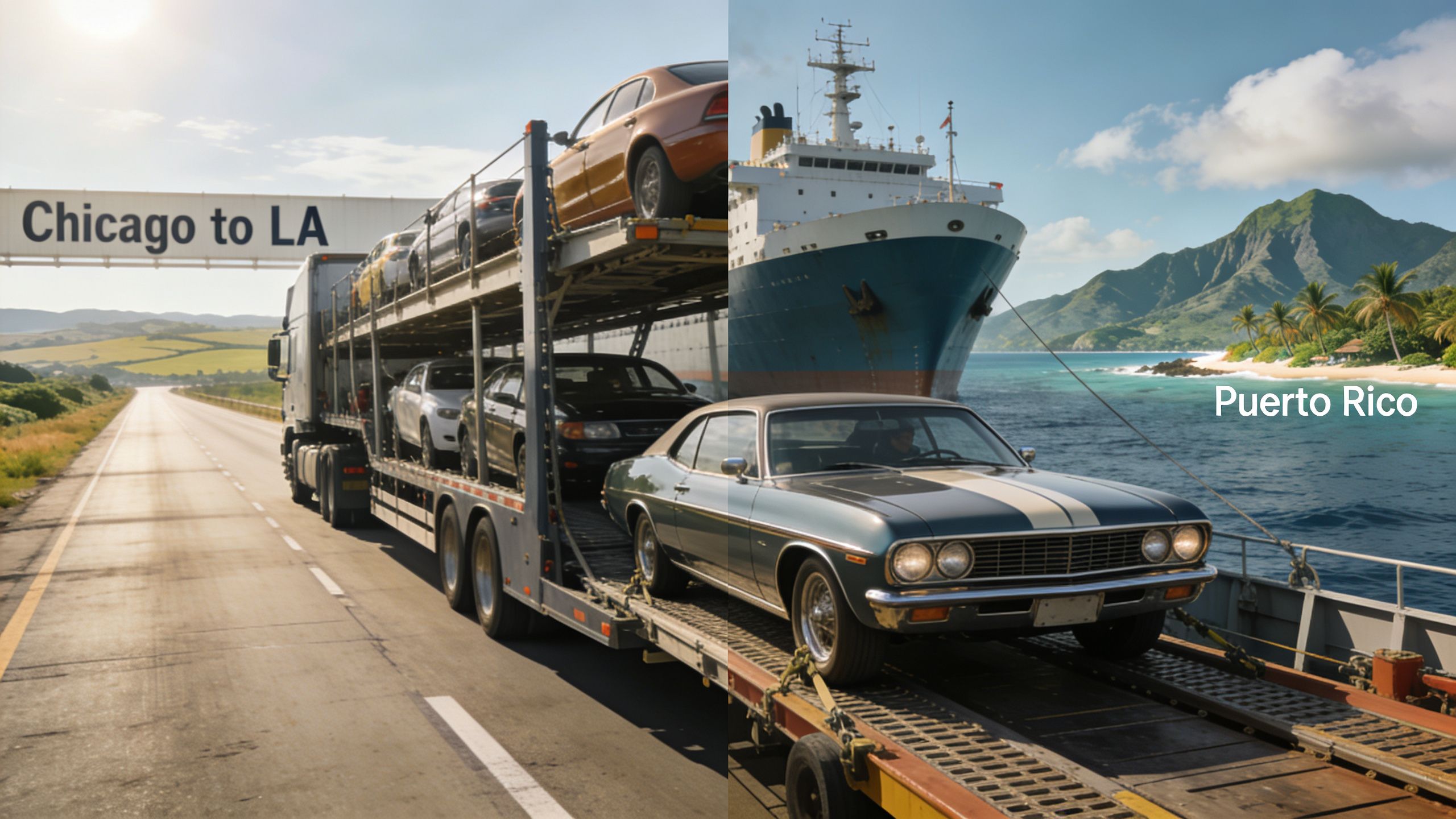
A mainland 2,000-mile route and a Puerto Rico move can look similar on paper. They aren't. One is usually a domestic truck lane. The other is a coordinated land-and-sea shipment with more checkpoints, more documentation, and more chances for a delay if the details are off.
A mainland route versus a Puerto Rico route
Take a common domestic shipment first. A vehicle moving from Chicago to Los Angeles usually gets assigned to a long-haul truck lane, picked up, inspected, loaded, moved across the country, and delivered.
Now compare that with a move from Chicago to San Juan. The vehicle may first travel by truck to a mainland port. After that, it enters port procedures, ocean scheduling, release documentation, and arrival handling in Puerto Rico before the owner can take delivery.
That's why a single national average often fails people planning island routes. Verified market guidance from FreightWaves on route-dependent car shipping quotes notes that pricing is highly route-dependent and that a 2,000-mile quote can differ by hundreds of dollars depending on corridor density, with a major difference between a high-volume lane like LA to Chicago and a lower-density or multi-modal route like Boston to San Juan, PR.
Why paperwork and communication matter more
Puerto Rico shipments usually require tighter document handling than a standard domestic move. Customers should be ready to provide ownership and identity documents, and they should confirm port requirements before the vehicle starts moving.
For these routes, experienced bilingual coordination matters because the shipment touches more parties:
- Mainland ground carrier
- Port receiving team
- Ocean transport operator
- Puerto Rico release process
- Final pickup or delivery coordination
Military families, students, snowbirds, dealerships, and first-time island shippers run into the same problem when nobody owns the whole process. One team handles trucking. Another handles port intake. Another handles ocean transit. If no one is guiding the paperwork, small mistakes create large delays.
A bilingual English and Spanish agent helps because the shipment often involves status updates, title or registration review, release instructions, and local coordination that customers need explained plainly and quickly.
Smart Tips for Reducing Your Car Shipping Cost
The easiest way to cut long-haul shipping costs isn't finding a magic coupon. It's making your shipment easier for a carrier to schedule.

Verified pricing guidance from Nexus Auto Transport's shipping calculator shows the cheapest long-haul quotes usually come from flexible pickup windows on major metro-to-metro lanes, while expedited or same-week pickup and remote rural locations can push a 2,000-mile open quote from the low end toward $1,600 to $1,900 or more.
The savings usually come from flexibility
If you want the lower end of the market, focus on these levers:
- Give a wider pickup window: A flexible schedule lets dispatch place your car on a truck that's already building the route.
- Use open transport for standard vehicles: Most daily drivers don't need enclosed service.
- Meet near a truck-friendly location: A large parking lot near a main road can be easier than a tight residential street.
- Book before you're in a panic: Rushed decisions usually cost more and limit your options.
The customer who saves the most is usually the one who gives the carrier room to work, not the one who demands the lowest number first.
Where people accidentally spend more
Some cost increases are self-inflicted.
A same-week request narrows the truck pool. A rural pickup adds miles the carrier can't bill efficiently. A vehicle that won't start may require extra handling. None of those issues are impossible, but each one reduces route efficiency.
This short video gives a helpful overview of how shipping choices affect total price:
A practical checklist before you request quotes:
- Check your route realism: Metro-to-metro is simpler than remote-to-remote.
- Be honest about the vehicle: Running condition and actual size matter.
- Choose protection based on the car, not anxiety: Open is usually enough for standard vehicles.
- Ask about flexibility, not just discounts: That's where the actual savings usually come from.
How to Get an Accurate Quote and Book Your Shipment
Accurate pricing starts with accurate inputs. If you leave out the pickup access issue, the fact that the vehicle is oversized, or that the destination is Puerto Rico, the first number you receive may not be usable.
What to have ready before you ask for pricing
Before you request a quote, gather the basics:
- Exact pickup and delivery cities
- Vehicle year, make, and model
- Running or non-running condition
- Preferred timing
- Open or enclosed preference
- Whether the route is domestic mainland only or includes Puerto Rico
If the shipment involves Puerto Rico, also ask what documents will be needed before the vehicle reaches the port. It's much easier to solve paperwork questions early than while the car is already in transit.
What the booking process should look like
A solid booking process is usually straightforward:
- Request the quote with complete route and vehicle details.
- Review the service type and confirm whether the pricing assumes flexible dates or expedited handling.
- Verify what's included in the rate, especially insurance handling, pickup method, and port coordination if applicable.
- Confirm dispatch timing before any payment terms become active.
- Prepare the vehicle by making sure it's accessible, reasonably clean for inspection, and ready for pickup.
- Inspect at pickup and delivery and keep copies of the vehicle condition report.
Ask one simple question before you book. “What conditions would change this quote?” A reliable answer tells you a lot about the company you're dealing with.
Customers should also expect direct communication once the order moves toward dispatch. That matters on every route, but especially on Puerto Rico shipments where the ground leg and ocean leg have to stay aligned.
The smoothest bookings happen when the customer gives complete information and the coordinator matches that information to the actual lane, instead of trying to force the lane to fit a low number.
Frequently Asked Questions About Long-Distance Shipping
Can I pack personal items in the car
Usually, customers should assume personal items are limited or not recommended. Carriers and port operations often restrict what can stay inside the vehicle, and extra contents can create inspection, liability, or weight issues. For Puerto Rico shipments, this matters even more because port and ocean procedures are stricter than a simple mainland truck move.
How long does a 2000-mile shipment usually take
Transit time depends on the lane, dispatch timing, weather, truck availability, and whether the route is domestic only or includes an ocean segment. Mainland 2,000-mile shipments are generally more straightforward than Puerto Rico moves because island routes include port handling and vessel schedules.
What documents are usually needed for Puerto Rico
Customers commonly need proof of ownership or authorization, vehicle registration details, and government-issued identification. Some shipments also require additional release or port documents depending on who owns the car and how it's being transported. The safest approach is to confirm the exact paperwork before pickup so the vehicle doesn't stall at the port.
Is the vehicle insured during transport
Transport arrangements typically include cargo insurance during the carrier leg, but customers should always ask what coverage applies and when. That's especially important when a shipment has multiple stages, such as mainland trucking plus ocean transport to San Juan. Clear answers matter more than assumptions.
If you're planning a mainland or Puerto Rico shipment and want a quote that reflects the actual route, timing, and vehicle, National Car Transport is one option to check. Their team works with door-to-door domestic moves, ocean and container shipping for island routes, and bilingual customer support in English and Spanish so customers can sort out pricing, paperwork, and scheduling before the vehicle is dispatched.