

You're staring at a relocation calendar that's already too tight. The company has signed off on the move, the employee has a start date in San Juan, and the house-hold goods plan looks manageable. Then the problem shows up, the car.
That's where corporate relocation goes sideways. People fixate on furniture, boxes, and temporary housing, but the vehicle is often the piece that breaks the schedule, especially when the move crosses the mainland-to-Puerto Rico line. A good corporate relocation service treats auto transport as a core workstream, not a side errand, because one missed pickup can leave an employee stranded, burn management time, and force expensive last-minute changes.
Table of Contents
- Why Vehicle Transport Is the Hidden Headache in Corporate Moves
- What a Corporate Relocation Service Actually Does
- Service Types and Vehicle Transport Options
- How the Engagement Process Works Step by Step
- Pricing Factors and Realistic Timelines
- Choosing the Right Provider and What Good Looks Like
- Common Questions About Corporate Vehicle Relocation
Why Vehicle Transport Is the Hidden Headache in Corporate Moves
A mid-size company opens a San Juan office and needs five employees on site in 30 days. One is leaving from Texas, one from New York, one from Illinois, and the other two are split between different mainland cities. The household-goods vendors can usually work around the same target date. The cars are harder, because each one has to be picked up, inspected, routed, and delivered on a separate clock.
That's the part most relocation plans underestimate. A corporate relocation service can look clean on paper and still fail in practice if no one owns the vehicle leg from the beginning. The employee isn't asking for a white-glove experience, they're asking a blunt question, “When will I have my car in the new city?” If the answer is vague, the move is already drifting.
The right response is to assign vehicle transport its own budget line, timeline, and carrier relationship. In a move like this, the car isn't an accessory to the household shipment, it's a separate logistics problem with its own risk profile. If the vehicle is heading to Puerto Rico, the stakes are even higher because the route is ocean-based, not just another interstate run. For a risk-aware view of cargo protection around those moves, a useful reference is cargo coverage for Florida shippers, especially when companies are comparing transport options that cross port and carrier handoffs.
Practical rule: if the employee needs the car on day one, book auto transport as soon as the relocation approval is signed. Waiting until the household move is underway is how delays start.
The best programs stop treating cars as an afterthought. They line up vehicle movement at the same time they finalize start dates, housing, and travel. That's how a corporate relocation service keeps the move controlled instead of reactive.
What a Corporate Relocation Service Actually Does
A real corporate relocation service is a managed program, not a single vendor task. It coordinates the employee's move across multiple workstreams, including household-goods shipping, temporary housing, destination support, tax and immigration coordination, and, increasingly, vehicle transport. The category has also become a measurable enterprise workflow, with companies tracking cost, time-to-relocate, retention, and benefit usage instead of just processing paperwork. Urbanbound's relocation analytics guidance makes that shift easy to see.
In-house programs and outsourced RMC models
Some companies keep relocation in-house. That means HR or mobility owns the policy, approves exceptions, and manages suppliers directly. Others use a relocation management company, or RMC, to run the day-to-day execution while the employer still owns the policy decisions. The key difference is control of process, not ownership of outcomes.
A clean policy design usually falls into one of three models. Full-service programs cover more services and fewer employee decisions. Lump-sum programs give the employee a fixed allowance and a lot more discretion. Core-flex sits in the middle, with a base package and optional add-ons. Vehicle transport fits inside all three, but it needs to be defined clearly, or employees will assume the wrong benefits and managers will approve inconsistent moves.
A strong relocation program leaves no ambiguity about what happens to the car, who books it, who inspects it, and who handles claims if something goes wrong.
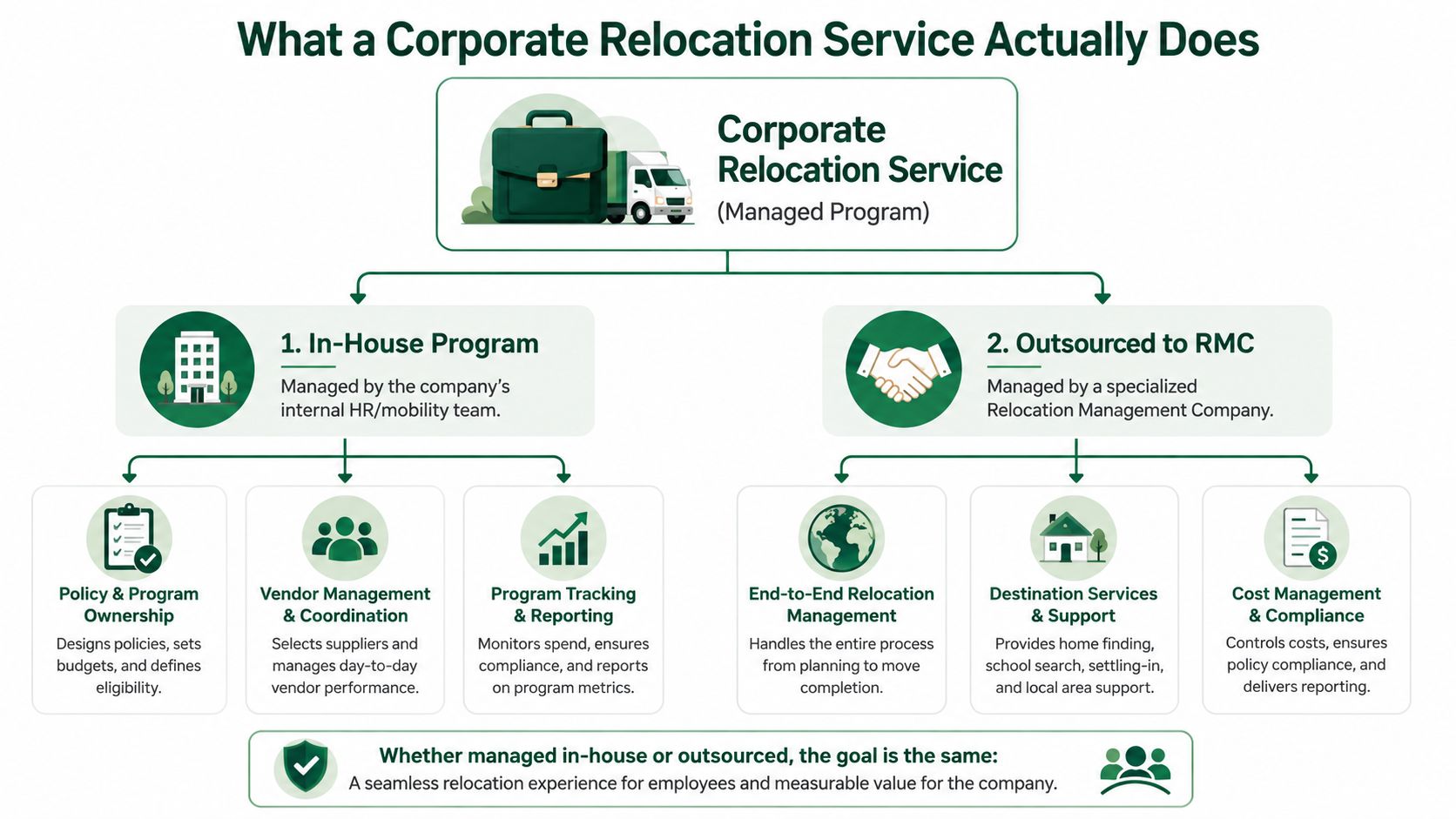
The smartest way to think about the service is this, the provider should reduce admin burden, surface cost early, and keep the move auditable. That matters whether the employee is moving a sedan to Atlanta or shipping a family SUV to San Juan. A corporate relocation service that can't explain the transport leg in plain language is not running a mature program.
Service Types and Vehicle Transport Options
Vehicle transport is not one category, and good providers don't pretend it is. The right mode depends on the car, the route, the timeline, and whether the move is domestic or island-based. If you match the wrong mode to the wrong vehicle, you either overpay or invite avoidable damage risk.
Match the mode to the vehicle
Open carrier transport is the default for everyday cars on standard mainland routes. It's the practical choice when the vehicle is ordinary, operable, and the priority is efficient scheduling. Enclosed carrier transport is the better fit for luxury cars, classics, low-clearance vehicles, or anything that needs extra shielding.
For Puerto Rico moves, the route shifts from road-only planning to a port-based structure. Door-to-port works well when a car leaves a mainland city and ships from a port such as Jacksonville. Port-to-door matters on the return leg, when the vehicle is collected after arrival and brought to the final destination. Container shipping is the most protective option, and it's often the right call for high-value or non-running vehicles.
| Carrier Mode | Best For | Typical Price vs Open | Transit Window |
|---|---|---|---|
| Open carrier | Everyday sedans, SUVs, standard mainland routes | Baseline | Shorter, widely available |
| Enclosed carrier | Luxury, classic, low-clearance, high-value vehicles | Higher | Usually longer to schedule |
| Door-to-port | Puerto Rico outbound moves from mainland homes or offices | Higher than simple domestic lane work | Depends on port timing |
| Port-to-door | Return moves from Puerto Rico to mainland destinations | Higher than open mainland delivery | Depends on sailing and port release |
| Container shipping | Non-running, specialty, or high-protection needs | Highest | More coordination-heavy |
If you want a service-level benchmark for residential-style pickup and delivery, door-to-door auto transport is the baseline most relocation teams should compare against. It isn't the right fit for every island move, but it's the standard that helps you spot weak routing assumptions.
Don't ignore fleet and commercial moves
Corporate relocation isn't only about one employee and one car. Fleet transfers, dealership inventory, and auction vehicles all need coordinated pickup windows and delivery documentation. Those moves are less forgiving because delays ripple across multiple stakeholders at once.
The mistake is forcing every transport into the same policy box. A corporate relocation service should be able to distinguish between a daily-driver sedan, a specialty vehicle, and a commercial vehicle pool without making the client relearn the process each time.
How the Engagement Process Works Step by Step
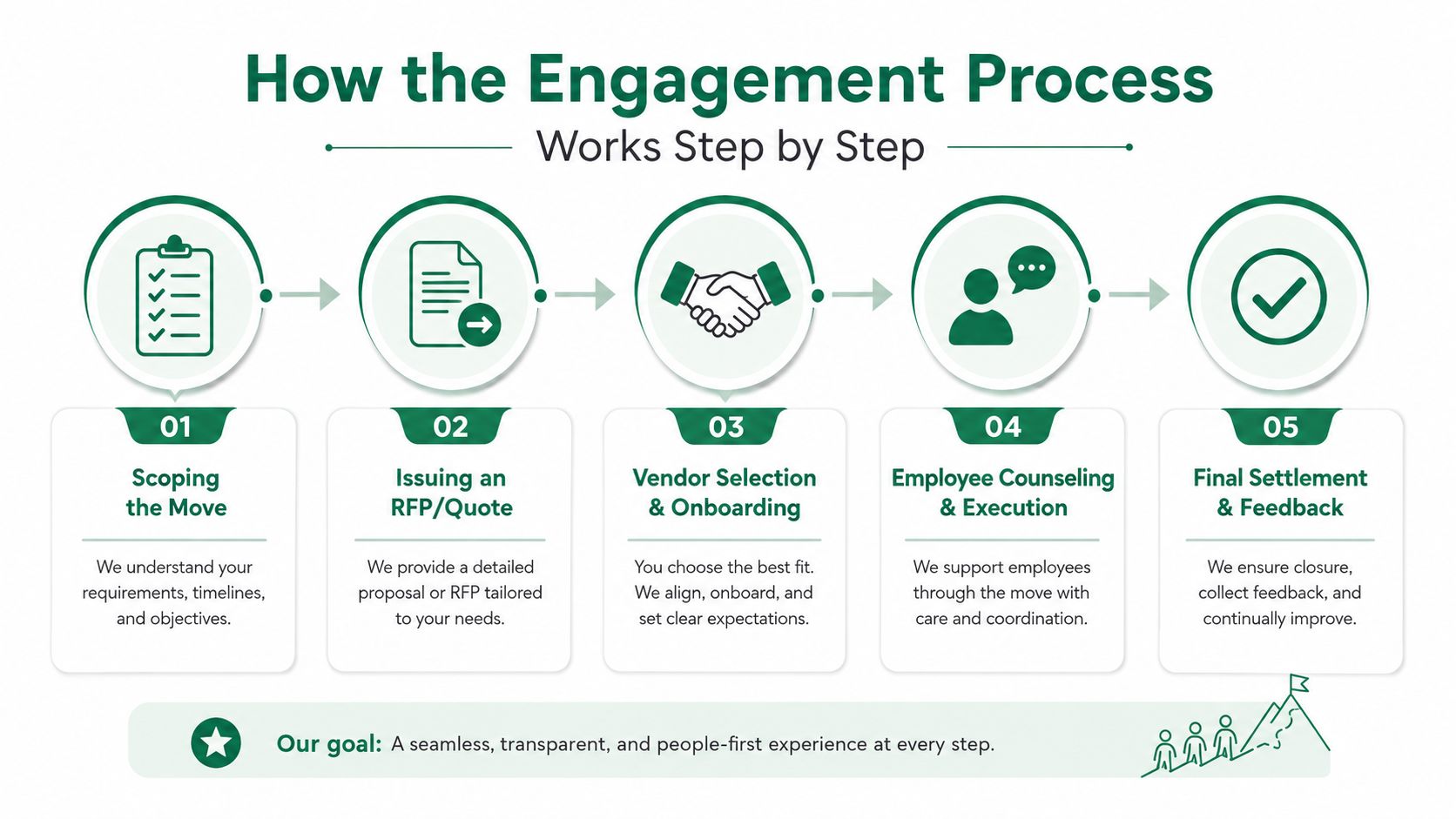
The cleanest moves start with a boring document trail. That's a compliment. Scoping, scheduling, inspection, tracking, and settlement should all be visible, because hidden steps are where moves get stuck.
What the employee sees
The employee usually experiences the process as a sequence of confirmations. First comes the request or quote. Then pickup is scheduled, the vehicle is inspected, and the driver arrives. The best providers keep the employee informed without forcing them to chase updates.
What HR and mobility should insist on
Internally, the workflow needs documented checkpoints. UrbanBound's guidance on relocation analytics says teams should track total program cost, cost by benefit category, soft costs, time-to-relocate, retention, and business impact metrics tied to major initiatives. International HR Adviser's shipment data guidance reinforces the practical side of that, asking whether pack, load, and delivery dates were correct, whether the crew was courteous and timely, and how claims and settlement were handled.
That's the core control system. If those fields aren't captured, the company can't tell whether a delay came from scheduling, handling, paperwork, or poor vendor follow-through.
Watch the red flags: vague ETAs, missing condition reports, and weak claims documentation usually mean the move is already slipping.
What changes on a Puerto Rico move
Mainland-to-Puerto Rico transport adds sailing and port handling, so the sequence has more handoffs. The paperwork matters more, the timing is tighter, and the final delivery depends on port release as well as the truck schedule. The car is no longer just moving down a highway, it's moving through a logistics chain that includes ocean freight and port coordination.
A disciplined corporate relocation service keeps each checkpoint visible. That's how you avoid the ugly surprise of an employee landing in San Juan with no vehicle and no clear answer about when it'll arrive.
Pricing Factors and Realistic Timelines
Price starts with distance, but that's only the first layer. Vehicle size, operability, carrier mode, seasonality, fuel surcharges, and island-specific handling all change the final number. For Puerto Rico, ocean freight and port fees enter the picture, so the budget has to reflect more than a mainland tow.
What actually drives the bill
A compact car on an open carrier is a different job from a non-running SUV in an enclosed setup. Open transport usually stays the most economical for standard moves, while enclosed and container options cost more because they add protection and handling complexity. The route matters too, because mainland-to-Puerto Rico transport includes a port leg, a sailing leg, and a destination leg after arrival.
Puerto Rico brings another surprise into the conversation, excise tax, or arbitrios, on arriving vehicles. Companies that budget only the transport line item often get caught off guard by that extra cost. If you're comparing broader office move budgeting and want a useful cost framework, TLC Moving & Storage office move costs is a practical reference point for seeing how relocation expenses can stack up when multiple logistics layers are involved.
Budget rule: the cheapest quote is not the cheapest move if it leaves out port handling, special equipment, or the cost of a delayed employee start date.
For a line-item comparison focused on auto shipping itself, car shipping cost is the right place to start. Use it as a benchmark, then add island-specific and policy-specific costs around it.
Timelines should be set conservatively
Domestic open transport is often fast enough to feel routine, but that speed doesn't mean every lane behaves the same. Mainland-to-Puerto Rico moves take longer because they depend on sailing schedules and port coordination, and peak travel periods make both the calendar and carrier availability tighter. Summer and snowbird months are the obvious pressure points.
The better practice is to give employees a real range, not an optimistic promise. If the timeline isn't explained clearly, people will treat the move as delayed even when the shipment is moving as planned.
A corporate relocation service earns its value here by setting expectations early. When the price, route, and transit window are honest, HR gets fewer escalations and the employee stops planning around fantasy dates.
Choosing the Right Provider and What Good Looks Like
The best provider is the one that makes the move simpler without hiding the details. I'd judge any auto transport partner on five things, carrier vetting, pricing clarity, licensing and bonding, actual human support, and how well they handle special routes like Puerto Rico.
What to look for
A strong provider should show you a vetted carrier network, not just a marketing promise. It should use transparent flat-rate pricing, so the quote doesn't morph after booking. It should also have dedicated advisors, because transfers like this are too important to dump into a generic call queue.
Bilingual support matters more than most companies admit. If your workforce includes English- and Spanish-speaking employees, the move goes better when the coordinator can explain timing, inspection steps, and paperwork without confusion. That's especially true for island shipments, where one missed detail can slow everything down.
National Car Transport is a useful example of how those standards can look in practice, with 25+ years of experience, an A+ BBB rating, transparent flat-rate pricing, and a network of 25,000+ vetted carriers. It also offers bilingual English/Spanish agents based in the U.S., which is exactly what many relocation programs need when the move has to be explained clearly to employees, families, dealerships, or military households.
If you're evaluating enclosed-service options for specialty vehicles, enclosed auto transport is the kind of service page that should answer the right questions before you ever book.
The bottom line on provider quality
A provider is good when it reduces uncertainty. A provider is weak when it pushes the uncertainty back onto HR or the employee. A mature corporate relocation service should feel like a guided process, not a scavenger hunt.
Common Questions About Corporate Vehicle Relocation
What insurance applies during transit
Coverage should be explained before pickup, not after a claim. The move should include a clear condition report at origin and another at delivery, because that's how damage disputes get handled fairly. If a provider can't explain the claims process in plain language, keep looking.
What paperwork do Puerto Rico shipments need
At minimum, the shipment should be prepared with the title and photo ID, and the vehicle's arrival obligations should be understood before it sails. Puerto Rico also has arbitrios on arriving vehicles, so the company or employee needs to know how that tax fits into the total move cost. That paperwork is part of the transport plan, not a post-delivery surprise.
How do fleet, dealership, and auction moves work
Those moves are managed differently because the volume and timing are different. Multiple vehicles need pickup coordination, status tracking, and delivery documentation that holds up across more than one recipient or location. A good provider can handle those moves without treating them like a one-car relocation.
Why does a dedicated bilingual agent matter
Because one human who knows the route, the paperwork, and the customer's language saves time on every call. A U.S.-based bilingual agent with 20+ years of auto transport logistics experience can spot problems before they turn into missed deliveries. That's not a luxury, it's what makes the move simple and quick when the clock is already moving.
If you're planning a corporate move and the vehicle leg needs to be handled right the first time, talk to National Car Transport. They coordinate domestic, Puerto Rico, and specialty vehicle shipping with experienced advisors, so you can stop chasing updates and start running the relocation like the business-critical process it is.