

You're probably dealing with the same mess every fleet manager knows too well. A driver is calling about a warning light, finance wants the fuel invoices reconciled, and operations just asked how fast you can move five vehicles to San Juan without turning the week into a fire drill. That's corporate fleet management, part finance control, part logistics coordination, part damage control, and all of it tied to whether vehicles are in the right place at the right time.
The old version of fleet work was about maintenance reminders and fuel cards. The 2026 version is much bigger than that. The market has turned into a real technology category, with digitization now mainstream and fleets increasingly managed as service systems instead of static assets, especially when you factor in leasing, telematics, and long-distance vehicle transport across the mainland and into Puerto Rico. A fleet leader who still thinks only in terms of oil changes is already behind.
What matters now is simple. You need to know which vehicles should exist, which ones should move, which ones should be replaced, and which moves are smarter to outsource than to drive. You also need clean data, because bad inputs turn every dashboard into noise. The best programs treat fleet management as a data and logistics problem, not just a maintenance schedule.
Table of Contents
- What Corporate Fleet Management Actually Looks Like in 2026
- The Core Components Every Fleet Program Shares
- Acquisition, Lifecycle, and the Real Cost Per Mile
- Telematics, Compliance, and the KPIs That Tie Them Together
- In-House Management Versus Outsourced Fleet Logistics
- Building or Optimizing a Corporate Fleet Program
- Smart Decisions and Future-Proofing for Fleet Leaders
What Corporate Fleet Management Actually Looks Like in 2026
A procurement manager starts the morning with a maintenance receipt, three driver complaints, and a request to move five vehicles from a mainland office to San Juan, Puerto Rico. That's a normal day now. The job isn't about steering wheels, it's about deciding what gets approved, what gets repaired, what gets replaced, and what gets shipped.
The market tells the same story. One industry source estimated the corporate fleet management market at $19.47 billion in 2020, with a projection of $52.50 billion by 2030 at a 10.6% CAGR from 2021 to 2030, and it also reported that 64% of fleet managers were already using GPS fleet tracking while 80% of mid-to-large fleet companies leased vehicles rather than owning them outright (fleet management statistics). That doesn't mean everyone is advanced. It means the baseline has shifted, and the weak operators are easier to spot.
What the role really covers
A fleet manager now sits between finance, operations, compliance, and logistics. Vehicles have to be acquired, insured, maintained, tracked, and eventually replaced or moved out of the system. If a business runs vehicles across the 48 states, from cities like Los Angeles, Chicago, Dallas, Atlanta, Seattle, Miami, Boston, Phoenix, Denver, and New York City, plus island lanes into San Juan, every decision touches routing and timing.
Practical rule: if a vehicle move creates more administrative work than operating value, it's a logistics problem, not a driver problem.
The smartest teams break the function into seven building blocks, acquisition, financing, maintenance, telematics, compliance, lifecycle replacement, and cost control. Miss one, and the rest get expensive fast. Handle them together, and you get a fleet that can absorb demand swings, route changes, seasonal relocations, and island shipping without chaos.
The Core Components Every Fleet Program Shares
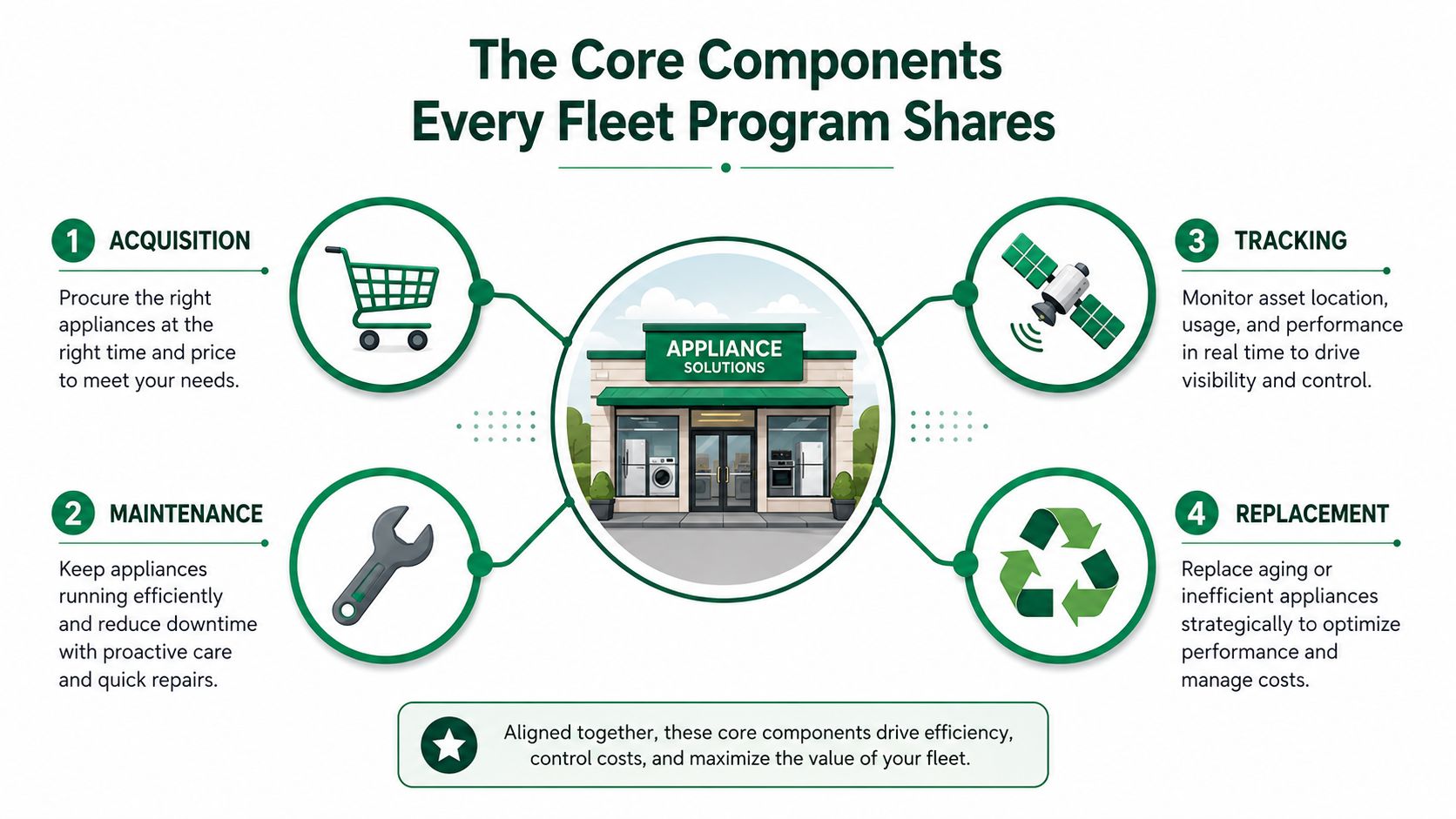
A fleet works a lot like a small appliance store. You buy inventory, finance it, maintain it, track where it is, replace worn-out units, and make sure the whole shop still makes money. If the store ignores maintenance, the floor fills with broken appliances. If it ignores replacement timing, the showroom fills with dead stock. Fleet programs fail the same way.
Acquisition and financing
Acquisition starts with use case, not ego. Buy the vehicle class that fits the route, payload, and service life. Lease when capital flexibility matters more than long-term ownership. If you want a practical maintenance reference while evaluating operating discipline, a resource like hgv maintenace can help frame how regular upkeep should be structured, even if your fleet is mixed rather than heavy-duty.
Maintenance and telematics
Maintenance only works when it's connected to real vehicle data. Telematics tells you where the vehicle is, how it's being used, and whether it's drifting into avoidable wear. That data is useless if service schedules don't consume it. The point isn't to collect dashboards, it's to keep assets on the road.
Compliance, replacement, and cost control
Compliance keeps the fleet legal. Replacement keeps it economically sane. Cost control keeps every other piece honest. You can't fix compliance after a violation the same way you can't recover value from a vehicle you kept two years too long. One weak layer pushes cost into the others, which is why the whole program has to be managed as a system, not a checklist.
Acquisition, Lifecycle, and the Real Cost Per Mile
Buying or leasing a vehicle is not a philosophical choice. It's a cost-per-mile decision dressed up in finance language. If a unit spends too much time underused, or sits too long before replacement, the fleet pays for it twice, once in carrying cost and again in downtime or depreciation.
The most useful benchmark is cost per mile, because it captures fuel, maintenance, labor, and depreciation together instead of pretending one expense line tells the whole story. A 2026 fleet KPI guide pegs average cost per mile for transport trucks at $2.26, and it pairs that with a 95% utilization target, <25% idle time, and <8.7 days of downtime per vehicle per year as practical thresholds for separating normal operating friction from real inefficiency (fleet KPI guide). For broader budgeting context, the U.S. trucking industry operating cost benchmark was $2.260 per mile in 2024, with the report attributing the small year-over-year decline mainly to cheaper fuel (ATRI update).
How to think about lifecycle math
If a vehicle is still in service but its downtime is creeping up, the issue may not be maintenance spend, it may be lost route capacity. That's why lifecycle decisions should be tied to utilization and replacement triggers, not just mileage on the odometer. A vehicle can look cheap on paper and still be expensive in the field.
The other mistake is treating all routes the same. Route type and vehicle class change the math, and high-utilization assets often shift the pain from fixed cost absorption to maintenance-induced downtime. If your fleet ships vehicles between hubs, mainland markets, and Puerto Rico, a move that looks inexpensive in isolation can still become costly once delays, idle days, and missed handoffs are counted.
| KPI | Benchmark | What It Tells You | How to Use It |
|---|---|---|---|
| Cost per mile | $2.26 | Overall operating efficiency | Compare vehicle classes, routes, and shipping choices |
| Utilization | 95% target | Whether assets are being used hard enough | Flag underused units and excess capacity |
| Idle time | <25% | How much time produces no value | Rework route plans and driver habits |
| Downtime per vehicle per year | <8.7 days | Reliability and maintenance drag | Trigger replacement or service review earlier |
For a practical shipping benchmark when moving vehicles rather than driving them, use the fleet transport cost logic in how fleet fuel management cuts costs alongside the pricing reference on car shipping cost so you can compare domestic routing against transport quotes with real numbers.
Bottom line: if a move burns more cost per mile in wear, fuel, and labor than it saves in speed, ship it.
Telematics, Compliance, and the KPIs That Tie Them Together
Telematics is not a nice-to-have anymore. It's the only way to connect vehicle location, mechanical state, and driver status into one operating picture. Microsoft's fleet reference architecture says real-time systems now have to process millions of events per hour with subsecond latency, and that they should support fleets of 10,000–50,000 vehicles in pilot and hundreds of thousands of vehicles at scale (fleet management architecture). That's the modern standard for visibility, not a bonus feature.
What belongs in the dashboard
Start with the basics, vehicle location, mechanical state, and driver status. Then bring in maintenance history, inspection records, and retention rules. If the data is sloppy at the source, the dashboard turns into decoration. Odometer readings, daily checks, defects, and telematics need to come in clean, or the KPI layer stops being useful.
Compliance belongs in the same system because the work overlaps. DOT rules, inspections, hours tracking, and documentation all become easier when the fleet uses one reporting layer instead of scattered spreadsheets. The job is not to collect more data. The job is to make the right data actionable before a failure or audit exposes the gap.
Data quality beats data volume every time. Bad inputs create bad dispatch decisions, bad maintenance timing, and false confidence.
For operators moving cars across states and onto islands, the same rule applies to route visibility. If you can't trust the source data, you can't trust the decision about whether a unit should stay in service, go to a dealer, or be shipped.
KPIs that actually matter
Cost per mile stays the headline number because it ties together the whole operating model. Utilization, idle time, downtime, and maintenance history tell you why the number is moving. Driver behavior and compliance records tell you whether the cause is controllable or structural. That's the connected loop fleet software should support, not a stack of disconnected reports.
In-House Management Versus Outsourced Fleet Logistics
Running fleet logistics internally gives you control. You own the process, you set the rules, and your team can react quickly when a local delivery needs a change. That works fine for routine moves inside a dense metro area like Houston, Philadelphia, or Orlando. It breaks down when the job spans multiple states or involves Puerto Rico, where capacity, timing, and port coordination matter more than office habits.
The cleaner model is to keep strategic control in-house and outsource the physical move when the route gets complicated. That means your team decides what moves, when it moves, and why. A logistics partner handles carrier matching, dispatch, scheduling, and the actual transport. If you need the simplest routing option, door-to-door auto transport removes a lot of handoff friction for mainland shipments and can also support port-based planning when the move is headed to or from Puerto Rico.
What in-house teams handle well
Internal teams are strongest when the move is predictable, local, and tied to a known business need. They can also protect sensitive schedules and coordinate closely with drivers, technicians, and sales teams. If the fleet is small enough and the lanes are simple, keeping it internal can make sense.
Where outsourcing wins
Outsourcing wins when the route spans states, islands, or time-sensitive delivery windows. It also wins when the team doesn't have the bandwidth to vet carriers, manage insurance questions, and coordinate bilingual customer support for mainland-to-island moves. In those cases, capacity matters more than control.
For dealers, auctions, and commercial buyers, the right partner should be able to handle the movement side without forcing your team to learn port workflows from scratch. If you need a practical landing page for that lane, the dealers resource shows how fleet and dealer transport is usually structured without making it sound harder than it is.
My rule: keep planning internal, outsource hauling when geography starts eating management time.
That's especially true for Puerto Rico routes. Door-to-port and port-to-door options each solve a different problem, and the better choice depends on who is controlling pickup, when the vessel booking is locked, and how much flexibility your schedule has. The wrong answer is pretending every move should be driven because the fleet already owns the vehicle.
Building or Optimizing a Corporate Fleet Program
The first 90 days should be blunt and measurable. Baseline cost per mile, review telematics coverage, check compliance gaps, and list every vehicle class by use case. Then decide which moves, like multi-state transfers, island shipments, military relocations, or auction pickups, are worth outsourcing instead of absorbing inside the ops team.
A transport manager in any serious fleet operation needs the same instincts, route discipline, documentation, and carrier oversight. If you want a solid professional benchmark for that role, the guide to transport management roles is useful because it frames the job as coordination, not just dispatch.
A practical launch checklist
- Onboard stakeholders: get finance, operations, safety, and procurement aligned before tools are selected.
- Audit current fleet: identify unused units, duplicate assignments, and routes that should be outsourced.
- Define policies: spell out maintenance intervals, replacement triggers, and approval rules.
- Set budget: connect spend limits to cost per mile and downtime exposure.
- Select technology: choose tools that can integrate telematics, inspection data, and reporting.
- Standardize maintenance: use the same service logic across vehicle classes where possible.
- Train drivers: make expectations clear on inspections, reporting, and route discipline.
- Establish KPIs: lock in cost per mile, utilization, idle time, and downtime.
- Review at 90 days: cut what doesn't work and expand what does.
If your operation includes dealerships, a managed provider should be able to coordinate vehicle flow without making your team chase updates all day. A resource like National Car Transport for dealers is relevant here because dealer logistics and fleet logistics often overlap, especially when you're moving inventory between states and to island markets.
What good vendors can do
A serious partner should offer security, integration, support hours, and the ability to handle niche transport lanes. Bilingual support matters when the operation touches Puerto Rico or serves mixed-language customer bases. Flat pricing also matters because surprise fees wreck budget discipline and slow approvals.
Smart Decisions and Future-Proofing for Fleet Leaders
The fleet leaders who win in 2026 won't be the ones who collect the most dashboards. They'll be the ones who use data to rightsize the fleet, choose the right ownership model, and stop wasting time on moves that should have been outsourced from the start. Cost per mile is the headline metric, but the gains come from utilization discipline, data quality, and logistics choices that match the route.
What deserves attention now
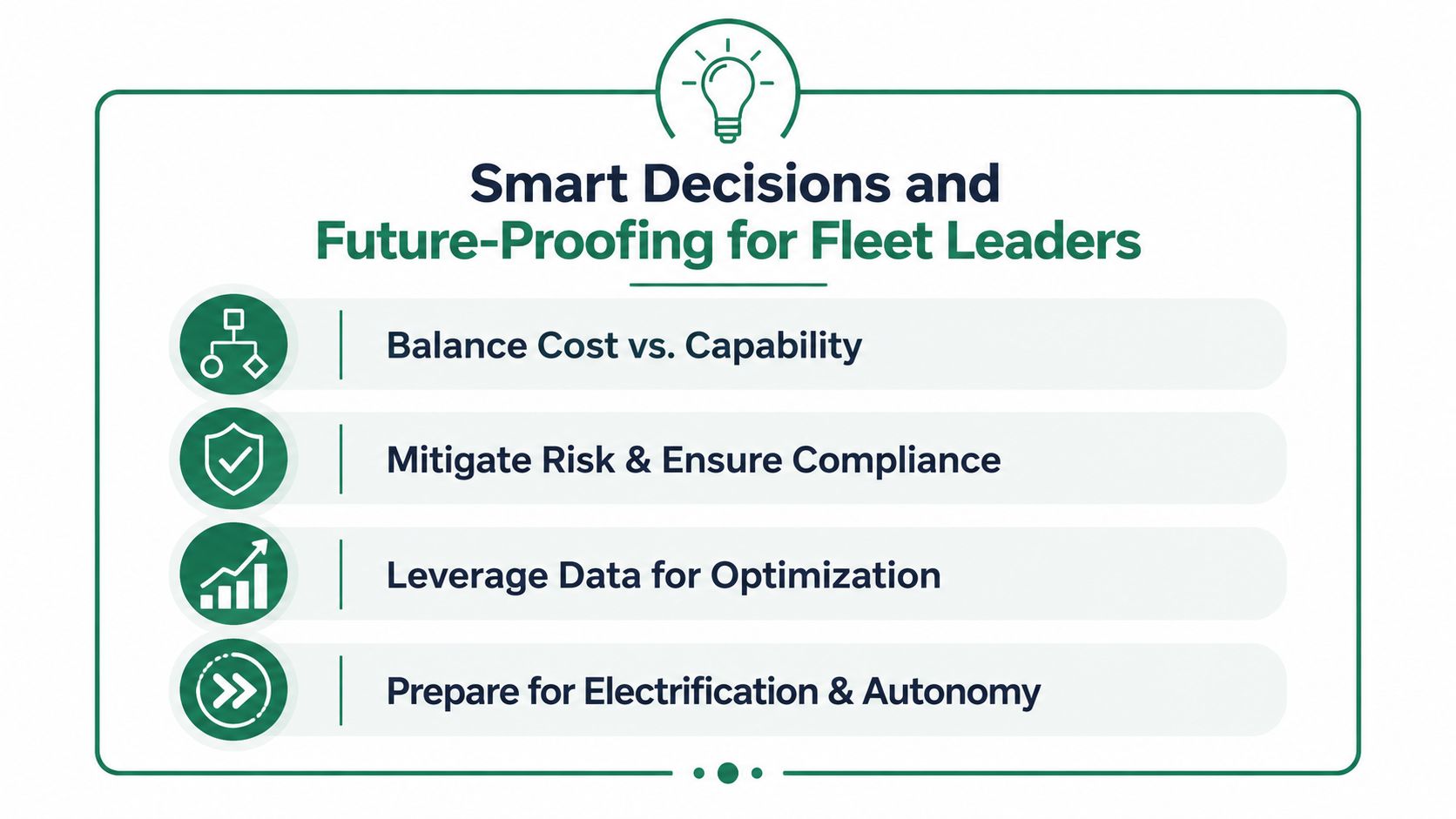
- Balance cost vs. capability: don't own vehicles just to feel in control.
- Mitigate risk and ensure compliance: keep inspections, documentation, and routing clean.
- Use data for optimization: apply telematics to spot underuse and hidden downtime.
- Prepare for electrification and autonomy: plan for charging, backup power, training, and operational continuity, not just vehicle selection.
Electrification is now part of the planning conversation, but it's not the only issue. Fleet-industry coverage makes it clear that charging infrastructure, technician training, funding, and backup planning all matter at the same time, especially when resilience is part of the brief (fleet managers and operations coverage). That's the right mindset. A fleet is a living system, and it should be reviewed quarterly, not treated like a one-time procurement project.
If your team is spending too much time coordinating mainland moves, island shipments, or dealer logistics, it's time to hand the transport piece to people who do it every day. Visit National Car Transport to see how experienced advisors can help you move vehicles across the U.S. and to Puerto Rico with clear pricing, carrier coordination, and bilingual support that keeps the process simple.