

Across National Car Transport's planning estimates, open transport for a standard sedan runs from $0.45 to $2.00 per mile as distance shortens, and enclosed transport carries a premium, including 40 to 60 percent above open rates on a given route. A low per-mile figure can be the riskiest choice on a collector car.
The more revealing number is the value riding on the trailer. Hagerty's collector-market review reported a median collector-car sale price of $27,500 at the start of 2025, while treating vehicles above $250,000 as a distinct segment. Both can share a route, but comparing their shipping arrangements by mileage alone ignores what the owner stands to lose.
A useful quote answers two questions: What does transportation cost, and what protection does that price buy?
Table of Contents
- What Cost Per Mile Really Measures for a Classic Car
- Typical Per-Mile Rates by Distance and Transport Type
- Why Enclosed Transport Costs More Per Mile
- The Factors That Move Your Rate Up or Down
- Worked Examples and Minimum Charges to Check
- Pricing, Transit and Paperwork
- Who Ships Classic Cars and What Each Group Should Ask
- Choosing a Carrier and Confirming Your Quote
What Cost Per Mile Really Measures for a Classic Car
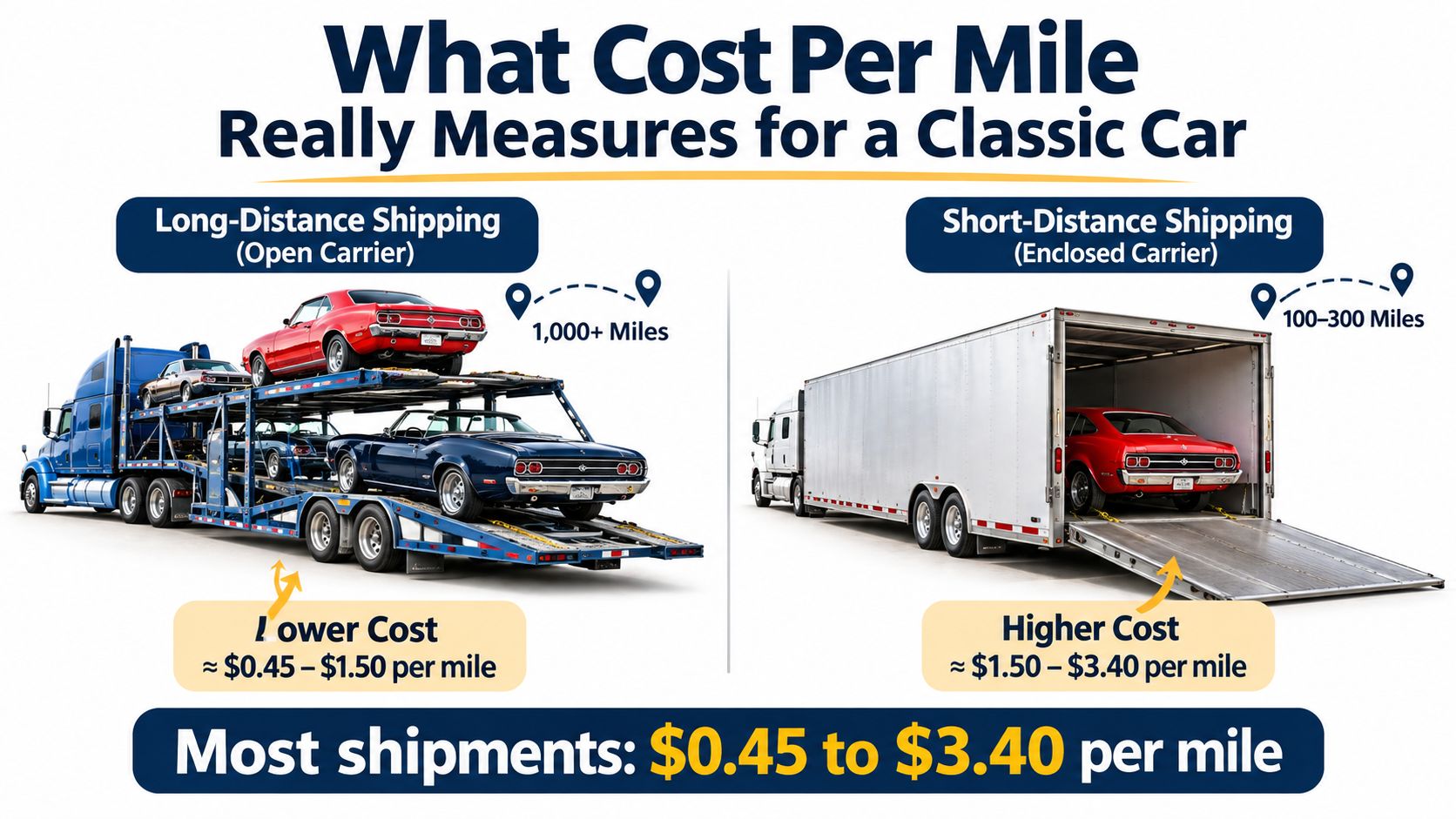
The headline range covers very different services. An open-carrier estimate for a running sedan isn't interchangeable with a specialized enclosed quote for an original-paint collector car, even when both display a price per mile.
Cost per mile is the total transport invoice divided by the loaded route miles. It's a logistics price, not a fuel price. The carrier must cover driver labor, trailer and loading equipment, dispatch, inspection, insurance, fuel, and operating margin.
The distinction matters because gasoline is only part of vehicle-related expense. The U.S. General Services Administration's FY2024 passenger-vehicle mileage benchmark was $0.8616 per mile, reflecting vehicle-use expenses rather than a commercial car-shipping quote. It provides context for operating costs, not a rate owners should expect a specialized carrier to match.
The graphic distinguishes the transport choices behind a mileage estimate.
Why the average can mislead
Think of transport pricing as a taxi meter that also charges for pickup and drop-off. The driver still has to reach the car, inspect it, position the trailer, load it, and complete the delivery handoff whether the journey is regional or cross-country.
Those tasks don't disappear on a short shipment. Instead, the carrier spreads their cost across fewer loaded miles, producing a higher effective rate.
Practical rule: Compare the complete service specification before comparing the mileage rate.
A classic's condition, originality, clearance, and replacement value also change the handling requirements without changing the road distance. A running driver-quality car and a fragile restoration may need different equipment on the same lane.
Start every comparison with total price, loaded miles, and open or enclosed equipment. Without those details, a classic car transport cost per mile figure is incomplete.
Typical Per-Mile Rates by Distance and Transport Type
| Distance band | Open carrier per mile | Enclosed classic per mile |
|---|---|---|
| Under 100 miles | $1.50–$2.00 planning band; minimum charge can raise the effective rate | Up to $3.40 |
| 100–499 miles | $1.50–$2.00 | $1.80–$2.25 |
| 500–1,000 miles | $0.90–$1.20 | Obtain a route quote; approximately $1.20–$2.03 at 1,000 miles |
| 1,000–1,500 miles | $0.70–$0.90 | Approximately $1.20–$2.03 at 1,000 miles; quote the remaining distance |
| 1,500–2,500 miles | $0.55–$0.70 | $1.00–$1.50 long-distance benchmark |
| 2,500 miles or more | $0.45–$0.60 | $1.00–$1.50 long-distance benchmark |
The open-carrier columns are National Car Transport's planning estimates for standard running sedans, not guaranteed classic-car prices. Our estimated totals are $600–$900 under 500 miles, $900–$1,300 for 1,500–2,500 miles, and $1,100–$1,500 for coast-to-coast trips of 2,500 miles or more.
The enclosed figures use separate published benchmarks, not a single continuous tariff. Navi's classic-car guide places single-car enclosed transport at $1.80–$2.25 per mile for trips of 0–500 miles. ConsumerAffairs' classic-car transport guidance puts the upper end at about $3.40 per mile for enclosed moves of 100 miles or less.
For the intermediate benchmark, MovingPlace's vintage-car guidance estimates a 1,000-mile enclosed move at $1,200–$2,025 or more, approximately $1.20–$2.03 per mile. Tempus Logix's classic-car guidance gives a $1.00–$1.50 per-mile long-distance premium-enclosed benchmark. The table preserves those scopes rather than inventing missing distance-band prices.
Turn a band into a budget
As a hypothetical calculation, a 1,200-mile open shipment at our $0.70–$0.90 planning band produces $840–$1,080. That's a budgeting exercise, not a carrier commitment.
Distance-band totals and mileage ranges are rounded planning tools. Don't multiply every endpoint and assume the result must match every published total, especially where minimum charges apply.
- Route density: Interstate corridors can offer more opportunities to share trailer capacity and arrange return loads.
- Rural access: A carrier may need additional unpaid approach mileage, known as deadhead, to collect or deliver the car.
- Quote scope: Door-to-door service, fuel adjustments, and specialized loading must be included before the comparison is meaningful.
A regional move can have a lower invoice but a higher mileage rate than a cross-country shipment. That isn't automatically overpricing. It can reflect the cost of serving the route.
Why Enclosed Transport Costs More Per Mile
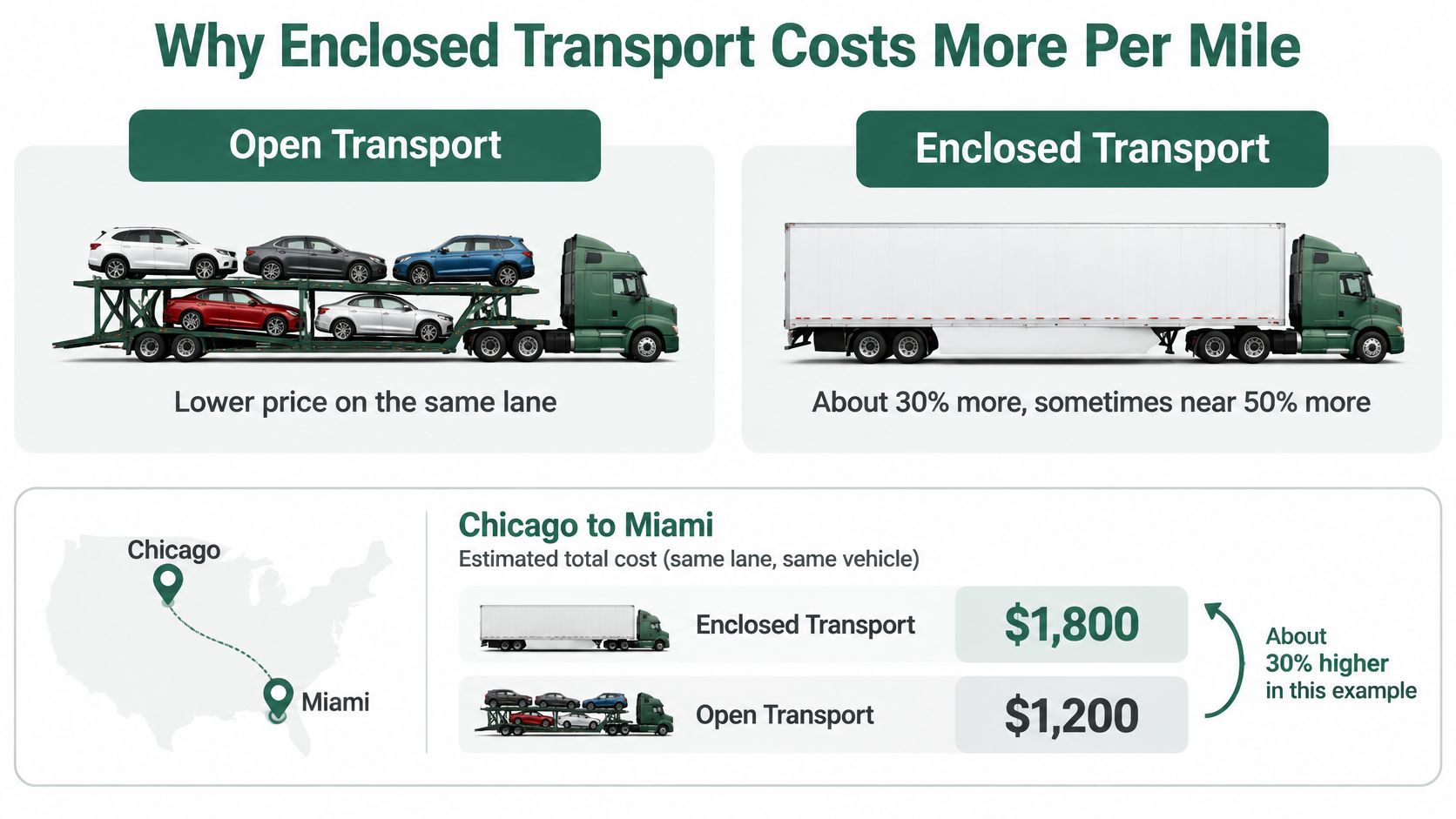
Enclosed shipping commonly costs about 30% more than open transport, while another benchmark puts the premium near 50%, according to Ship A Car's collector-car shipping guidance. Our Chicago-to-Miami enclosed estimate is 40–60% above the open rate.
That premium buys a different risk-control specification, not extra distance. Covered equipment limits weather and debris exposure, while specialized loading and lower trailer capacity change the carrier's operating economics.
This comparison illustrates the main trade-offs.
| Factor | Open transport | Enclosed transport |
|---|---|---|
| Weather and road debris | Exposed on the trailer | Covered during carriage; confirm protection during handoffs |
| Loading method | Standard ramps | Hydraulic lift gate available for low or exotic cars; specify it |
| Vehicles per trailer | Larger shared loads; confirm assigned equipment | Lower capacity; confirm assigned equipment |
| Cargo insurance | Set by carrier policy | Verify per-vehicle protection rather than assuming higher coverage |
| Typical price difference | Baseline rate | About 30–50% above open in published comparisons |
| Best fit | Driver-quality cars and budget moves | Classics, exotics, and high-value vehicles needing added protection |
Match equipment to the car
We use winch-equipped enclosed trailers for inoperable classics. A car that doesn't run must be identified before dispatch so the driver arrives with the correct loading equipment.
Low-clearance vehicles also need ramp-angle planning. Our classic-car service uses enclosed trailers, soft tie-downs, and hydraulic loading, but the vehicle's dimensions and modifications still need review.
Choose enclosed auto transport for a low-clearance or exotic car, a vehicle with high replacement value, or a car you wouldn't willingly leave exposed outdoors. Enclosed service is quoted on request, so add it before comparing offers.
The video provides another view of the transport choice.
To assess the premium, divide the additional enclosed charge by the car's declared value. The result shows what share of the asset's value you're spending on added protection.
Then verify per-vehicle cargo limits, exclusions, deductibles, and valuation terms. An aggregate trailer limit isn't a promise that each car is covered for its full declared value.
The Factors That Move Your Rate Up or Down
The strongest price driver isn't always distance. It can be the equipment or coverage necessary to move the particular car without accepting an unsuitable exposure.
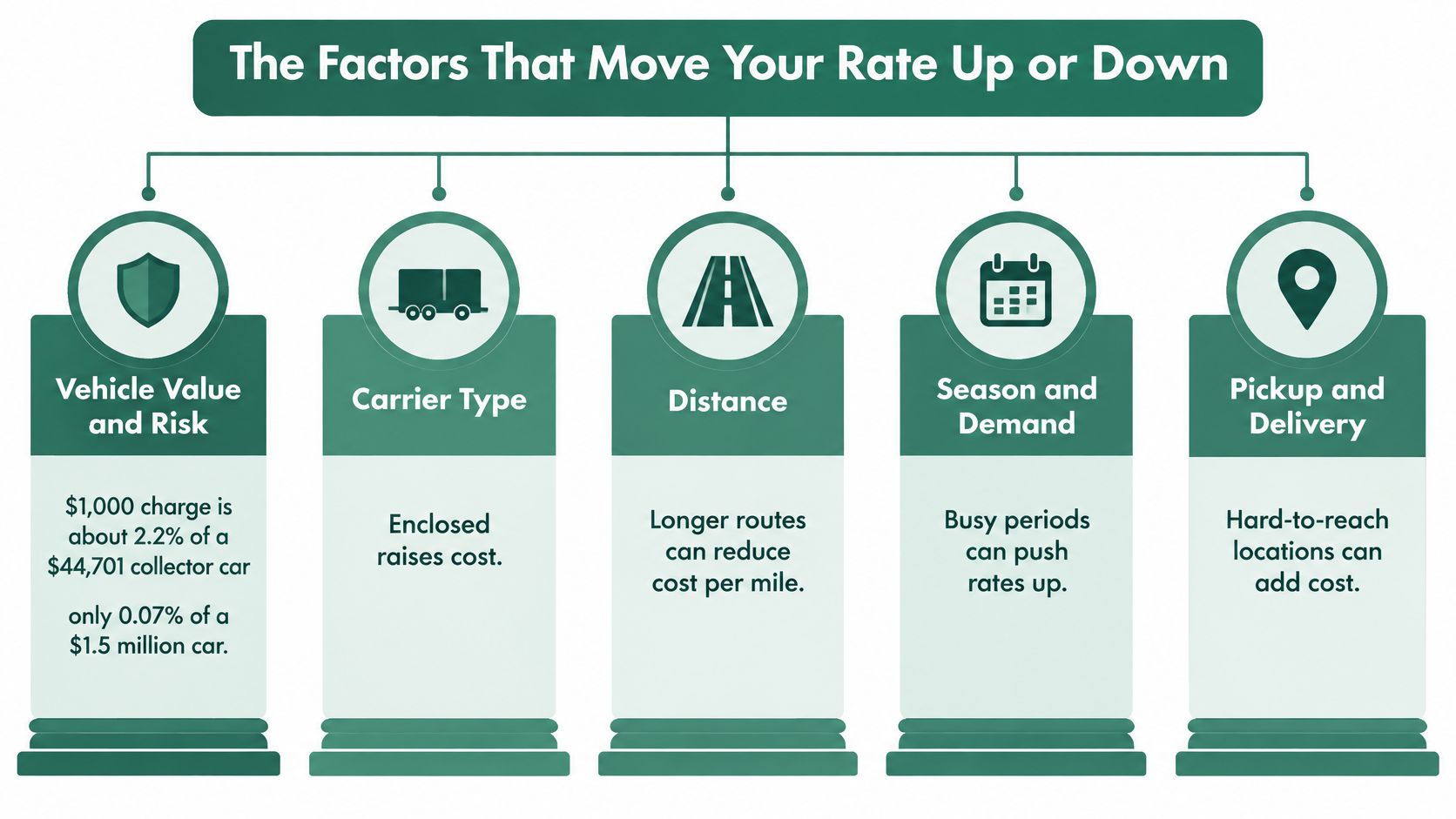
Hagerty's 2025 market review reported an average collector-dealer asking price of $44,701. Using that value for comparison, a hypothetical $1,000 transport charge is about 2.2% of the car's asking price, versus 0.07% of a hypothetical $1.5 million collector car. The same shipping expense carries a very different economic significance.
The following graphic groups the main pricing considerations.
Vehicle requirements and route constraints
Value and vulnerability push the specification upward. Original finishes, scarce trim, and costly restoration work warrant a discussion about loading methods and the basis on which an insurer would value a loss. A declared value alone doesn't establish agreed-value coverage.
Size also changes the quote. Our New York-to-Miami open estimate is $700–$900 for a sedan or compact, compared with $850–$1,150 for a pickup or van.
- Condition: Disclose whether the car starts, rolls, steers, and brakes, along with leaks, loose components, and modifications.
- Access: Identify tight streets, steep driveways, gated estates, and safe truck meeting locations before booking.
- Timing: Our published open-sedan estimates aren't guaranteed and fluctuate with season, fuel prices, and route demand.
Consider Los Angeles to Phoenix, Chicago to Atlanta, and Dallas to Houston as corridor examples to price against the actual loaded distance. Don't assign a city-pair rate until the pickup and delivery addresses establish the route. A rural collection outside those cities may require additional approach driving.
A cheaper route estimate isn't a saving if it excludes the drive needed to reach your car.
Protect the agreed scope
Before accepting the price, photograph existing flaws in good light, record modifications, and provide accurate operating details. Get the pickup and delivery access arrangements in writing.
The useful distinction is between a price change caused by new information and an offer that never included the required service. Accurate disclosure helps prevent the former; an itemized written scope helps identify the latter.
Worked Examples and Minimum Charges to Check
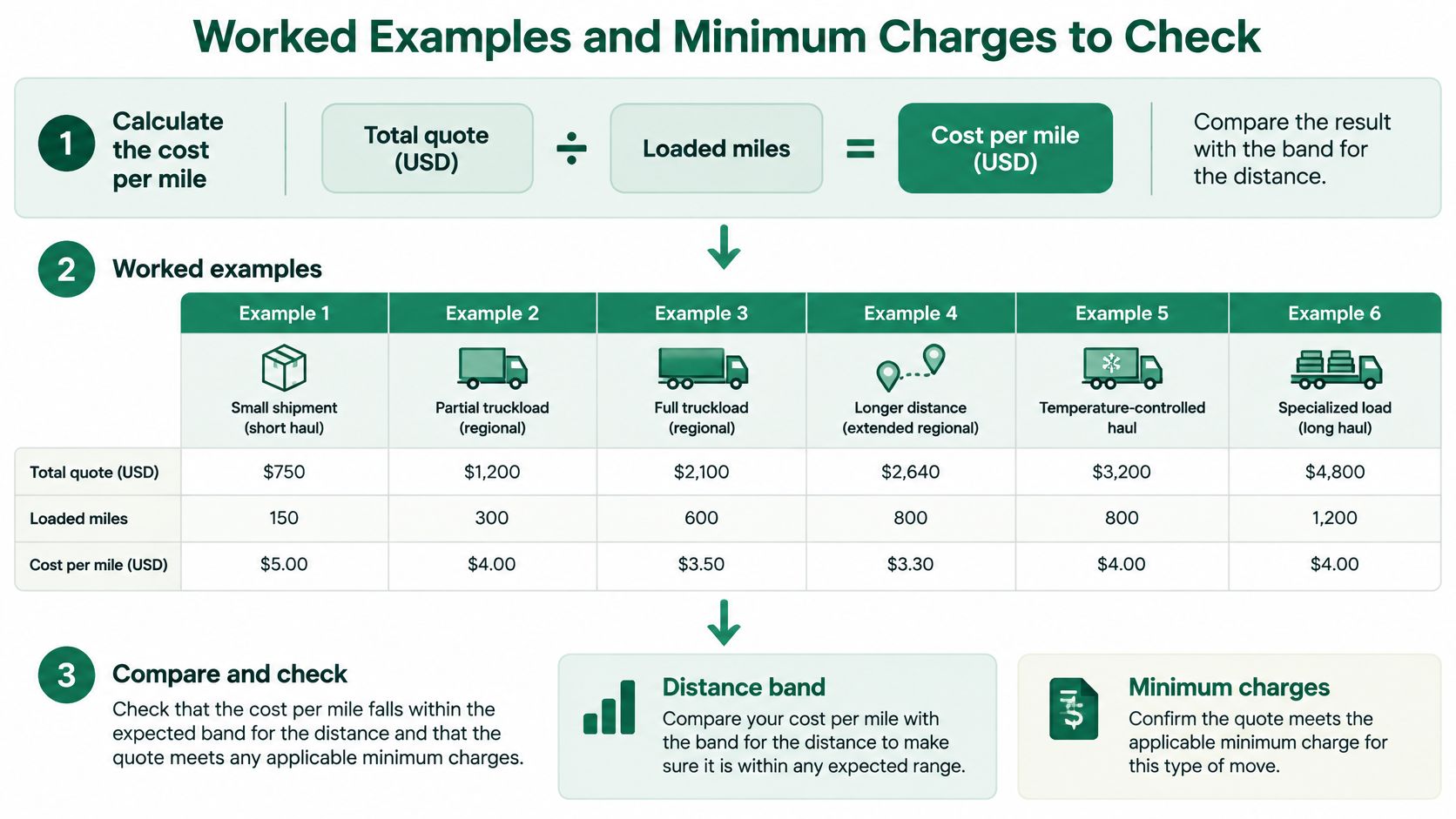
Total quote ÷ loaded miles = cost per mile. Apply that formula only after combining every required transport charge into the total.
The scenarios below are hypothetical arithmetic examples, not offers or completed shipments. Assumed distances are identified, and the reference bands are budgeting comparisons rather than guarantees.
| Scenario | Miles | Total quote | Cost per mile | Reference band |
|---|---|---|---|---|
| Open sedan, long haul | 2,600 assumed | $1,300 | $0.50 | $0.45–$0.60 for 2,500 miles or more |
| Open sedan, mid-length | 1,800 | $1,100 | $0.61 | $0.55–$0.70 for 1,500–2,500 miles |
| Open sedan, 1,200 miles | 1,200 | $950 | $0.79 | $0.70–$0.90 for 1,000–1,500 miles |
| Open sedan, short haul | 300 assumed | $600 | $2.00 | $1.50–$2.00 under 500 miles; check minimum |
| Enclosed classic, short haul | 500 assumed | $900 assumed | $1.80 | $1.80–$2.25 short-distance benchmark |
| Enclosed classic, long haul | 1,800 | $2,400 | $1.33 | $1.00–$1.50 long-distance benchmark |
The graphic shows the calculation and comparison sequence.
Read the result without overreading it
In the hypothetical open-sedan example, $950 divided by 1,200 miles is about $0.79 per mile, inside our corresponding open planning band. That establishes that the arithmetic is plausible, not that the offer has adequate coverage or suitable equipment.
For the hypothetical enclosed classic, $2,400 divided by 1,800 miles is about $1.33 per mile. The next question is whether that total includes the loading and coverage the vehicle needs, rather than whether the number looks low.
The short-haul scenario demonstrates the minimum-charge problem. A hypothetical $600 invoice over 300 miles produces $2.00 per mile. A carrier doesn't eliminate the pickup and delivery work just because the car travels a shorter route.
Comparison test: A mileage rate is useful only when the numerator includes everything you must pay.
Use our car-shipping cost information to establish a starting budget, then request a vehicle-specific total. If enclosed transport or inoperable loading is quoted separately, combine those charges before making a decision.
Finish each comparison with the same record:
- Total payable: Include every required service and identify any contingent charges.
- Effective mileage rate: Use the agreed loaded route, not a straight-line map distance.
- Written inclusions: Record equipment, loading, delivery arrangements, and insurance terms.
The lowest calculated rate should survive that comparison before it becomes the preferred offer.
Pricing, Transit and Paperwork
A Puerto Rico shipment isn't a mainland mileage calculation continued across the water. Consider a car collected in Chicago, moved by truck to a departure port, carried by vessel, and handed over in San Juan. Each segment has its own scheduling, custody, and documentation requirements.
We coordinate mainland-to-Puerto Rico and return shipments, including door-to-port and port-to-door arrangements. Our classic-car shipping uses one flat rate with insurance included; the written quote should identify which inland, port, ocean, and final-delivery services that rate covers.
Establish the route and filing responsibility
The Census Bureau's Foreign Trade Regulations guidance treats a shipment as an import into Puerto Rico when its port of unlading is there, or when it unloads at a U.S. port but the ultimate consignee is in Puerto Rico. Give the coordinator the actual consignee and unloading arrangement, not merely the nearest city.
For used self-propelled vehicles, CBP's Puerto Rico ruling says the movement isn't an export under 19 CFR 192.2, so that rule's 72-hour advance ownership-document requirement doesn't apply. Electronic Export Information must still be filed through the Automated Export System with the VIN or PIN, and inspection remains possible.
- Authority: The FMCSA's Puerto Rico guidance explains that for-hire operations generally need appropriate operating authority, including qualifying movements performed within Puerto Rico.
- Records: Retain ownership evidence, the contract, bill of lading, and invoices. The Pennsylvania DMV's import/export guidance identifies shipping records as useful documentation and distinguishes Puerto Rico vehicles from imported vehicles.
Confirm applicable Puerto Rico excise-tax obligations separately rather than assuming they're transport charges. Request a route-specific sailing and delivery schedule, and provide both addresses, VIN, consignee, and port details.
Alaska and Hawaii also require multimodal totals rather than mainland mileage comparisons. Our Alaska shipping is priced as one flat rate with insurance included.
Who Ships Classic Cars and What Each Group Should Ask
The customer category doesn't itself set the rate. The scheduling, release requirements, and handling arrangements associated with the shipment change what the coordinator must organize.
Individual owners and collectors should establish the car's value and vulnerability before choosing equipment. For an auction purchase, confirm release authorization and operability with the seller so the final checklist reflects the vehicle awaiting collection.
Questions matched to the move
- Snowbirds: Establish seasonal pickup flexibility and whether the price remains valid if departure slips. Record those conditions alongside the quoted total.
- Military families: Provide orders-related timing constraints and a named delivery contact at the base or residence, especially for Puerto Rico moves.
- Students: Determine whether open transport suits a driver-quality car and identify the minimum charge before choosing a budget.
- Dealerships: Request consistent handling, batch coordination, and separate VIN documentation through our dealer transport service.
- Businesses and fleet collectors: Establish account arrangements, a per-vehicle coverage schedule, and one responsible contact before authorizing dispatch.
Our contiguous-state coverage includes major-city origins and destinations such as the following, with Puerto Rico service through San Juan.
| Region | State and city examples |
|---|---|
| Northeast | Maine, Portland; New Hampshire, Manchester; Vermont, Burlington; Massachusetts, Boston; Rhode Island, Providence; Connecticut, Hartford; New York, New York City; New Jersey, Newark; Pennsylvania, Philadelphia |
| South | Delaware, Wilmington; Maryland, Baltimore; Virginia, Richmond; West Virginia, Charleston; North Carolina, Charlotte; South Carolina, Charleston; Georgia, Atlanta; Florida, Miami; Kentucky, Louisville; Tennessee, Nashville; Alabama, Birmingham; Mississippi, Jackson; Arkansas, Little Rock; Louisiana, New Orleans; Oklahoma, Oklahoma City; Texas, Houston |
| Midwest | Ohio, Columbus; Michigan, Detroit; Indiana, Indianapolis; Illinois, Chicago; Wisconsin, Milwaukee; Minnesota, Minneapolis; Iowa, Des Moines; Missouri, Kansas City; North Dakota, Fargo; South Dakota, Sioux Falls; Nebraska, Omaha; Kansas, Wichita |
| West | Montana, Billings; Wyoming, Cheyenne; Colorado, Denver; New Mexico, Albuquerque; Idaho, Boise; Utah, Salt Lake City; Arizona, Phoenix; Nevada, Las Vegas; Washington, Seattle; Oregon, Portland; California, Los Angeles |
An origin anywhere in the mainland can require different coordination from a pickup directly on a carrier corridor. Use the complete address, not the city name alone, to establish the service.
Choosing a Carrier and Confirming Your Quote
Choose the lowest per-mile quote only when its equipment, coverage, and schedule suit the car. Open transport suits a driver-quality classic, while a valuable or irreplaceable vehicle needs a protection-led comparison even at a higher invoice.
National Car Transport ships classic cars nationwide, including Puerto Rico coordination, backed by 25+ years of experience, an A+ BBB rating, and a network of 25,000+ vetted carriers. Its flat rate includes insurance, and an advisor reviews the vehicle's requirements before dispatch.
Confirm the complete commitment
- Price and method: Record the total, effective mileage rate, and whether the assigned trailer is open or enclosed.
- Coverage: Obtain the per-vehicle limit and valuation basis, not just confirmation that insurance is included.
- Handoffs: Establish door-to-door access, authorized contacts, and the inspection procedure.
- Timing and operability: Classic-car transit takes 1–10 days; confirm the route window and disclose loading limitations. Puerto Rico ocean scheduling needs a separate itinerary.
Our U.S.-based bilingual English/Spanish agents can align the vehicle details, equipment, and delivery arrangements before the driver arrives, so the quote reflects the car rather than a generic sedan.
A dedicated agent's value is making the required decisions clear before pickup, not presenting an attractive mileage number.
Before booking:
- Gather value records and condition photos, documenting existing flaws.
- Request open and enclosed quotes with the VIN, both addresses, and operating details.
- Compare totals, per-mile equivalents, and inclusions, then select the service that fits the car's exposure.
National Car Transport offers insured, flat-rate classic-car shipping across the mainland and to and from Puerto Rico. Visit National Car Transport with your VIN, pickup and delivery addresses, and condition details to request a vehicle-specific quote and compare the protection behind the price.