

The most popular advice on finding the cheapest way to move across the country is also the most misleading. You're told to rent the biggest truck you can afford, load everything you own, and drive. That sounds thrifty because the rental quote is the only number you see on day one.
It isn't your total. A loaded truck burns expensive fuel, puts you in hotels for several nights, and often forces a second person to drive your car behind you. You're paying for cubic volume, labor, lodging, and lost workdays whether they're on the quote or not. For many households, the cheaper path is a hybrid. Cut the inventory first, ship the car separately if it has to cross the country anyway, and travel light. Price the whole trip, not the headline rate, and the ranking of your options changes fast.
Table of Contents
- Cross-Country Moving Costs by Method
- What to Sell Donate or Ship
- What Turns a Low Quote Into a High Bill
- When a Hybrid Move Beats a Truck and Which Setup Fits
- How to Check Movers and Car Carriers
- Pick the Lowest All-In Plan
Cross-Country Moving Costs by Method
The cheapest way to move across the country is the option with the lowest delivered total after volume, labor, lodging, fuel, and the car. It isn't the smallest number in an ad. A method that looks cheap for a full house can be wasteful for a renter with a mattress, a desk, and twelve boxes.
Start by separating two jobs most guides lump together. Moving household goods is one purchase. Moving a vehicle is another, with different pricing and paperwork. If you quote them as one blurred bundle, you can't tell which part is driving the bill. If you quote them separately, you can shrink each one on its own.
For readers relocating to cut long term housing costs, that separation matters even more. People exploring geographic arbitrage for financial independence from The Money Maniac aren't just buying transportation, they're buying a lower monthly burn rate in a cheaper city. Paying to haul low value furniture to a cheaper market can erase months of that saving.
The Six Methods at 2,500 Miles
Driving your own car with only essentials avoids a crew and a second vehicle, but operating cost and hotels remain. A rental truck shifts labor onto you and adds weak fuel economy, mileage, equipment, and often a one way fee. A portable container keeps your loading schedule flexible while a company moves the box. Boxed freight fits a small shipment, not a house of furniture.
Full service movers handle loading, linehaul, and unloading. According to Forbes Advisor's analysis of cross country moving costs, the average full service moving cost for a 2,500 mile cross country move was $4,600 in 2025, with analyzed prices ranging from $2,400 to $15,000. Shipping the car and flying or taking the train with a smaller load is the hybrid to price against the truck, and many skip this option.
All-in signals for a 2,500-mile move
| Method | Cost signal | Who does the work | Usually cheapest when |
|---|---|---|---|
| Drive your own car with a reduced load | About $726 operating cost at 29.04 cents per mile before lodging, meals, and tolls | You drive and carry only what fits | One car and very little furniture |
| Rental truck you load and drive | Rental plus fuel; a 500-mile truck leg alone can be about $170 to $260 in fuel at 8 to 12 MPG, before mileage, insurance, and hotels | You load, drive, and unload | A full household and several free driving days |
| Portable moving container | Container plus linehaul; you still pack | You load; the company moves the container | Flexible dates and a legal place to park it |
| LTL or boxed freight | Priced on weight and cube for boxes, not furniture | You pack; the carrier hauls freight | A few hundred pounds, not a household |
| Full-service interstate mover | 2025 average $4,600 for 2,500 miles; analyzed range $2,400 to $15,000 | Crew loads, hauls, and unloads | Your time is worth more than DIY labor savings |
| Ship the car and travel separately | Vehicle transport quote plus airfare or rail and a smaller goods shipment | A carrier moves the car; you ship less | The car must move and a truck would be half empty |
A cheap ad is not a total. The number that matters is what you pay after the last hotel, the last tank, and the car are accounted for.
Circle two rows, not six. If you're unsure where vehicle transport fits, check how car shipping cost is built by distance and vehicle type before you assume driving it yourself is free. Then request quotes on one identical inventory for both rows. Changing the inventory between quotes makes the comparison meaningless, and it's the fastest way to pick the wrong method with confidence.
What to Sell Donate or Ship
Moving everything is often the expensive choice. Every bulky item you keep consumes cube in a truck or container, adds packing time, and can push you into a larger vehicle. If replacing it at the destination costs less than hauling it, you're paying a premium to keep something you don't value that much.
The image below frames the first decision you should make before you request any quote.
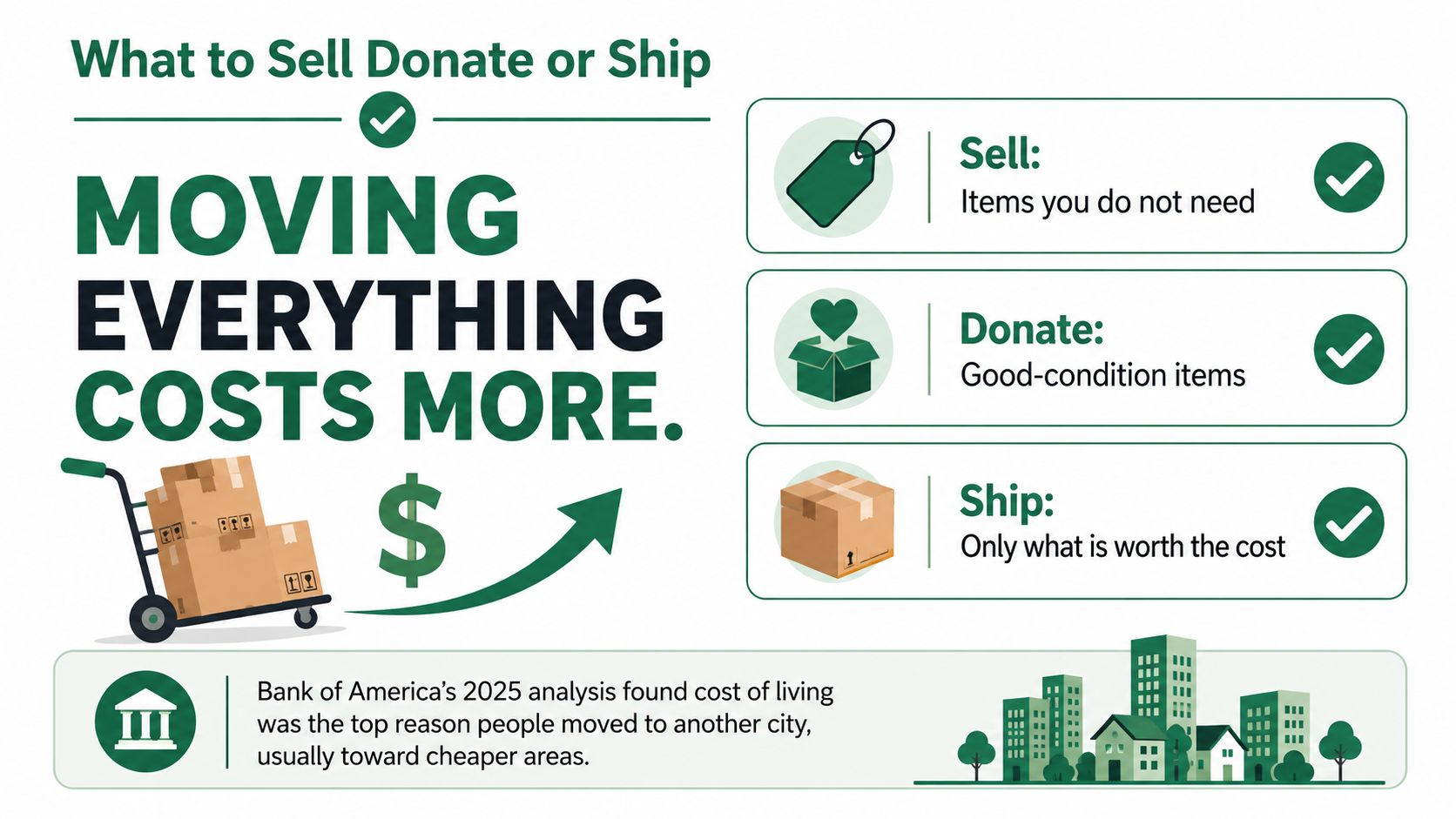
That logic fits why people move in the first place. Bank of America's 2025 analysis, summarized in Move.org's state of moving research, reported that cost of living had become the most important factor when consumers moved to another city, while moves generally favored comparatively less expensive areas. The same research notes that in one 2025 survey, DIY movers commonly paid for truck rental at 41%, packing supplies at 38%, and storage at 26%. If you're moving toward cheaper housing, hauling and storing cheap furniture works against the reason you left.
The Keep or Cut Test
Run each bulky item through a simple test. Compare its replacement price at the destination with its cubic feet multiplied by your shipment rate, plus storage months if it won't go straight into the new place. Subtract what you could get by selling or donating it now. Ask one final question. Does keeping it force a bigger truck, a container you otherwise wouldn't need, or a second car on the road?
Particle board furniture, old exercise gear, and a worn sofa usually fail first. They're bulky, fragile, and cheap to replace locally through used marketplaces. Documents, clothing you wear, quality tools, and anything costly or hard to replace stay. Sentimental items are a separate category, so decide consciously rather than letting them ride along by default.
If you have a houseful to sell rather than a few pieces, research how marketing your Annapolis estate sale works on DIYAuctions. The principle travels well beyond Maryland. Photograph lots early, price for pickup, and finish before you measure cube.
The short video below walks through the same sell, donate, or ship sorting in visual form.
Number the cull so you finish it:
- List misfits first. Write down items that won't fit the new floor plan, climate, or lease.
- Price local replacements. Check delivered prices at the destination, not memory.
- Sell or donate failures. Remove them before you request quotes.
- Re-measure remaining cube. Count boxes and furniture that survived the test.
- Choose the method last. Pick truck, container, freight, or full service for the smaller load.
Students, renters, military families, and snowbirds with short leases should default to essentials plus the car. Your new, smaller inventory is what every later quote must use, word for word.
What Turns a Low Quote Into a High Bill
A non binding estimate can surprise you at delivery. Treat the first price as a draft, not a promise. If the final weight is higher than estimated or the crew performs services that weren't listed, the total moves with it.
Under FMCSA rules described in the FMCSA household goods FAQ, a household goods carrier must provide a written estimate covering transportation, accessorial services, and advance charges. A non-binding estimate can change because final charges may depend on actual shipment weight and services performed. A binding estimate guarantees the total price for the quantities and services stated, and estimates must be based on an actual or virtual inspection of the goods.
The graphic below shows where that draft price tends to grow.
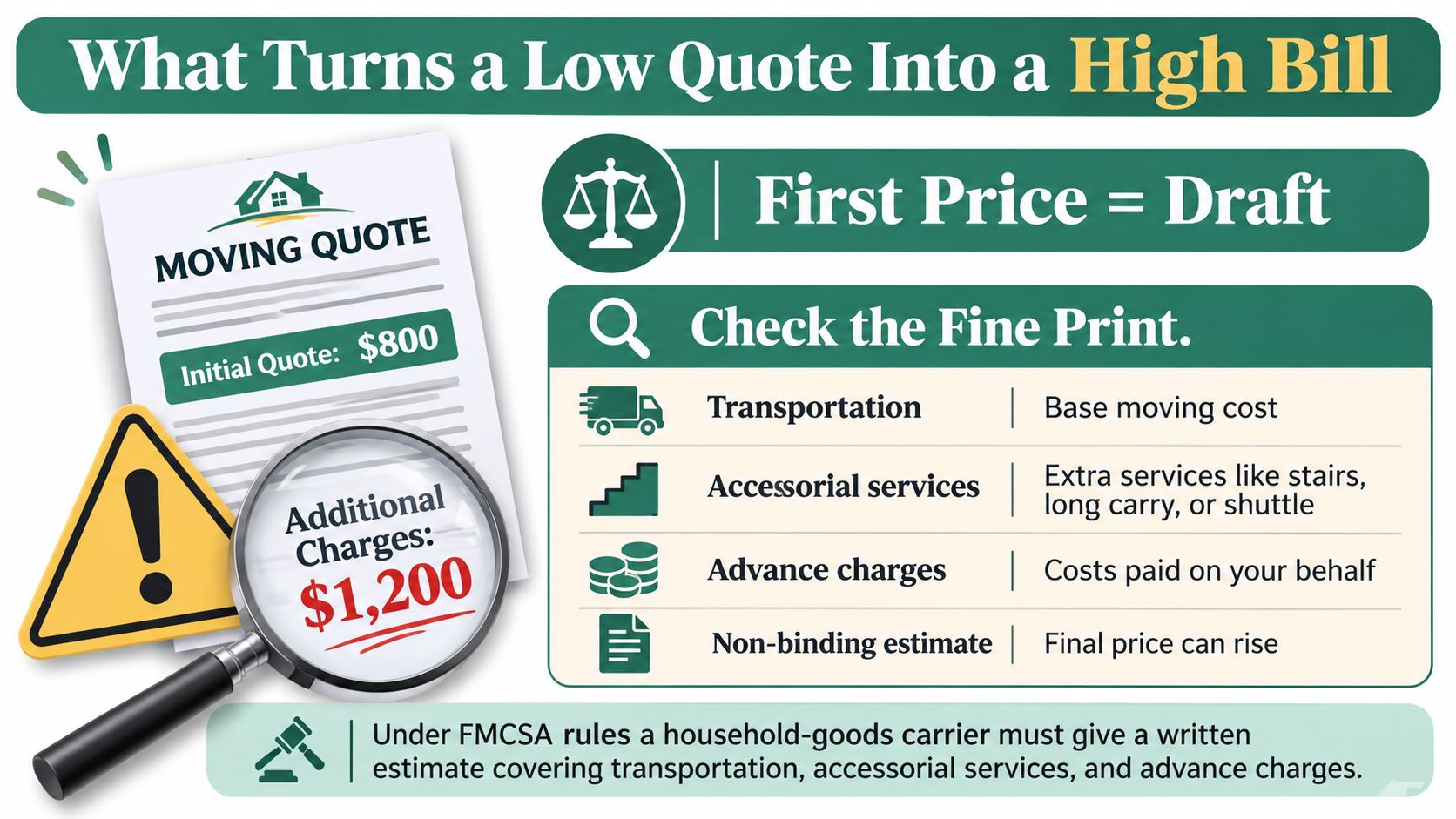
Accessorials dominate long hauls because they're tied to your buildings, not just your mileage. Long carries from the truck to your door, stairs, elevator reservations, and shuttle trucks when a semi can't park near the residence all add labor. Packing, crating, storage days, and higher valuation coverage add more. None of these appear in a base linehaul rate, and any one of them can dwarf a small difference between two transportation quotes.
Why Distance Breaks Local Price Logic
Don't stretch a local quote across the country. For moves exceeding 100 miles, Americans spent an average of $3,291 in 2024, compared with $1,666 for moves under 100 miles, according to ConsumerAffairs survey results reported by Yahoo Finance. As a mid distance marker, the average cost of a move between 200 and 500 miles was $2,703 in 2024, according to This Old House's moving industry analysis. Those figures set scale. They aren't coast to coast prices, and using them that way understates a cross country budget.
- Send one inventory. Give every company the same culled list, with dimensions for bulky pieces.
- Describe both addresses. Note stairs, elevators, parking distance, and any shuttle risk at pickup and delivery.
- Fix the packing scope. State exactly who packs, what gets crated, and how many storage days you need.
- Declare valuation clearly. Use the same coverage level for every bid so totals stay comparable.
- Calculate unit cost. Divide each all in total by cubic feet or pounds to see which bid is cheaper per unit moved.
Compare all in totals rather than line item rates. Note whether each estimate is binding, document each carrier's dispute and claims procedure, and keep the inventory used for quoting. If there's a weigh in or delivery adjustment later, that saved inventory is your evidence.
When a Hybrid Move Beats a Truck and Which Setup Fits
Test the truck before you book it. Compare a rental quote with a mover quote and stop. The better test compares a rental truck with a hybrid where the car ships separately, you fly or take the train, and only the culled load moves as freight, container, or household goods.
The comparison below lays out that test side by side.
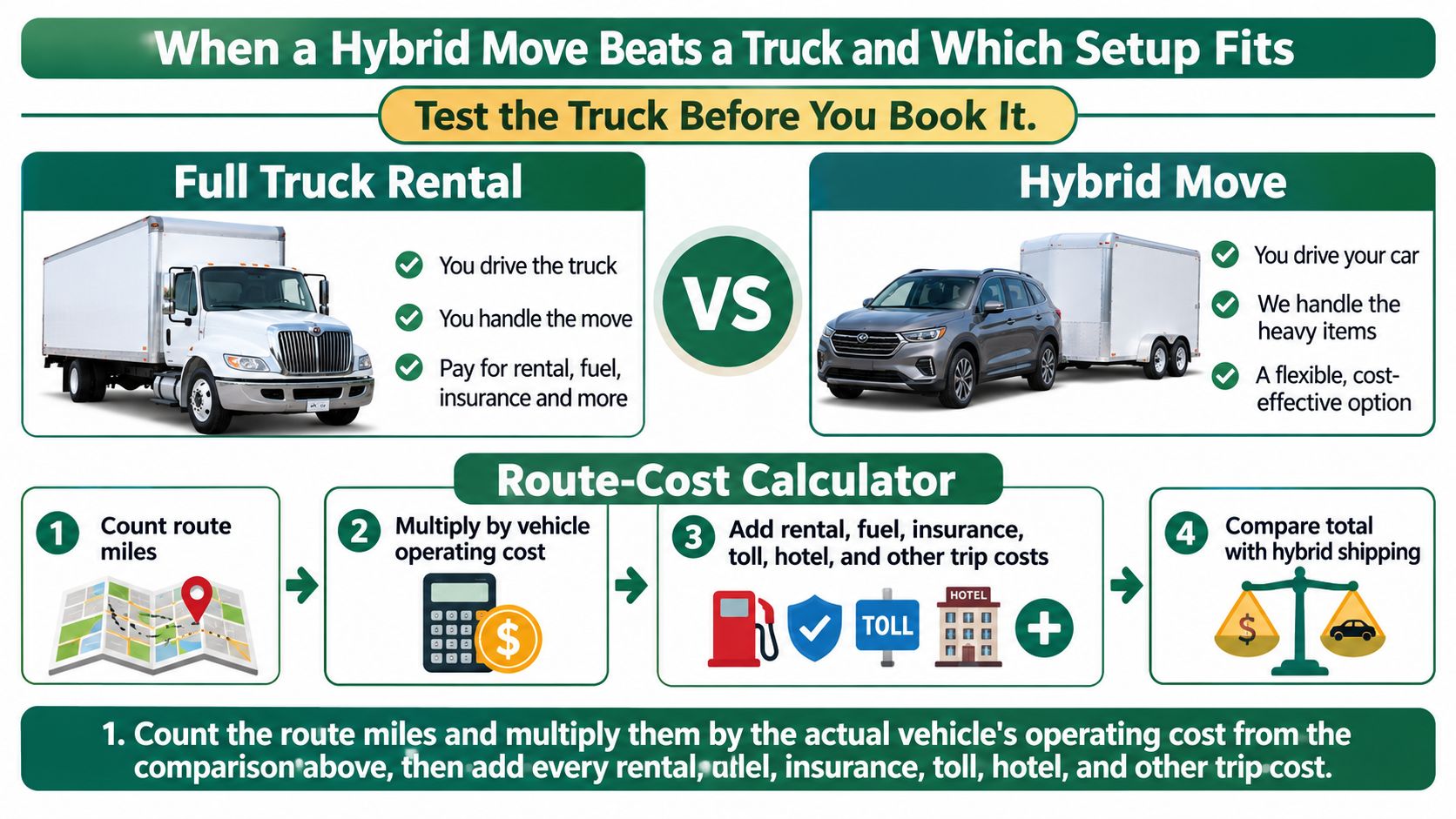
AAA's benchmark makes the driving portion concrete. AAA's 2026 Your Driving Costs brochure assigns a weighted average operating cost of 29.04 cents per mile, comprising 17.32 cents for fuel and 11.73 cents for maintenance, repair, and tires. At 2,500 miles, that equals approximately $726 in vehicle operating cost before rental charges, taxes, tolls, lodging, meals, labor, and the value of the driver's time. Vehicle class changes the result, with 23.12 cents per mile for a small sedan, 34.22 cents for a midsize pickup, and 35.69 cents for a half-ton pickup. AAA cautions that its figures are estimates and actual costs vary with vehicle type, fuel economy, route, and driving conditions.
Run the Three Step Hybrid Test
- Price the drive accurately. Multiply route miles by your actual vehicle's operating cost, then add truck or trailer rental, fuel, insurance, tolls, hotels, and meals for every night on the road.
- Add the people cost. Count workdays lost to driving and loading, plus a second driver if a personal car must also cross the country.
- Price the hybrid on the same route. Get an open vehicle transport quote for the car, a flight or train fare for you, and a shipment price only for the culled volume.
Route miles times the real operating cost, plus every night on the road. If the truck would roll half empty, the hybrid usually wins.
For the vehicle leg, open car transport is the budget option dealerships commonly use for ordinary cars, SUVs, and pickups. Enclosed transport costs more and makes sense for classics, exotics, and high value vehicles where weather and road exposure matter. Don't pay enclosed prices for a daily driver unless its value justifies it.
Match the Setup to the Household
A student or renter with little furniture doesn't need a truck at all in most cases. Sell the bulky pieces, freight the boxes, and ship or drive one car. A full house is different. After the cull, a binding full service estimate or a container can beat a rental once injury risk, loading help, and several hotel nights enter the math.
Snowbirds aren't rebuilding a household, so shipping the car and leaving or storing furniture keeps the move proportional. Military families should keep a personal second vehicle and household goods as separate bookings because the services and paperwork differ. Puerto Rico is not a road trip. The car trucks to a Florida port, rides ocean freight to San Juan, and then reaches places such as Bayamón, Carolina, Ponce, or Mayagüez through port to door or door to port service.
Which setup fits the move
| Situation | Lower-cost setup | Why it wins |
|---|---|---|
| Student or renter with little furniture | Sell bulky items, freight the boxes, drive or ship one car | Replacement furniture can cost less than cube |
| Family with a full house | Binding full-service estimate or a container after a cull | Labor, injury, and hotel nights erase cheap truck ads |
| One car that must arrive and a light household | Open car transport, a small shipment, and a flight or train | Avoids a second driver and a half-empty truck |
| Snowbird or seasonal resident | Ship the car; leave or store furniture | You are not rebuilding a whole household |
| Military family with a personal second vehicle | Keep household goods and the extra car as separate bookings | They are different services and paperwork |
| Dealership, auction, or online purchase | Open transport for ordinary cars; enclosed for high value | You are moving a vehicle, not a dwelling |
| Anywhere on the mainland to or from San Juan | Truck to a Florida port, ocean freight, then port or island delivery | No highway connects Puerto Rico to the states |
How to Check Movers and Car Carriers
Screen for legality before you screen for price. A company that can't identify itself properly shouldn't get your car, your furniture, or your deposit. Run these five checks in order and stop the conversation if one fails.
- Get the legal identity. Ask for the legal name and USDOT or MC number, and write them down exactly as given.
- Confirm operating authority and insurance. A DOT number alone isn't enough for for hire work.
- Name the product you're buying. Vehicle transport and household goods moving follow different rules.
- Map every leg for Puerto Rico. Identify who handles inland trucking, ocean sailing, port handling, and island delivery.
- Compare written terms. Check pickup windows, delivery scope, and whether mainland vehicle transport charges anything before a truck is assigned.
The federal baseline is specific. FMCSA registration and insurance guidance states that for hire motor carriers generally need operating authority in addition to a USDOT number, and carriers must maintain financial responsibility appropriate to their operation. FMCSA also identifies a $750,000 minimum liability level for a for hire property carrier under 49 CFR 387.9. Before booking, request the carrier's legal name, USDOT or MC number, insurance information, and written pickup and delivery terms.
Vehicle Transport Is Not Household Goods Moving
Shipping only a car from Sacramento to New York is vehicle transport. The same applies to cars moving between Dallas, Chicago, Atlanta, Miami, or Los Angeles for a relocation, dealership transaction, military move, or online purchase. FMCSA says a person transporting a vehicle is not automatically a household goods motor carrier and does not need HHG authority merely for that reason. Hiring a crew for furniture and personal belongings is a different regulated service, with its own estimates and claims rules.
That distinction protects your budget. You can accept a binding household goods estimate for furniture while booking the car on a separate vehicle transport quote, such as door to door auto transport on mainland routes, without forcing one company to price both jobs badly. Separating them clarifies insurance, paperwork, and delivery responsibility.
For San Juan shipments, write down who owns each leg and what insurance applies during loading, inland movement, port handling, and delivery. Regulatory cargo minimums are not the same as your car's value, whether it's a sedan, SUV, classic, or dealership unit. Get coverage limits, exclusions, and deductibles in writing for every leg. A broker with a large vetted carrier network can help coordinate that sequence, and National Car Transport is one long running U.S. option people use when they want a person, not a form, to sort those legs. Stop if a company won't give a legal name or a written scope.
Pick the Lowest All-In Plan
Make the decision with an if then rule. If your culled inventory fills a truck and you can spare the driving days without losing income, book the rental or container you already priced. If the truck would be half empty, or a second person would have to drive the car across the country, ship the vehicle and travel separately.
That second branch is where a coast to coast car shipment becomes its own product, distinct from a household van. Continental open auto transport is commonly the budget path dealerships use for ordinary vehicles. We estimate shipping a car in the continental U.S. at $600 to $1,500 and 1 to 10 days depending on distance, with insurance included in one flat rate and no money charged on mainland routes until the car is assigned to a truck. Route, vehicle size, running condition, and season move that estimate, so treat the range as a planning band and confirm it with a current quote.
Budget Puerto Rico as an Ocean Move
For Puerto Rico, budget the ocean leg explicitly. We estimate shipping a car from Los Angeles or the West Coast to Puerto Rico at $1,395 to $1,795, with 12 to 16 days total transit, because the car first trucks to the sailing and then travels to San Juan. Mainland pickups can start anywhere in the 48 states, from Seattle, Denver, and Phoenix to Houston, Boston, and San Francisco, but the island leg still runs through port handling and ocean freight.
National Car Transport, with 25+ years of experience, an A+ BBB rating, transparent flat rate pricing, and a network of 25,000+ vetted carriers, is a practical place to get that flat rate priced as one sequence. Our U.S. based bilingual English and Spanish agents, with over 20 years of experience in auto transport logistics, can sequence pickup, port, and delivery under one quote and explain which documents each leg needs. Not one vehicle transport is alike, and having an agent guide you makes the process simple and quick at a good value.
Bring three things to any final quote request. Bring your culled inventory for household goods, the exact pickup and delivery ZIP codes, and whether the car runs and drives. For a San Juan move, add your preferred port or island delivery city. Then book the option whose all in total, not its ad, was lower, and confirm every price and duration against a current written quote before you commit your dates.
Ready to price the hybrid before you rent a truck you'll have to fuel, load, and drive for days? Get a transparent flat rate for open or enclosed vehicle transport anywhere in the continental United States, or for combined truck and ocean service to and from San Juan, Puerto Rico, with a U.S. based bilingual agent coordinating pickup through delivery. Visit National Car Transport and bring your ZIP codes, vehicle details, and travel dates so your quote reflects the actual trip, not a generic estimate.