

Everybody loves the lowest quote until the truck never gets assigned. That's the mistake that burns money in car shipping, because open transport is already the budget default, and the biggest savings come from understanding why one lane prices cleanly while another quote looks cheap on paper and then falls apart at dispatch.
If you're comparing three numbers for the same sedan, the spread usually isn't random. It reflects route density, distance, pickup flexibility, and whether the quote was built to move the car or just attract your call. If you want a useful benchmark before you shop, shipping for auto parts is a good reminder that transport pricing always starts with the load, the lane, and the handling requirements, not a fantasy flat fee. For a simple cost reference, see the National Car Transport car shipping cost guide.
Table of Contents
- Why the Cheapest Quote Is Not Always the Cheapest Shipping
- How Open Transport Pricing Works
- Smart Booking Tactics That Lower Your Open Transport Rate
- Choosing a Carrier Without Paying for Mistakes
- Shipping to Puerto Rico on an Open Transport Budget
- Avoiding the Traps That Turn Cheap Quotes Into Expensive Moves
Why the Cheapest Quote Is Not Always the Cheapest Shipping
A cheap quote is worthless if no carrier accepts it. Open carriers handle nearly 90% of all auto transport shipments, and their lower operating cost usually places them below enclosed service. The key question is whether the price fits the lane well enough for a carrier to dispatch the vehicle FreightWaves open vs enclosed car shipping.
Stop treating auto shipping like a fixed retail purchase. Brokers build quotes around route density, distance, pickup access, timing, and available carrier capacity. A thin lane or difficult pickup can make an attractive number impossible to book. A market-supported quote may cost more upfront but avoid rescheduling, silence from dispatch, and a last-minute increase.
Compare three quotes for the same vehicle and investigate the outlier. A number far below the others usually signals an underpriced offer, omitted charges, or assumptions about pickup conditions. The missing cost can appear later as handling fees or a call requesting more money before the vehicle moves.
Use a basic test: can the quoted amount attract a carrier on that route? The shipping for auto parts guidance reinforces the same pricing principle. The load, lane, and handling requirements determine the actual cost, not an arbitrary flat fee. For another practical benchmark, review this car shipping cost guide before accepting an unusually low offer.
Practical rule: judge a quote by its ability to move the car, not by how impressive it looks on the first screen.
For a dependable open move, require transparent pricing, a vetted carrier network, and a dispatch process that accounts for the actual route. National Car Transport can be evaluated against those standards, without treating the lowest advertised number as proof of value. A quote that survives dispatch is the one that protects your budget.
How Open Transport Pricing Works
Open transport pricing follows the lane, not a universal flat fee. Distance drives the per-mile figure because loading, dispatch, and linehaul costs spread across more miles on longer routes. Short trips therefore look expensive per mile, while long-haul open shipping can deliver much better mileage value. The Forbes car shipping cost guide provides a useful benchmark for comparing those ranges.
Calculate the quote per mile, then judge it against the route length and carrier demand. A short haul can exceed $2 per mile. Longer open shipments often fall near $1.00 to $1.40 per mile on dense lanes, while some benchmarks show $0.45 to $0.60 per mile at 2,000+ miles and as little as $0.33 per mile at 3,000 to 3,500 miles. Those lower figures reflect favorable lane density, not a guaranteed national rate. Short-haul benchmarks can sit around $0.80 per mile for 0 to 500 miles, so distance alone does not determine the final quote.
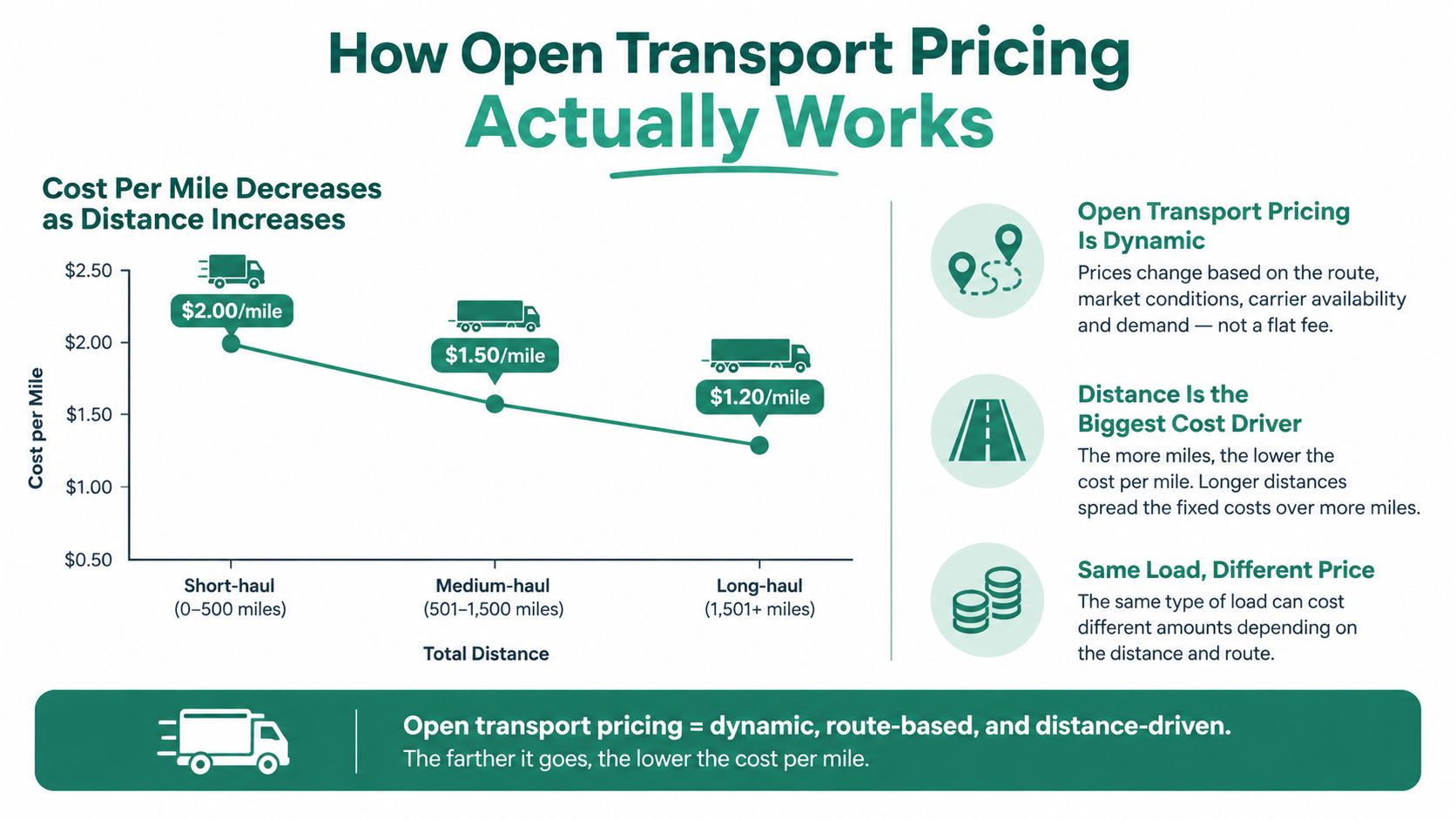
Typical Open Transport Cost per Mile by Distance
| Distance Band | Typical Cost per Mile | What It Means for Your Quote |
|---|---|---|
| 1 to 200 miles | About $2.50 to $2.75 | Short trips can look deceptively expensive per mile |
| 200 to 500 miles | About $1.90 to $2.00 | Mid-range hauls usually price more efficiently |
| 500 to 1,000 miles | About $1.40 to $1.55 | The lane starts rewarding distance |
| 1,000 to 1,500 miles | About $1.20 to $1.30 | Common interstate pricing territory |
| 2,000+ miles | About $0.45 to $0.60 | Best per-mile value usually shows up here |
Source: Forbes car shipping cost guide.
Service type changes the calculation. Open carriers average about $1.75 per mile, compared with roughly $2.65 per mile for enclosed service, a premium of about 51% for added protection. Enclosed transport is the wrong place to chase an open-carrier price. Choose it when the vehicle requires protection, then accept that the equipment and handling cost more.
For a route-level view of open pricing, review the National Car Transport open car transport page. It helps separate normal lane economics from a quote that is too low to attract a truck.
Smart Booking Tactics That Lower Your Open Transport Rate
The cheapest per-mile deals usually come from longer lanes with dense carrier supply. That's the first thing people miss. A cross-country move on a busy corridor can price better than a short, awkward run from a remote suburb because the carrier already has freight flowing through the lane and doesn't need to detour far to make money.
Book into a lane, not into a panic
If you book too early in a low-demand area, the market can't really help you. If you book too late, you invite premium pricing because carriers know you're out of time. The sweet spot is not about a magic calendar date, it's about giving the dispatcher enough time to match your car into an existing route without forcing an empty reposition.
Best move: stay flexible on pickup, especially with a multi-day window. That lets the broker or carrier slot your car into a truck that's already moving your direction.
Use geography instead of fighting it
A quote from a major city usually comes in cleaner than a quote from a rural pickup thirty minutes off a main corridor. If you can meet a driver closer to an interstate, a busy metro edge, or a common truck route, you give the carrier fewer dead miles. That's not theory, that's how open trailers get filled.
Vehicle readiness matters too. Operable, clean, and low fuel is the cheap setup. A messy, hard-to-inspect, or non-running car invites extra handling and extra friction. The more work the driver has to do, the less attractive your shipment looks to the lane.
Simple rule: if the car is easy to inspect and easy to load, the quote is easier to keep stable.
When you're comparing offers, compare at least three and keep a backup carrier in play. That gives you negotiating power without pretending every company can match every lane. National Car Transport is one option that fits this conversation because it works with open and enclosed moves, uses a vetted carrier network, and supports customers with bilingual agents based in the U.S. who can guide the booking in English or Spanish.
Choosing a Carrier Without Paying for Mistakes
The lower number isn't always the better company. Brokers and regional carriers price differently, and that difference matters. One industry guide says brokers can add about 10% to 25% to base rates, while regional carriers in low-demand areas may quote 20% to 30% below national brokers but with narrower coverage and less forgiving scheduling Cars.com car shipping money guide.
That doesn't mean the regional quote is automatically better. It may just mean the carrier has less cushion, fewer runs, or a tighter lane strategy. If the quote is materially below the lane average, the load often sits unassigned until the dispatcher asks for more money. That's the failure mode people hate most, because it turns a “cheap” booking into a delayed move with no real control.
What a dependable quote usually looks like
A good provider is boring in the right ways. Transparent flat-rate pricing, no upfront charge until a carrier is matched, a real carrier network, and someone who can explain what's included before you commit. That's especially important for people relocating on a deadline, buying online, or coordinating fleet moves where the shipment has to happen.
Here's how I'd filter competing offers:
- Match the lane average: If the quote is far below other open offers for the same distance, treat it as a dispatch risk.
- Check the payment trigger: No upfront charge until assignment is a better structure than paying before anyone accepts the load.
- Ask who handles rebooking: If the first carrier falls through, you want a process, not excuses.
- Listen for the details: A real advisor talks about timing, route density, and preparation, not just the lowest number.
A cheap quote is only cheap if it gets your car on a truck without a second round of negotiations.
Shipping to Puerto Rico on an Open Transport Budget
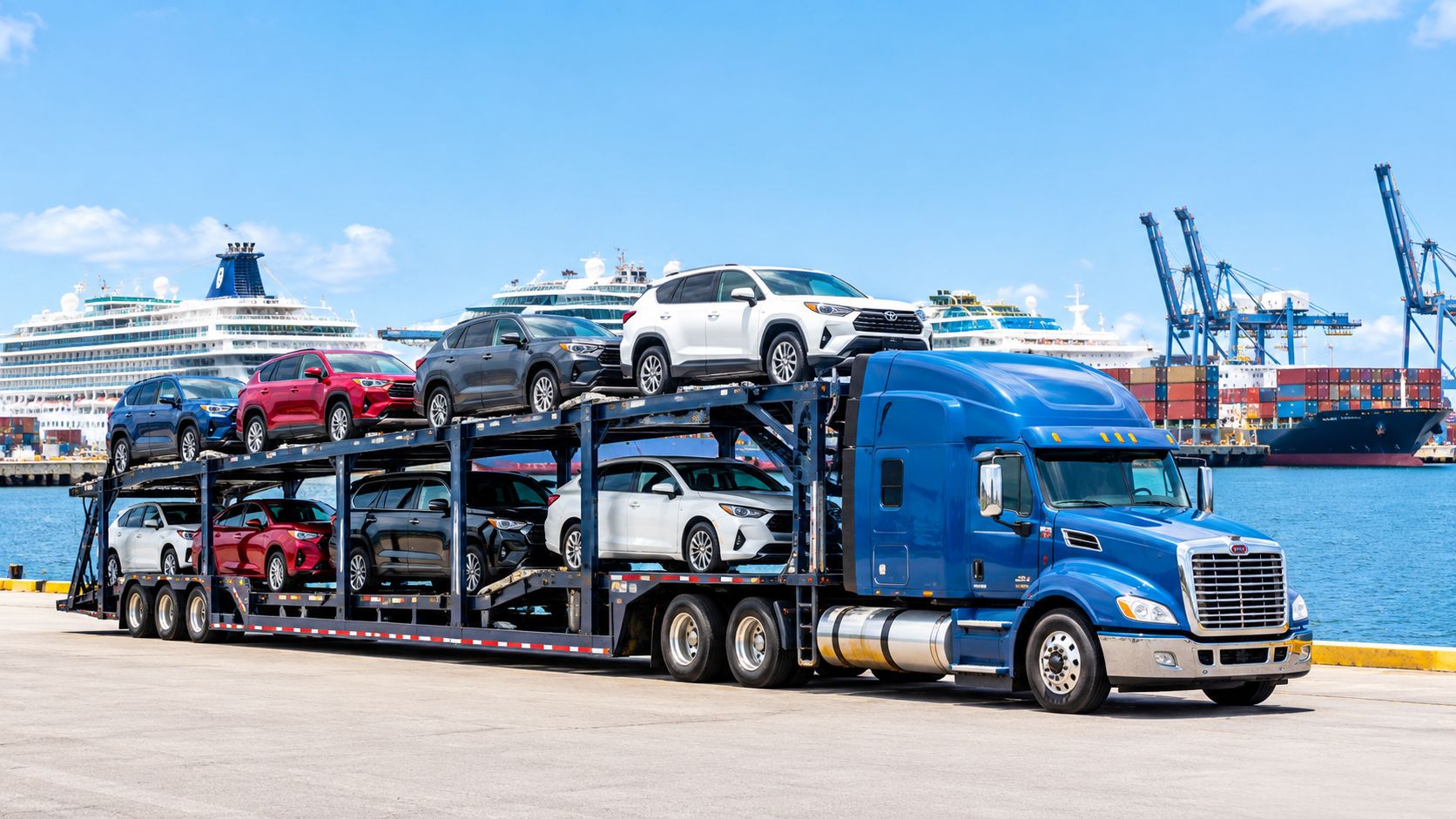
Puerto Rico changes the budget equation. The move combines mainland trucking with ocean freight, so the cheapest open-carrier rate applies only to the port leg. For mainland-origin shipments, common departure points include Jacksonville, Florida, and Pennsauken, New Jersey, before the vehicle travels by vessel to San Juan Puerto Rico car transport guide. On mainland-bound returns, Crowley states that vehicles leaving Puerto Rico do not require a U.S. Customs and Border Protection inspection when the destination is the mainland. CBP inspection applies when the vehicle is shipped to a foreign port Crowley Puerto Rico shipping guide.
The paperwork controls the schedule
Before export, shippers coordinate with ACAA, CESCO, and the Puerto Rico police stolen-vehicle branch. The vehicle must also be clean, have less than one-quarter tank of fuel, and display a legible VIN on the doors, hood, trunk, and dashboard USCG Puerto Rico checklist. Missing any of these requirements can stop the handoff even when the mainland pickup is ready.
Document expiration dates create another scheduling risk. The police pre-inspection certificate remains valid for five days, the ACAA no-debt certificate for thirty days, and the no-fines certificate from DTOP or Obras Públicas for three days. Pre-shipping inspection runs weekly on Mondays and Wednesdays, with the vehicle available at least 48 hours in advance Puerto Rico shipping requirements.
Book around those deadlines, not just around the lowest quote. A bilingual, U.S.-based agent can coordinate island paperwork with mainland pickup timing, reducing the chance that an expired certificate causes a missed sailing. Use National Car Transport's Puerto Rico car shipping information to compare route handling and pickup coordination without treating the mainland open-transport price as the full move cost.
Avoiding the Traps That Turn Cheap Quotes Into Expensive Moves
A low open-transport quote is only cheap if the carrier can dispatch it at that price. Delivery charges, terminal handling, insurance add-ons, and other soft costs can raise the final bill after the quote has won your business. Compare the complete move, not the first number on the screen.
The same problem appears with underpriced bids. If a quote sits far below the going rate for the lane, the carrier may never secure a driver. You then rebook under time pressure, often paying more for the same route. On Puerto Rico moves, compare the full route budget separately from a domestic lane. Port, inland, and scheduling costs can change which quote offers the lower total.
Run this check before you book
- Normalize the quote per mile: Divide the total transport charge by route distance before comparing lanes or providers.
- Check the lane average: A bid far below comparable quotes deserves questions, not an immediate deposit.
- Confirm the payment trigger: Find out whether payment is due when a carrier is assigned, at pickup, or later.
- Ask about add-ons: Get delivery charges, terminal handling, insurance extras, and rebooking terms in writing.
- Verify your flexibility window: A narrow pickup window can raise the rate and make dispatch harder.
Open transport is the cheapest mainstream option for a reason, but the lowest advertised number is not always the lowest completed cost. Book the quote that can be explained, dispatched, and completed without surprise charges.
If you are comparing a domestic move or a Puerto Rico route, normalize each quote per mile, confirm the payment trigger, and ask who handles rebooking before you commit.
National Car Transport handles open and enclosed shipping across the U.S. and Puerto Rico. Visit National Car Transport to compare your route before booking.