
The cheapest sticker rarely equals the cheapest car to own. In today's market, a “cheap” vehicle often means a 7-year-old car with about 73,000 miles, not the nearly new bargain many buyers still expect.
That changes how you should shop. A low asking price can disappear quickly after tires, brakes, suspension work, air-conditioning repairs, title problems, transport, registration, and deferred maintenance enter the picture. I've watched buyers save on the purchase and lose the savings before the first service appointment.
A good deal is not the cheapest vehicle you can locate. It's the vehicle with the lowest three-year ownership risk after purchase, inspection, paperwork, and delivery.
Table of Contents
- Why Cheap Used Car Deals Are Harder to Find in 2026
- Where to Source Real Bargains
- What Your Budget Actually Buys Today
- Negotiation Tactics That Move the Number
- Inspect Before You Commit
- Getting the Car Home, Mainland or Puerto Rico
- Putting It All Together
Why Cheap Used Car Deals Are Harder to Find in 2026
The old bargain formula was simple. Find a lightly used three-year-old car, negotiate hard, and drive away with modern reliability at a steep discount. That formula has weakened.
The average three-year-old used car rose from $23,624 in 2019 to $32,651 in 2026, an increase of $9,027, or 38.2%, according to iSeeCars' analysis of used-car affordability. The same analysis found that only 11.4% of three-year-old vehicles were priced below $20,000 in 2026, compared with a much larger share in 2019.
The lower end has also moved older. CNBC's market reporting found that a $15,000 to $20,000 budget bought about a seven-year-old car with 73,000 miles in Q1 2025, compared with a four-year-old vehicle with 47,000 miles in Q1 2020. The share of used sales below $20,000 fell from 64% to 43% over that period, as documented in CNBC's used-car affordability report.
The practical shift: Cheap used car deals now require a condition and repair-risk test, not just a price search.
Edmunds reported an average transaction price of $32,461 for a three-year-old used vehicle in Q2 2026, up 4% year over year and 15.5% from Q2 2021. Vehicles sold for under $15,000 represented only 17.8% of used sales, while vehicles priced at $50,000 and above reached 8.3%, according to Edmunds' Q2 2026 used-car report.
| What “Cheap” Means | 2019 Market | 2026 Market |
|---|---|---|
| Three-year-old vehicle | More sub-$20,000 availability | Average price of $32,651 |
| Five-year-old vehicle | 69.2% below $20,000 | 26.6% below $20,000 |
| $15,000 to $20,000 budget | Younger, lower-mileage inventory | About seven years old and 73,000 miles |
The number that matters is not the listing price. It's the expected cost of keeping the car safe and dependable. A $7,500 vehicle with neglected suspension, worn tires, and an uncertain service history can be a worse purchase than a more expensive car with documented maintenance.
Where to Source Real Bargains
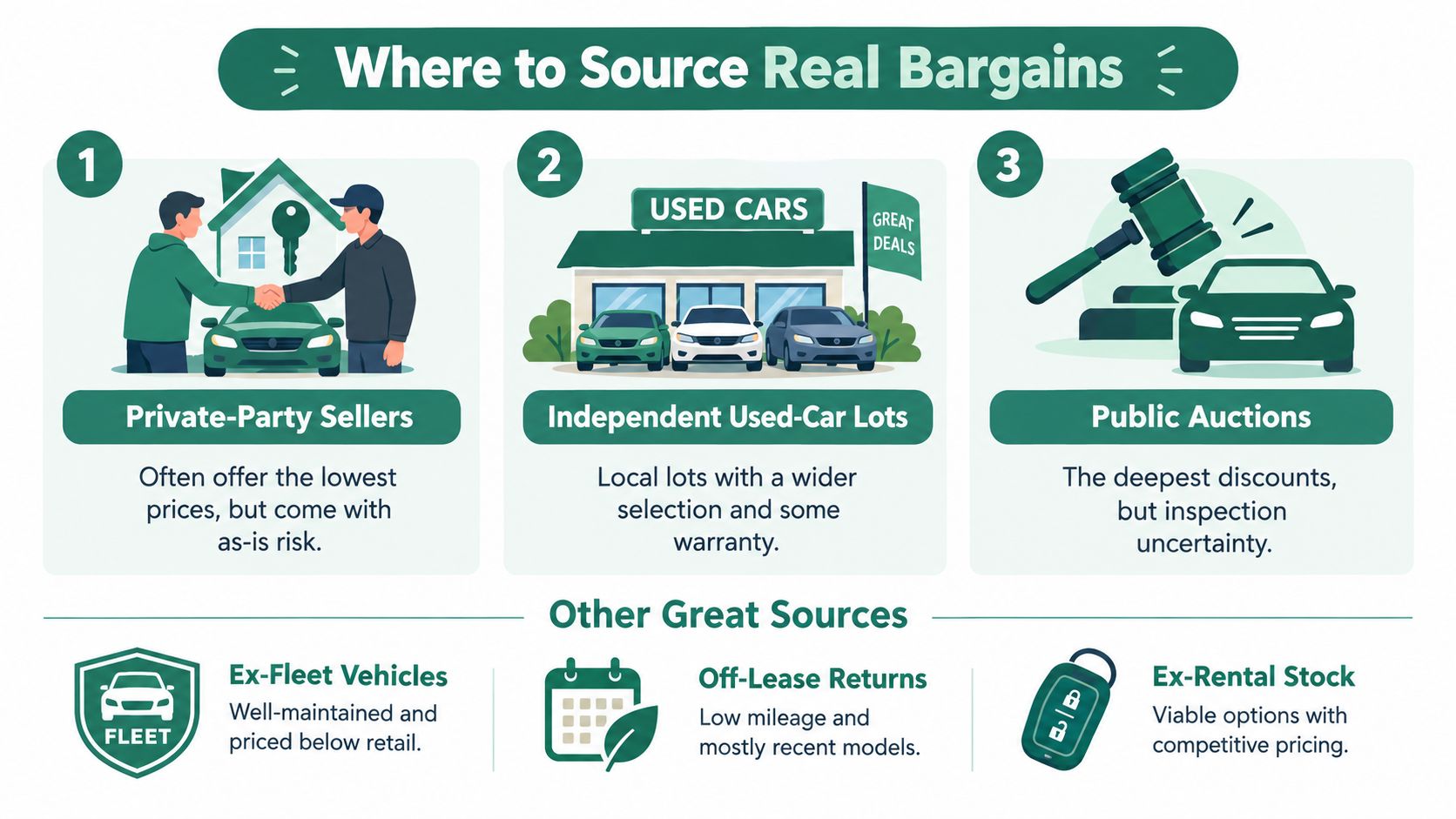
Start in three places at the same time: private-party listings, independent dealers, and auctions. Each channel produces a different kind of bargain, and each transfers a different amount of risk to you.
Private sellers often provide the cleanest path to a lower purchase price because there's no dealership markup or sales process layered onto the transaction. You'll usually get more direct answers about how the vehicle was driven and maintained, but you'll also carry the inspection burden. Never treat a private seller's confidence as a mechanical inspection.
Independent used-car lots offer broader selection and may provide some paperwork support or limited warranty coverage. That convenience has value, but it doesn't make the vehicle automatically sound. Ask for the out-the-door price in writing before visiting, including vehicle price, documentation charges, taxes, registration, and every add-on.
The Edmunds used-car buying guide recommends comparing private-party listings with dealer inventory, sorting by price, mileage, and distance, and using written out-the-door prices for a true comparison. It also notes that private-party vehicles can sell for several hundred to a couple thousand dollars below dealer pricing, depending on the vehicle and market.
Match the channel to your experience
Public auctions can expose you to damaged, incomplete, or poorly documented vehicles. Copart, IAA, and dealer-only auction lanes may work for buyers who understand title brands, repair estimates, transport logistics, and resale limitations. They're a poor choice for someone who needs dependable transportation immediately and can't inspect before bidding.
The secondary tier deserves attention:
- Ex-fleet vehicles: These can have consistent service records, but inspect for heavy use and cosmetic wear.
- Off-lease returns: Maintenance documentation can be stronger than on an anonymous private listing, though condition still varies.
- Dealer trade-ins: Dealers may price these aggressively when they don't fit their retail inventory, but “as-is” often means you must perform the due diligence.
For dealerships, auction buyers, and online vehicle purchases, dealer vehicle transport services can become part of the sourcing decision. A cheap car that sits across the country is not cheap until you know the delivery cost and timing.
My preferred method is straightforward. Search private listings for specific models, cross-check those vehicles against dealer inventory, and use auctions only when you can inspect the car or have a qualified person do it. The cheapest source is not automatically the best source. The best source is the one that gives you enough information to price the risk.
What Your Budget Actually Buys Today
A bargain budget should buy a repair profile, not just a vehicle. Start with the amount you can spend after taxes, registration, inspection, transport, and immediate maintenance. If the entire budget goes to the seller, you haven't created a transportation plan. You've created a breakdown fund.
The market data gives a useful reality check. In Q1 2025, the $15,000 to $20,000 range generally reached a vehicle about seven years old with approximately 73,000 miles. That is materially different from the younger, lower-mileage car the same budget could reach earlier in the market cycle.
At the lower end, age and mileage create more variation between individual cars. One older sedan may have complete service records and a careful owner. Another may have an attractive exterior, a weak transmission, mismatched tires, accident repairs, and no meaningful maintenance history. The badge matters less than the evidence.
Use a total-cost worksheet
Write down these categories before you make an offer:
- Purchase price
- Sales tax and registration
- Inspection and history report
- Immediate tires, brakes, fluids, or service
- Insurance
- Expected repairs
- Depreciation
- Mainland or Puerto Rico transport
Do not assign a repair number just to make the spreadsheet look complete. For an older vehicle, the responsible estimate is the cost identified by an independent inspection plus a reserve for unresolved risk. A seller who refuses inspection has already supplied useful information.
| Budget Tier | Typical Vehicle | Purchase Price | Three-Year Maintenance | Three-Year Insurance + Registration | Effective Three-Year Cost |
|---|---|---|---|---|---|
| Under $15,000 | Older, higher-mileage inventory | Under $15,000 | Vehicle-specific, inspection required | Vehicle- and location-specific | Purchase, transport, ownership, and repair costs combined |
| $15,000 to $20,000 | About seven years old and 73,000 miles in the cited market example | $15,000 to $20,000 | Estimate from service records and inspection | Vehicle- and location-specific | Purchase price plus documented ownership costs |
| Above $20,000 | Newer or lower-risk inventory may be available | Above $20,000 | Usually easier to assess, not automatically low | Vehicle- and location-specific | Compare added purchase cost with reduced repair uncertainty |
Before committing to a distant vehicle, use a written car-shipping cost guide to include transport in the same worksheet. A $1,000 purchase discount is meaningless if shipping, immediate repairs, and paperwork consume it.
My rule: Pay more for evidence, not for promises. A documented service history and clean inspection can justify a higher price. A shiny exterior cannot.
Negotiation Tactics That Move the Number
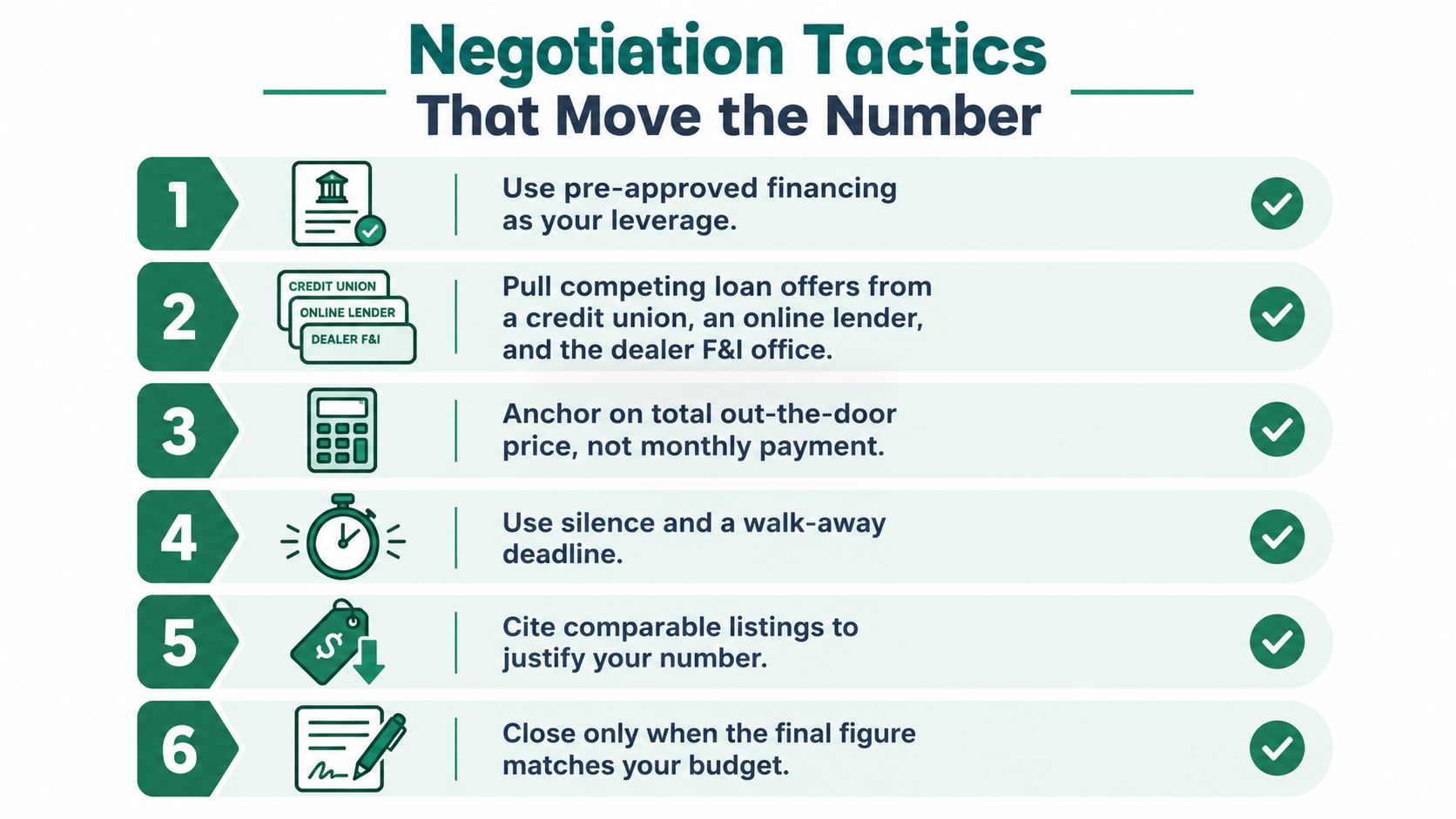
The strongest negotiation begins before you contact the seller. Get financing approved independently, establish your maximum total spend, and compare the target vehicle with similar listings. A buyer who knows the market can negotiate. A buyer who only knows the monthly payment can be redirected.
Use the seller's out-the-door number as the negotiating target. Monthly payments hide term length, interest, add-ons, and fees. Ask for the vehicle price, documentation fee, taxes, registration, dealer products, and any other charge in writing.
The valuation guidance in the Edmunds used-car buying steps supports using current market value, trade-in benchmarks, and a disciplined opening offer. It also notes that a buyer can start roughly 10% to 15% below asking, depending on condition and the strength of the listing.
The negotiation sequence
- Get pre-approved: Bring a firm financing ceiling. A pre-approved loan keeps the conversation focused on the vehicle rather than the dealer's preferred payment structure.
- Compare the market: Save comparable listings with similar age, mileage, trim, title status, and location.
- Make a clean offer: State your price and conditions clearly. For example: “I can complete the purchase at this out-the-door figure if the inspection confirms the listing condition.”
- Require written figures: Do not rely on a verbal promise that fees will be removed later.
- Use defects correctly: A worn tire, warning light, leak, or overdue service is not a vague reason to negotiate. It's a documented cost.
- Be willing to leave: A seller who won't provide basic records or a pre-purchase inspection is not offering a bargain.
Use valuation tools that reflect current listings and transactions. The cited Edmunds guidance notes that Kelley Blue Book updates pricing guidance weekly using dealership transactions, auction sales, and online listings across more than 100 U.S. regions.
Never negotiate only against the sticker. Negotiate against the complete cost of owning and moving the vehicle. If the seller's price is fair but the car needs immediate work, the offer must reflect that work. If the seller won't adjust, your answer is not an argument. It's a different vehicle.
Inspect Before You Commit
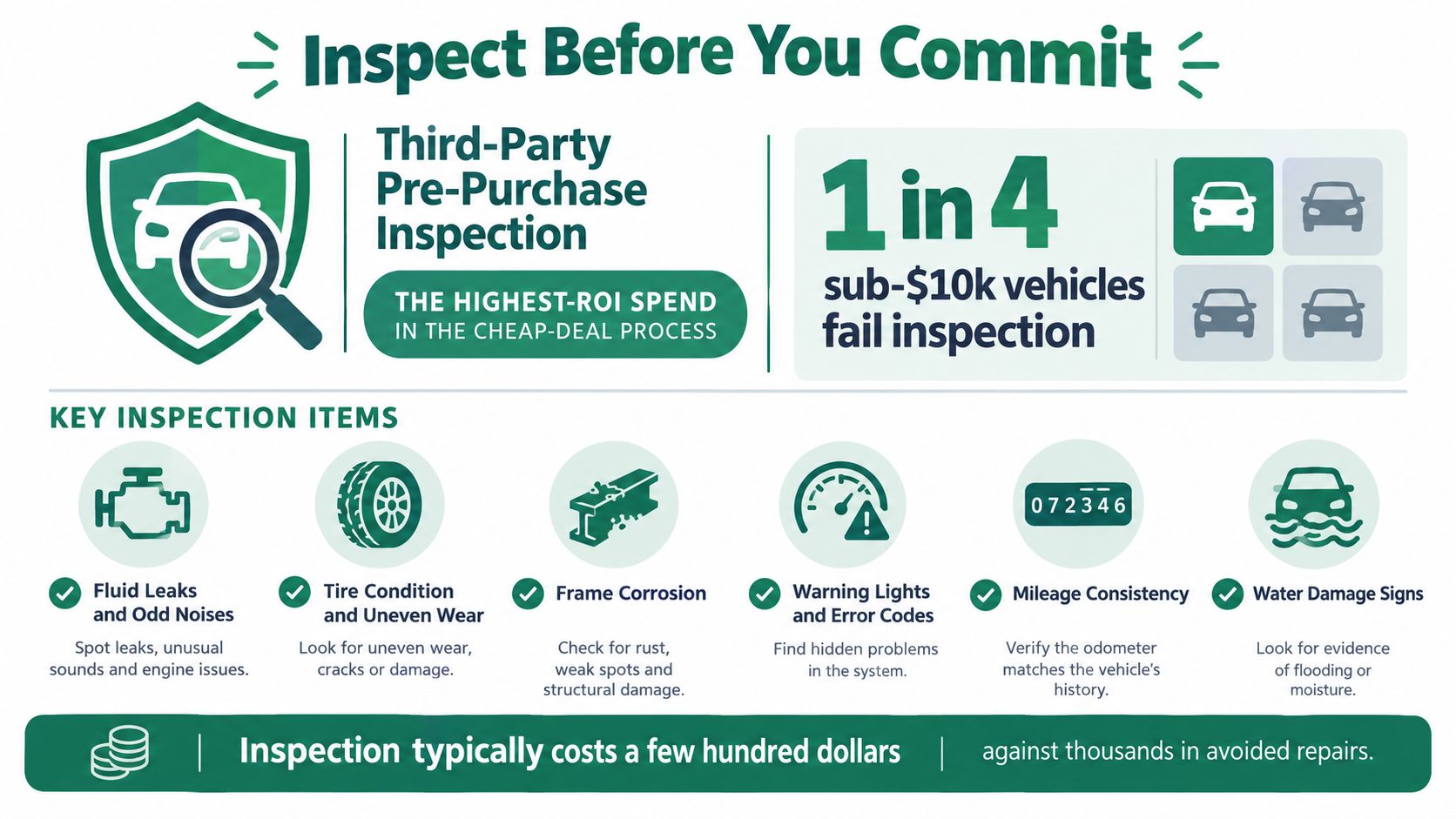
The independent inspection is the best protection in the cheap-car market. Sellers can misunderstand a vehicle's condition, minimize warning signs, or fail to notice problems. A third-party mechanic has no reason to protect the sale.
Inspection data reported by Cars24 found issues involving 45% of inspected used cars for tires, 30% for suspension, 25% for engine problems, 25% for air-conditioning problems, 15% for brakes, 20% for odometer tampering, and 25% for accident history, as detailed in its used-car inspection guide. Those findings don't mean every low-priced vehicle is defective. They do mean a low sticker price deserves technical verification.
What the inspection must cover
Ask the mechanic to document findings, not just say the car “looks good.”
- Road behavior: Test transmission shifts, braking feel, steering pull, vibration, and unusual noises.
- Computer scan: Check stored and pending diagnostic codes, not only whether the dashboard is clear during the visit.
- Underbody condition: Look for rust, leaks, bent components, fresh undercoating, and collision repairs.
- Engine and fluids: Check fluid levels, contamination, leaks, smoke, and cold-start behavior.
- Tires and brakes: Inspect tread wear, uneven wear, tire age, rotor condition, and remaining brake material.
- History consistency: Match the VIN, mileage, title, service records, and accident disclosures.
A short visual inspection is not enough. Undercarriage damage, corrosion, leaks, and suspension wear can remain hidden without proper access to the underside of the vehicle.
Decision rule: If the inspection uncovers a repair that changes the economics, pause the purchase. Get a written estimate and require a price adjustment that reflects the real work, or walk away.
The inspection report also gives you the cleanest negotiating evidence. “I think this car needs work” is weak. “The mechanic documented a leaking component and uneven tire wear” is specific, verifiable, and tied to a cost.
Getting the Car Home, Mainland or Puerto Rico
Transport belongs in the bargain calculation before you send money. For domestic moves across the lower 48, open transport is normally the practical choice for ordinary daily drivers. Enclosed transport makes more sense for a valuable classic, exotic, low-clearance vehicle, or a car that needs additional protection from exposure.
The lower 48 market includes routes between major cities such as New York City, Boston, Philadelphia, Washington, D.C., Atlanta, Miami, Orlando, Jacksonville, Charlotte, Nashville, Chicago, Detroit, Cleveland, Dallas, Houston, New Orleans, Denver, Phoenix, Las Vegas, Los Angeles, San Diego, San Francisco, Seattle, Portland, Salt Lake City, Minneapolis, Kansas City, St. Louis, and Albuquerque. The same logistics principles apply whether the car is moving between those cities or from a smaller surrounding community.
Before shipping, confirm the title and registration requirements in the destination state. A practical resource on out of state title transfer can help buyers identify paperwork questions before the vehicle arrives.
Puerto Rico requires a different plan
Puerto Rico shipping commonly uses two legs. A truck carries the vehicle from its mainland origin to a port such as Jacksonville, Miami, Savannah, Houston, or New York. An ocean shipment then carries it to the Port of San Juan. The Puerto Rico route guidance identifies Jacksonville as handling the largest share of Puerto Rico vehicle traffic and explains why port-to-port service is usually more economical than door-to-port service, since the customer delivers the vehicle to the mainland port.
Published route examples show how much origin changes the schedule and price:
| Route or Mode | Typical Cost | Transit Window | Best For |
|---|---|---|---|
| Orlando to San Juan | $1,649 | 8 to 9 days | Buyers near central Florida |
| Miami to San Juan | $1,879 | 9 to 11 days | South Florida vehicles |
| New York to San Juan | $2,309 | 10 to 12 days | Northeast inventory |
| Los Angeles to San Juan | $2,609 | 13 to 15 days | West Coast purchases |
These route examples come from published Puerto Rico shipping estimates. Treat them as planning references, not guaranteed quotes. Vehicle size, pickup location, port handling, documentation, sailing schedules, and delivery arrangements affect the final result.
For interstate transport brokers, the FMCSA requires registration through the Unified Registration System and financial responsibility in the form of a $75,000 surety bond or trust fund, as described in the applicable auto-transport compliance information. Ask any broker who will handle your shipment to explain who is contracting with the carrier and how the vehicle will be inspected at pickup.
A reliable Puerto Rico car shipping service should give you a written shipment plan, clear port instructions, realistic timing, and a checklist for preparation. Remove personal items, disable toll tags, leave only the required fuel level, photograph existing damage, and keep copies of the title and shipping documents.
Putting It All Together
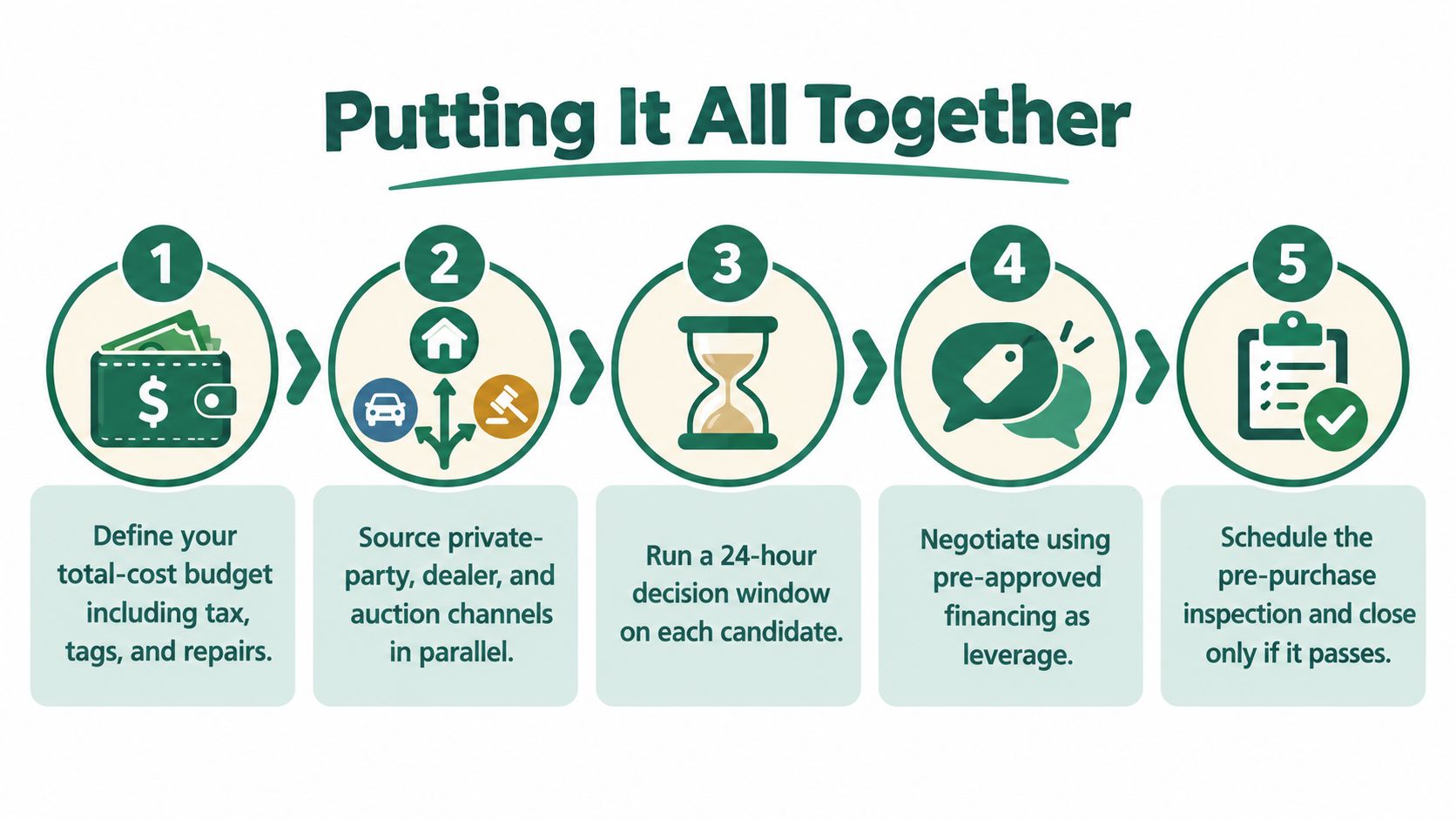
The right process is sequential, even though the research happens in parallel. First, define the total amount you can spend on the vehicle, immediate repairs, insurance, registration, inspection, and delivery. Then search private sellers, independent dealers, and auction inventory without becoming emotionally attached to one listing.
Give every candidate the same test:
- Confirm the paperwork: Match the VIN, title status, seller identity, mileage, and service records.
- Price the complete deal: Include taxes, fees, repairs, transport, and registration.
- Check comparable vehicles: Compare similar age, mileage, trim, condition, and location.
- Negotiate in writing: Use a firm out-the-door figure and pre-approved financing.
- Inspect independently: Do not release final payment until the inspection supports the deal.
- Book delivery deliberately: Choose open or enclosed transport for the mainland, or plan the port and ocean leg for Puerto Rico.
A human advisor earns the fee at the points where documents and practical condition diverge. That means reading the vehicle history alongside the mechanic's findings, spotting title-branding or flood-damage concerns, and selecting transport that fits the car's value and destination. Snowbirds, military families, students, dealerships, and businesses also need the schedule coordinated around move dates, port appointments, and delivery access.
Use this message when contacting a seller:
“I'm interested, subject to a clean title review, an independent inspection, and a written out-the-door price. Please send the VIN, service records, title status, and your complete price before I arrange payment or transport.”
Use this message with a mechanic:
“Please inspect the vehicle for accident repair, rust, leaks, tires, brakes, suspension, engine and transmission condition, diagnostic codes, air conditioning performance, and mileage consistency. I need written findings and repair priorities.”
For mainland delivery, confirm pickup access, destination access, vehicle condition, and the carrier's inspection process. For Puerto Rico, confirm the mainland port, San Juan delivery arrangement, required documents, and the expected sailing window before buying the vehicle.
National Car Transport helps buyers, snowbirds, military families, students, dealerships, and businesses move vehicles across the lower 48 and between the U.S. mainland and Puerto Rico, with 25+ years of experience, an A+ BBB rating, transparent flat-rate pricing, and a network of 25,000+ vetted carriers. Their bilingual English and Spanish agents are based in the USA and have more than 20 years of experience in auto-transport logistics, so visit National Car Transport for guidance on the right shipping plan for your vehicle.