

Most U.S. mainland car transport truck prices fall in the $600-$1,400 range for typical sedans on open carriers over 500-1,500 miles. The price is shaped less by distance alone than by lane density, vehicle size, transport type, and seasonality.
You may be relocating from New York to Florida, sending a vehicle from Los Angeles to Texas, moving between Chicago and Atlanta, or arranging a shipment to San Juan. The quote on your screen can look surprisingly high for a short route or unexpectedly reasonable for a long one. That isn't necessarily inconsistent pricing. It usually reflects how easily a carrier can fill its deck, how far it must travel empty, and how difficult your vehicle and addresses are to service.
For mainland transport, customers commonly request pickup or delivery near major cities such as Birmingham, Montgomery, Anchorage is outside the contiguous network, Phoenix, Little Rock, Los Angeles, Denver, Hartford, Wilmington, Washington, D.C., Jacksonville, Miami, Atlanta, Honolulu is outside the contiguous network, Boise, Chicago, Indianapolis, Des Moines, Wichita, Louisville, New Orleans, Portland, Baltimore, Boston, Detroit, Minneapolis, Jackson, Kansas City, Helena, Omaha, Las Vegas, Manchester, Newark, Albuquerque, New York City, Charlotte, Fargo, Columbus, Oklahoma City, Portland, Philadelphia, Providence, Columbia, Pierre, Nashville, Austin, Salt Lake City, Montpelier, Richmond, Seattle, Charleston, Madison, and Cheyenne. Customers also arrange mainland pickup from these corridors for onward transport to San Juan, Puerto Rico.
The honest way to evaluate a car transport truck price is to separate the bundled service from the variables you can influence. The carrier has fixed expenses that won't disappear because your route is short. You can still lower the quote by providing accurate vehicle details, choosing practical equipment, accepting a flexible pickup window, and avoiding unnecessary accessorial services.
Table of Contents
- What a Car Transport Truck Price Actually Includes
- The Operating Cost Stack Behind Every Quote
- Open vs Enclosed Transport and How Each Is Priced
- How to Request an Accurate Quote Step by Step
- Why Lane Density and Distance Pull Prices Apart
- Shipping to and From Puerto Rico at a Glance
- Smart Ways to Lower Your Price and Avoid Surprises
What a Car Transport Truck Price Actually Includes
A car transport truck price is a bundled transportation service, not a simple mileage calculation. The bundle generally covers arranging a carrier, assigning the vehicle to a route, coordinating pickup and delivery, completing condition documentation, and moving the car between serviceable locations.
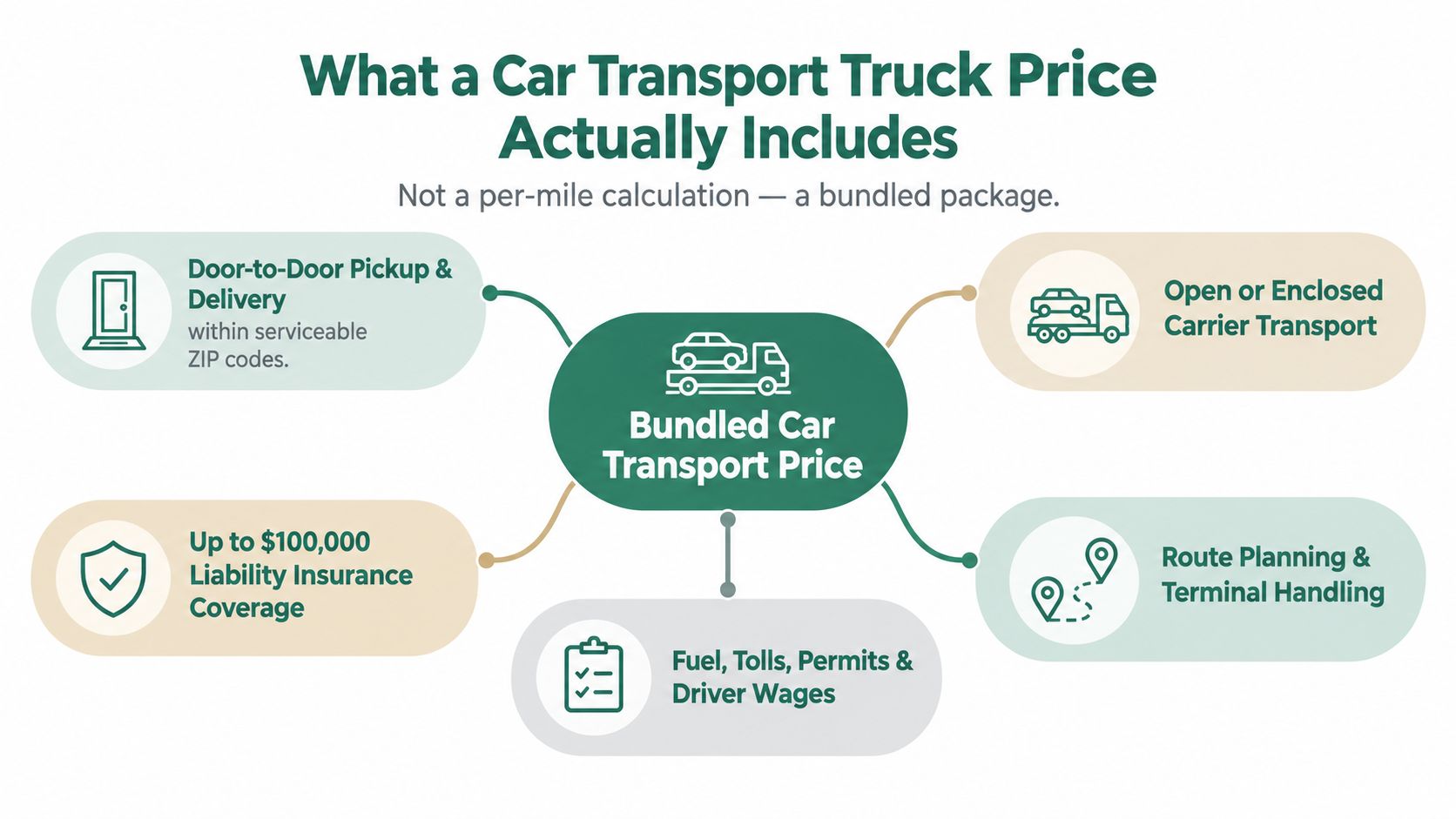
What normally belongs in the quote
Door-to-door service usually means the driver comes as close as legally and practically possible to the requested addresses. A large carrier may not be able to enter a narrow residential street, gated community, low-clearance garage, or congested downtown block. In that situation, the driver and customer choose a nearby safe meeting point.
The carrier also completes a bill of lading inspection at pickup and delivery. This document records the vehicle's condition, existing marks, mileage details where applicable, and delivery observations. Read it carefully before signing, because it is the main record used to compare the vehicle's condition at both ends.
Dispatch and scheduling labor are part of the service too. Someone has to match your vehicle to available equipment, communicate with the driver, track timing, manage address restrictions, and resolve changes caused by weather, traffic, or loading delays. A quote that appears to cover only truck movement still depends on this coordination.
The U.S. Bureau of Labor Statistics historical truck transportation index provides useful context. Its 1990 base was 100.0, rising to 123.0 in 1995, then declining to 117.3 in 1996 before reaching 119.4 in 1997. The corresponding general-freight-trucking index followed a similar pattern, moving from 100.0 in 1990 to 123.6 in 1995 and 119.3 in 1997. These changes show why a quoted rate isn't a permanent tariff. The historical FHWA table reproduces the relevant truck transportation price series.
What may be conditional
Some services sit outside the basic open-carrier quote:
- Enclosed equipment: A covered trailer for classics, collectibles, and high-value vehicles.
- Top-load positioning: A preferred deck position when available.
- Guaranteed pickup timing: A tighter scheduling commitment than a normal pickup window.
- Vehicle condition services: Winching, forklift loading, or other handling for an inoperable car.
- Difficult access: A rural, restricted, or unsuitable address that requires a terminal or alternate meeting point.
- Special dimensions: Lifted trucks, oversized SUVs, low-clearance cars, or unusual modifications that consume more deck space.
Ask whether the quoted figure is the complete transport price, which items are conditional, and what could change after dispatch. A transparent quote should explain the equipment, route, pickup expectations, delivery conditions, payment terms, and inspection process in plain language.
The Operating Cost Stack Behind Every Quote
A carrier doesn't price your shipment from loaded miles alone. The truck must reach your vehicle, load it safely, operate under commercial regulations, and often find the next shipment after delivery. Those costs remain relevant even when the vehicle itself travels on a straightforward route.
The 2024 American Transportation Research Institute benchmark reported average trucking operating cost of approximately $2.260 per mile, with non-fuel marginal cost at $1.779 per mile. A 1,000-mile movement at the total operating benchmark implies roughly $2,260 in direct truck-operation expense before brokerage margin, deadhead, tolls, storage, special handling, and profit. The benchmark and its operating-cost discussion are summarized here.
Five cost layers customers should understand
| Cost Layer | What It Covers | Typical Share of Price |
|---|---|---|
| Linehaul | Loaded movement between origin and destination | Core portion |
| Deadhead | Empty positioning miles before pickup or after delivery | Small to substantial, depending on lane |
| Fuel and tolls | Fuel consumption, fuel adjustments, and route tolls | Variable |
| Loading and handling | Inspection, ramps, winching, securing, and delivery coordination | Conditional |
| Carrier overhead | Driver pay, insurance, equipment, maintenance, permits, and compliance | Persistent operating cost |
Linehaul is the visible part of the move, but it isn't the whole economics. Dense corridors can support several loaded vehicles heading in similar directions. A sparse route may require the carrier to price the trip around the entire movement, including miles with no vehicle on the deck.
Deadhead is the hidden lever customers notice only when a quote seems high. If a driver must leave a major freight corridor to collect one car, the carrier needs to recover that time, fuel, and lost loading capacity. A rural pickup or delivery can therefore cost more than a longer urban-to-urban move.
Fuel and tolls add another moving part. The Federal Reserve Bank of St. Louis, using Bureau of Labor Statistics data, shows the truck transportation freight index at 100.0 in June 2009, 125.3 in August 2019, 151.361 in August 2024, and 152.531 in July 2025. The index increased approximately 52.5% from June 2009 to July 2025, while also moving up and down during shorter periods. Review the underlying FRED series for truck transportation freight pricing.
Don't treat a fuel surcharge as the entire fuel cost or assume it covers every operating expense. Driver compensation, equipment ownership, insurance, tires, repairs, permits, and dispatch remain part of the carrier's required revenue. If you're comparing equipment options, a resource such as find your perfect equipment trailer can also help explain how trailer configuration affects usable capacity.
For a broader pricing framework, review car shipping cost factors and quote guidance, then ask whether your quote accounts for loaded miles only or includes repositioning and accessorial work.
Open vs Enclosed Transport and How Each Is Priced
Open transport is the practical default for most everyday cars. The vehicle travels on an exposed multi-car carrier, where the carrier can combine several shipments and spread its operating costs across the load. That higher deck utilization generally makes open shipping the baseline price.
Enclosed transport places the vehicle inside a covered trailer. It limits exposure to weather, road debris, and public visibility, making it more appropriate for classic cars, restored vehicles, exotics, collector vehicles, and especially valuable SUVs. The protection is useful, but the equipment usually has less available capacity and may operate on fewer lanes.
Choose equipment by risk, not by habit
| Feature | Open Carrier | Enclosed Carrier |
|---|---|---|
| Price position | Standard baseline | Higher than open service |
| Protection | Exposed to normal road and weather conditions | Covered protection from weather and debris |
| Capacity economics | More vehicles can usually share the load | Fewer vehicles fit, increasing cost per vehicle |
| Best fit | Daily drivers, family cars, dealer inventory, standard SUVs | Classics, exotics, restored vehicles, and high-value cars |
| Availability | Broad network across common domestic lanes | More specialized and lane-dependent |
Vehicle dimensions matter in both options. Federal guidance commonly places commercial vehicle height limits between 13 feet 6 inches and 14 feet, while federal size rules allow combinations up to 81.5 feet in cargo-carrying length under specified trailer conditions. A carrier must also manage axle weight, ramp angles, deck length, and clearance. The FHWA size and weight guidance explains these physical operating limits.
That is why a lifted pickup, oversized SUV, or inoperable sedan can't be priced as though it occupies the same space as a standard operable car. An enclosed trailer may also be unavailable on a less-traveled route, creating a longer wait or a higher quote because the carrier must reposition specialized equipment.
Open service remains the sensible choice when your vehicle is a normal daily driver and ordinary transport exposure is acceptable. Use open car transport service when price, availability, and broad route coverage matter more than enclosed protection.
How to Request an Accurate Quote Step by Step
A vague quote usually begins with vague shipment information. Give the broker or carrier enough detail to price the actual move, not an idealized version of it.
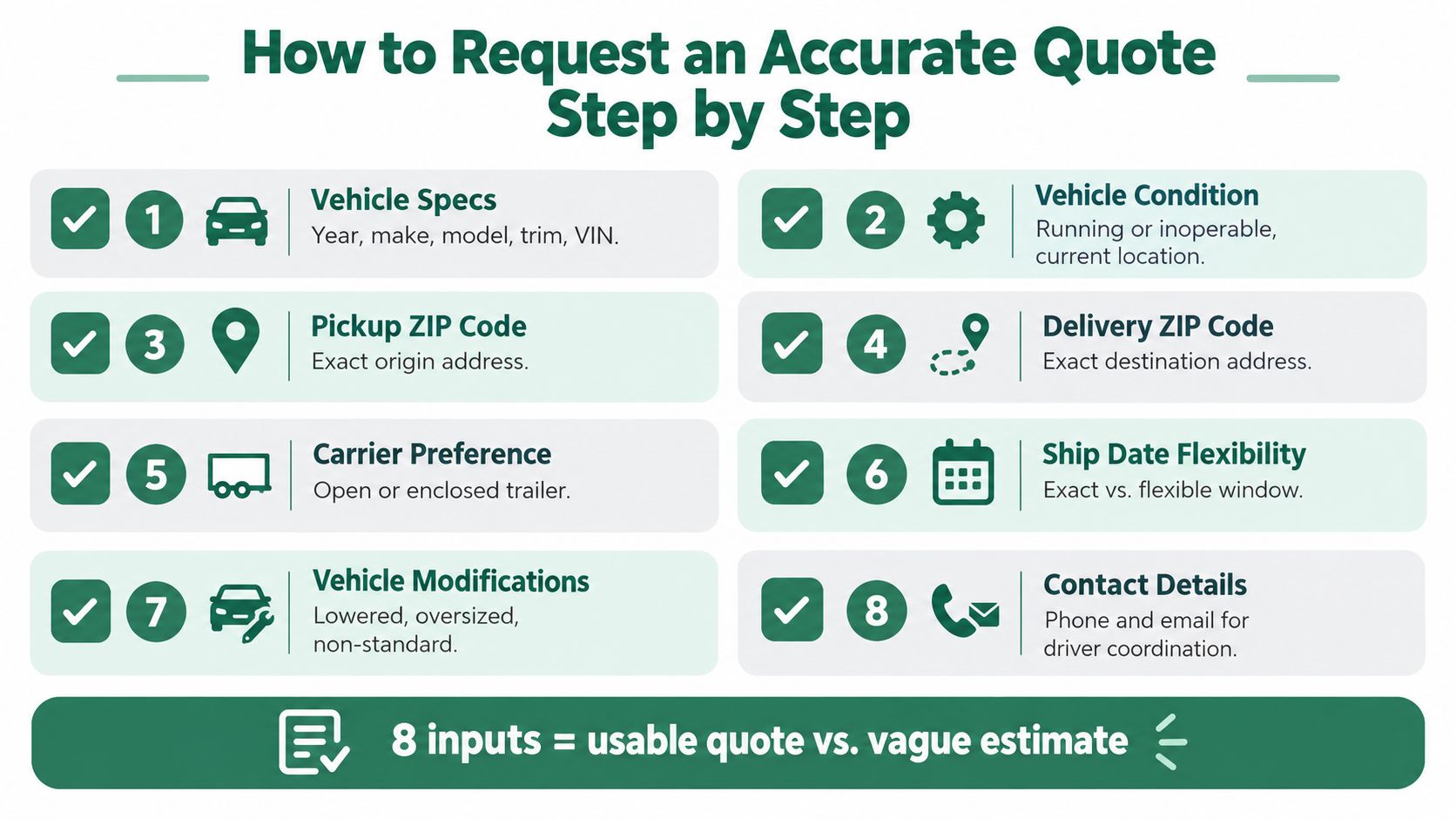
Eight inputs that make a quote usable
- Vehicle identity: Provide the year, make, model, trim, and VIN when available. A base sedan and a long-wheelbase SUV may look similar in a short inquiry but occupy different deck space.
- Running condition: State whether the vehicle starts, rolls, steers, and brakes. An inoperable vehicle may require a winch, forklift, or special loading position.
- Pickup ZIP code: Give the exact origin ZIP and disclose whether the address is residential, commercial, gated, rural, or restricted.
- Delivery ZIP code: Use the actual destination rather than a nearby city name. The final approach can change the route and the safe delivery point.
- Equipment choice: Decide whether you need open or enclosed service. Don't request a low open-carrier price and assume enclosed protection is included.
- Pickup flexibility: Offer a range of acceptable dates whenever possible. Flexibility helps the dispatcher match your car to an existing route.
- Modifications: Mention lowered suspension, lifted components, oversized tires, roof equipment, non-running condition, or unusual ground clearance.
- Contact details: Give the driver usable phone numbers and an email address. Pickup and delivery coordination fails quickly when the driver can't reach the customer.
Put the commercial terms in writing
Ask for the expected dispatch window, the amount due before or at dispatch, cancellation terms, and the conditions that could change the price. Confirm whether the quote is flat-rate, whether the deposit is refundable under stated conditions, and whether a residential address may require an alternate meeting location.
A commercial address or a nearby major-road meeting point can simplify loading, but don't list an address where the customer can't legally or safely meet the driver. Accuracy protects both sides. It reduces re-dispatch risk, rejected loads, surprise handling requirements, and arguments at delivery.
The bill of lading should match the vehicle and the agreed transport conditions. Take your own timestamped photos at pickup and compare them with the delivery inspection before accepting the vehicle.
Why Lane Density and Distance Pull Prices Apart
A customer moving a car 300 miles may receive a higher per-mile quote than someone shipping one across the country. The reason is usually lane density, not a mileage error. A lane includes the origin, destination, and nearby corridors where carriers can find additional vehicles. When loads move in both directions, the truck stays productive. When demand runs one way, the carrier builds the empty return into your price.
Recent industry reporting found that 100-499-mile moves averaged about $2.04 per mile, while shipments of 2,500 miles or more averaged roughly $0.55 per mile. Those figures reflect consolidation, backhaul opportunities, and carrier-network density. They do not mean that every long shipment is cheaper overall. The industry discussion of lane economics and car-shipping rates is available from CCJ Digital.
Why short routes can cost more per mile
A short regional move still requires appointment coordination, dispatching, loading, inspection, and equipment time. The carrier has fewer miles over which to recover those fixed costs. A longer shipment may fit a truck already traveling that corridor, with several vehicles sharing the same route and reducing the cost assigned to each car.
The route itself changes the quote. Atlanta to Dallas, Los Angeles to Phoenix, and New York to Florida typically offer more carrier activity than a pickup near a small town. A rural destination can require a detour, a smaller local carrier, or extra positioning time. That detour can erase the apparent advantage of a shorter distance.
| Lane Type | Example Route | Distance | Price Range | Per-Mile Cost |
|---|---|---|---|---|
| Short regional move | Dense metropolitan corridor | 100-499 miles | Market-sensitive | About $2.04 per mile average in reported data |
| Mid-length move | Urban-to-urban domestic lane | Varies | Market-sensitive | Depends on backhaul and capacity |
| Rural or low-density move | Remote origin or destination | Varies | Often higher | Can exceed a dense lane at the same distance |
| Long-haul move | Shipment of 2,500 miles or more | 2,500+ miles | Market-sensitive | Roughly $0.55 per mile average in reported data |
Carrier cost pressure also limits how far a dispatcher can reduce a quote. Fuel, labor, insurance, maintenance, equipment, permits, and unpaid repositioning all sit behind the rate. Thin margins in recent industry benchmarks help explain why an unusually low offer may signal limited capacity, a longer pickup wait, an inexperienced operator, or a service compromise.
Ask three questions before comparing quotes. Is the origin on a regular carrier corridor? Can pickup or delivery happen near a major road or metro area? Is the destination likely to support another load? Those answers often explain the price more accurately than a mileage calculator. For Puerto Rico shipments, treat mainland lane density as only one part of the calculation, because ocean movement, terminal handling, taxes, and compliance create a separate cost layer.
Shipping to and From Puerto Rico at a Glance
Puerto Rico is not just a longer mainland car shipment. The vehicle must move through a separate ocean and import process, with transport charges and government charges kept apart in your budget.
A mainland shipment normally begins with inland pickup and coordination for the Puerto Rico destination. Customers may be relocating to San Juan, returning to the mainland, sending a car to family, supporting a dealership, or moving for military duty. The quote should identify inland transport, ocean or container arrangements where applicable, terminal handling, documentation, and final delivery separately.
The excise tax is a separate budget item
Puerto Rico's Department of Treasury provides an online estimator that accepts a VIN or the vehicle's make, model, and year. Use the official Puerto Rico vehicle excise-tax estimator before treating a shipping quote as your complete landed cost.
The published automobile excise schedule begins with a minimum tax of $637.50 for taxable value up to $6,170. For taxable value above $6,170 and up to $10,690, the calculation is $637.50 plus 10.2% of the excess over $6,170. Higher brackets use 19.6%, 23.0%, 27.2%, and 34.0%, and a taxable value above $44,890 is calculated as $9,253.10 plus 34.0% of the amount over $44,890. The Puerto Rico Treasury schedule lists these brackets and formulas.
| Line Item | Typical Cost | Notes |
|---|---|---|
| Mainland pickup | Quote-specific | Depends on origin city, address, and vehicle condition |
| Ocean or island transport | Quote-specific | Confirm equipment and shipping method in writing |
| Terminal handling | Quote-specific | May apply at origin or destination facilities |
| Puerto Rico excise tax | Vehicle-value dependent | Estimate it separately through Treasury |
| Import documentation | Process-dependent | Keep the bill of lading and related records |
| San Juan delivery | Quote-specific | Confirm the final delivery point and access |
Importers must file the applicable declaration of imported merchandise electronically through SURI, and the monthly import-tax return is due by the tenth day of the following month. Official guidance also identifies the bill of lading and related import records as important documents, with vehicle descriptions potentially including make, year, model, color, quantity, and identification number. Puerto Rico Treasury import guidance explains the declaration and record requirements.
Military customers should verify orders, authorization, and the prescribed vehicle-processing process before booking commercial transport. Coast Guard guidance identifies the San Juan Vehicle Processing Center, while Fort Buchanan directs service members to use the Defense Personal Property System for household-goods moves. Government-authorized transportation isn't automatically the same as a privately arranged shipment. Fort Buchanan's moving guidance provides the relevant military-process information.
For a shipment involving San Juan, review the Puerto Rico car shipping service and request a quote that separates transportation from tax and government obligations.
Smart Ways to Lower Your Price and Avoid Surprises
The most effective savings usually come from making your shipment easier to place on an existing route. Price control isn't about pressuring a dispatcher to accept an unrealistic number. It's about reducing deadhead, avoiding unnecessary equipment, and giving the carrier enough flexibility to use available capacity.
Change the variables you actually control
- Offer flexible dates: A range of acceptable pickup dates gives the dispatcher more opportunities to match your vehicle with a truck already serving the lane.
- Use practical meeting points: If a large carrier can't safely enter your street, agree on a nearby commercial area or accessible road instead of forcing a dedicated detour.
- Choose open transport when suitable: Everyday vehicles generally don't need enclosed service. Reserve the premium equipment for vehicles whose condition or value justifies it.
- Prepare the vehicle thoroughly: Remove personal belongings, disclose modifications, and state clearly whether the car runs, rolls, steers, and brakes.
- Check every accessorial: Ask why a quote includes oversized handling, inoperable loading, guaranteed timing, storage, rural access, or special delivery service.
- Keep one point of contact: A single experienced advisor can coordinate the quote, carrier assignment, insurance verification, inspection, and delivery communication without making you repeat the same details.
Don't trade a real total for a tempting number
The lowest initial quote isn't always the lowest completed shipment price. A carrier may decline a load if the vehicle's dimensions were understated, the pickup address is inaccessible, or the customer expected enclosed service without paying for enclosed equipment. Get the full amount, payment timing, dispatch window, and cancellation rules in writing.
National Car Transport offers door-to-door mainland and Puerto Rico coordination, open or enclosed equipment, transparent flat-rate pricing, a nationwide network of 25,000+ vetted carriers, and more than 25 years of experience with an A+ BBB rating. Its U.S.-based bilingual English and Spanish agents have more than 20 years of auto transport logistics experience, and the company supports individuals, snowbirds, military families, students, dealerships, and businesses with shipment guidance from scheduling through delivery.
One vehicle transport isn't like another. The right agent makes the process simpler by checking the route, matching the equipment, explaining the price, and keeping the customer informed instead of leaving the customer to decode separate line items alone.
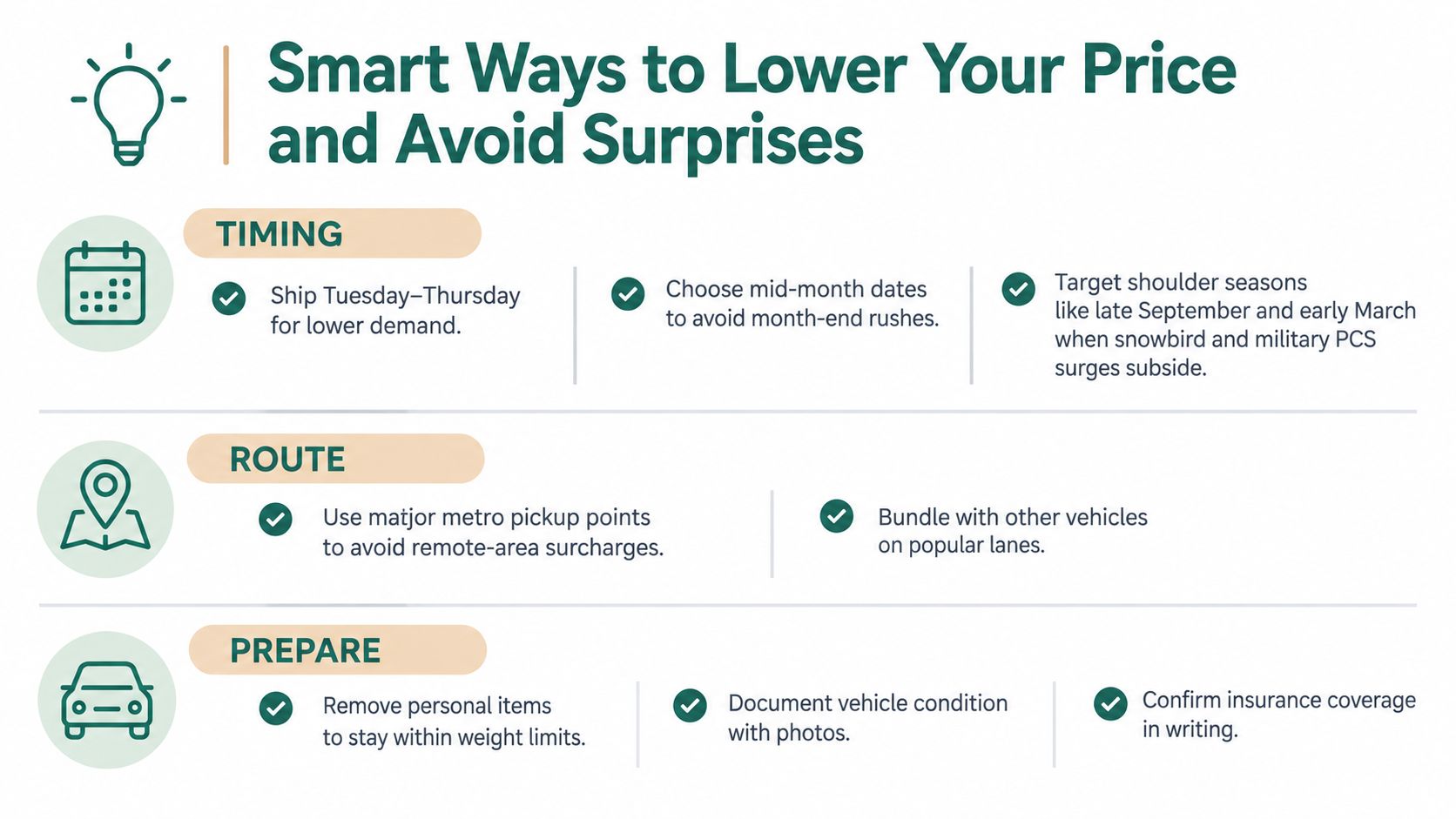
A practical quote should answer more than “How much does it cost?” It should tell you what equipment is assigned, where the vehicle will be picked up, how flexible the dates are, which charges are included, and whether Puerto Rico taxes or import obligations remain outside the transport total.
For a final review, compare the written quote with the vehicle's actual condition, dimensions, addresses, and timing requirements before authorizing dispatch.
Request a detailed quote from National Car Transport with your vehicle information, exact ZIP codes, preferred equipment, and pickup flexibility. Their bilingual U.S.-based agents can explain the carrier-cost stack, separate Puerto Rico taxes from transport charges, and guide your shipment from booking through the delivery inspection.