

Most North Carolina car shipments run $400 to $900 on open carriers for common corridors, and same-day pickup is often available in Charlotte, Raleigh, and Greensboro. If you're trying to move a car in or out of the state, the key question isn't just price, it's whether your pickup zip code is easy for a carrier to reach without wasting time or adding friction.
You might be relocating for work, sending a student car to campus, or timing a snowbird move before the weather turns. The right carrier can keep it simple, but North Carolina has enough metro, mountain, and coastal quirks that a cheap quote can turn into a headache fast if the dispatcher didn't plan the route properly.
Table of Contents
- Why North Carolina Is a Major Car Transport State
- How Pricing Actually Works for North Carolina Shipments
- Open Versus Enclosed Transport in North Carolina
- Preparing Your Vehicle and What the Pickup Process Looks Like
- North Carolina Rules That Shape a Legitimate Shipment
- Choosing the Right Carrier for Your North Carolina Move
- Booking Your Shipment and What Happens Next
Why North Carolina Is a Major Car Transport State
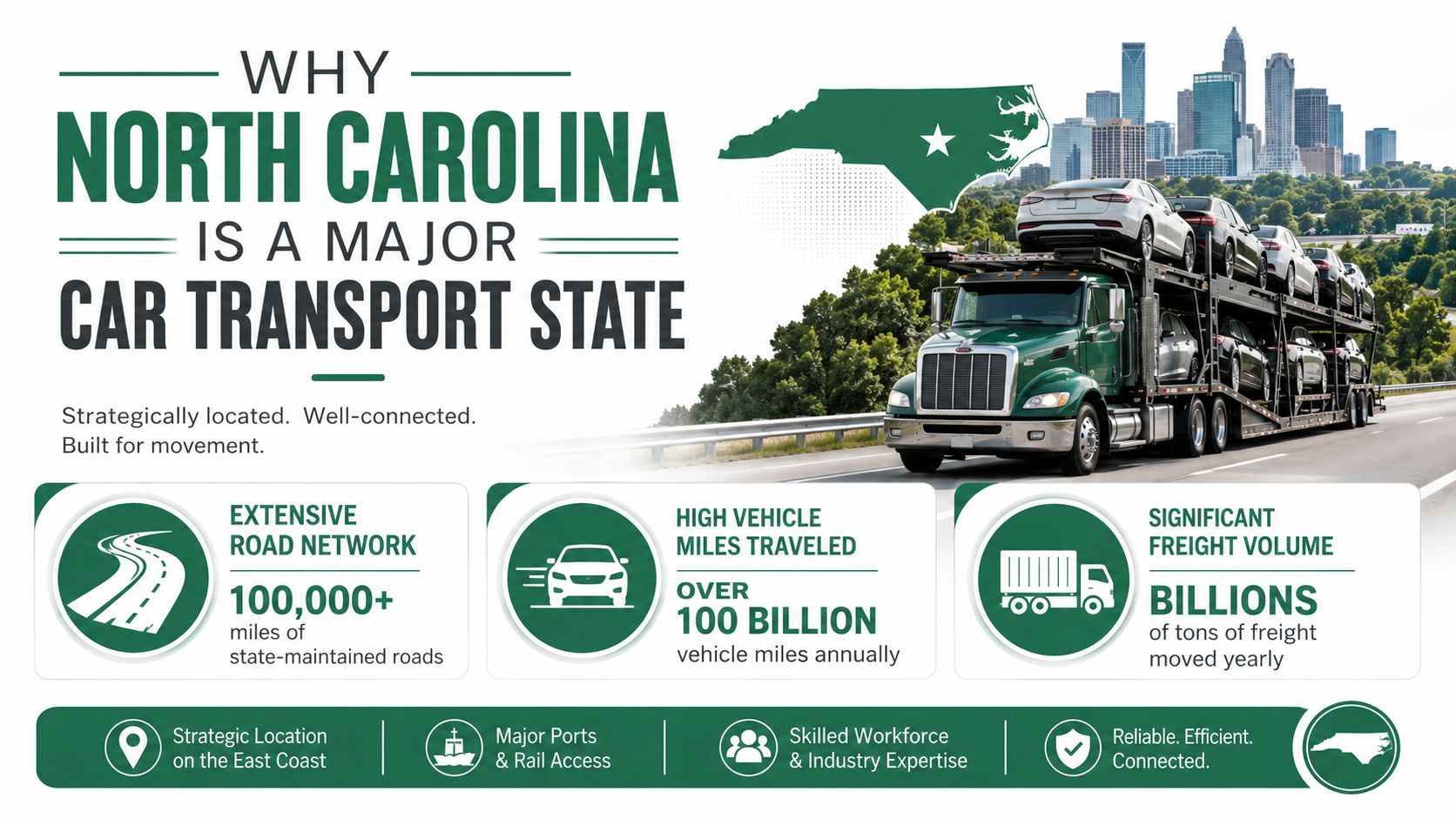
North Carolina is busy enough that carriers keep coming back. The state's annual vehicle miles traveled hit 131,008,358,770 in 2024, and the public road network includes 108,827 miles and 232,230 lane miles. That kind of road density matters because it gives dispatchers more places to stage trucks, build partial loads, and keep open carriers moving efficiently across the state's biggest population centers North Carolina road system and VMT data.
The freight picture is just as clear. NCDOT says more than 600 million tons of cargo moved over North Carolina highways in 2017, and trucking handled nearly 83% of inbound, outbound, internal, and through freight tonnage. Nearly 43% of truck flows were internal to the state, which tells you this isn't just a pass-through market, it's a real distribution state with steady local demand North Carolina freight highway profile.
What that means for your shipment
If you're shipping from Charlotte, Raleigh, Greensboro, or Wilmington, you're in the kind of market carriers like. That usually means better truck availability, more flexible pickup windows, and more competitive rates than you'd see in a thinly served rural lane. It also explains why car transport North Carolina quotes can look sharp on high-volume interstate routes and much less friendly once the pickup point drifts toward the mountains or the coast.
Practical rule: The easier it is for a truck to reach your location and reload quickly, the better your odds of getting a clean quote and a faster pickup.
That's the core tradeoff in North Carolina. The state is well served overall, but not every address is equally easy. Asheville-area pickups, Outer Banks deliveries, and other low-access locations demand more planning than a simple metro-to-metro move, and that planning shows up in timing and price.
How Pricing Actually Works for North Carolina Shipments
A North Carolina quote starts with distance, but that's only the first layer. The carrier still has to weigh vehicle size, operability, pickup access, delivery access, and how fast you want the truck to move. That's why a flat-rate quote should be readable, not mysterious. If the dispatcher can't explain what's included, you're not looking at a transparent offer.
Corridor pricing is the fastest reality check
Route examples from published North Carolina lanes show how wide the spread can be. Charlotte to Atlanta is listed at $377, Raleigh to Washington, DC at $466, Wilmington to Philadelphia at $377, and Asheville to New York City at $533 published North Carolina route examples. Those examples are useful because they show how a carrier can price a shorter, well-connected lane below broader expectations, while a longer or less convenient lane moves higher.
| Sample North Carolina Shipping Corridors | |||
|---|---|---|---|
| Origin | Destination | Estimated Price | Notes |
| Charlotte | Atlanta | $377 | Dense interstate lane |
| Raleigh | Washington, DC | $466 | Strong corridor demand |
| Wilmington | Philadelphia | $377 | Competitive eastern route |
| Asheville | New York City | $533 | Mountain access adds complexity |
The main point is simple. If you get a quote far outside the neighborhood of these published examples, ask why. Maybe the vehicle is oversized, maybe it's non-running, maybe the pickup is awkward. Those are fair reasons. A vague answer is not.
What should move the price up or down
Here's the clean checklist I'd use if I were pricing a shipment for a customer:
- Vehicle size and weight: Bigger vehicles take up more trailer space and can cost more.
- Running condition: Inoperable cars need extra labor and equipment.
- Pickup access: Tight streets, steep grades, and blocked entry points can force a nearby meet-up.
- Service type: Open carrier is usually cheaper than enclosed.
- Timing: Rush moves cost more because the dispatcher has less room to build an efficient load.
If you want a flat-rate benchmark before you call around, use a reference point like the North Carolina shipping cost guide. A good quote should make sense against the lane, not just sound nice on the phone.
Open Versus Enclosed Transport in North Carolina
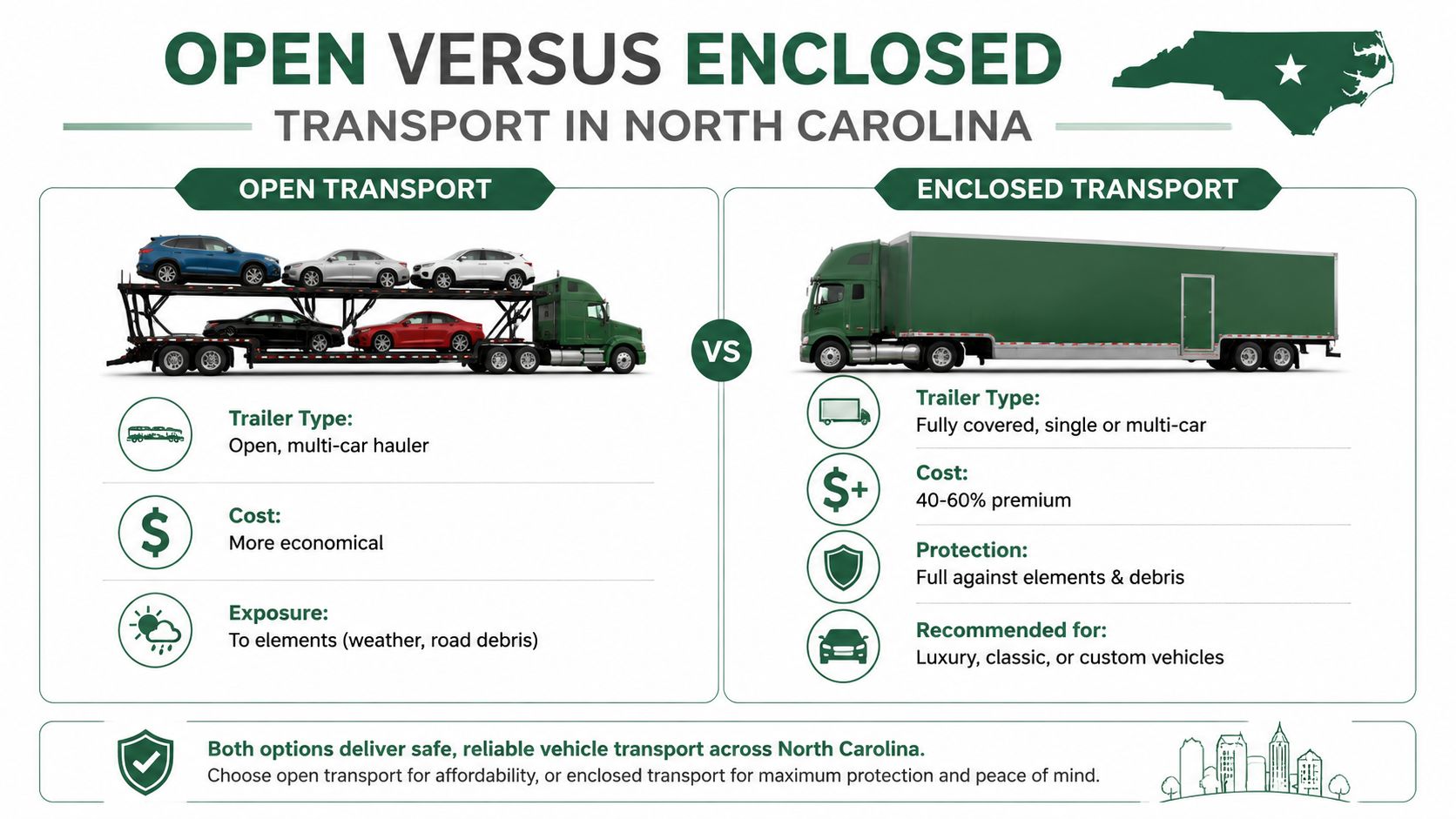
Open transport is the default choice for ordinary shipments. Your car rides on a multi-car trailer, exposed to weather and road debris, but you pay less and carriers are easier to find. For a daily driver, a family sedan, or a used car move, open transport is usually the smart call. It is popular because it does the job without padding the bill.
When enclosed is worth it
Enclosed transport is the premium lane. It fully covers the vehicle and usually runs at a 40 to 60 percent premium over open transport. Pay that premium when the car justifies it, especially for a classic, exotic, custom, or otherwise high-value vehicle. The extra protection also makes sense if you are moving something low to the ground that needs a more controlled loading process.
North Carolina gives you real reasons to think hard about that upgrade. Pollen, summer thunderstorms, mountain road debris, and coastal salt air all make exposure more than a theory. If the car is special, the trailer choice should match that reality.
Match the trailer to the vehicle, not the ego
A car that can handle a little weather does not need enclosed transport just because it sounds safer.
Use the expensive trailer for vehicles that need it. Lowered cars may need a hydraulic lift gate. Motorcycles and specialty vehicles often need a specific loading setup. If the car is a daily driver and you are watching budget, open transport is the sensible call.
For a straightforward comparison of how open service works, the open transport service details page lays out the basics without making you guess what is included.
Preparing Your Vehicle and What the Pickup Process Looks Like
A bad pickup usually starts with a bad handoff. A dirty car can hide scratches, loose items can turn into a mess, and weak batteries or soft tires can slow the driver down before the truck even gets rolling. Prep the vehicle the right way, and the inspection moves faster, the paperwork stays cleaner, and there is less room for a dispute later.
The morning-of checklist
- Wash the vehicle: A clean car makes the inspection more accurate.
- Photograph every side: Get clear shots of dents, scrapes, and wheel damage.
- Remove personal items: Empty the car of valuables and loose items.
- Check fluids and battery: A car that can't roll or start on cue creates delay.
- Set the fuel level low: Keep only what you need for loading and unloading.
- Disable or secure the alarm: Drivers don't want a car screaming halfway down the interstate.
- Hand over a working key: The carrier needs a key for loading and unloading.
North Carolina customers also need to think about where the truck can get in and out. A door-to-door setup is straightforward in the Triangle or Charlotte, but rural roads, steep driveways, gated communities, and tight mountain access can force the driver to meet you at a wider nearby lot, truck stop, or other safe staging point. That is normal. It is not a failure of service. It is the reality of moving a large car hauler through parts of the state that were never built for one.
At pickup, the driver will inspect the vehicle and document its condition on the Bill of Lading. Read it, compare it to your photos, and sign only after the notes make sense. If anything looks off, say so before the truck leaves. That paperwork is the record that matters if you ever need to pursue a damage claim.
A direct pickup plan saves time. If you want the carrier to handle the coordination at your home, the door-to-door auto transport option should spell out how the handoff works before you book.
Delivery is a second inspection, not a formality
Delivery deserves the same attention. Walk the car with the driver, compare it to the pickup record, and do not rush the final signature. If there is a problem, document it right away and note it before the Bill of Lading is closed out. That is how a claim starts. It does not start with an angry phone call after the truck has already pulled away.
Expect the same access rules on the way out that you dealt with on pickup. A carrier may not be able to fit a long truck onto a narrow street or up a steep rural approach, especially in the mountains or out in the county. Good shippers stay flexible, answer the driver fast, and have a backup meeting spot ready if the route turns out tighter than planned.
North Carolina Rules That Shape a Legitimate Shipment
North Carolina doesn't treat every transport the same, and neither should you. A carrier that looks fine on a website can still be wrong for an intrastate move if it doesn't have the right state authority. Under North Carolina Utilities Commission rules, a motor carrier may not engage in intrastate commerce for compensation without the proper certificate of exemption, and federal FMCSA authority alone doesn't grant that right North Carolina Utilities Commission rules. That's the first thing to understand if your shipment stays entirely within the state.
The details that separate real operators from sloppy ones
North Carolina also has a clear vehicle-marking requirement for household-goods carriers. The carrier's name or trade name and its North Carolina number must appear on each side of the vehicle in letters and figures at least three inches high, with the number also shown on the rear left upper quadrant in the same size North Carolina household-goods marking rule. That's not decorative. It's a compliance check.
Oversize and overweight moves bring their own math. A single-trip permit costs $12 for each dimension over lawful limits, including height, length, width, and weight up to 132,000 pounds, and overweight vehicles pay an additional $3 per 1,000 pounds over 132,000 pounds North Carolina permit statute. There's also an annual permit fee of $200 for moving house trailers or trailer frames. If your vehicle or setup falls into that category, the permit cost is part of the shipment, not an afterthought.
Timing rules matter more than most people think
North Carolina's movement restrictions are strict. Permitted movement is generally limited to sunrise to sunset, no movement is allowed from 12:00 p.m. on the weekday preceding through 12:00 p.m. on the weekday following Independence Day, Thanksgiving, and Christmas, continuous 24-hour travel is not authorized for vehicle combinations over 112,000 pounds, and movements can't happen when visibility is less than 500 feet North Carolina movement restrictions. Those rules can change your pickup window fast.
Legit carriers charge more when compliance requires more planning. That's normal. A cheap operator who ignores permit and timing rules is not a bargain, he's a problem waiting to happen.
Choosing the Right Carrier for Your North Carolina Move
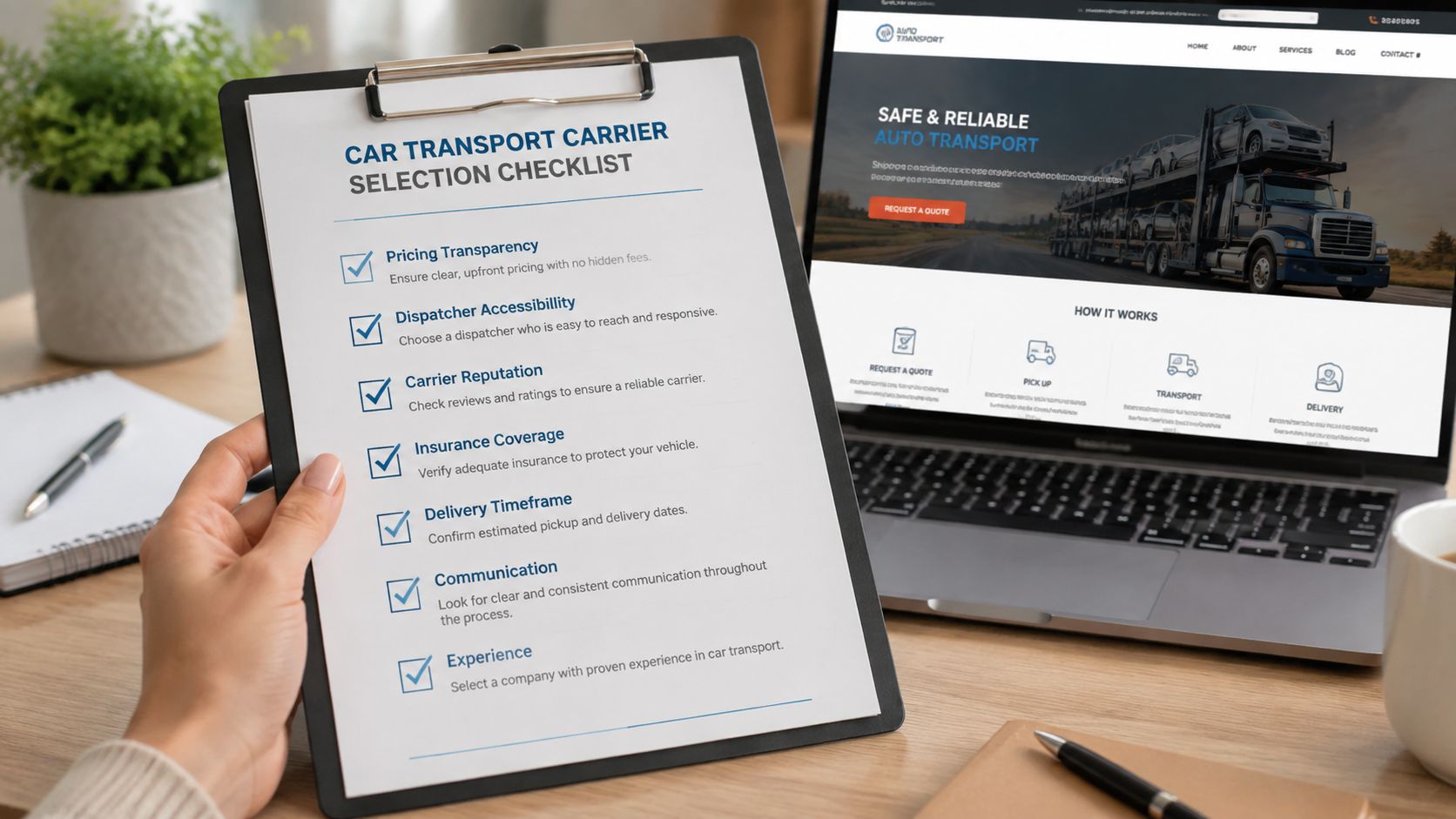
The right carrier is transparent before you book and reachable after you book. That sounds basic, but a lot of quotes fail on both counts. A real dispatcher should tell you what the price covers, what could change it, and how quickly they can match your shipment to a truck. If the answer is fuzzy, move on.
What to verify before you hand over a car
Look for a carrier or broker that gives you a flat-rate quote, not a bait-and-switch number that changes after you're already committed. Ask whether the company has licensed, bonded, and insured carriers in its network, and ask for proof. If the rep won't give you a physical address or keeps dodging insurance questions, that's your cue to walk.
A large vetted network matters because it helps a dispatcher build a route that works. A nationwide operation like National Car Transport uses a network of 25,000+ vetted carriers, provides transparent flat-rate pricing, and supports customers with bilingual English/Spanish agents based in the U.S. with over 20 years of auto transport logistics experience. That combination is useful when a move needs real coordination, not just a cheap number.
Practical rule: A good transport provider explains dispatch, pickup, and delivery in plain English. A weak one talks around those steps.
Red flags you should not ignore
- Large upfront deposits: If the money pressure comes first, be careful.
- Vague delivery windows: Good dispatchers give ranges they can defend.
- No documentation: Insurance, authority, and company details should not be secret.
- Too-good-to-be-true rates: Underpriced quotes often show up as surprises later.
- No one answers the phone: You want a dispatcher who can solve a problem.
That's especially important for households that are car-light, relocating, or juggling timing-sensitive moves. If your shipment is tied to school schedules, military orders, or a temporary gap without a vehicle, communication matters as much as price.
Booking Your Shipment and What Happens Next
Start with the basics, and keep them accurate. You'll need the pickup and delivery zip codes, the vehicle year and model, whether it runs, and whether you want open or enclosed transport. If you're asking for a flat-rate quote, don't leave out access details just to make the number look better. A clean quote is worth more than a pretty one.
Once you book, the dispatcher should assign the shipment, match it to a carrier, and confirm the pickup window. That's the point where the move becomes real. If the truck is already in Charlotte, Raleigh, or Greensboro, same-day pickup is often possible. If the pickup is in a harder-access area, expect more coordination and be ready to meet at a safer nearby spot if the truck can't fit your street.
Most open-transport shipments within the lower 48 take one to seven days once dispatched. That's a useful planning window if you're coordinating work, flights, or a closing date. It's also why I tell customers to book early when they can, and to stay flexible when the route is rural or the dates are tight.
After booking, keep your phone on and your keys ready. The best outcomes come from simple coordination, not constant second-guessing.
If you want a straight answer on North Carolina shipping, get a quote from National Car Transport and compare it against your route, vehicle, and pickup access. They handle door-to-door moves, open and enclosed service, and bilingual support, which makes it easier to keep the shipment on schedule without chasing five different people for basic updates.