

If you're trying to move a vehicle in or out of Austin, you're probably dealing with a real-life deadline. A job start date, a school move, a military transfer, a car bought online, or a seasonal relocation that doesn't leave much room for mistakes. The part that catches people off guard isn't only the transport itself. It's the pickup window, the truck access, the paperwork, and whether the company coordinating it understands how Austin deliveries work on the ground.
Austin is a busy shipping market, but that doesn't make the process automatic. The U.S. vehicle-shipping industry was valued at $10.5 billion in 2026, with 7,073 businesses operating in the sector in 2025, according to IBISWorld's vehicle shipping services industry analysis. That tells you two things right away. There are plenty of options, and sorting good operators from risky ones matters.
Most customers don't need a sales pitch. They need straight answers. If you're comparing quotes for car transport in Austin, the useful questions are simple: Can the truck reach my street? Should I pay for enclosed? What paperwork matters? How long is realistic? And what happens if I'm shipping beyond the mainland, including Puerto Rico?
Table of Contents
- Navigating Your Austin Car Shipping Journey
- Choosing Your Service Open vs Enclosed Transport
- Decoding Austin Car Transport Costs and Pricing
- Typical Routes and Transit Times From Austin
- Austin Pickup and Delivery A Local's Guide
- Paperwork Insurance and Carrier Vetting
- Austin Car Transport FAQs
Navigating Your Austin Car Shipping Journey
Austin moves fast. People relocate for work, students arrive and leave on tight schedules, dealerships move inventory, and families buy vehicles from out of state that need a clean handoff at delivery. In a market like this, the shipping process works best when you treat it like a logistics job, not a simple reservation.
Start with the route, not the quote
The first thing to lock down is the route pattern. Is your vehicle going on a major interstate lane with regular carrier traffic, or is it headed to a location that needs more coordination at pickup or delivery? That answer affects availability more than most first-time shippers realize.
A reliable booking process usually follows this order:
- Confirm the exact addresses so the dispatcher can spot access issues early.
- Choose the right service level based on the vehicle, not on fear.
- Set a realistic pickup range instead of demanding a narrow window the market may not support.
- Verify compliance details before the car is assigned to a carrier.
- Prepare the vehicle so pickup doesn't get delayed over avoidable issues.
Practical rule: The smoother customer usually gets the smoother shipment. Clear timing, accurate addresses, and reachable phone numbers solve more problems than last-minute urgency.
Austin rewards flexibility
Austin is active enough that carrier options are usually there, but flexibility still matters. If your dates can move slightly, dispatch has more room to match the vehicle with a truck already moving through the corridor instead of forcing a difficult fit.
That same mindset matters for pickup locations. A house address may be listed as door-to-door, but the actual handoff may need to happen nearby if the street can't handle a large trailer. Customers who understand that early usually avoid day-of confusion.
For anyone who wants a better sense of how professional drivers think about road conditions, spacing, and vehicle control, these truck driving safety tips are useful context. They won't teach you how to book transport, but they do help explain why experienced drivers are selective about where they load and unload.
What experienced coordination looks like
Good coordination isn't flashy. It means the customer knows what to expect, the carrier has accurate information, and the dispatch side isn't improvising after the truck is already on the way. That's where a seasoned broker or transport coordinator helps most.
National Car Transport is one option in this space. It handles door-to-door vehicle shipping across the U.S., Puerto Rico, Alaska, and Hawaii, offers open and enclosed service, and works with transparent flat-rate pricing with no upfront charge until a carrier is assigned.
Choosing Your Service Open vs Enclosed Transport
The decision between open transport and enclosed transport is often made too quickly. The right choice isn't about which option sounds safer in the abstract. It's about matching the trailer type to the vehicle, the risk tolerance, and the budget.
Open transport is the standard choice
Open transport is the workhorse of the industry. It's the method utilized for daily drivers, student vehicles, family SUVs, and standard relocation shipments. If you're shipping a regular-use car and your goal is practical, cost-conscious movement from one city to another, open is usually the right answer.
Austin benchmarks put most shipments in the roughly $550 to $1,250 range for sedans, with pricing differences driven largely by whether you choose standard open service or premium enclosed service, according to RoadRunner Auto Transport's Austin car shipping page.
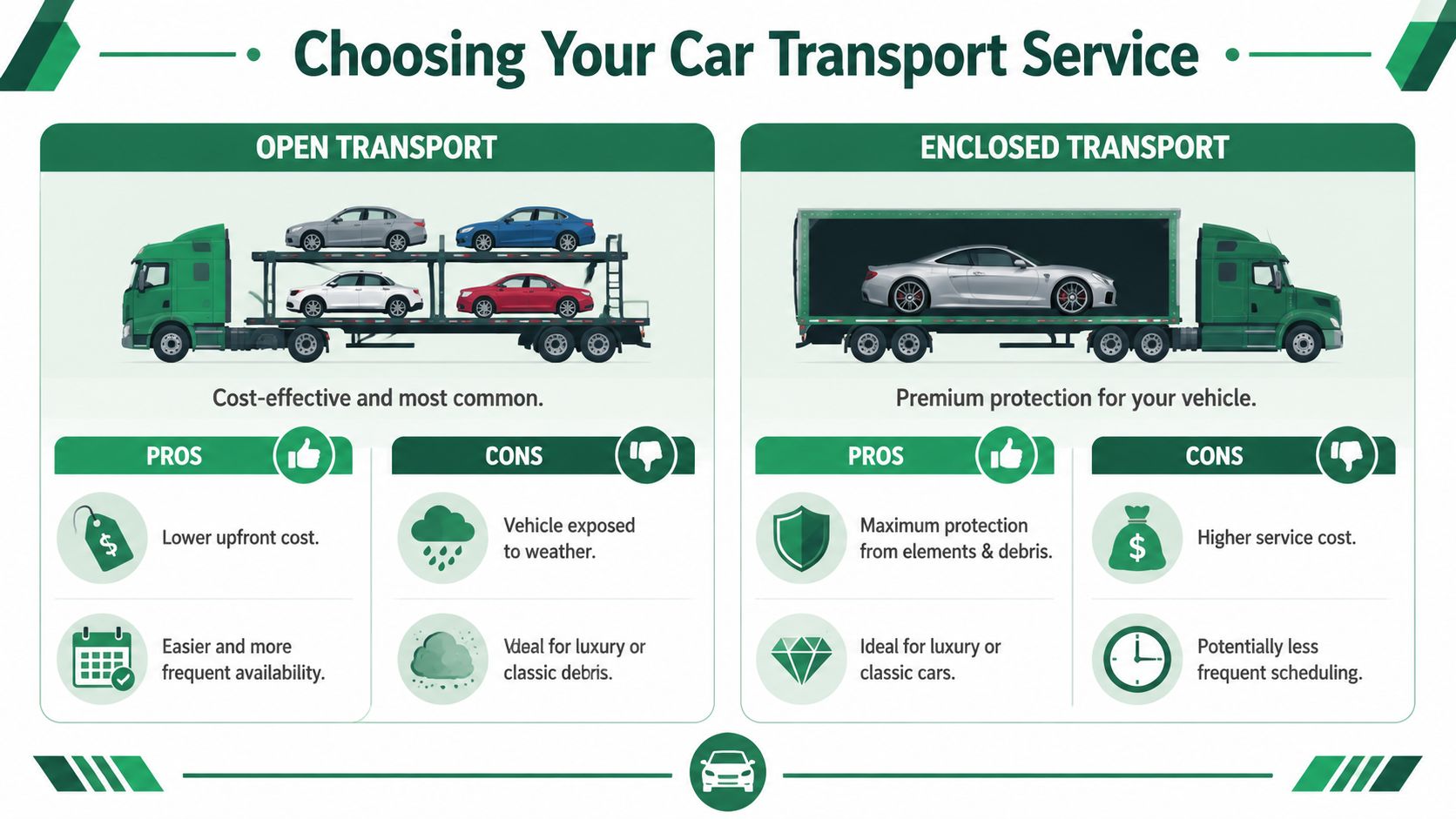
A straightforward way to see it:
| Service type | Best fit | Main upside | Main trade-off |
|---|---|---|---|
| Open transport | Daily drivers, standard relocations, dealership moves | Lower cost and broader availability | Exposure to weather and road debris |
| Enclosed transport | Classic, luxury, exotic, specialty vehicles | Added protection and more controlled environment | Higher cost and tighter scheduling |
Enclosed transport is a protection decision
Enclosed transport makes sense when the vehicle's value or condition changes the calculation. That includes collector vehicles, recently restored classics, low-clearance specialty cars, and luxury models where owners want more shielding from debris and weather exposure.
This isn't about fear. It's about priorities. If a customer would lose sleep over a standard open move, enclosed is often the cleaner answer. If it's a commuter car with normal wear and ordinary use, paying extra for enclosed may not solve a real problem.
Open is the industry standard because it works well for most vehicles. Enclosed is the premium option because some vehicles justify added protection.
What works and what doesn't
What works:
- Match the service to the car's role. A daily-use sedan usually belongs on open transport.
- Use enclosed for high-value or irreplaceable vehicles. That's where the premium has a practical reason.
- Ask about timing with the same seriousness as price. Enclosed routes can take more coordination.
What doesn't:
- Choosing enclosed just because the quote feels more "professional."
- Choosing open for a specialty vehicle you know you want protected more carefully.
- Assuming all risk disappears with enclosed. It reduces exposure, but paperwork and inspection still matter.
Decoding Austin Car Transport Costs and Pricing
Price is usually the first question, but it shouldn't be the first decision. A transport quote only makes sense when you understand what it's built on. In Austin, the number moves for operational reasons, not because someone typed a random rate into a calculator.
A typical car shipment to or from Austin covers an average of 1,579 miles, takes about 2 to 6 days, and commonly falls between $775 and $1,375, depending on distance, vehicle size, and transport type, according to Sherpa Auto Transport's Austin route guide.
The cost drivers that actually matter
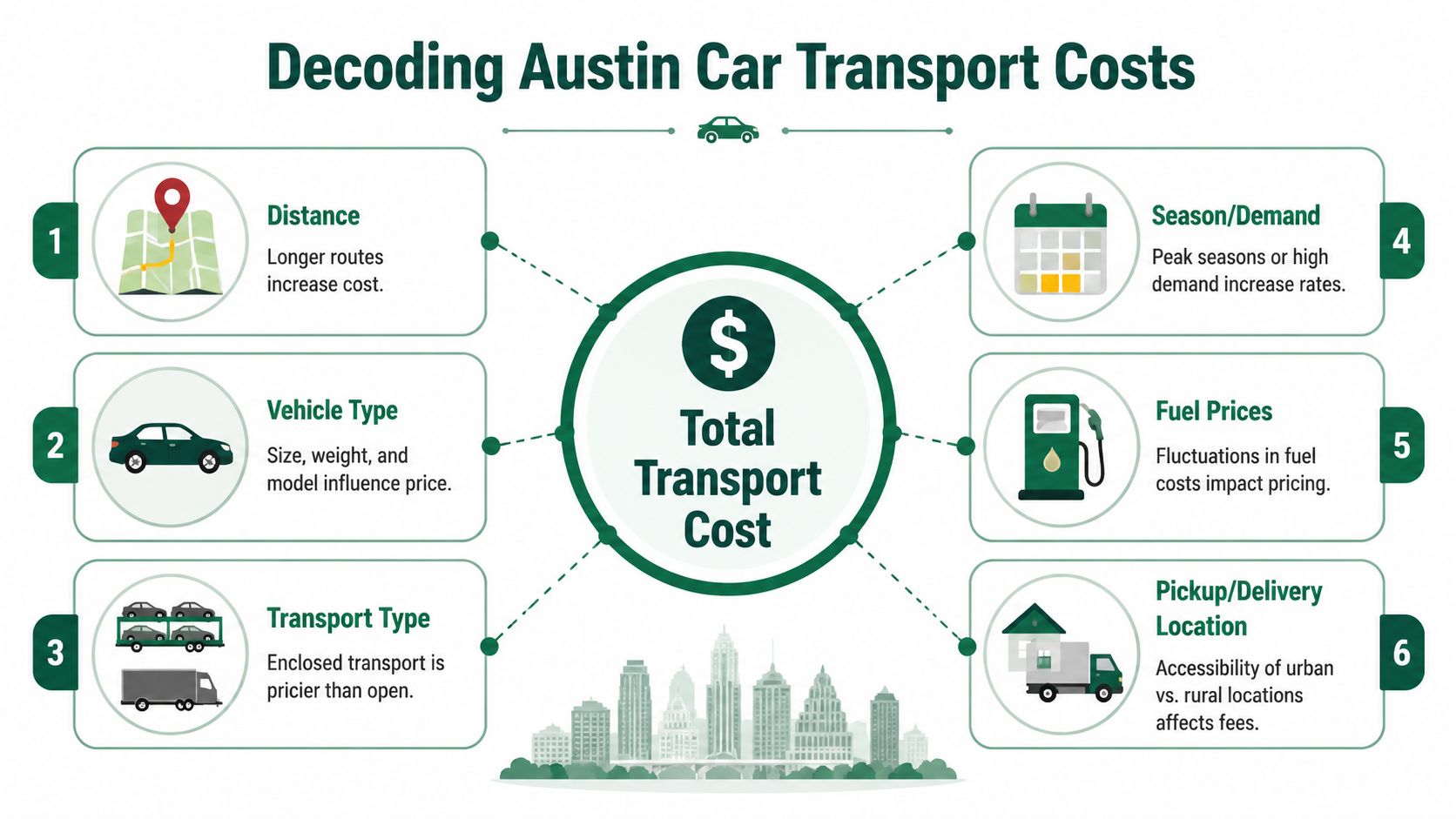
The quote usually moves because of a handful of variables working together:
- Distance: Longer routes usually cost more because they take more carrier time and route space.
- Vehicle type: Sedans, SUVs, trucks, and specialty vehicles don't occupy the same trailer footprint.
- Transport type: Enclosed service carries a premium over open service.
- Season and demand: Certain windows are tighter, and tighter markets reduce flexibility.
- Fuel conditions: Fuel costs influence operating reality even when customers don't see that line directly.
- Pickup and delivery access: Easy suburban access is different from a restricted downtown handoff.
Customers often fixate on mileage alone. Mileage matters, but route efficiency matters too. A desirable lane with regular traffic can be easier to price than a less convenient move with awkward loading conditions.
Why the cheapest quote often creates problems
A very low quote can mean one of several things. It may be based on optimistic dispatch assumptions. It may leave no room for a realistic carrier match. Or it may ignore practical details like access restrictions, vehicle operability, or time sensitivity.
That doesn't mean higher is always better. It means the quote should line up with how the shipment will move.
If a quote sounds unusually cheap, ask what has been assumed about timing, trailer type, and pickup access. That's where bad surprises usually start.
This short overview gives a useful visual on how auto transport pricing works in practice:
How to read a quote like a coordinator
When reviewing Austin car transport pricing, check for these points before you book:
Pickup window clarity
A good quote should reflect when the vehicle can realistically be loaded, not just the day you'd prefer.Vehicle description accuracy
Oversize vehicles, lift kits, or non-running conditions need to be disclosed early.Address practicality
If you're in a dense neighborhood or downtown area, ask whether an alternate meeting point may be needed.Rate structure
Flat-rate pricing is easier for most customers to evaluate because it reduces confusion over surprise add-ons.
The best pricing conversation is the one that leaves nothing vague. A clear rate with realistic assumptions is worth more than a low quote that falls apart in dispatch.
Typical Routes and Transit Times From Austin
Transit time depends on more than the map. Dispatch density, route popularity, loading sequence, and legal driving-hour limits all shape the schedule. That's why one move feels straightforward while another on paper looks similar but takes more coordination.
Austin sits on a busy long-distance corridor, so many shipments move on familiar national lanes. That helps when you're headed to major mainland destinations. It also helps when the first leg of a more specialized route, such as Puerto Rico shipping, begins in Texas.
Estimated route table
The table below gives planning-level examples for common moves from Austin. These are practical estimates, not promises, and actual scheduling depends on route flow, service type, and pickup conditions.
| Destination City | Distance (Approx. Miles) | Est. Transit Time | Est. Cost Range |
|---|---|---|---|
| Los Angeles, CA | Long-haul route | Multi-day transit | Varies by vehicle and service type |
| New York, NY | Long-haul route | Multi-day transit | Varies by vehicle and service type |
| Miami, FL | Long-haul route | Multi-day transit | Varies by vehicle and service type |
| Chicago, IL | Long-haul route | Multi-day transit | Varies by vehicle and service type |
| San Juan, Puerto Rico | Ground leg plus ocean leg | Longer coordinated timeline | Varies by ground and ocean service |
Mainland shipping versus Puerto Rico shipping
Mainland routes are simpler because they stay on one mode of transport. The vehicle is picked up, loaded onto a carrier, moved across the route, and delivered when the truck reaches the destination sequence.
Puerto Rico is different. The mainland portion still starts with standard vehicle transport, but the move then shifts into port handling and ocean shipping before final release or onward coordination on the island. That means the paperwork and timing discipline matter even more.
For customers moving between Austin and Puerto Rico, the key is coordination between the ground segment and the port segment. If those handoffs aren't managed correctly, delays start stacking up.
What helps transit stay on track
Three habits make a real difference:
- Be reachable during the pickup window. Missed calls can push a load to the next available slot.
- Prepare the vehicle before the truck arrives. Last-minute issues create preventable delays.
- Stay flexible on exact handoff points. This matters even more in dense Austin neighborhoods.
The fastest shipment isn't always the one with the shortest map distance. It's the one that fits a live route, has a ready customer, and can be loaded without friction.
If you're shipping on a common domestic lane, Austin is usually a manageable origin or destination. If you're shipping to Puerto Rico, choose a coordinator who handles both the inland and island side as one connected process, not as separate tasks.
Austin Pickup and Delivery A Local's Guide
Generic car shipping advice frequently reveals its limitations. Customers hear "door-to-door" and assume a full-size transport truck can pull right up to any house, apartment, condo tower, or downtown curb. In Austin, that often isn't how the final handoff works.
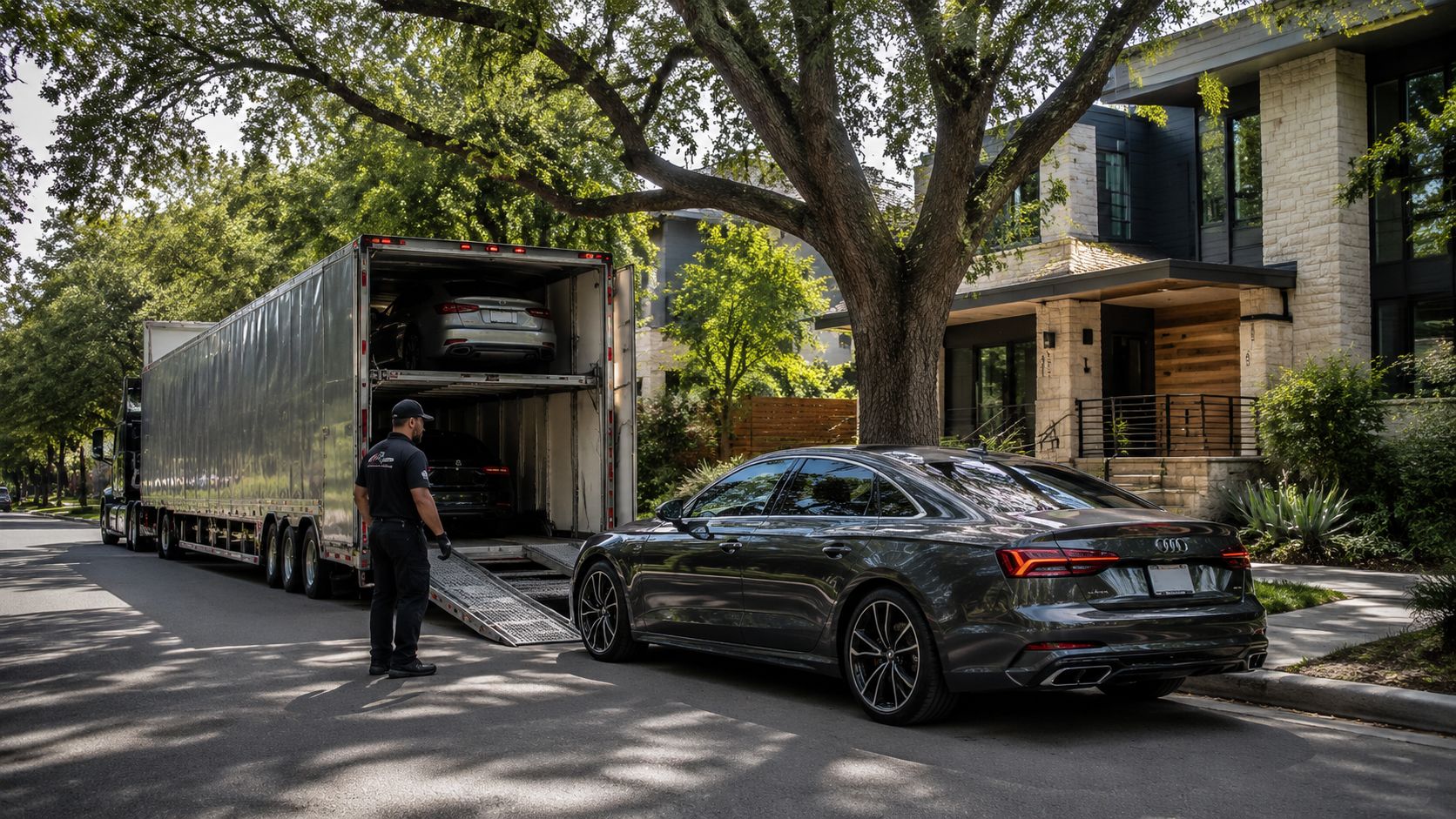
A key logistical challenge in Austin is that many residential or downtown streets are inaccessible to large transport carriers, often requiring customers to coordinate with the driver to meet at a nearby, spacious location for safe loading and unloading, as noted by WeShipCars in its Austin car transport guidance.
Where Austin pickups get tricky
Downtown is the obvious challenge. Tight turns, curb restrictions, traffic pressure, and limited staging room make large-truck loading difficult. But the same problem shows up outside downtown too.
Older neighborhoods with narrower streets can be awkward for long trailers. Some apartment communities don't allow commercial carrier entry. Certain HOA communities have gate limitations or truck rules that need to be handled ahead of time.
Typical problem spots include:
- Downtown corridors: Limited room to stop, load, or safely maneuver
- Dense residential streets: Parked cars and tight turning radius
- HOA-managed communities: Entry restrictions and commercial vehicle rules
- Apartment complexes: Loading zones that don't fit a full carrier setup
What actually works in Austin
The cleanest solution is usually a nearby meet point that gives the driver room to work safely. That could be a large retail parking lot, a wide-access commercial area, or another open location agreed on in advance.
Good handoffs share the same traits:
- Plenty of space to turn and stage
- Low traffic conflict
- Clear phone contact between customer and driver
- A backup plan if the first location is crowded
If you're arranging car transport in Austin, ask this before booking: "If the truck can't reach my address, where would you suggest we meet?" That one question prevents a lot of stress.
Customers usually don't mind meeting nearby. They mind finding out at the last minute.
Practical prep before the driver arrives
Use this short checklist:
- Walk your street mentally from a truck driver's perspective. Can a long trailer enter, turn, and leave safely?
- Check for gates, low branches, and parked-car bottlenecks.
- Keep your phone on during the pickup window.
- Be willing to drive a short distance to a better meeting point.
Austin pickup and delivery goes smoothly when people plan for real street conditions instead of relying on the phrase "door-to-door" as if it means curbside access is guaranteed everywhere.
Paperwork Insurance and Carrier Vetting
Paperwork is where a shipment becomes real. If the documents are sloppy, the expectations are sloppy. If the insurance details are unclear, the risk sits with you until something goes wrong. This is not the part to rush through.
Reputable carriers must meet strict FMCSA requirements, including proper authority and cargo insurance coverage, and a dense network of compliant carriers helps support faster pickups and more reliable transit times in busy markets like Austin, according to AmeriFreight's Austin car shipping overview.
The documents that matter most
At minimum, pay attention to these items:
- Bill of Lading: This is the core shipping document. It records the vehicle's condition and governs the handoff.
- Carrier insurance proof: Don't assume it's in place. Verify it.
- Pickup and delivery inspection records: Photos help support the written inspection.
- DOT and MC details: These help confirm the carrier is operating with proper authority.
- ID and vehicle documents: Have them ready so pickup doesn't stall.
The Bill of Lading gets overlooked by first-time customers. It shouldn't. If damage is discovered at delivery, that document becomes central to how the issue is evaluated.
Insurance is only useful if you understand it
Carrier cargo coverage and your own personal auto policy are not the same thing. The carrier's cargo policy applies to the shipment itself under the carrier's terms. Your personal policy may or may not overlap in useful ways, depending on the situation.
If you ever need to understand what happens after a serious insurance event, this guide on the total loss process explained is a good background resource. It isn't specific to routine transport claims, but it does help customers understand how insurers evaluate major vehicle-loss situations.
Vet the carrier before the truck shows up
Don't stop at the quote. Ask direct questions.
| Check item | Why it matters |
|---|---|
| FMCSA authority | Confirms the carrier is legally operating |
| Cargo insurance | Establishes the basic protection framework |
| Inspection process | Reduces disputes at delivery |
| Communication plan | Keeps pickup and delivery coordinated |
A carrier being available isn't the same as a carrier being properly vetted.
Disciplined coordination is paramount. A company with a large network of vetted carriers can screen for licensing, insurance, and operational fit before dispatch, instead of trying to solve those questions after the assignment is already made.
Austin Car Transport FAQs
Can I pack personal items in my car
Ask before you do it. In practice, personal items can create problems with weight, inspection clarity, and liability. If something inside the vehicle shifts, breaks, or goes missing, that issue may not be treated the same way as damage to the vehicle itself.
The safest approach is simple. Remove valuables, paperwork you need immediately, toll tags if instructed, and anything loose that could move around during transit.
How does same-day pickup in Austin actually work
Same-day pickup isn't something anyone should assume. It depends on whether a compliant carrier with the right route and trailer space is already available in the market. In Austin, that can happen because carrier activity is dense, but the shipment still has to fit a live dispatch opportunity.
What helps: flexible timing, accurate vehicle details, and quick customer response. What hurts: incomplete booking information, hard-to-access pickup points, and unrealistic timing demands.
What if my family primarily speaks Spanish
Then work with a transport coordinator who can handle the shipment clearly in Spanish from booking through delivery. That matters more than people think, especially when the shipment involves family coordination, military moves, student relocations, or Puerto Rico shipping where multiple handoffs may be involved.
A bilingual support team based in the U.S. can make the process much easier because the customer doesn't have to guess what a document means or what the next step is.
Will shipping affect my insurance costs
Transport itself isn't the same issue as your standard driving history, usage, or policy structure, but customers often review coverage when they're relocating or changing vehicles. If you're also comparing ways to reduce your ownership costs after the move, this overview of Mitchell-Joseph car insurance savings is a practical place to start.
What's the biggest mistake people make with car transport in Austin
They assume the truck can reach any address and that every quote means the same thing. The better move is to confirm access, service type, paperwork, and timing before the order is locked in.
If you need a straightforward plan for shipping a vehicle to or from Austin, including domestic routes and Puerto Rico moves, National Car Transport is one place to start. The company works across all 50 states, Puerto Rico, Alaska, and Hawaii, offers open, enclosed, and island shipping options, uses transparent flat-rate pricing with no upfront charge until carrier assignment, and supports customers with experienced bilingual agents based in the U.S.