
Your PCS orders have arrived, the household-goods appointment is taking shape, and you still need the car for school runs and clearing the installation. Now you're trying to decide whether to drive, use a government vehicle-processing center, or book a commercial carrier without paying for something your orders already cover.
Car shipping for military families starts with entitlement, not a transport quote. A move within the contiguous United States and an assignment to Puerto Rico can involve different payment rules, different handoffs, and very different destination costs. The right plan keeps your report date, vehicle acceptance, and total budget connected without treating them as the same problem.
Table of Contents
- What Orders Cover and How the Move Gets Built
- Prepare the Vehicle for Acceptance
- Choose Door-to-Door, Terminal, or Enclosed Service
- Flat Rates and Transit Times to Puerto Rico
- Two PCS Paths Side by Side
- Confirm Entitlement, Then Book Transport
What Orders Cover and How the Move Gets Built
Your orders may authorize government-funded vehicle shipment or storage for an eligible overseas or other outside-the-contiguous-U.S. move. For a CONUS-to-CONUS move, commercial car shipping is usually the member's responsibility. Before comparing carrier quotes, ask your transportation office which rules apply to your orders.
The Military OneSource's PCS entitlements guide explains that many qualifying overseas moves allow shipment or storage of one privately owned vehicle, generally up to 20 metric tons. Costs above that limit may fall to the member. For domestic moves, the government may instead provide a monetary allowance in lieu of transportation for mileage, fuel, tolls, and related travel expenses.
The distinction is practical: a driving allowance does not authorize hiring a carrier and submitting its bill. A commercial coordinator can arrange transport, but cannot approve your entitlement or promise reimbursement. Get the transportation office's answer before booking.
Who pays to move a military POV
| Move type | Who pays for the vehicle | Limit or allowance | What the member should do |
|---|---|---|---|
| Overseas or other OCONUS, one POV | Government may ship or store | Generally one POV up to 20 metric tons; excess cost above that | Confirm eligibility and routing with the transportation office |
| CONUS to CONUS, member drives | Government may pay a monetary allowance in lieu of transportation | Mileage, fuel, tolls, and related travel expenses | Keep orders and travel records; don't assume shipping reimbursement |
| CONUS to CONUS, commercial shipment | Usually the member | No standard government shipping entitlement | Compare driving costs and time with a written carrier quote |
| Exception involving insufficient driving time or inability to operate the vehicle | Possible government help if the office approves | Orders-based, individual approval | Ask the transportation office before booking privately |
| Second vehicle on any PCS | Member ordinarily budgets the shipment | The usual government-funded overseas entitlement doesn't extend to an additional car | Budget a separate commercial shipment |
The guide to preparing for a PCS identifies possible domestic exceptions, including insufficient time to drive or inability to operate the vehicle. Explain your circumstances to the transportation office. A tight schedule alone does not confirm that an exception applies.
The definition of a qualifying POV matters as well. Military OneSource describes it as a self-propelled motor vehicle with at least four wheels, owned or leased for 12 months or longer by the member or an eligible dependent. A recreational vehicle, modified truck, or newly leased vehicle may not fit the benefit, so ask the office to review it.
Build the move around the orders
The Government Accountability Office's personal-property shipment overview reports that DoD moves and stores approximately 300,000 personal-property shipments worldwide annually, at about $2 billion a year. Your vehicle belongs to the broader moving process, but its authorization is separate from the household-goods shipment.
Use the orders to establish the basics before arranging transport. Check the gaining location, report date, dependent information, and any amendments. Then confirm whether you need an official vehicle-processing appointment, a commercial carrier, or both. The transportation office determines what the orders authorize; a private carrier can only provide transport under the terms of its quote.
Practical rule: Confirm who pays, who books, and where you surrender the vehicle before committing money.
Compare the full costs, not just the price of fuel or the carrier's quote. For driving, include lodging, meals, time away from work, and transportation after arrival. For shipping, use a written quote and account for how you will get around before the car arrives. This comparison helps clarify the trade-off: driving uses your time and may add travel expenses, while a commercial carrier charges for transport and may not be covered by your orders.
Mainland coverage means specific pickup locations
Commercial carriers can connect major-city areas across the contiguous states with mainland destinations or a Puerto Rico gateway. Share pickup and delivery ZIP codes, rather than state names alone, so the coordinator can assess access and routing for the actual locations.
Representative origin and destination markets include:
- Northeast: Portland, Maine; Manchester, New Hampshire; Burlington, Vermont; Boston, Massachusetts; Providence, Rhode Island; Hartford, Connecticut; New York City, New York; Newark, New Jersey; and Philadelphia, Pennsylvania.
- Mid-Atlantic and Southeast: Wilmington, Delaware; Baltimore, Maryland; Virginia Beach, Virginia; Charleston, West Virginia; Charlotte, North Carolina; Charleston, South Carolina; Atlanta, Georgia; Jacksonville, Orlando, Tampa, and Miami, Florida.
- South and central states: Louisville, Kentucky; Nashville, Tennessee; Birmingham, Alabama; Jackson, Mississippi; New Orleans, Louisiana; Little Rock, Arkansas; Oklahoma City, Oklahoma; and Houston and Dallas, Texas.
- Great Lakes and Midwest: Columbus, Ohio; Detroit, Michigan; Indianapolis, Indiana; Chicago, Illinois; Milwaukee, Wisconsin; Minneapolis, Minnesota; Des Moines, Iowa; Kansas City, Missouri; Omaha, Nebraska; and Wichita, Kansas.
- Plains and Mountain states: Fargo, North Dakota; Sioux Falls, South Dakota; Billings, Montana; Cheyenne, Wyoming; Denver, Colorado; Albuquerque, New Mexico; Phoenix, Arizona; Salt Lake City, Utah; and Boise, Idaho.
- Pacific states and Nevada: Seattle, Washington; Portland, Oregon; Los Angeles, San Diego, and Sacramento, California; and Las Vegas, Nevada.
Puerto Rico is a separate entitlement and cost question, not another mainland destination. San Juan is the port handoff, so confirm the final delivery address and routing separately. Keep ocean freight, San Juan handling, and Hacienda excise tax distinct from the transport quote when working out the landed cost. Alaska and Hawaii also require destination-specific entitlement and routing discussions rather than assumptions based on a mainland move.
Prepare the Vehicle for Acceptance
A vehicle can run well and still be turned away at acceptance. Recall status, cleanliness, fuel level, cargo, and authorization documents can all affect whether it is ready to load. For an overseas shipment, work through the receiving facility's requirements before the appointment.
The Military OneSource moving FAQs describe overseas acceptance requirements: the vehicle must be clean and dry, electrical or fire-related recalls must be documented as resolved, and fuel must be no more than one-quarter tank, within the 25% maritime limit for liquid-fueled vehicles.
Finish the acceptance checklist before departure
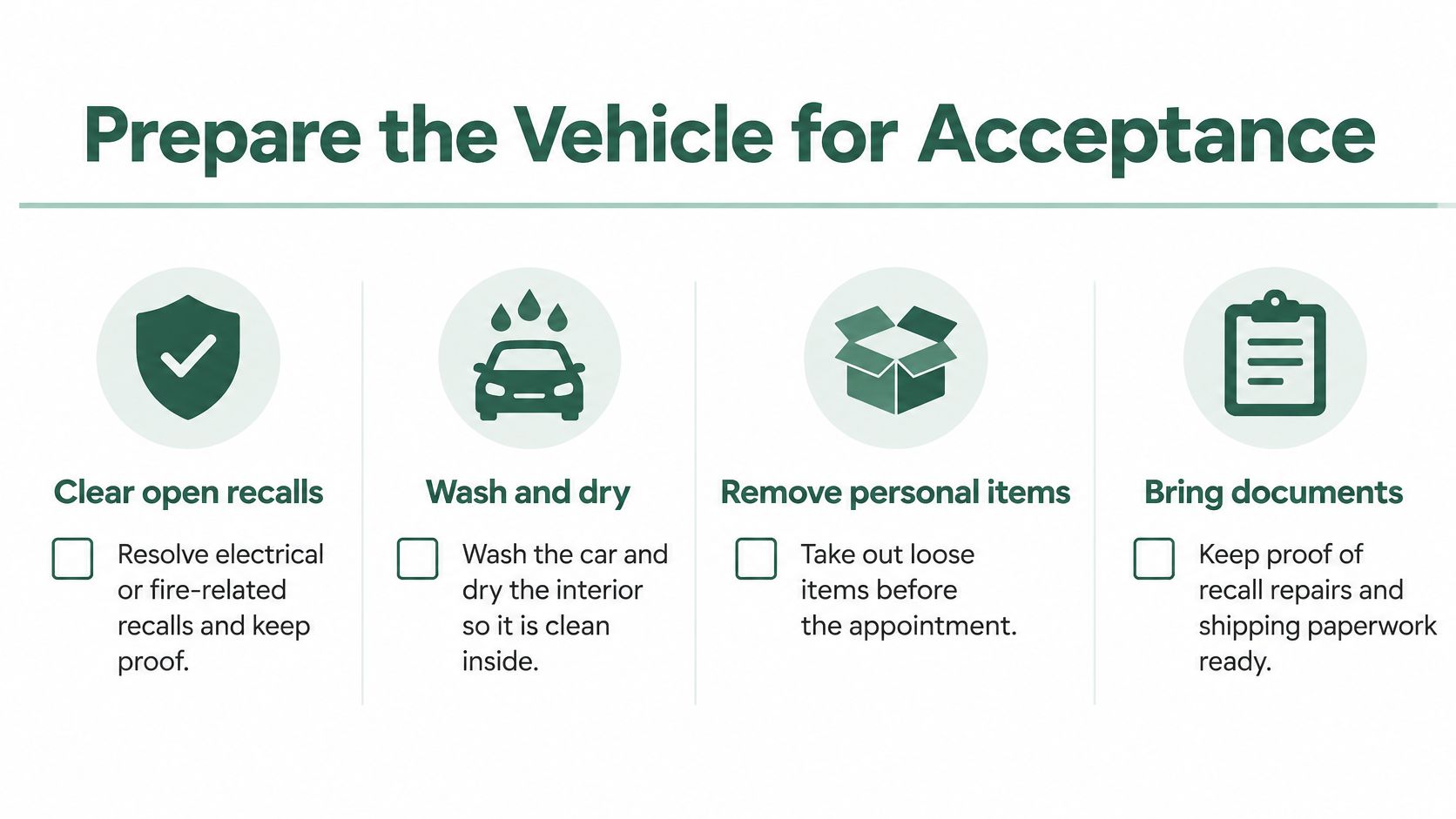
Resolve electrical and fire-related recalls. Check the VIN with the manufacturer and arrange any required repair. Keep proof that the repair is complete. An appointment confirmation alone does not show that the defect was fixed.
Wash the exterior and dry the interior. Clean wheel wells, remove mud and debris, and vacuum the cabin. A clean vehicle is easier to inspect, while moisture inside can cause problems during enclosed ocean transit.
Remove household goods and unauthorized cargo. The trunk is not extra space for a household-goods shipment. Ask the processing facility which operational or passenger items are allowed, such as a jack, tire tools, jumper cables, spare tire, child seat, or stroller.
Photograph the vehicle in daylight. Record each panel, the wheels, windshield, roof, interior, and odometer. Keep the original files. At delivery, compare the vehicle with the pickup inspection before signing.
Set the fuel level for the booked service. Check the gauge before the processing appointment. Too much fuel may require corrective work and put the scheduled sailing at risk.
Organize the document folder. Ask the receiving facility for its current checklist. Gather orders, photo ID, registration, ownership documents, and any required lienholder or lessor permission. If someone else will act for you, confirm what authorization that person needs.
Use this checklist while preparing the car:
Protect the inspection record
Photograph existing stickers and accessories so they appear in the condition record. Add military veteran decals after delivery if you want to avoid changing the vehicle between pickup and delivery photos.
For a domestic commercial leg, ask the carrier about its fuel and cargo rules. Vessel limits may not apply to that leg, but clear cargo areas and condition photos still help document the handoff.
Arrange destination pickup before leaving the vehicle. When a government-shipped POV is available, confirm the collection deadline in the notice or with the processing office. Missing that deadline can complicate pickup, so make sure you know who will collect the car and when.
A failed inspection is a schedule problem, not a paperwork technicality.
Choose Door-to-Door, Terminal, or Enclosed Service
A tight duty schedule can make a low shipping quote costly in time. Choose a handoff that fits your vehicle, route, and calendar, then compare the full arrangement rather than the transport price alone.
Match the service to the situation
| Service | Good fit | Question to settle before booking |
|---|---|---|
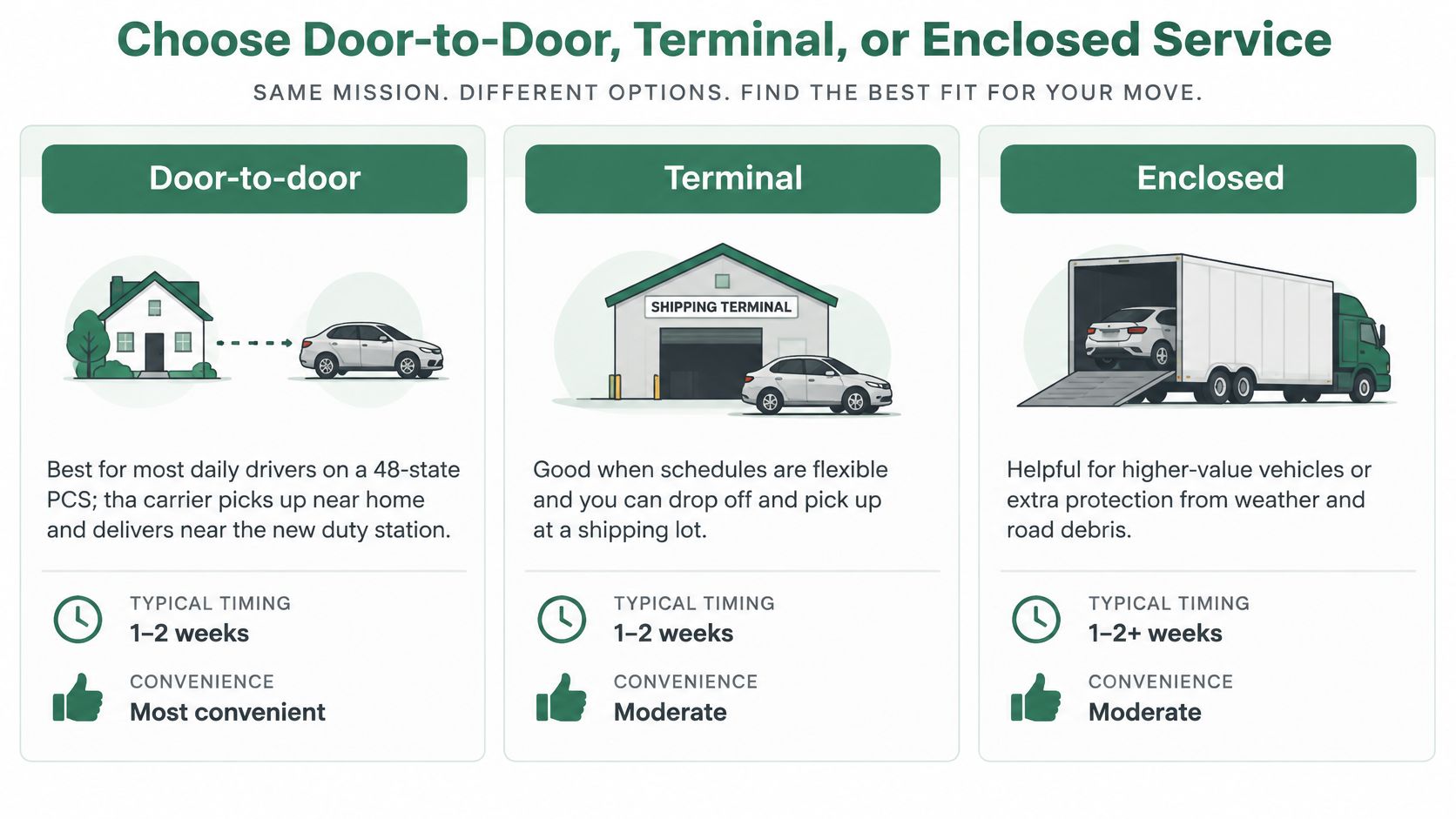
| Door-to-door open | Daily drivers and ordinary mainland relocations | Can the truck safely reach each address? |
| Terminal-to-terminal | Owners who can independently drop off and collect the car | What are the facility hours and storage conditions? |
| Enclosed | Classics, luxury cars, modified vehicles, and vehicles needing additional protection | What loading equipment and clearance can the carrier accommodate? |
| Door-to-port or port-to-door | Mainland–Puerto Rico shipments | Who handles each inland leg and destination release? |
With door-to-door auto transport, pickup and delivery take place at accessible locations near the requested addresses. Narrow streets, low branches, installation restrictions, or limited turning room can mean meeting the truck at a nearby spot instead.
Enclosed transport shields a vehicle from weather and road debris. Tell the coordinator about low ground clearance, nonstandard wheels, alarms, or modifications before carrier assignment. The trailer's loading equipment must suit the vehicle.
Terminal service may fit when someone can take the car to the facility while you travel. Factor in rides, facility hours, and possible storage charges. A terminal quote is only cheaper if those arrangements do not add costs or complications.
This comparison highlights the practical differences:
Separate movement from destination compliance
Puerto Rico adds an ocean leg and a San Juan handoff, which must be coordinated separately from delivery to a home or dealership. Ask who receives arrival notices, supplies release documents, and collects the vehicle. For this non-contiguous move, keep ocean freight, San Juan handling, and any Hacienda excise tax distinct from the transport quote. The shipment price does not by itself establish the vehicle's total landed cost or entitlement.
Under the Puerto Rico excise-tax statute, a bonded dealer introducing vehicles must file the applicable declaration no later than 10 days after taking possession. That dealer-specific deadline does not apply automatically to every private owner.
The carrier manages transportation and shipment records. The owner, dealer, or authorized importer must confirm declaration, payment, ownership, VIN, and registration requirements, and keep the bill of lading for that process.
Insurance needs a separate check. Copeland Insurance Agency's military insurance guide offers context for personal coverage questions during a PCS. Ask the shipping coordinator to explain carrier coverage, exclusions, and how to file a claim.
Flat Rates and Transit Times to Puerto Rico
A Puerto Rico move has two separate clocks: getting the vehicle to the ocean gateway, then moving it by sea and arranging release in San Juan. The distance to the gateway, the booked sailing, and the port handoff all affect the pickup-to-release schedule. Ask for a written route-specific estimate rather than relying on the ocean crossing alone.
For Puerto Rico car shipping, request a route-specific flat-rate quote that identifies the origin, destination handoff, vehicle, and services included. If the proposed route goes through Jacksonville and San Juan, have both locations and the sailing connection stated in the quote. A flat rate is useful only when its boundaries are clear.
Read the freight quote as a transport contract
Check whether the price covers mainland trucking, ocean freight, and port handling, and whether it includes delivery beyond San Juan. Ask how the agreement treats cancellation, a missed port cutoff, storage, extra handling, and destination delivery. Those terms explain what you may owe if the vehicle cannot make its planned handoff.
Keep these cost categories separate:
- Mainland trucking: Movement from the pickup address or terminal to the ocean gateway.
- Ocean freight: The booked vessel movement and its acceptance conditions.
- San Juan handling: Port services and release-related charges included in the transport agreement.
- Island delivery: Any onward movement to the actual receiving address.
- Government charges: Hacienda excise tax, registration, and other applicable destination costs.
Arrival in San Juan does not mean delivery to a home elsewhere on the island. If the receiving address is in Bayamón, Carolina, Guaynabo, Caguas, Ponce, Mayagüez, or Arecibo, give the carrier that destination and confirm whether collection or onward transportation is included.
A return shipment from Puerto Rico to the mainland needs its own quote. Direction can change documentation, charges, and sailing availability, so do not assume the outbound booking's terms will apply.
Calculate landed cost separately
Hacienda excise tax is separate from freight unless the agreement expressly says otherwise. The Department of Hacienda vehicle excise schedule starts at $637.50 for taxable value through $6,170 and reaches a top bracket of $9,253.10 plus 34.0% of value above $44,890.
That percentage applies to the value above the bracket threshold, not automatically to the vehicle's full value. Purchase price and Hacienda taxable valuation are not interchangeable, so check the official estimate before budgeting. Use SURI with the VIN or the vehicle's make, model, and year to estimate the excise tax. Military households should confirm how their particular orders apply with the appropriate office rather than assume an exemption or liability.
Budget checkpoint: Add transport, applicable tax, registration, onward delivery, and temporary transportation before comparing shipping with selling or storing the car.
The same cost separation helps snowbirds, students, dealerships, and business fleet managers. A clear freight quote shows the transportation portion; it does not necessarily cover every cost of putting the vehicle on the road.
Two PCS Paths Side by Side
The same transportation choices produce different plans when the orders and family calendars change. These hypothetical cases show how to make the decision without treating commercial shipping as an automatic military benefit.
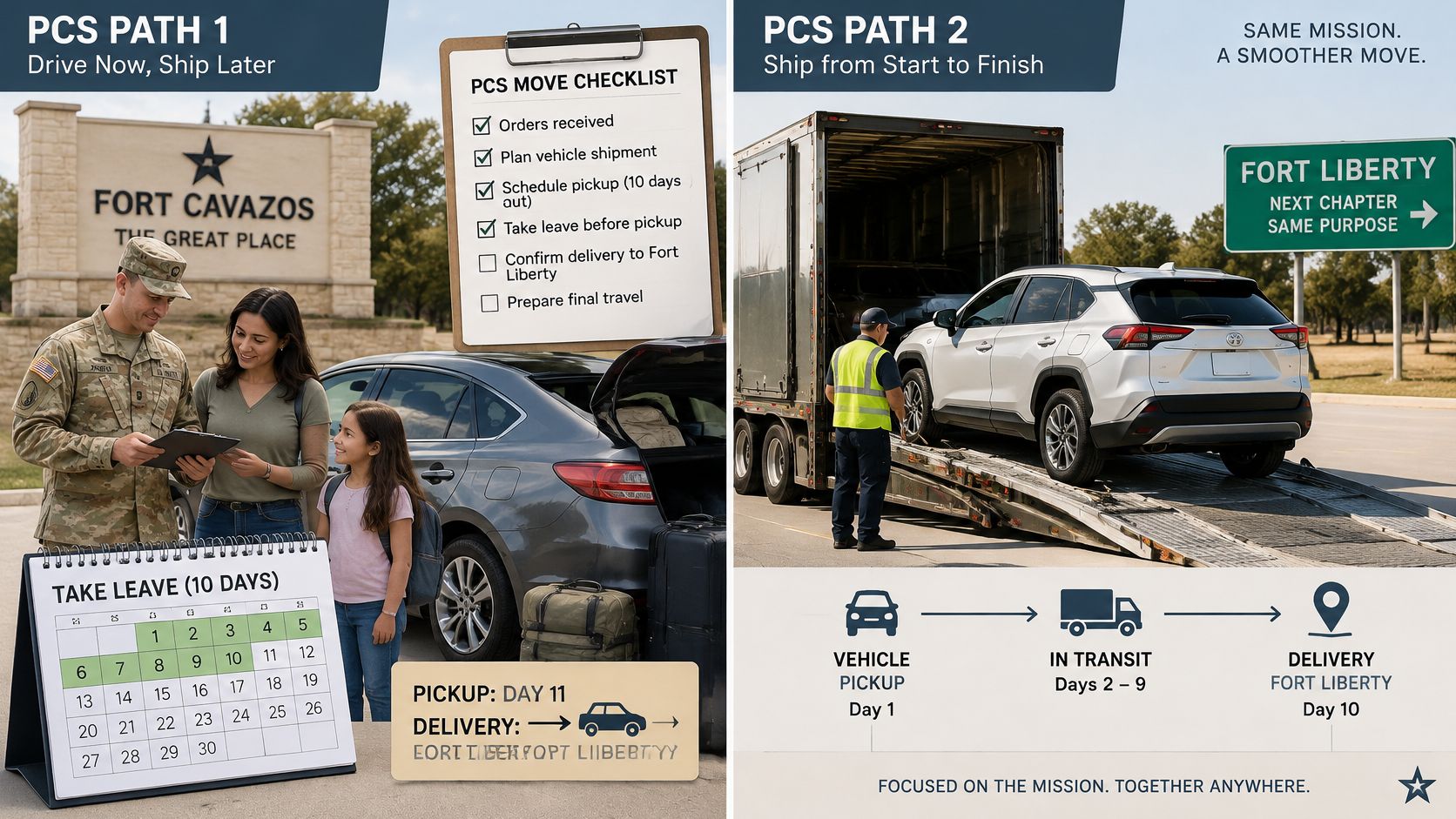
The visual contrasts the main paths:
A mainland move with conflicting departure dates
Say a soldier receives CONUS orders between a Texas installation and a North Carolina installation. The spouse needs the family sedan until the household-goods crew finishes, but the soldier must leave earlier to report.
The family asks the transportation office about the actual circumstances and receives confirmation that private shipping won't be reimbursed. They compare an open-carrier quote with the spouse's driving itinerary, lodging, and childcare arrangements, then choose the option that leaves a workable departure day.
Their booking names the spouse as the pickup contact and identifies a delivery location outside the installation if truck access isn't available. They keep kitchen boxes with the household goods, document the sedan's condition, and arrange local transportation until delivery.
The decision isn't that shipping is always cheaper. It's that the car and the reporting service member can't travel together without disrupting the rest of the move.
A Puerto Rico assignment with an additional family car
Now consider a Navy household leaving Norfolk for Puerto Rico. The transportation office confirms the authorized government vehicle shipment, and the family follows the official processing instructions for that car.
An additional vehicle used by a student dependent needs a separate commercial decision. The family checks ownership and shipping permission, requests an inland connection to the booked port, and names a receiving contact who can respond when the vehicle becomes available in San Juan.
Before committing, they check destination tax treatment and estimate applicable charges through SURI. They also decide whether the receiving contact will collect at the port or whether island delivery belongs in the quote.
Keep the handoffs in view while reviewing the available transport options:
Both households work backward from the report date, but neither assumes the vehicle must arrive on the same day as the family. A temporary ride, an authorized receiving contact, and a realistic pickup window can make a better plan than a delivery promise the carrier can't support.
Confirm Entitlement, Then Book Transport
Book the authorized plan, not the plan you hope will be reimbursed. A short conversation with the transportation office can prevent duplicate reservations, missed appointments, and a private bill you didn't budget for.
Use a confirm-then-book sequence
Resolve the entitlement. Ask whether your orders authorize vehicle shipment, storage, a driving allowance, or an exception requiring approval. Keep the answer and relevant amendments with your move documents.
Choose the correct booking channel. Follow official processing when the government arranges the car. If you're paying privately, compare written open, enclosed, or island-route proposals without double-booking the vehicle.
Make the quote complete. Supply the VIN, operating condition, ZIP codes, modifications, contact names, and report-date constraints. For island service, specify the port handoffs and any required onward delivery.
Check permission and payment terms. Have ownership documents, ID, and any required lienholder authorization ready. Ask whether a military or veteran discount applies and obtain the final price and conditions in writing.
Keep an advisor attached to the shipment
National Car Transport is a commercial option with 25+ years of experience, an A+ BBB rating, transparent flat-rate pricing, and a network of 25,000+ vetted carriers. Its U.S.-based bilingual English/Spanish agents have over 20 years of auto-transport logistics experience and coordinate vehicle-specific arrangements from pickup inspection through delivery.
Use the car-shipping cost guide to prepare your pricing questions. No shipment is identical, so an assigned agent should clarify the handoffs, explain exclusions, and help you choose practical service rather than quote a low headline price.
For a Florida connection, Forever Florida Insurance's discussion of Florida auto coverage for service members can help frame questions for your insurance agent. Confirm your own policy arrangements separately from the carrier's transportation coverage.
For a member-paid PCS vehicle, request a written quote that identifies the pickup window, transport type, and destination handoff, including Puerto Rico ocean service when needed. Visit National Car Transport with your vehicle details and confirmed entitlement to discuss a mainland or San Juan shipping plan built around your report date.