
Shipping a car overseas usually costs $850 to $4,500, and that number moves based on where the vehicle is going, how you ship it, and the car's size and weight. If you're moving to Puerto Rico, the math and timeline are different from a long-haul international route, and that's where clearer guidance is needed than the internet usually provides.
You're probably dealing with one of a few real-life situations right now. A military move. A job relocation. A seasonal move. A student heading to the island. A dealership trying to move inventory. Or you just bought a vehicle on the mainland and need it in San Juan without turning the process into a full-time job.
People frequently get tripped up. They ask one simple question, “What's the car shipping cost overseas?” and get a number with none of the parts explained. Then the quote changes, the port asks for documents they didn't prepare, and the final bill doesn't look anything like the first estimate. That's avoidable.
At National Car Transport, we've spent 25+ years helping customers ship vehicles across the mainland, Alaska, Hawaii, and Puerto Rico, with U.S.-based bilingual English and Spanish agents who've spent 20+ years in auto transport logistics. We know from experience that no two shipments are alike. One family shipping from Dallas to San Juan has a different route, timing, and paperwork path than a snowbird moving a sedan from Boston or a business shipping units from Los Angeles. Clear guidance matters.
Table of Contents
- Your Guide to Overseas Car Shipping Costs
- Understanding the Core Factors of Your Shipping Quote
- RORO vs Container Shipping Which Method is Right for You
- A Special Focus on Shipping a Car to Puerto Rico
- Navigating Customs Paperwork Duties and Taxes
- Your Shipping Timeline from Pickup to Delivery
- Expert Tips to Reduce Costs and FAQs
Your Guide to Overseas Car Shipping Costs
You get one quote to move your car overseas. Then a second company asks better questions about pickup, port access, title status, and destination release. That gap tells you everything. Overseas auto shipping is not one service. It is a coordinated chain, and the price only makes sense when each step is spelled out.
After two decades helping customers at National Car Transport, I can tell you where confusion starts. People compare a headline number without checking what is included. A real overseas move can involve inland transport, port handling, vessel booking, document review, customs coordination, and final release. Miss one of those pieces and the “cheap” quote usually stops being cheap.
Published estimates for overseas car shipping from the United States vary widely, which is normal for this market. The final number changes with route, vehicle size, method, and how much support you need before and after the ocean leg. If you have ever compared specialty moving quotes, the same principle applies in other industries too, including Get n Go Removals' piano pricing. The base number is only useful once you know the service scope.
Puerto Rico needs separate attention. It sits in a gray area for many customers because it is a U.S. territory, but the transport process still runs through a port system with vessel schedules, cargo cutoff times, inspections, and release procedures. Domestic-only carriers often oversimplify this route. That is a mistake.
Why customers get confused
The problem is rarely the ocean crossing itself. The problem is the handoff between stages.
Customers shipping from the lower 48 to San Juan often focus on one question: “What does it cost?” The better question is: “What exactly is my quote covering from pickup to release?” A car leaving Miami is one type of job. A car starting in Denver, Phoenix, Chicago, or Boston is another. The mainland leg, terminal process, and scheduling window can change the price just as much as the vessel booking.
These are the details that usually move the number:
- Origin location: Distance to the departure port affects inland transport and timing.
- Vehicle size and condition: Larger or non-running vehicles often cost more to handle.
- Shipping setup: Terminal drop-off, port delivery, or door-to-port service each price differently.
- Cargo restrictions: Personal items inside the vehicle can limit your shipping options.
- Destination release needs: The person receiving the car must be prepared with the right documents and timing.
Good advice goes beyond a broad range. It explains what raises the price, what slows the job down, and what you can control before booking.
If you are shipping to Puerto Rico, treat the move as a full logistics plan, not a simple rate request. That coordination is the difference between a smooth shipment and a frustrating one.
Understanding the Core Factors of Your Shipping Quote
A real shipping quote is a cost map, not a teaser rate. If you are sending a vehicle overseas, and especially if you are booking the U.S. to Puerto Rico lane, the number only makes sense once you know which parts of the move are included and which parts will be billed later.
The base quote is only the starting point
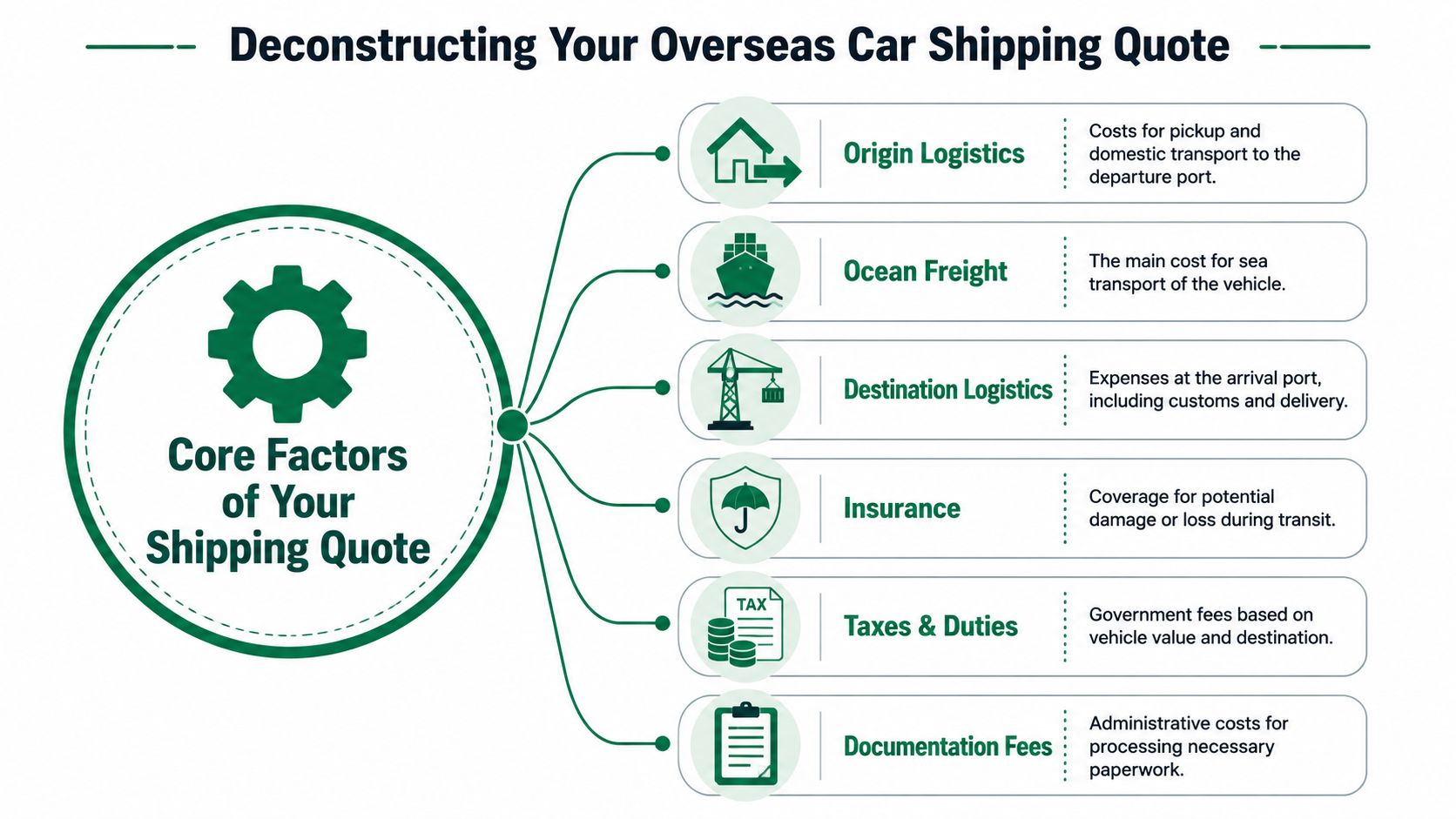
A good quote breaks the job into stages. That matters because overseas vehicle shipping is rarely one charge from start to finish. You are paying for coordination across pickup, port handling, ocean transport, document review, and release.
Here is what should be spelled out before you book:
| Quote component | What it covers | Why it changes |
|---|---|---|
| Origin logistics | Pickup or inland move to the departure port | Distance from your home or business to port |
| Ocean freight | Vessel space for the vehicle | Route demand, method, and destination |
| Destination logistics | Port handling and release steps | Local rules, terminal process, final delivery needs |
| Insurance | Transit protection | Vehicle value and coverage terms |
| Taxes and duties | Import-related charges | Destination rules |
| Documentation fees | Processing and filing paperwork | Shipment type and destination requirements |
This pricing structure is not unique to auto transport. Specialty movers price the same way. A useful comparison is Get n Go Removals' piano pricing, where access, handling difficulty, and route complexity all change the final bill. Vehicle shipping works the same way. The car is only one part of the job. The handling chain is the other.
The charges that change your quote fastest
I tell customers to focus on the items that move the price quickly, because those are the ones that create confusion later.
- Vehicle size and weight: A full-size truck or large SUV costs more to move than a sedan because it takes more space and can require different handling.
- Operable or non-running condition: A vehicle that cannot roll, steer, or brake normally often triggers extra labor and equipment charges.
- Shipping method: The method affects both price and eligibility. I cover that choice in detail in the next section.
- Origin and destination setup: Port drop-off is priced differently from inland pickup. The same applies on the destination side.
- Route frequency: Common shipping lanes are usually easier to schedule and price than less active routes.
- Season and vessel space: Tight capacity raises rates, especially when bookings bunch up around summer moves, military relocations, and year-end demand.
For Puerto Rico shipments, one detail gets overlooked all the time. Mainland distance still matters. A car leaving Jacksonville or Miami is a very different quote from a car that first needs to move from Seattle, Denver, or Minneapolis to the port. Customers fixate on the water leg and miss the inland leg. That is where many quote gaps start.
Ask this before you approve any rate
Ask one direct question: What will I owe before the vehicle is released?
That question exposes weak quotes fast.
Some companies show a low front-end number, then leave terminal handling, documentation support, release fees, or destination services vague. In the Puerto Rico corridor, that is a bad way to buy. You want the full path explained in plain language, from pickup in the lower 48 to release in San Juan.
Practical rule: If one quote is far below the rest, assume it is incomplete until someone shows you every charge in writing.
The best quote is not the cheapest one on page one. It is the one that tells you exactly who is handling each stage, what is included, what is excluded, and what happens if the vehicle arrives late, inoperable, or missing paperwork. That is how experienced agents keep an overseas shipment under control.
RORO vs Container Shipping Which Method is Right for You
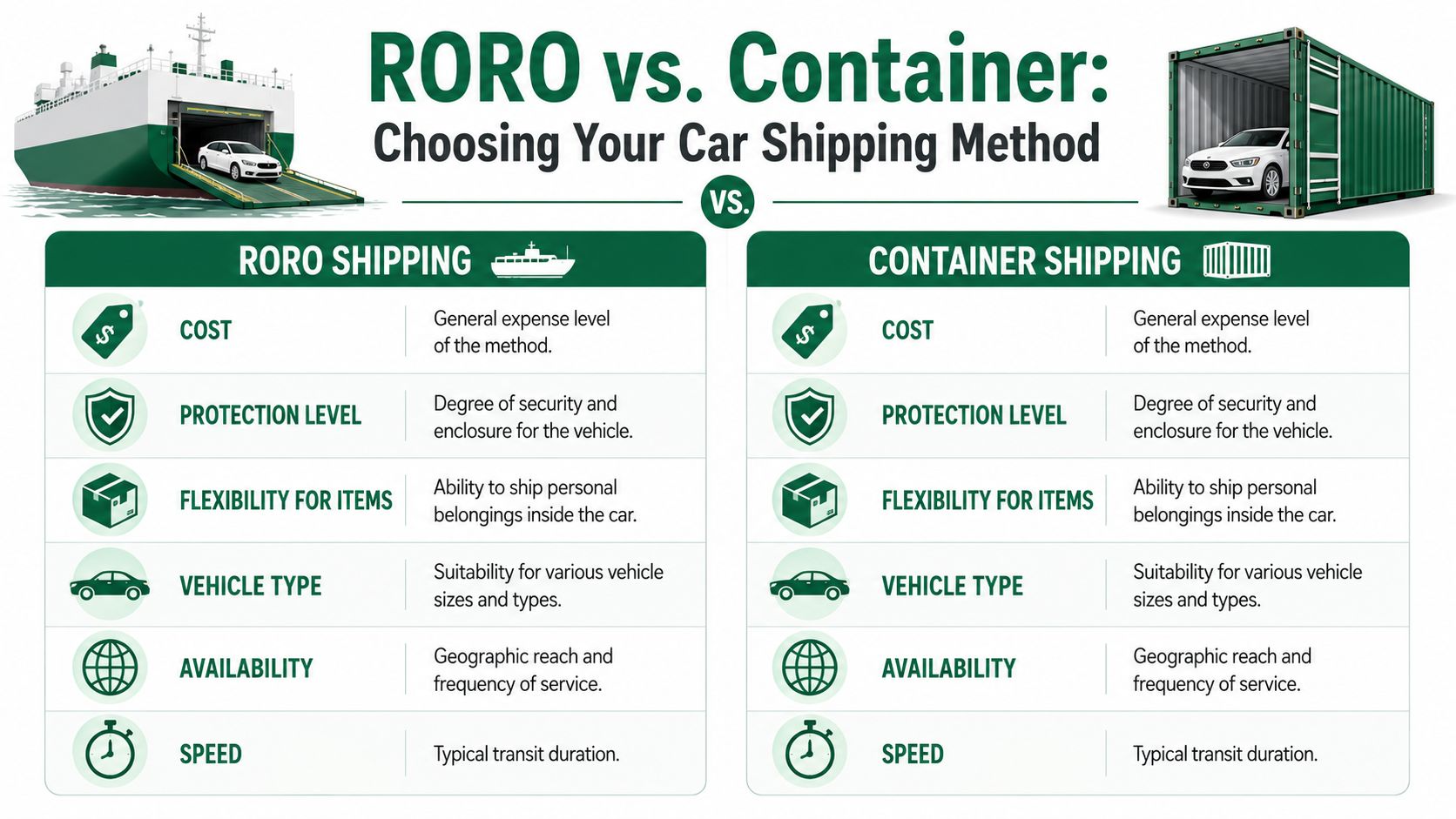
The shipping method sets the rules for your move. It affects price, vehicle eligibility, handling, and how much protection you get in transit. On the mainland to Puerto Rico lane, this choice is usually straightforward once you match the method to the car.
Choose RORO when you have a standard running vehicle
RORO, short for Roll-on/Roll-off, is the practical choice for daily drivers that run, steer, and brake normally. The vehicle is driven onto the vessel, secured on the ship, and driven off after arrival. That process keeps handling simple, which is why RORO is usually the lower-cost option.
For many Puerto Rico shipments, RORO should be your first quote.
It works best for customers shipping a normal sedan, SUV, or pickup who want a clean port-to-port ocean move without paying for enclosed space. It is also the method I recommend first for military relocations and household moves when the vehicle itself is not rare, oversized, or delicate.
Keep the limits in mind:
- Best for: Operable daily drivers and budget-focused shipments
- Less suitable for: Collector cars, luxury vehicles, lifted trucks with special clearance concerns, and non-running units
- Personal items: Rules are tight, and you should assume the vehicle must stay empty unless your agent gives written approval for a specific exception
Trouble starts when customers book the cheapest method first, then ask for special handling, extra cargo, or help with an inoperable vehicle later. Those changes can delay the booking or force a method change.
Choose container shipping when the vehicle needs more protection or flexibility
Container service gives you more control over how the vehicle moves. The car is loaded into an enclosed container, secured inside, and protected from open exposure during the ocean leg. If you are shipping a higher-value unit or a vehicle with low production value to you personally, that added protection is worth paying for.
For the Puerto Rico corridor, container shipping is often the right call for:
- classic and collector vehicles
- luxury cars
- non-running vehicles
- vehicles with custom parts or lower ground clearance
- business shipments that need tighter handling control
Container shipping also gives shippers more options. You may use a shared container to manage cost or book an exclusive container if privacy and direct control matter more than price.
Here is the practical way to choose:
| Method | Usually better for | Main tradeoff |
|---|---|---|
| RoRo | Operable daily drivers, budget-focused shipping | Less flexibility, less enclosure |
| Consolidated container | Higher-value vehicles, customers wanting more protection | Slightly higher price |
| Exclusive container | Maximum control and privacy | Higher cost than shared options |
My advice is simple. If your vehicle is a standard runner, start with RORO. If the car is valuable, modified, non-operational, or hard to replace, price container service immediately and do not try to save a few hundred dollars in the wrong place.
To see the handling differences in motion, this short video gives a useful visual overview of overseas vehicle shipping.
If you're shipping a collector car, a luxury vehicle, or a non-runner, pick the method that fits the vehicle first and the budget second.
A Special Focus on Shipping a Car to Puerto Rico
Puerto Rico is where general overseas advice stops being enough. This route has its own rhythm, and if you're shipping from the U.S. mainland to San Juan, you need to think in two legs: mainland transport to the port, then ocean transport to Puerto Rico.
How the mainland to Puerto Rico process actually works
Let's use a realistic path.
A customer in Orlando, Miami, Dallas, Atlanta, Chicago, Phoenix, Los Angeles, or another mainland market first needs to move the vehicle into the Puerto Rico export lane. Sometimes that means direct drop-off near the port. Sometimes it means domestic transport from inland cities before the vessel leg even begins.
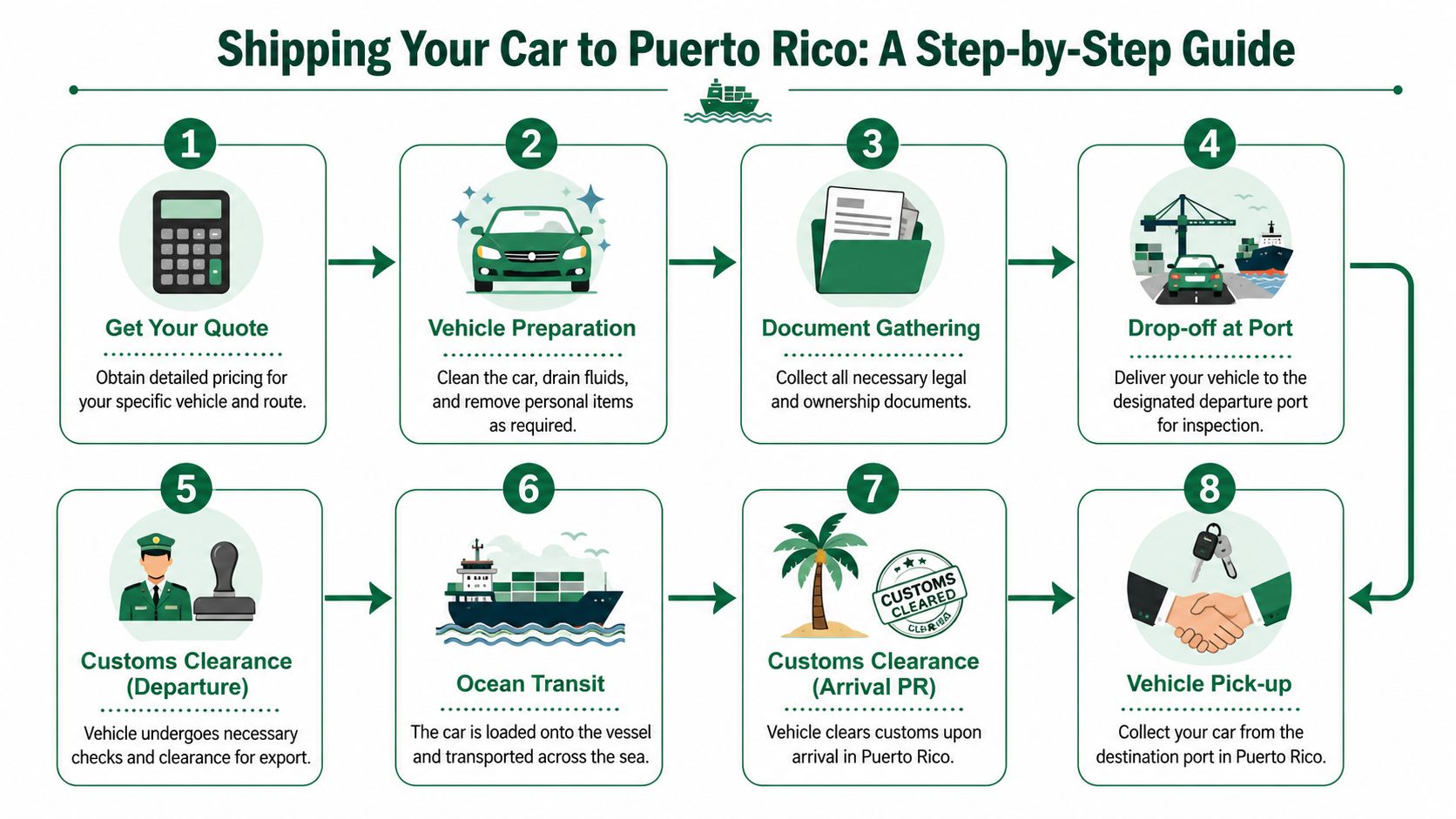
Once the vehicle reaches the departure point, the process becomes more port-driven:
- Quote and booking
- Vehicle prep
- Document review
- Port delivery
- Export clearance
- Ocean transit
- Arrival processing in Puerto Rico
- Pickup in or near San Juan
This route moves faster than many full international lanes. Shipping from Orlando, FL to San Juan, PR at 1,609 miles takes 8 to 9 days and costs approximately $1,649, while Miami to San Juan at 1,181 miles takes 9 to 11 days, with pricing affected by fuel, vessel availability, and market demand, according to Montway's Puerto Rico shipping explainer.
What Puerto Rico pricing usually depends on
Puerto Rico rates are heavily shaped by vehicle dimensions and the lane feeding into the port. If you're moving a standard passenger vehicle, the quote is more predictable. If you're moving a taller van, lifted truck, or oversized unit, the price changes quickly.
A useful benchmark comes from Jacksonville to Puerto Rico. Vehicles under 82" width and 76" height cost $1,202, while units measuring 77–100" height cost $1,302, with listed fees including bunker, environmental, TAC security, port, terminal, handling surcharges, and SED export declaration in TOTE Maritime's Puerto Rico personal vehicle pricing.
That's a good reminder that “my car is only slightly bigger” still matters in shipping.
Here's the practical breakdown:
- Standard-size vehicles: Easier to fit into routine pricing brackets
- Taller or oversized vehicles: More likely to trigger higher charges
- Mainland origin city: Affects how much inland transport is needed before the ocean leg
- Timing: Peak periods can tighten vessel space and raise costs
RoadRunner notes that Puerto Rico shipping usually takes 1 to 3 weeks on average, and peak periods can increase costs by up to $400 to $500 per week in its Puerto Rico car shipping overview. That matters for snowbirds, military families, and students who are all trying to move around similar calendar windows.
Who usually benefits most from this route
Puerto Rico shipping isn't just for one type of customer. I see the same corridor serve very different needs:
- Military families: PCS schedules don't leave much room for mistakes.
- Snowbirds and seasonal residents: They need reliability more than drama.
- Students: Timing and budget usually matter equally.
- Dealerships and businesses: Consistency matters more than one-off bargain pricing.
- Families relocating full time: They often need mainland pickup plus port coordination in one plan.
For this corridor, having one dedicated agent matters because mainland dispatch, port cutoffs, and release timing have to line up. Not one vehicle transport is alike. The customers who do best are the ones who work from a complete route plan, not a single attractive quote.
Navigating Customs Paperwork Duties and Taxes
A shipment can be booked correctly, loaded on time, and still turn into a headache at the destination if the paperwork is sloppy or the charges were never spelled out. I have seen that happen more often than any ocean transit problem.
What your shipping quote may not include
A low quote means very little without line-by-line detail.
Customers often focus on the ocean rate and miss the charges that appear later. You need to ask about origin handling, destination terminal fees, document processing, marine insurance, port storage if pickup is delayed, and any local taxes or duties. Customers then get hit with charges they assumed were already built into the price.
That matters even more on overseas moves because every destination handles imports differently. Duties, release fees, inspections, and tax rules vary by country. If your route is not Puerto Rico, get the destination charges confirmed in writing before the vehicle reaches the port.
Puerto Rico deserves special attention because many customers ask about arbitrios and assume someone will sort it out after arrival. That is the wrong approach. The amount depends on the vehicle and current local rules, so verify it before the car sails and build it into your budget from day one.
A good quote shows the transport charge, port charges, paperwork fees, insurance options, and destination costs separately.
If a company cannot explain each fee clearly, keep shopping.
Documents you should have ready early
The paperwork itself is straightforward. The timing is what causes trouble.
Have these documents ready before the vehicle goes to the port:
- Vehicle title: Confirms ownership for export and release
- Bill of sale: Helps when the vehicle was recently purchased or title details need support
- Government-issued ID: Must match the booking and ownership records
- Booking confirmation and shipping instructions: Keeps delivery, contact, and release details consistent
- Destination-specific forms: Required forms vary by route and port
Preparation goes beyond documents. Clean the vehicle so inspection is easy. Remove personal items if the carrier does not allow them. Keep a working key available. Make sure the vehicle starts, rolls, and can be inspected without argument.
Puerto Rico shippers, military families, and business accounts usually benefit from one dedicated agent handling the file from booking through release. That keeps the title review, port cutoff, and arrival paperwork aligned. One missing document can cost you days.
Paperwork is not complicated. Late paperwork is expensive.
Your Shipping Timeline from Pickup to Delivery
A customer in Denver books a car for San Juan and expects one delivery date. What they need is a realistic sequence. Overseas auto transport runs on handoffs, port cutoffs, vessel schedules, and release procedures. That is even more important on the Puerto Rico lane, where the ocean leg is usually manageable but missed paperwork or a late port arrival can still cost you days.
The timeline starts before the vehicle reaches the port. Inland pickup can take time, especially from states far from the departure terminal. After that, the vehicle still has to clear origin inspection, match the booking details, meet the port cutoff, and wait for loading. Good agents plan those steps backward from the sailing date instead of guessing and hoping the car gets on the next vessel.
Here is the normal flow:
- Mainland pickup or terminal drop-off
- Origin inspection and booking confirmation
- Port intake and loading schedule
- Ocean transit
- Arrival unloading and terminal handling
- Release review, including customs if the route requires it
- Final pickup or local delivery
Each phase has its own delay risk.
In my experience, the biggest scheduling mistake is treating ocean transit as the whole job. It is only one segment. A car can sit longer waiting for pickup, miss a cutoff at the port, or wait on release documents after arrival. That is why I tell customers to plan around a delivery window, not a single promised day.
Puerto Rico shipments usually feel simpler than broader international moves because the route is shorter and the process is more familiar to U.S. shippers. Even so, the file has to stay clean from start to finish. If your title, booking name, vehicle details, or contact information do not line up, the delay does not happen at sea. It happens at the handoff points.
Arrival is where many customers lose patience. The vessel can be in port, but the car is not ready for release the minute it docks. Terminal handling, document matching, and local processing still have to be completed. For Puerto Rico, that final stage often decides whether the move feels organized or frustrating.
The best timeline is the one with buffer built in.
If you are shipping from inland states such as Ohio, Tennessee, Colorado, Nevada, or Missouri, give the origin side extra room. If you are shipping to Puerto Rico for a military move, a household relocation, or fleet support, use one dedicated agent to control the file from pickup through release. That is how you keep a routine shipment from turning into a port problem.
Expert Tips to Reduce Costs and FAQs
A costly overseas shipment usually goes wrong before the car reaches the port. The owner books late, picks the wrong shipping method, or treats Puerto Rico like a generic international route. That is how a manageable move turns into extra storage fees, missed sailings, and a quote that grows after booking.
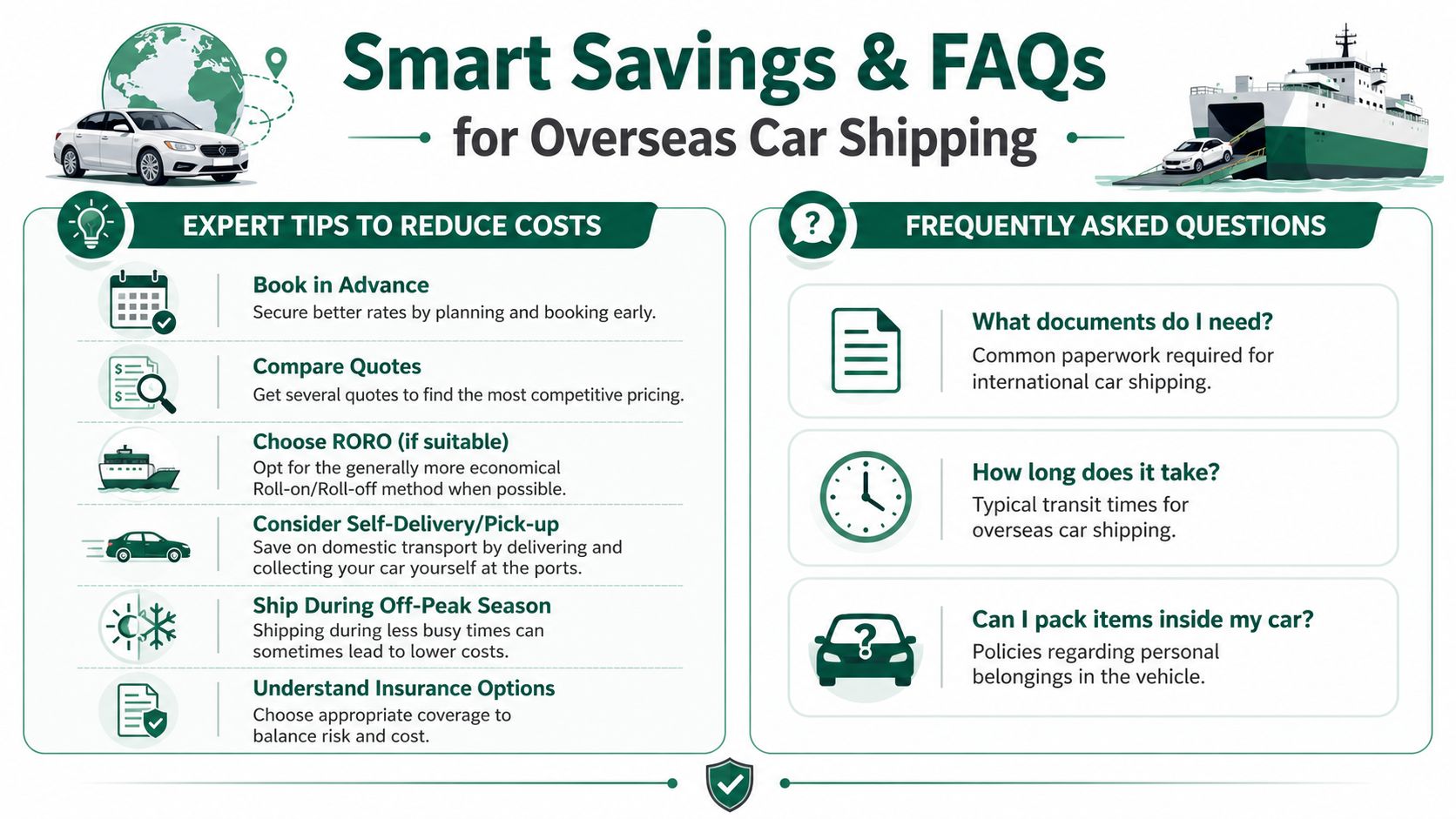
Smart ways to keep costs under control
Start with the decision that affects price the fastest. Book early. Good vessel space, solid inland carrier coverage, and realistic port schedules get tighter as your timeline shrinks. Last-minute bookings limit your choices and usually cost more.
Then make the moves that lower the bill:
- Use RoRo if your vehicle qualifies: For a standard operable vehicle, RoRo is usually the better value. Choose container service only when you need added protection, you are shipping a high-value vehicle, or your route requires it.
- Deliver the vehicle to the port yourself if the drive makes sense: That can cut inland transport charges, especially on the mainland side.
- Keep the vehicle empty unless you booked a method that allows cargo: Personal items create inspection problems, weight issues, and port delays.
- Clean the car and document its condition before pickup: A dirty vehicle can slow inspection, and weak photo records make damage claims harder.
- Ask for an itemized quote: You need to see the inland leg, port charges, ocean freight, and destination fees separately. If a company cannot break down the price, do not trust the number.
- Use one agent for the full file: Puerto Rico moves go better when one person tracks the booking from mainland pickup through port release.
One more point matters for Puerto Rico. Flexibility on the mainland pickup date helps more than people expect. If your ship date is fixed but your pickup window is too tight, the whole file gets harder to control.
A common question is whether you can pack the car with personal belongings. The answer depends on the shipping method. Container shipping allows it, while RoRo strictly forbids anything beyond a spare tire and jack, according to Schumacher Cargo's car shipping guidance. If you need to move household goods with the vehicle, say that at the start, before anyone books the wrong service.
Common questions
Is marine insurance included?
Sometimes. Sometimes only basic coverage is included. Ask for the coverage terms in writing, the claim limits, and what deductibles apply.
Do military families get a different process?
The route still depends on clean documents, realistic scheduling, and port release coordination. Military customers usually need tighter planning because report dates are fixed and delays are less forgiving.
Should I buy a car instead of shipping mine?
Ship your current vehicle if it is reliable, paid off, and fits your needs in Puerto Rico. Buy locally only if your vehicle has low value, known mechanical issues, or the total shipping and registration cost makes replacement the better financial move.
What is the best choice for Puerto Rico?
For many mainland to San Juan shipments, the best plan is simple. Use the shipping method that fits the vehicle, separate the inland and ocean charges on the quote, and work with one agent who handles the file all the way to release.
If you want a no-pressure plan instead of a vague estimate, talk with National Car Transport. We handle car shipping across all 50 states and Puerto Rico with transparent flat-rate pricing, an A+ BBB rating, and a network of 25,000+ vetted carriers. Our bilingual U.S.-based agents speak English and Spanish, and many have over 20 years in auto transport logistics. That matters because not one vehicle transport is alike. Whether you're shipping from Miami, Orlando, Jacksonville, New York, Chicago, Dallas, Los Angeles, or anywhere else in the mainland to San Juan, we'll walk you through the process step by step and keep it simple, quick, and priced clearly.