
Shipping a car from Florida to California usually lands between $1,050 and $2,615 for open transport, and the trip commonly takes 7 to 15 days. That's the working range on this 2,703-mile lane, not the bait number you see in a flashy ad.
Most articles stop there. That's not enough. If you want to understand car shipping cost from Florida to California, you need to know how the lane works, how carriers think, and how to read a quote without getting sold a number that won't get a truck to your driveway.
This route is one of the classic cross-country auto transport lanes in the U.S. It matters for relocations, snowbirds, military moves, student moves, dealership transfers, and seasonal traffic between major Florida cities like Miami, Orlando, Tampa, and Jacksonville and California markets like Los Angeles, San Diego, Sacramento, and the Bay Area. It also sits inside a broader nationwide network that includes all 48 states, Alaska, Hawaii, and Puerto Rico, where port logistics change the math completely. For Puerto Rico moves, San Juan is the central island port commonly referenced by shipping guides, while Jacksonville is often treated as the primary mainland port, though some carriers also work through Long Beach and Philadelphia, which can change both timing and handling logistics (Puerto Rico vehicle shipping routes).
If you're shipping a daily driver, the job is simple. Get a realistic rate, stay flexible, and avoid overpaying for services you don't need. If you're shipping a classic, luxury car, or a vehicle to or from Puerto Rico, the details matter more because route type, port handling, and trailer type move the final price fast.
Table of Contents
- What the Florida to California Lane Actually Looks Like
- How Distance and Per Mile Pricing Set the Baseline
- Open vs Enclosed Transport and What the Upgrade Really Buys You
- What Moves Your Quote Up or Down
- How to Estimate Your Own Florida to California Cost
- Practical Ways to Bring the Price Down
- What Happens After You Book the Shipment
- Putting It All Together Before You Get a Quote
What the Florida to California Lane Actually Looks Like
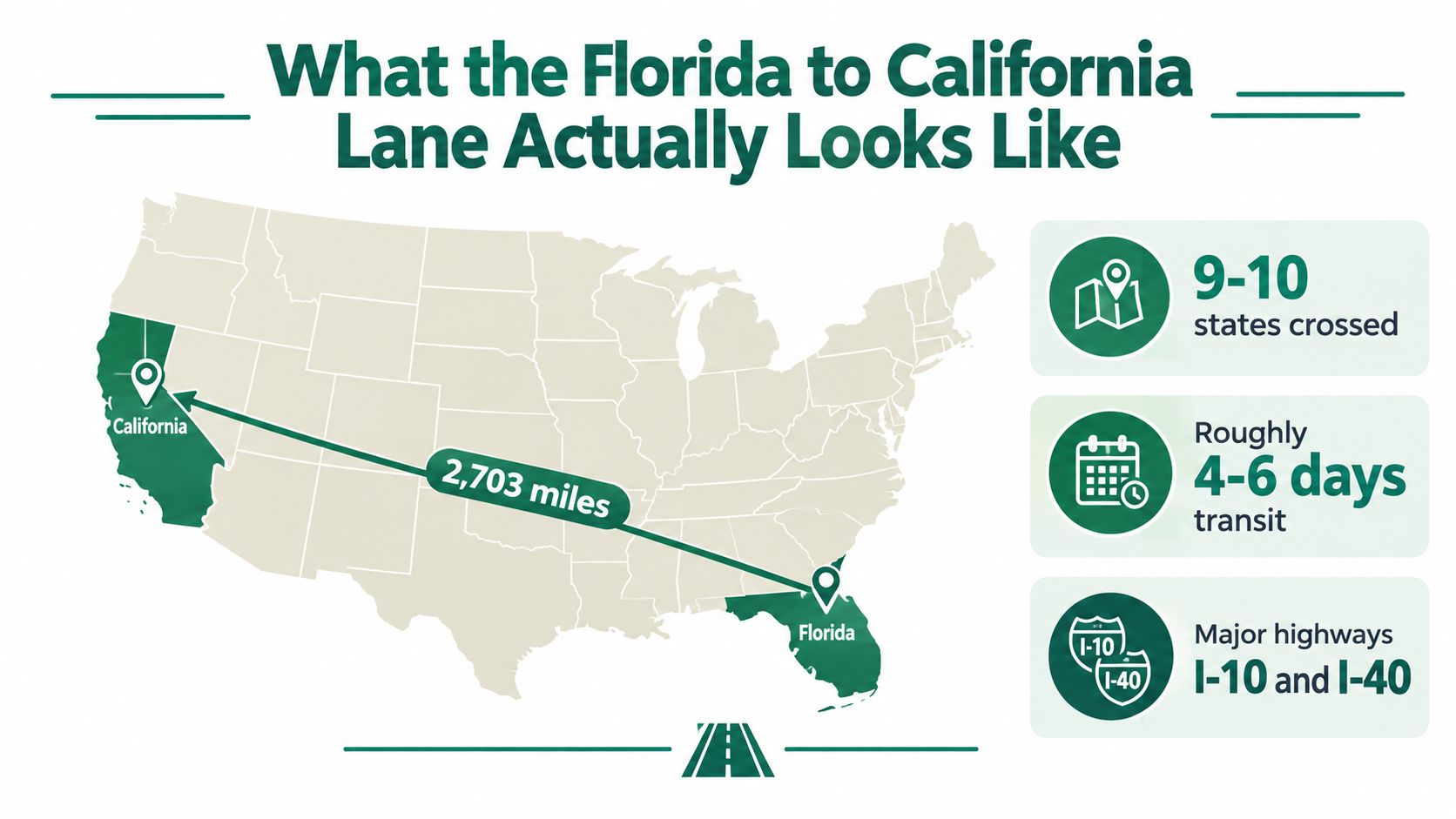
2,703 miles is the working length of this Florida-to-California run, according to Florida to California route overview and pricing. That distance matters because this is not some oddball route a carrier has to invent on the fly. It is a repeat lane with steady volume, familiar interstate routing, and enough demand that dispatchers can price it with real confidence instead of guessing.
That is also why the headline range only gets you so far. A quote on this lane is built from a known long-haul base, then adjusted for trailer type, vehicle size, season, and how far your addresses sit from the main freight path. If you want to read a quote properly, start there.
Why this lane usually books cleaner than others
Carriers like density. Florida gives you Miami, Orlando, Tampa, and Jacksonville. California gives you Los Angeles, San Diego, Sacramento, and the Bay Area. Those metros produce enough shipments that trucks can stay loaded instead of burning empty miles getting into or out of the job.
That matters more than first-time shippers expect.
Dispatcher rule: The closer your pickup and delivery are to major metro freight corridors, the less deadhead a carrier absorbs, and the more honest the quote usually is.
A Miami-to-Los Angeles move is usually simpler to place than a pickup in a small inland Florida town with delivery to a remote California suburb. The truck still has to cross the country either way. The extra cost often shows up on the edges, not in the middle.
What the lane really looks like in dispatch
On paper, this is one long coast-to-coast shipment. In real dispatch, it is a chain of workable segments. A carrier has to get to your pickup, load the car into the right position on the trailer, run the main interstate route, manage other customer stops, then work your delivery into the unload order.
That is why broad timing windows on this lane are normal. A truck is not driving your car nonstop from one address to the other. It is running a revenue route with multiple vehicles, legal driving-hour limits, fuel stops, weather exposure, and traffic delays in two of the busiest states in the country.
The first quote mistake to avoid
Do not judge a Florida-to-California quote by the total alone. Read the route first.
Ask three direct questions:
- Is this metro to metro, or am I paying for out-of-route pickup or delivery?
- Is the quote built for open or enclosed transport?
- Is the date window flexible enough for a carrier to accept the job?
If a quote looks cheap but your addresses sit far from major corridors, or your timeline is tight, that low number may be padding in reverse. It gets posted low, then raised later when no truck takes it. That is common on this lane, and it is one of the easiest ways to waste days.
What actually changes the number on this route
Four things move this lane fast:
- Vehicle size: Sedans are easier to load and easier to fit than long-bed trucks, lifted SUVs, or oversized vans.
- Trailer type: Open is standard. Enclosed costs more because capacity is tighter and the equipment is different.
- Timing: Peak season and short notice push pricing up.
- Endpoints: Major-city access usually prices better than rural or hard-to-reach addresses.
That is the shape of the lane. The route itself is familiar. The final number depends on how easy your specific shipment is to add to that route without costing the carrier extra time, space, or empty miles.
How Distance and Per Mile Pricing Set the Baseline
Long-haul pricing gets misunderstood because people fixate on the total and ignore the math. Carriers don't.
On a lane this long, published cost guidance shows that per-mile rates usually fall as distance increases. One pricing estimator shows about $1.00 to $1.80 per mile for 0 to 500 miles versus roughly $0.45 to $0.75 per mile for 2,000+ miles, and another open-carrier guide says cross-country rates can drop to about $0.33 per mile on 3,000 to 3,500-mile routes (distance-based car shipping cost estimator).
That's why a short run can look expensive per mile while a coast-to-coast move looks cheaper per mile but still costs more overall. Fixed costs get spread out. Fuel, labor, and equipment use still keep climbing with distance.
The baseline math on this lane
For Florida to California, the verified route data works out to an implied long-haul rate of about $0.63 to $0.97 per mile on the broader average shipment range tied to this corridor. That's a believable number for a major coast-to-coast lane.
Here's the clean way to sanity-check any quote. Take the lane mileage, compare it to the type of trailer, then ask whether the total fits the route instead of asking whether it's the “lowest.”
| Per-Mile Pricing on the Florida to California Lane | Lane Length | Typical Per-Mile Rate (Open) | Sample Total | Per-Mile Rate (Enclosed) | Sample Total |
|---|---|---|---|---|---|
| Long-haul Florida to California | 2,703 miles | about $0.63 to $0.97 | about $1,699 to $2,615 | qualitatively higher than open on this lane | varies by carrier and vehicle |
How to use this without overthinking it
If your quote falls wildly outside the normal long-haul pattern, stop and ask why. Some quotes are low because they aren't real dispatch numbers. Some are high because the company padded the margin or built in a hard pickup promise.
A simple way to compare pricing is to line up the rate against published cost guidance, then compare it with route-specific examples on a tool like the car shipping cost guide from National Car Transport. You're not looking for perfect precision. You're looking for whether the quote is in the market.
If the per-mile math doesn't make sense, the quote probably doesn't either.
Open vs Enclosed Transport and What the Upgrade Really Buys You
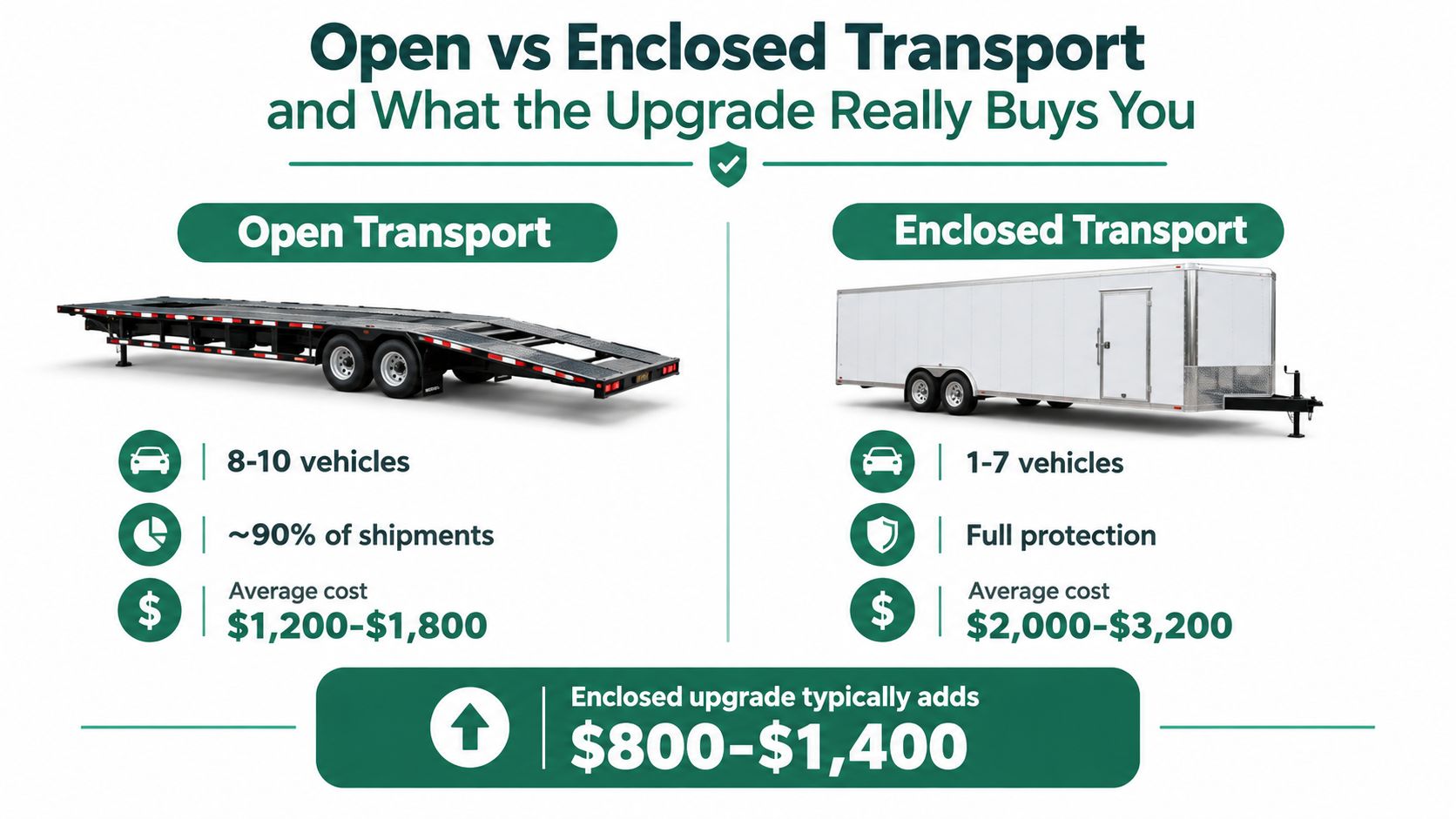
On a 2,703-mile Florida-to-California move, enclosed shipping usually adds roughly $1,000 or more over open. That is not a cosmetic upgrade. It is a different service level with a different trailer, tighter capacity, and a smaller pool of carriers.
One current route guide puts open transport around $1,350 to $1,500 and enclosed around $2,360 to $2,625 on this lane, while also showing open quotes on some bookings closer to $1,050 to $1,525, depending on timing and setup (Florida to California open and enclosed pricing).
That spread matters because people get sold on fear instead of fit. For a regular daily driver, open is usually the right buy. For a high-dollar car, a fresh repaint, or a vehicle with real collector value, enclosed earns its keep.
What open transport actually buys you
Open transport buys you market pricing, more available trucks, and faster matching on a busy coast-to-coast lane. That is why dispatchers book so much of it.
If you are shipping a standard sedan, crossover, SUV, or pickup, open is the default for a reason. It works. The car rides outside, so expect dust, road film, and the normal grime that comes with long-haul trucking. That is inconvenience, not a crisis.
What you are paying for with enclosed
Enclosed transport buys protection from weather and road debris, but it also buys access to a narrower carrier network. Fewer enclosed trailers run this lane, so the quote climbs faster and your pickup timing can get tighter.
Pay for enclosed if the car would be expensive to correct cosmetically or hard to replace. Good examples:
- Classic cars with aging paint, trim, or glass
- Luxury vehicles where finish condition affects value
- Exotics and collectibles with low ground clearance or specialty handling needs
- Fresh restorations that should not ride exposed across the country
If you want to compare service details before you approve the upcharge, review this enclosed auto transport service overview.
A short visual helps here:
Dispatcher advice: Read the quote line by line. If enclosed adds a four-figure premium, ask what you are getting beyond a covered trailer. Lift-gate handling, lower deck count, softer scheduling, and higher cargo insurance can justify real money. Vague “premium protection” language cannot.
What Moves Your Quote Up or Down
A Florida to California quote can swing by several hundred dollars on the same 2,703-mile lane. The route stays the same. The shipment details do not.
Earlier pricing examples on this lane showed a wide spread, and that spread is not random. A dispatcher prices around loadability first. If a carrier can grab your car in a busy Florida market, move it on a standard schedule, and unload in a busy California market, the job is easier to cover. Easier loads get better rates. Loads that burn time, waste trailer space, or force tight timing cost more.
The biggest quote movers
| Price Movers on the Florida to California Lane | Typical Price Impact | Direction |
|---|---|---|
| Vehicle size | Higher for larger, heavier vehicles | Up |
| Transport type | Enclosed costs materially more than open | Up |
| Metro vs remote pickup | Major city access tends to price better | Down in dense markets |
| Metro vs remote delivery | Major city delivery tends to price better | Down in dense markets |
| Seasonal demand | Higher demand tightens capacity | Up |
| Date flexibility | Flexible windows give dispatchers more room | Down |
| Route demand imbalance | Weak backhaul or one-sided demand can raise rates | Up |
How this plays out on an actual order
A standard sedan from Miami to Los Angeles is straightforward. An oversized pickup from a rural Florida address to a mountain town in California is not. Same coast-to-coast lane. Different trailer space, different driver time, different price.
Size matters because carriers sell deck space, not just miles. A long-bed truck, lifted SUV, or heavy EV can block a position that would otherwise fit a smaller unit. If your vehicle is oversized, ask whether the quote reflects length, weight, or both. If the rep cannot answer that cleanly, the quote is probably padded.
Timing moves price fast.
Give a dispatcher a five-day pickup window and there is room to match your car with a truck already heading west. Demand a one- or two-day pickup and the rate usually climbs because the carrier has fewer chances to fit you in. That extra money is not magic. It is the cost of forcing the schedule.
Season also changes the lane. Florida sees heavy outbound traffic when snowbirds head west, students relocate, and household moves stack up. In busy weeks, carriers skip cheap loads and take the stronger-paying ones first. If your quote jumps during a high-demand stretch, compare the pickup window before you argue about the number.
Access problems add cost fast
Bad access is one of the easiest ways to overpay because shoppers miss it until dispatch.
- Tight neighborhoods with low trees, narrow turns, or HOA restrictions often require a meet point
- Rural pickup roads add time and dead miles
- Apartment and condo deliveries regularly need an off-site handoff
- Steep driveways or low-clearance entries create loading risk for low cars
These are not small details. They change how the driver plans the stop, and sometimes whether the truck can service the address at all. If your rep does not ask about access, bring it up yourself before booking.
One line item people read poorly
Market imbalance matters, especially on long lanes.
Carriers love freight that keeps the trailer full in both directions. If your shipment lands in an area with weaker reload options, the carrier may price that risk into the order. That is one reason two Florida-to-California quotes can differ even when the mileage looks close. One drop is easy to reload from. The other is not.
Read your quote line by line and ask what is doing the damage. If the company says the rate is higher because of size, urgency, rural access, or a weak delivery market, that is a real explanation. If they hide behind vague wording, push back and ask for the actual adjustment. That is how you spot padding and negotiate back to a dispatchable market rate.
How to Estimate Your Own Florida to California Cost
You don't need a spreadsheet monster. You need a clean estimating process.
Start with the lane, then adjust
For a Florida to California move, start by assuming a long-haul open rate that fits the verified route guidance already covered above. Then adjust for three things:
- Your vehicle size
- Your trailer type
- Your pickup and delivery access
If your car is a standard sedan and both ends are in large metros, your quote should sit closer to the more efficient side of the lane. If the vehicle is oversized or the addresses are awkward, the price climbs.
Read the quote line by line
A usable quote should answer these questions clearly:
- Is it open or enclosed?
- Is it door-to-door or will you meet the truck nearby?
- Are the pickup dates flexible or fixed?
- Is the company quoting a real dispatchable rate or a teaser number?
- Are port segments involved for Puerto Rico jobs?
Broker-built pricing varies because brokers don't all have the same carrier relationships or the same margin strategy. Some quote close to market. Some quote low and hope they can raise the price later when no carrier takes the load.
One provider in this space, National Car Transport, is known for 25+ years of experience, an A+ BBB rating, transparent flat-rate pricing, and a network of 25,000+ vetted carriers, with bilingual U.S.-based agents in English and Spanish who focus specifically on auto transport logistics. That setup matters because not every vehicle move is alike, and having an experienced advisor who can explain timing, route fit, and service type is often the difference between a smooth shipment and a messy one.
The right quote doesn't just show a price. It shows that the company understands your route, your vehicle, and your timing.
Sanity-check before you book
If a quote looks suspiciously low, ask one blunt question: Would a carrier take this load at that rate?
A real quote should line up with the lane, the season, and the truck type. If it doesn't, you're not comparing offers. You're comparing realistic pricing against wishful pricing.
Practical Ways to Bring the Price Down
If your goal is lower cost, don't haggle blindly. Change the job in ways that make it easier for a carrier to accept.
The moves that usually help most
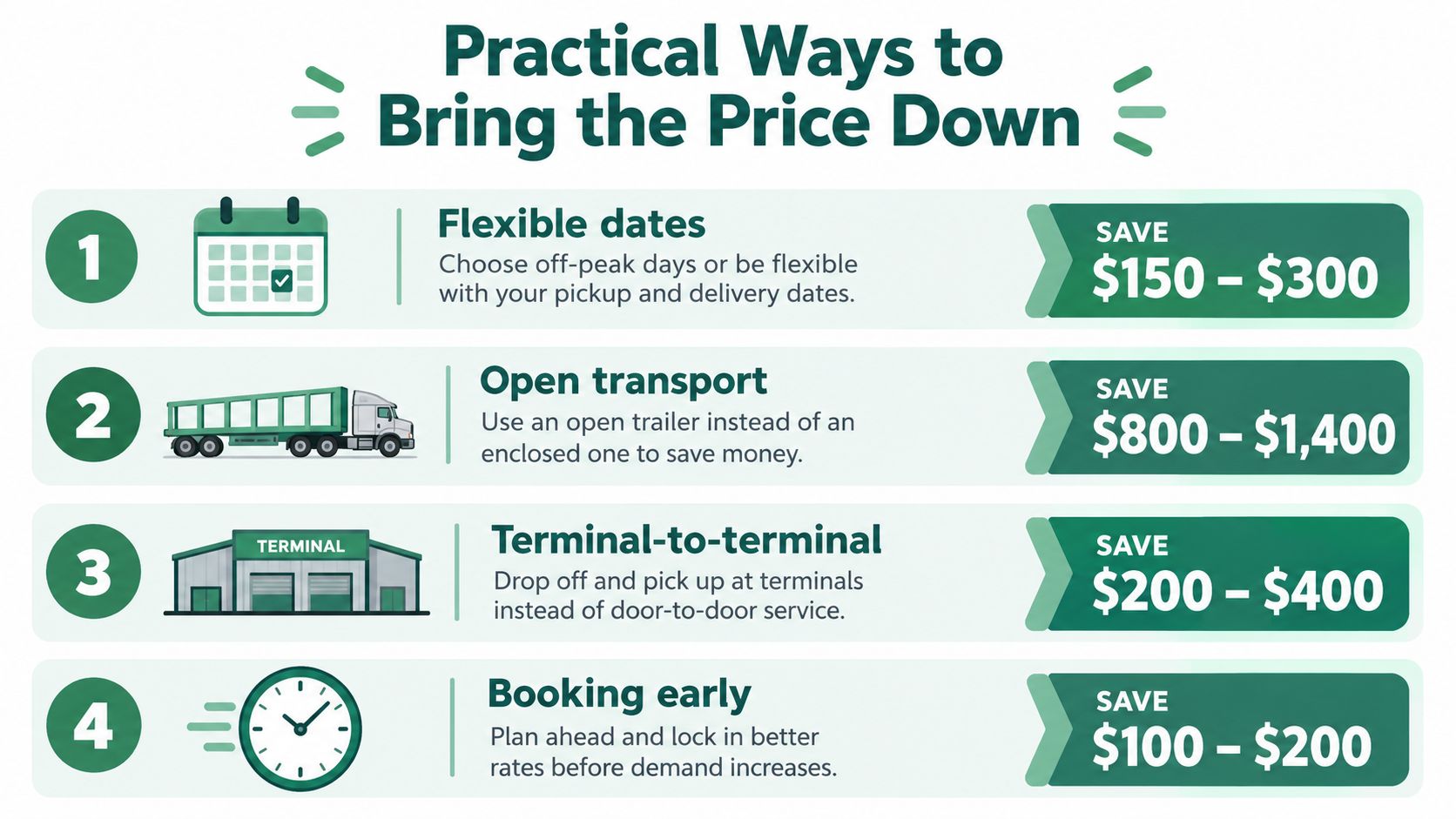
- Stay flexible on pickup dates: A broader window gives dispatch more room to match your car onto an existing route.
- Use open transport: For most vehicles, this is the cheapest legitimate option.
- Choose major-city handoff when possible: Meeting near a carrier-friendly area can help if your neighborhood is tight or remote.
- Book before the last minute: Urgency shrinks your options fast.
- Avoid paying for protection you don't need: Daily drivers usually don't need enclosed service.
What to do if you're shipping to Puerto Rico
Puerto Rico moves are different from mainland moves because you're dealing with port logistics and ocean capacity. If you can align your inland pickup with a common mainland port such as Jacksonville, the process is usually cleaner than trying to force a less common routing. If a West Coast connection like Long Beach fits the rest of the move better, that can work too, but route choice changes handling and timing.
What never works
Chasing the cheapest online quote is the fastest way to waste time.
The lowest quote often isn't the rate that gets your car moved. It's the rate that gets your phone to ring. Then the story changes. The truck “isn't available,” the lane “got tighter,” fuel “shifted,” or the dispatcher says the original number won't cover the load.
Cheap quotes are easy to generate. Hard part is getting a driver to honor them.
If you want a lower rate, give the carrier something useful: flexibility, easier access, or a simpler service type.
What Happens After You Book the Shipment
Once you book, the process becomes operational. That's where good communication matters.
Dispatch and pickup
The order gets posted and matched with a carrier. Then you move into the pickup window. On pickup day, the driver inspects the vehicle and documents visible condition on the Bill of Lading.
For customers choosing residential service, this is also where practical access gets sorted out. If a full-size truck can't safely enter your street, the handoff happens at a nearby lot, shopping area, or other legal meeting point. That's normal on door-to-door auto transport, especially in dense neighborhoods and HOA communities.
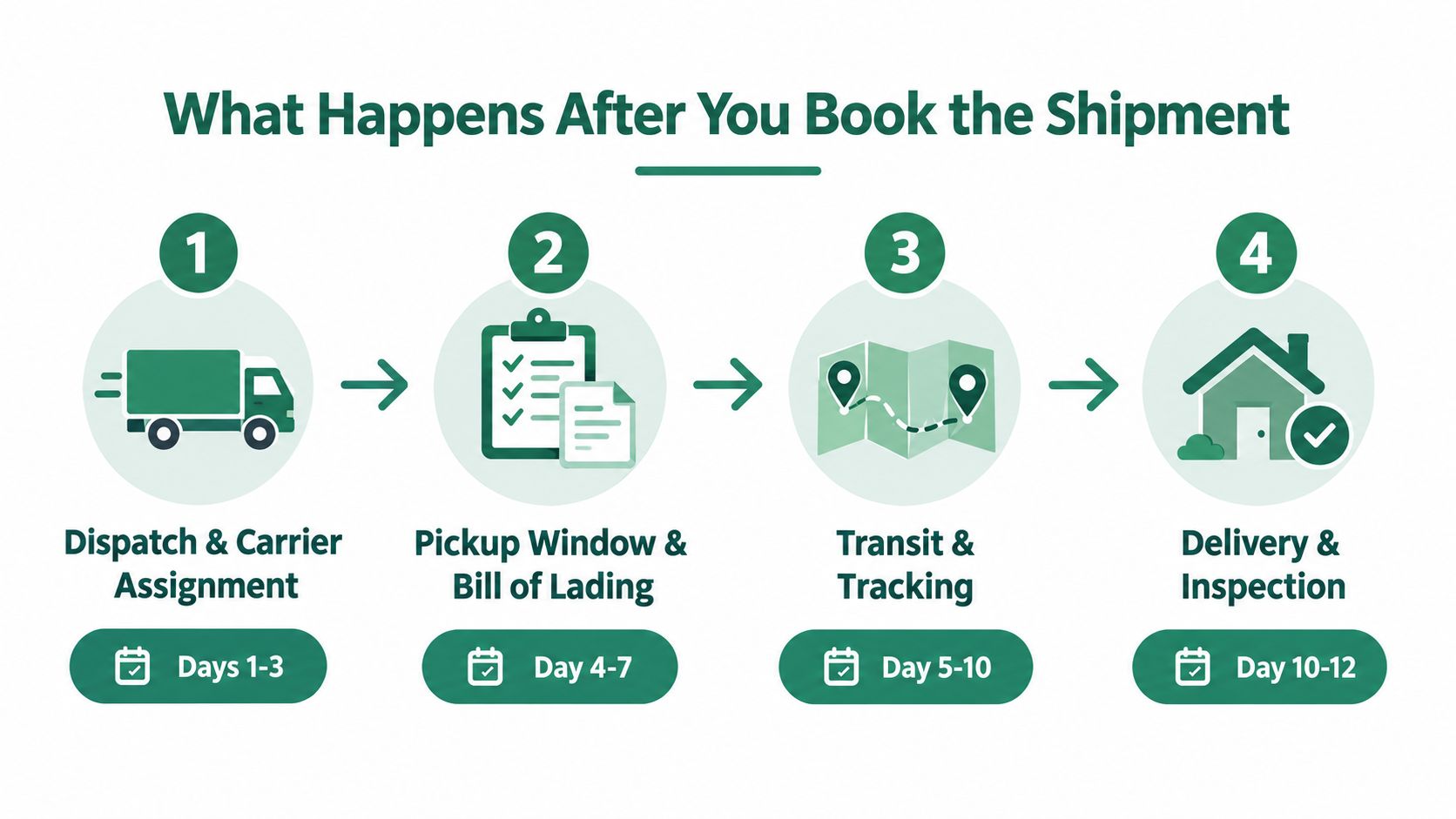
Transit and delivery
The truck runs the route, makes scheduled stops, and updates progress as delivery gets closer. A normal coast-to-coast move isn't a straight private haul for one customer. It's a routed commercial trip with multiple operational stops.
At delivery, you inspect the vehicle with the driver and compare it to the pickup record. Keep your Bill of Lading, your booking confirmation, and your contact trail until the job is fully closed.
A note on paperwork and regulation
Customers sometimes assume household moving rules apply to car shipping the same way they apply to furniture moves. They don't. The FMCSA states that federal consumer-protection rules in 49 CFR Part 375 apply to household goods motor carriers in interstate or foreign commerce, and the booklet explains topics like binding and nonbinding estimates, inventories, and mover responsibilities (FMCSA Rights and Responsibilities booklet). That's useful context if you're comparing an auto shipment to a household move, but they aren't the same service.
Putting It All Together Before You Get a Quote
If you only remember three things about the car shipping cost from Florida to California, remember these.
First, this is a long, established lane. Second, open transport is the right answer for many people. Third, the quote only makes sense if the route, vehicle, and timing all match the number.
The fastest way to compare quotes correctly
Use this short checklist before you request pricing:
Confirm the trailer type
Open or enclosed changes the whole comparison.List the exact cities
Major metro access usually helps. Remote points usually don't.State whether your dates are fixed or flexible
That's one of the clearest pricing levers you control.Ask how the company handles route complications
This matters for apartment pickups, oversized vehicles, and Puerto Rico port work through San Juan, Jacksonville, Long Beach, or Philadelphia.
Quick reference table
| Quick Reference: Florida to California Car Shipping at a Glance | Open Transport | Enclosed Transport |
|---|---|---|
| Common route distance | 2,703 miles | 2,703 miles |
| Published price range on this lane | about $1,050 to $2,615 | about $2,360 to $2,625 in one current route guide |
| Practical use case | Daily drivers, most standard vehicles | Classic, luxury, exotic, or highly sensitive vehicles |
| Availability | Broader | More limited |
| Exposure | Open to weather and road grime | Protected trailer environment |
The right move now is simple. Get two or three quotes that are dated, specific, and clearly describe the service. Compare the actual transport type, route access, and timing. Don't compare a real quote against a fantasy number.
If you're pricing a Florida to California move, National Car Transport offers door-to-door service across the mainland and Puerto Rico, with open, enclosed, and port-based vehicle shipping options handled by U.S.-based bilingual agents who know the lane. If you want a quote that reflects the market instead of a teaser rate, visit National Car Transport.