
You're probably here because you need a number fast.
Maybe you're moving from Dallas to Phoenix for work, buying a car from another state, sending a vehicle to a college student, planning a snowbird move to Florida, or trying to figure out the extra layers involved in shipping a car between the mainland and San Juan, Puerto Rico. Often, the first step is to open a calculator and type in a route. That's sensible. It gives you a starting point.
What confuses people is what happens next. The estimate looks simple, but car shipping pricing isn't flat or static. In the U.S. market, major consumer guides place the national average to ship a car at roughly $1,020 to $1,215, depending on the source and measurement period, and Kelley Blue Book says a typical 1,000-mile shipment averages about $1,020, or about $1.02 per mile as a rough rule of thumb for a standard vehicle on that distance (AmeriFreight summary of Kelley Blue Book and market averages).
That helps. But it still doesn't answer the question you care about, which is: what will your shipment cost?
A good car shipping cost calculator in the USA gives you a realistic estimate. An experienced logistics coordinator helps you understand why that number moves, what details matter, and what needs to be confirmed before you book. That human part matters even more on complicated moves, especially military relocations, snowbird routes, dealership shipments, and Puerto Rico transport where overland and port logistics have to line up correctly.
Table of Contents
- Introduction: Decoding Your Car Shipping Estimate
- How a Car Shipping Cost Calculator Actually Works
- The 7 Key Factors That Determine Your Shipping Cost
- Distance and route shape the base price
- Open or enclosed changes the equipment and price
- Vehicle size matters more than many people expect
- Your pickup and delivery points affect real-world access
- Seasonality can move the market quickly
- Running or non-running changes loading complexity
- Timing and special requirements can change the quote
- A Step-by-Step Guide to Using an Online Calculator
- Sample Shipping Costs and Common Scenarios
- Special Routes: Shipping to Puerto Rico, Alaska, and Hawaii
- Conclusion: From Online Estimate to Confirmed Booking
Introduction: Decoding Your Car Shipping Estimate
A calculator feels definitive because it returns a number. In reality, it's more like the first serious draft of your shipping price.
If you're relocating from Los Angeles to Houston, sending a vehicle from Chicago to Miami, or arranging transport from Orlando to San Juan, the estimate usually starts with mileage. That's why so many people hear broad rules like “about a dollar a mile.” For a standard vehicle on a typical route, that can be a useful mental shortcut. But it stops being reliable the moment your shipment has non-standard details.
Practical rule: Use the calculator to set expectations, not to assume the final invoice is locked.
People usually get tripped up in three places:
- Route assumptions: A city-to-city quote may look straightforward, but exact ZIP codes can change access, carrier availability, and route efficiency.
- Vehicle assumptions: A sedan, an SUV, and a pickup don't occupy the same deck space or create the same loading constraints.
- Service assumptions: Open carrier, enclosed transport, timing flexibility, and island shipping all affect what equipment is needed.
That's why two shipments that seem similar on the surface can price differently. A student moving a compact car from Atlanta to Boston won't be quoted the same way as a military family shipping a larger SUV on a tighter timeline, and neither move resembles a mainland-to-Puerto Rico shipment that includes port handling and documentation.
The smart way to use a car shipping cost calculator USA shoppers find online is to treat it as the beginning of the conversation. Once you understand what it's measuring, the estimate becomes much more useful.
How a Car Shipping Cost Calculator Actually Works
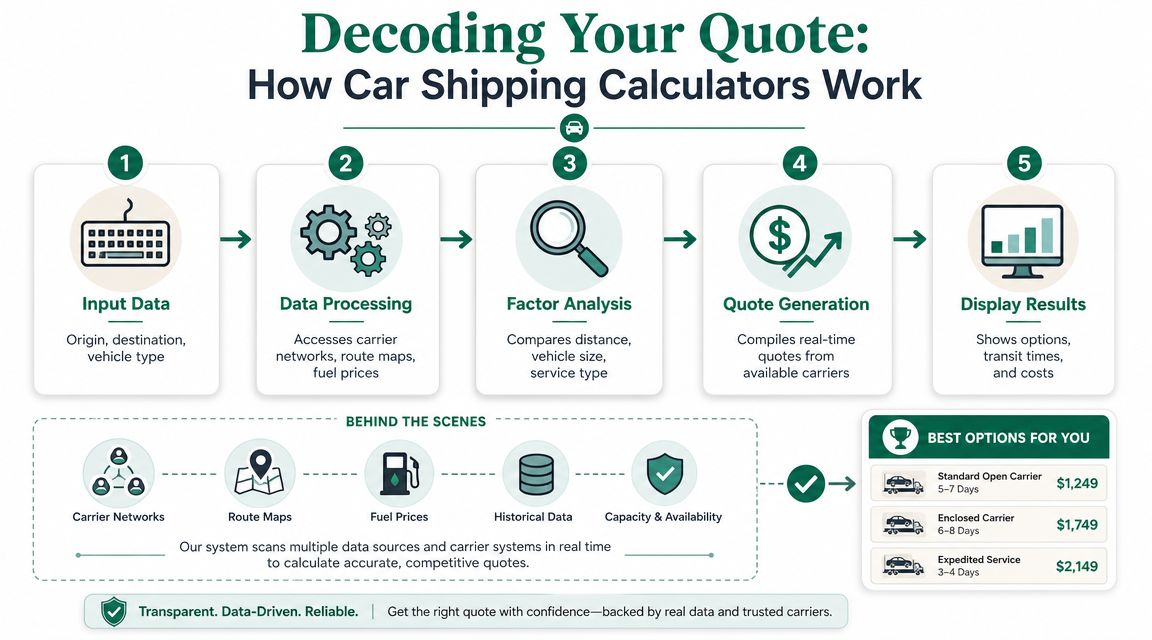
A shipping calculator works a lot like a flight search engine. You enter the trip details, and the tool tries to match your request to current market conditions, common route patterns, and available transport setups.
It isn't just multiplying miles by one fixed rate. It's trying to predict what a carrier or brokered network is likely to charge for your exact shipment profile.
It starts with your shipment inputs
The first part is obvious. You enter the origin, destination, vehicle details, and transport type.
The less obvious part is how much those details matter. A car shipping calculator is only as accurate as the information fed into it. Industry guidance notes that the most important inputs are exact origin and destination ZIP codes, vehicle year/make/model, running condition, transport method, and pickup timing, because those inputs affect lane density, carrier availability, and seasonal price pressure (Sherpa guide to car shipping calculator inputs).
Then it translates your move into a lane
In logistics, a route isn't just a line on a map. It's a lane. Some lanes are busy and efficient. Others have fewer trucks moving through them, less backhaul opportunity, or more difficult pickup windows.
A calculator tries to place your shipment inside that lane logic. That's why a route between two major metro areas often behaves differently from a route that starts in a rural town or ends in a tightly restricted neighborhood.
A quote can change even when the distance barely changes, because the route quality changed.
It compares service level and equipment needs
A standard operable sedan on open transport is the baseline many tools assume. Once you change the service level, the calculator has to look for a different kind of equipment match.
Enclosed shipping, oversized vehicles, modified vehicles, and inoperable vehicles all create narrower carrier options. The estimate reflects that smaller pool.
Estimate versus locked price
This is the part customers should understand before booking. An online estimate is a market-based projection. A confirmed flat-rate quote comes after someone verifies the details that calculators often simplify.
That human review matters when the move includes Puerto Rico port delivery, military timing, gated communities, dealership release procedures, auction pickup, or a neighborhood where a large hauler can't safely enter. The calculator gets you close. A skilled coordinator gets you clear.
The 7 Key Factors That Determine Your Shipping Cost
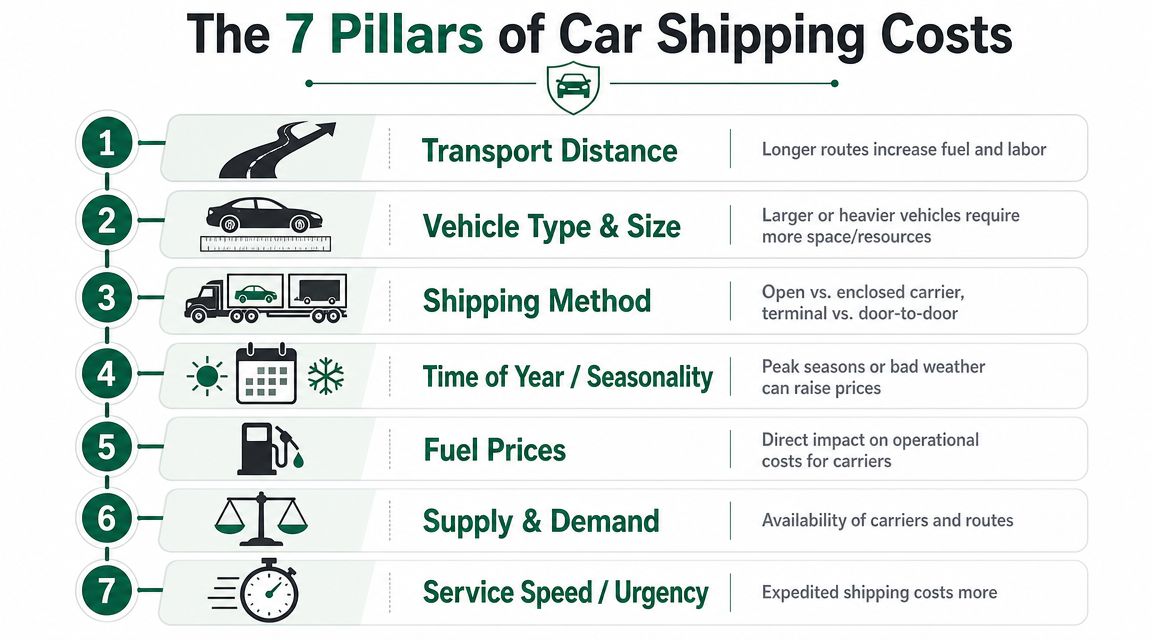
Price changes for reasons that are usually logical once someone explains them plainly. Here are the seven variables that drive most quotes.
Distance and route shape the base price
Distance matters, but not in a straight-line, one-rate-per-mile way.
Longer trips usually cost more overall, yet shorter trips can cost more per mile because dispatching, loading, paperwork, and coordination costs still exist on every shipment. That's why experienced coordinators look at route type, not just mileage.
Open or enclosed changes the equipment and price
Open transport is the standard option for most everyday vehicles. Enclosed transport uses lower-capacity equipment and adds protection from weather and road debris, so it's usually chosen for classic, luxury, exotic, or high-value vehicles.
Published market data shows how meaningful that difference can be. Sherpa Auto Transport reported average shipment costs of $1,804 for enclosed transport versus $1,205 for open transport, a difference of $599 per shipment. The same dataset reported average costs of $1,193 for sedans, $1,271 for SUVs, and $1,472 for pickup trucks (Move.org summary of Sherpa shipment data).
Vehicle size matters more than many people expect
A larger vehicle isn't just heavier. It also takes up more usable trailer space.
That matters because carriers have to balance deck layout, axle weight, and loading sequence. A pickup, full-size SUV, or modified vehicle can limit how the rest of the trailer is loaded. That's one reason larger vehicles usually quote above a standard sedan.
Your pickup and delivery points affect real-world access
People often think “door-to-door” means a truck will always arrive directly in front of the home. Sometimes it does. Sometimes it can't.
A quote built from ZIP codes may not capture a downtown street with tight turns, a gated community with truck restrictions, a steep residential road, or a rural location that's hard for a large carrier to reach. In those cases, the practical solution is a nearby meeting point such as a large parking lot or commercial area.
- Dense cities: Narrow streets, traffic restrictions, and curb space can complicate loading.
- Rural areas: Fewer passing carriers can mean longer matching times or adjusted logistics.
- Apartments and HOAs: Access rules can force a handoff at a safer nearby location.
Seasonality can move the market quickly
Some routes are stable for much of the year. Others swing noticeably when demand piles up.
U.S. industry data notes strong seasonal patterns, especially when winter snowbird traffic pulls capacity toward Florida, Arizona, and Texas, and when summer moves increase demand from major metros (BTS transportation data context). If you've ever wondered why the same route looks cheaper one month and tighter the next, that's often the reason.
A low estimate during a soft period doesn't always predict what the live market will do when your pickup window arrives.
Running or non-running changes loading complexity
A vehicle that starts, steers, and brakes is easier to load. A non-running vehicle may require special handling and more planning.
Even if the route is common, operability changes how the driver approaches the pickup and what equipment is practical. That detail should always be disclosed up front. If it isn't, the first estimate may understate the complete job.
Timing and special requirements can change the quote
Flexible timing usually gives dispatchers more room to match the right carrier. Tight windows can reduce options.
Special requests matter too. Modified suspension, oversized tires, lowered vehicles, auction release timing, dealership hours, military base access, and island shipping paperwork all add coordination steps. None of those make the move impossible. They just make accuracy more dependent on human review.
A Step-by-Step Guide to Using an Online Calculator
If you want a useful estimate, don't rush the form. Most bad quotes start with missing details.
What to gather before you start
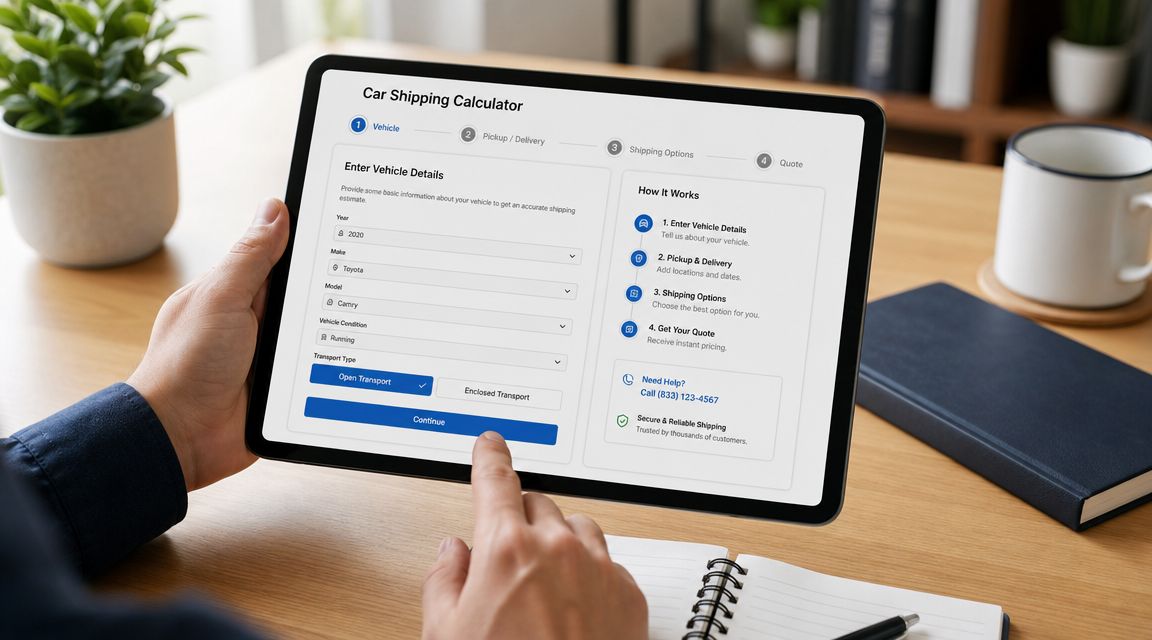
Have these details ready before you open the calculator:
- Exact pickup ZIP code and exact delivery ZIP code
- Vehicle year, make, and model
- Whether the vehicle runs and rolls
- Preferred transport type, usually open or enclosed
- Your target pickup timing, even if it's still flexible
Quote accuracy depends on operational details, not just geography. The industry guidance cited earlier makes that clear: exact ZIP codes, vehicle details, running condition, transport method, and pickup timing are the core inputs that shape the estimate.
How to enter your details correctly
Don't substitute a nearby city if the actual pickup point is outside town. And don't label a vehicle “operable” if it has mechanical problems that could affect loading.
Use the form the same way a dispatcher would want to receive the job:
- Be precise about location: The correct ZIP code is better than a broad metro area.
- Name the actual vehicle: Trim level isn't always required, but the correct year/make/model helps.
- Choose the correct service type: If you know you need enclosed, select enclosed from the start.
- Be honest about timing: “As soon as possible” means something different from “next month.”
The fastest way to get a frustrating callback is to enter a simplified version of the shipment and expect the simplified price to hold.
What to ask after you get the estimate
Once the calculator returns a range or projected price, ask the practical follow-up questions people often skip:
- Is this quote based on open or enclosed transport?
- Does it assume the vehicle is operable?
- Is the pickup address accessible to a full-size car hauler?
- For Puerto Rico shipments, does this estimate include the port portion or just the mainland leg?
- If I'm flexible on dates, can that help with carrier matching?
For many customers, this is the point where speaking with a bilingual English/Spanish agent becomes helpful. Complex moves don't need complicated language. They need clear answers.
Sample Shipping Costs and Common Scenarios
Examples help more than theory. They show how the calculator behaves in situations people face.
Quick reference table
The table below uses the published open transport per-mile benchmarks from Montway: about $1.85 per mile for 1 to 500 miles, $0.91 per mile for 501 to 1,500 miles, and $0.59 per mile for 1,500+ miles (Montway mileage band benchmarks). These are illustrative estimate examples for common route types, not guaranteed quotes.
| Scenario | Example route | Likely mileage band | Estimate style |
|---|---|---|---|
| Short regional move | Charlotte to Atlanta | 1 to 500 miles | Higher per-mile pricing is common on shorter routes |
| Mid-range relocation | Chicago to Dallas | 501 to 1,500 miles | Often falls into the middle band many shoppers expect |
| Cross-country move | Los Angeles to Miami | 1,500+ miles | Higher total cost, but lower per-mile math |
| Snowbird route | New York area to South Florida | 501 to 1,500 miles | Price can tighten or rise with seasonal demand |
| Mainland to port move | Midwest city to a Florida port for Puerto Rico shipment | Depends on inland route | Inland calculator may only cover the first leg |
How these scenarios play out in real life
A student move is often more flexible than it feels. If pickup and delivery windows have some room, a standard operable sedan on open transport is usually straightforward. The key is entering the exact campus-area delivery ZIP and checking whether a large carrier can legally stop nearby.
A snowbird move gets more sensitive to timing. Routes into Florida can tighten when seasonal demand is high, so the estimate may shift more than expected if someone waits too long to confirm.
A military relocation often has less flexibility. Families moving on government-driven schedules usually need clarity, documentation, and dependable communication more than a bare-bones online estimate.
A dealer or online purchase adds coordination on the seller side. The car may be ready, but the release contact, lot hours, keys, title status, or loading access can still affect how smooth the pickup goes.
For Puerto Rico-bound vehicles, many customers make the same mistake. They look at a mainland calculator, see a number, and assume that's the full shipment. Often it's only the domestic leg to the port, not the complete island move.
Special Routes: Shipping to Puerto Rico, Alaska, and Hawaii
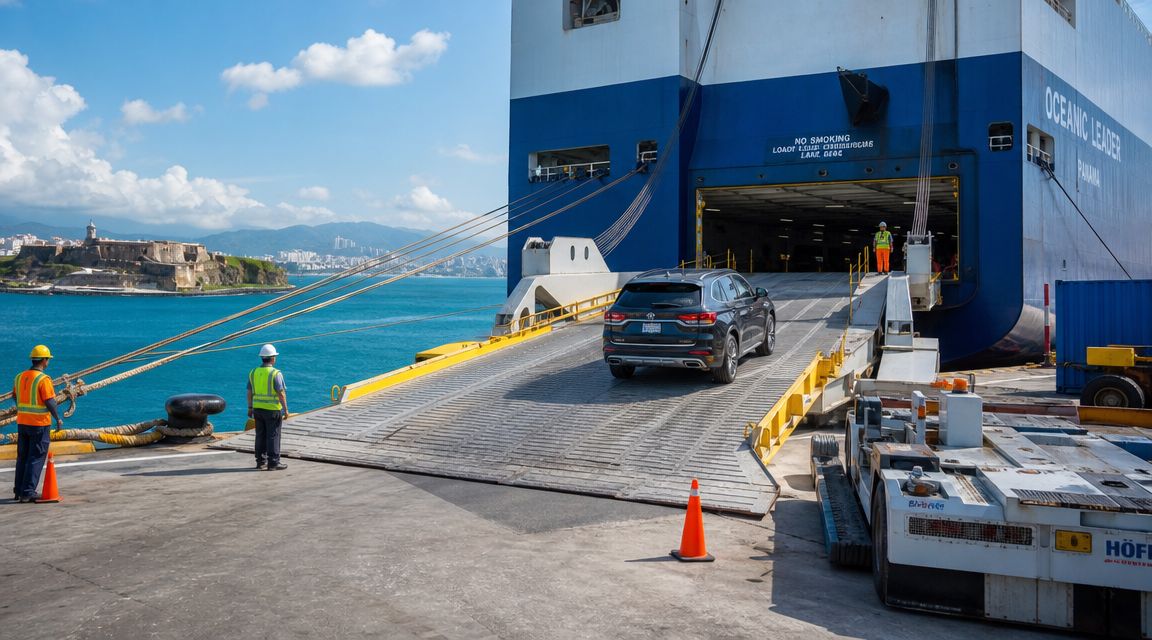
A special route feels less like booking one truck and more like handing off a relay baton. Your car may move from a local carrier to a port team, then to a vessel, then to another release or delivery contact at the destination. Each handoff can affect timing, paperwork, and cost.
Why Puerto Rico shipping feels different
Puerto Rico shipments often combine two jobs in one quote. One part is mainland trucking. The other is ocean transport, port handling, and vehicle release on the island.
That is why customers who rely only on a standard online calculator can get confused. The calculator may price the inland leg to a Florida port while leaving out the ocean segment, port fees, document review, or final pickup arrangements in San Juan.
A bilingual shipping agent helps connect those pieces. For Spanish-speaking families, military households, and customers coordinating with relatives or contacts in Puerto Rico, clear communication matters as much as the rate. A good agent explains what the quote includes, what happens at the port, which documents are needed, and who will be the point of contact at each stage.
Common Puerto Rico situations include:
- Families relocating between the mainland and San Juan
- Dealers moving inventory to or from Puerto Rico
- Military transfers with fixed reporting dates
- Seasonal residents who want their own vehicle on the island
What changes the price on an island route
The biggest pricing question is coverage. A flat rate only feels predictable if you know whether it covers the full trip or just one segment.
Puerto Rico shipments can change in price based on the inland origin, the port used, vessel schedules, document requirements, and the timing of your booking. Seasonal demand on mainland routes into Florida can also tighten space and affect the first leg of the move, especially during heavy relocation periods and winter traffic to the South.
One practical question clears up a lot of confusion.
Ask, “Does this quote cover pickup, port delivery, ocean transport, and final release, or only the mainland leg?”
That single question often reveals whether two separate prices are being discussed.
Alaska and Hawaii follow the same logic
Alaska and Hawaii have different port networks and routing patterns, but the quoting logic is similar. Your vehicle may need inland trucking, a port drop, marine transport, and a handoff at the destination.
The shipment is manageable. It just needs coordination.
Customers usually avoid problems when they confirm a few points before booking:
- Which legs of the move are included in the quote
- Whether the vehicle goes to a port, a terminal, or a residential delivery point
- What paperwork or ID is required before release
- Who is responsible for each handoff
- Whether the price is a firm flat rate or a starting estimate subject to change
For these routes, the calculator is still useful. It gives you a starting range. The person who turns that range into a dependable booking is the agent coordinating the full chain, answering questions in plain language, and catching the small details before they become expensive surprises.
Conclusion: From Online Estimate to Confirmed Booking
A good calculator saves time. It gives you a rational starting point, helps you compare options, and tells you whether your budget is in the right range.
But the estimate isn't the whole story. Real car shipping depends on route conditions, equipment type, vehicle details, timing, and access. That's especially true on seasonal lanes, for larger vehicles, and on Puerto Rico, Alaska, or Hawaii shipments where more than one transport segment may be involved.
One of the most overlooked issues is the final approach to your pickup or delivery point. Consumer guidance from the FMCSA makes clear that access can be the deciding factor because the practical constraint is whether a 75 to 80 ft car carrier can safely enter and maneuver at the location (FMCSA consumer rights and access guidance). That's why “door-to-door” sometimes becomes a nearby meeting point instead of a literal curbside stop.
So use the car shipping cost calculator USA shoppers rely on. Just don't stop there.
Ask whether the quote reflects your exact ZIP codes, your actual vehicle, your service type, your timing, and your route reality. If you're shipping to or from major cities across the mainland, heading south for the season, coordinating a military move, sending a student vehicle, or arranging transport with San Juan, Puerto Rico involved, those details turn a rough estimate into a workable plan.
If you want help turning an online estimate into a dependable booking, National Car Transport is a practical next step. The company serves all 50 states, Puerto Rico, Alaska, and Hawaii, with 25+ years of experience, an A+ BBB rating, transparent flat-rate pricing, and a network of 25,000+ vetted carriers. Their U.S.-based bilingual agents speak English and Spanish and bring over 20 years of auto transport logistics experience, which matters when a move includes special timing, port coordination, military needs, snowbird routes, dealership releases, or a hard-to-access pickup location. No two vehicle shipments are exactly alike, and having an experienced advisor guide the process can make it simpler, quicker, and far more predictable.