

When you need a car shipped, you’re likely opening five tabs, comparing quotes, skimming review sites, and ending up more confused than when you started. One company looks flawless on one platform and terrible on another. Another has a strong score, but the complaints all mention the same problem: poor communication once the car is picked up.
That confusion is normal. Car shipping company reviews help, but they don’t tell the whole story. A star score can point you in the right direction, but it won’t tell you how a company vets carriers, what insurance covers, who answers the phone when there’s a delay, or how well they handle a tougher route like Puerto Rico.
The car shipping business is large and busy. The U.S. vehicle shipping industry reached $9.9 billion in 2023, according to ConsumerAffairs auto transport industry statistics. With that many shipments moving, review volume matters. So does context.
Table of Contents
- Navigating the Maze of Car Shipping Company Reviews
- How to Read Between the Lines of Customer Reviews
- The 7 Key Criteria for Evaluating Any Car Shipper
- 2026 Car Shipping Company Comparison
- Shipping for Your Specific Needs Military, Snowbirds, and Puerto Rico
- Your Final Decision Checklist
- Frequently Asked Questions About Car Shipping
Navigating the Maze of Car Shipping Company Reviews
If you read enough car shipping company reviews, you’ll notice a pattern fast. The same company can be called “smooth and professional” by one customer and “impossible to reach” by the next. That doesn’t always mean the reviews are fake. It usually means the shipment details were different, the route was different, or the customer expected something the company never clearly promised.

The mistake people make is treating a review score like a final verdict. It isn’t. In auto transport, you need to know what happened before pickup, during dispatch, in transit, and at delivery. A company can have polite sales staff and still struggle with follow-through. Another can have fewer glowing reviews but run a tighter process once the vehicle is assigned.
What reviews usually miss
Most reviews summarize feelings, not operations. They tell you whether a customer was happy, frustrated, or surprised. They rarely spell out whether the carrier was properly vetted, whether the insurance discussion was clear, or whether the customer understood the difference between an estimate and a firm rate.
That’s a problem on standard mainland routes. It matters even more on island shipments, seasonal rush periods, and military relocations where timing and paperwork can make or break the experience.
Practical rule: Don’t ask “Which company has the best reviews?” Ask “Which company shows the least risk for my exact route and vehicle?”
What actually prevents problems
A reliable shipper usually gets the basics right before the truck ever arrives:
- Carrier screening: They don’t just post your vehicle and hope for the best.
- Insurance clarity: They explain what’s covered, what isn’t, and how claims are handled.
- Communication discipline: You know who to call, when updates happen, and what delays look like in real life.
- Route-specific experience: Shipping from Miami to Dallas isn’t the same as shipping from Chicago to San Juan.
Good reviews support those traits. They don’t replace them.
How to Read Between the Lines of Customer Reviews
A review score matters, but context matters more. In car shipping, the strongest signals usually come from consistency across platforms, review volume, and whether the comments mention details that sound like real transport events instead of generic praise or rage.
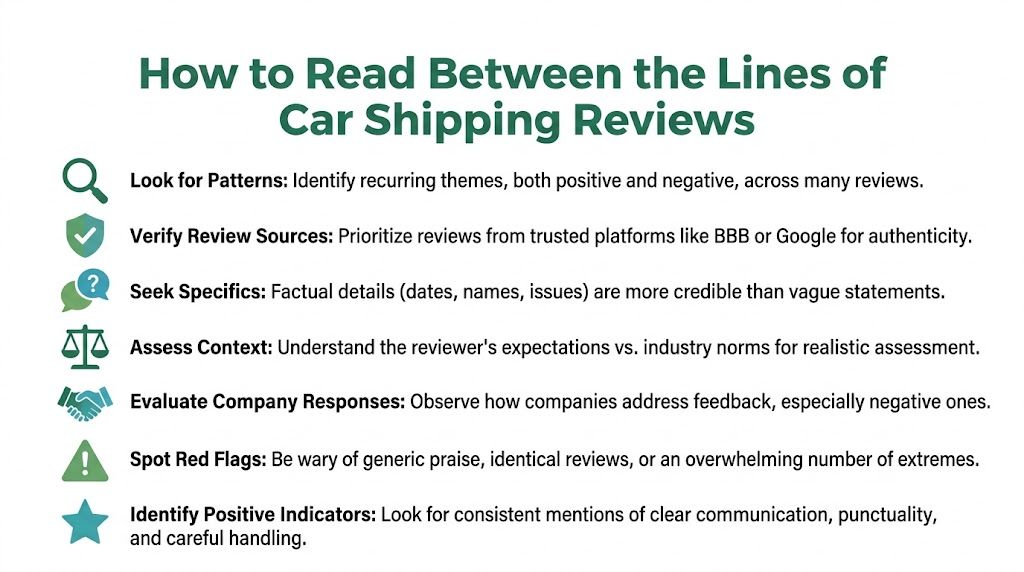
Cars.com notes that customer reviews are central to credibility in this industry, and some of the strongest public benchmarks include uShip at 4.5 stars from over 12,000 Trustpilot reviews with an A+ BBB rating, and SGT Auto Transport at 4.5 stars from more than 1,000 Trustpilot reviews plus a 4.7 Google rating from thousands of customers, as listed in Cars.com’s roundup of best car shipping companies.
Start with volume, then read the complaints
A company with a high rating and a deep pool of reviews has given you more data to work with. A company with only a handful of reviews may still be good, but you have less evidence.
Then ignore the glowing homepage language and read the lower-rated reviews carefully. You’re not looking for perfection. You’re looking for patterns.
Here’s what to watch:
- Repeated price complaints: If multiple reviewers say the final price changed late in the process, pay attention.
- Dispatch confusion: Reviews that mention “couldn’t get an update” or “no one knew where the driver was” often point to weak coordination.
- Delivery complaints with specifics: A complaint that includes dates, route details, and communication history is more useful than a vague angry paragraph.
- Company responses: A serious company answers problems directly instead of posting canned replies.
Know who is being reviewed
A lot of customers don’t realize they may be reviewing the broker relationship, the carrier experience, or both. That distinction matters.
The broker usually handles quoting, dispatch, paperwork, and customer communication. The carrier handles the physical transport. If a review says pickup communication was excellent but delivery condition was poor, those are not the same operational issue.
A review that says “great customer service” may only mean the office was responsive. It does not automatically mean the assigned carrier was excellent.
Read for operational clues
The best reviews mention practical details. That might include inspection handling, pickup windows, route changes, or how the company managed a delay.
The least useful reviews usually sound like this:
- Too vague: “Amazing service, highly recommend.”
- Too theatrical: all emotion, no shipment facts.
- Too polished: wording that sounds copied from marketing material.
A more credible review usually includes a few grounded details:
| Review clue | What it tells you |
|---|---|
| Mentions pickup and delivery timing | The customer likely went through a real shipment |
| Notes vehicle condition at arrival | They paid attention to inspection and handoff |
| Describes communication by phone or text | You can judge update quality |
| Mentions route complexity | Helpful for matching your own shipment type |
Separate isolated problems from systemic ones
Late delivery can happen in this business. Weather, traffic, port scheduling, mechanical issues, and route loading all affect timing. One delay doesn’t prove a company is unreliable.
A cluster of similar complaints does.
If ten customers complain about the same handoff problem, same lack of callbacks, or same billing surprise, that’s no longer random noise. That’s process.
The 7 Key Criteria for Evaluating Any Car Shipper
A five-star profile can still produce a bad shipment. I have seen highly rated brokers miss pickup windows, hand a job to a weak carrier, or go quiet the moment a route gets complicated. Reviews help, but they do not show the operating details that decide whether your car arrives on time, intact, and without billing drama.
These are the seven checks that matter before you book.
Price transparency
Rates in this business swing hard based on distance, season, route density, vehicle size, operability, and trailer type. As noted earlier, ConsumerAffairs reports a wide pricing range. That is normal. What is not normal is a quote that sounds firm until the vehicle is posted, then starts changing.
Get the quote in writing and pin down the terms:
- Is this a fixed price or a market estimate?
- Can the amount change after a carrier is assigned?
- What adds cost, oversized vehicles, inoperable status, remote access, storage, or rescheduling?
- For Puerto Rico or other port moves, which fees are included and which are separate?
Cheap is not automatically bad. Unclear is bad. The trouble usually starts with vague wording around dispatch, fuel, port handling, or accessorial charges.
Insurance coverage
“Fully insured” is sales language, not a usable answer.
Ask for the carrier’s cargo insurance limits, ask whether there is a deductible, and ask what the policy excludes. Personal items inside the vehicle are often limited or excluded. Mechanical issues are not cargo claims. Pre-existing damage has to be documented well or the claim gets messy fast.
For higher-value vehicles, the inspection process matters almost as much as the policy itself. If the company cannot explain how condition is recorded at pickup and delivery, the insurance conversation is incomplete.
Carrier vetting
Review scores often mislead people. A broker may have friendly office staff and still assign your car to a carrier with thin paperwork, poor communication, or a weak service record.
Ask how carriers are screened before dispatch. A serious shipper should verify active DOT and MC authority, insurance status, and basic operating history. They should also know which carriers are dependable on your route, not just who clicked fastest on a load board. That matters even more for difficult lanes, non-running vehicles, enclosed moves, and Puerto Rico shipments that involve more than one handoff.
Delivery speed and reliability
Ignore broad promises like “fast shipping.” Ask for a pickup window, a delivery window, and a clear explanation of what could move those dates.
Reliability is not the same as speed. A company that gives a realistic range and stays in contact usually performs better than one that promises an exact day too early. On dense mainland routes, timing is easier. On rural lanes, weather-hit corridors, or any shipment involving a port, timing gets tighter and communication matters more.
The key question is simple. If the schedule slips, who tells you, how fast, and with what revised plan?
Customer service quality
A good agent prevents small problems from turning into expensive ones.
That means catching missing lienholder paperwork before pickup. It means confirming whether the car rolls, steers, and brakes before a driver arrives without the right equipment. It means calling ahead when the delivery location cannot take a truck and setting a practical meetup point instead of creating a last-minute mess.
For Puerto Rico moves, experienced human support matters even more. Those shipments often involve port rules, ID matching, title or registration checks, and timing across inland and ocean legs. A call center script is not enough.
Coverage and route fit
“Nationwide” does not tell you much. The true test is whether the company handles your exact lane well.
A shipper can be excellent from Dallas to Atlanta and still struggle with Montana pickups, Key West deliveries, or San Juan port coordination. Ask how often they run your route, whether they use regular carriers there, and what changes if the address is rural, gated, military, or at a port. Route fit is one of the clearest predictors of how smooth the job will go, yet it rarely shows up in a star rating.
Specialized service options
Vehicles and routes do not all belong in the same template.
Standard sedans on open transport are straightforward. Classics, exotics, low-clearance cars, and high-value SUVs often justify enclosed equipment. Inoperable vehicles need a winch or forklift access plan. Auction purchases, college moves, military PCS orders, and Puerto Rico shipments all come with their own paperwork and scheduling issues.
A capable company should explain the trade-offs clearly. If they push one shipping method for every situation, they are selling inventory, not solving your transport problem.
2026 Car Shipping Company Comparison
Public review data gives you one view. Operational discipline gives you another. When comparing major providers, I look for a mix of review credibility, licensing discipline, quote clarity, and how well the company handles unusual shipments.
Montway often stands out in public benchmarks. According to BAH Logistics’ review of leading U.S. auto transport companies, Montway has an A+ BBB rating, a 4.0-star Trustpilot score from over 2,000 reviews, and 19 years of active DOT/MC compliance without safety violations or bond revocations. That kind of record matters because it points to sustained operating discipline, not just strong marketing.
Top Car Shipping Company Feature Comparison
| Feature | National Car Transport | Montway Auto Transport | SGT Auto Transport |
|---|---|---|---|
| BBB standing | A+ BBB rating | A+ BBB rating | Strong public review presence |
| Pricing approach | Transparent flat-rate pricing | Quote-based pricing | Known for price matching in public reviews |
| Carrier network | 25,000+ vetted carriers | Vetted carrier network | Nationwide transport network |
| Geographic fit | Mainland U.S., Puerto Rico, Alaska, Hawaii | Nationwide U.S. coverage | Broad U.S. coverage, door-to-door options excluding Alaska in cited public review summary |
| Human support | Dedicated bilingual agents in the U.S. | National support operation | National customer support |
| Best fit | Customers who want route guidance, flat-rate clarity, and island expertise | Customers who want a large established provider with strong compliance history | Customers comparing review strength and flexible booking features |
What Montway does well
Montway’s strongest advantage is that its public profile combines scale, compliance, and consumer visibility. When a company has moved a large number of vehicles and still maintains strong standing on major review platforms, that tells you it has built repeatable systems.
For mainstream domestic routes, that usually means a broad dispatch footprint and a process that can absorb volume.
Where SGT gets attention
SGT tends to come up in discussions where shoppers care about review sentiment and quote flexibility. It has a visible online reputation and tends to appeal to customers comparing options carefully before booking.
That said, even a well-reviewed provider still needs to be judged on the exact shipment. A Florida-to-New York open carrier move is one thing. A port-coordinated Puerto Rico shipment is another.
Where direct human guidance makes the biggest difference
The limitations of a simple ranking list become apparent. Large review platforms are useful, but they don’t capture how well a company handles messy real-world situations:
- A seller can’t release the car on the original day
- The vehicle arrives at the port before paperwork is complete
- A military family needs timing that lines up with housing and travel
- A student has a narrow drop-off window
- A Puerto Rico move needs bilingual coordination and document follow-up
Those issues rarely show up cleanly in a star score.
The best car shipping company reviews are often the ones that mention how a company handled a problem, not just how it handled an easy shipment.
How to compare companies fairly
When you line up providers, compare them against the same decision points:
- How clear is the quote?
- How experienced is the support team on your route type?
- How strong is the company’s public credibility?
- How much confidence do you have in the carrier assignment process?
- Can the company explain the handoff steps without sounding vague?
If a provider can answer those questions cleanly, it’s already ahead of many competitors.
Shipping for Your Specific Needs Military, Snowbirds, and Puerto Rico
The biggest flaw in most car shipping company reviews is that they flatten every shipment into one score. A routine move from one mainland city to another is not the same as a PCS move, a seasonal relocation, or a Puerto Rico shipment with inland and ocean coordination.

Move.org points out a real gap in the industry. Reviews focus heavily on star ratings, but they don’t break down promised versus actual delivery windows or pickup punctuality in a standardized way, and complaints about late delivery are common without much quantified context, as discussed in Move.org’s analysis of car shipping review gaps.
Military moves need tighter coordination
Military families usually care about timing, documentation, and communication more than polished marketing. They’re often working around reporting dates, housing uncertainty, and family travel. A decent review score won’t tell you whether a company is good at handling shifting pickup addresses or short-notice schedule changes.
For this type of move, experienced coordination matters because somebody has to keep the details straight when the plan changes.
Snowbirds need consistency
Seasonal routes get busy. That doesn’t automatically create bad service, but it does increase pressure on dispatch and communication. Snowbirds often need specific pickup and delivery timing tied to departure dates, condo access rules, or gated communities.
Practical service surpasses slogans. A company should be able to explain timing windows clearly and tell you what happens if the truck can’t access your exact address.
Puerto Rico is where expertise shows
Puerto Rico shipments expose weak operators fast. The move isn’t just a truck pickup and drop-off. It involves inland transport, port coordination, documentation, vessel scheduling, and final delivery planning on the island.
For Puerto Rico, ask directly about:
- Port process: Who handles handoff and where the vehicle is delivered before ocean transit.
- Document handling: What ownership or authorization paperwork is needed.
- Condition reporting: How the vehicle is inspected at each transfer point.
- Communication chain: Who updates you during the mainland leg and during the island portion.
- Language support: Whether English and Spanish communication is available if needed.
A review that says “car arrived fine” doesn’t tell you whether that company is organized enough for Puerto Rico. On these routes, a knowledgeable human agent is far more valuable than a high average score by itself.
For Puerto Rico shipments, the right question isn’t “Are the reviews good?” It’s “Who owns the handoffs, paperwork, and updates from start to finish?”
That same logic applies to students relocating across the mainland, dealerships moving inventory, and families shipping to or from San Juan. The more moving parts a shipment has, the less useful a raw star rating becomes.
Your Final Decision Checklist
Before you book, slow down and check the basics. Most avoidable problems show up before the vehicle is dispatched.
Use this short checklist
- Verify public credibility: Check BBB standing and confirm the company is properly licensed to arrange or move vehicles.
- Get the quote in writing: Make sure the pricing terms are clear, especially whether the rate is flat or subject to change.
- Ask about insurance details: Don’t settle for “it’s insured.” Ask what’s covered during transit and what the claim process looks like.
- Ask how carriers are vetted: A serious company should be able to explain how it screens the transporters in its network.
- Confirm your point of contact: Know who will update you during dispatch, pickup, transit, and delivery.
- Match the company to the route: If you’re shipping to Puerto Rico, Alaska, Hawaii, or a remote area, ask about direct experience with that kind of move.
- Clarify equipment needs: If the car is inoperable, oversized, classic, or high-value, confirm the right trailer type and loading setup.
One final filter
If a company answers basic questions vaguely, assume the shipment itself will be handled vaguely too. Clear answers usually come from teams that know their process.
Frequently Asked Questions About Car Shipping
Can I ship an inoperable vehicle
Yes, in many cases you can. The key issue is whether the vehicle can be safely loaded and unloaded with the right equipment. If it can’t move under its own power, the company may need a winch-equipped trailer or a carrier prepared for non-running vehicles. Tell the shipper up front. If you wait until pickup day, the driver may not have the right setup.
What documents are needed to ship a car to Puerto Rico
The exact paperwork can vary with the shipment setup, but you should expect to provide a photo ID, proof you’re authorized to ship the vehicle, and ownership-related documents such as the title or lienholder authorization if there’s a loan. Puerto Rico shipments can also involve port and tax-related paperwork, so ask for the full document list early and confirm who checks it before the vehicle heads to the port.
Can I pack personal items in my car during transport
It’s usually not a good idea. Personal items generally aren’t treated the same way as the vehicle itself during transport, and they can create problems with weight, inspection, and liability. On island routes, that concern gets even more important because household goods and vehicle shipping are handled differently. If you need to leave anything in the car, ask first and get the rules in writing.
If you want help from a team that handles both mainland routes and complex Puerto Rico moves, National Car Transport is worth a close look. They’re a U.S.-based provider with 25+ years of experience, an A+ BBB rating, transparent flat-rate pricing, and a network of 25,000+ vetted carriers. Their bilingual U.S.-based agents work in English and Spanish, and that kind of experienced human support is especially useful when your shipment involves port logistics, military timing, dealership coordination, or a route where one missed detail can slow everything down.