

Virginia interstate car shipping usually lands between $550 and $2,000, depending on distance and transport type, and most moves finish in about 1 to 10 days. If you're moving out of Richmond, Northern Virginia, Hampton Roads, or a smaller Virginia town, the job is choosing the right lane, the right carrier type, and a pickup plan that works.
That's why car shipping companies Virginia buyers should stop thinking about the state as one flat market. Virginia behaves like a corridor state, and the quote you get depends on whether your car is staying in the Mid-Atlantic, heading into the Southeast, or going coast to coast. The difference shows up in timing, dispatch speed, and whether the truck can reach your street without forcing a roadside handoff.
Table of Contents
- Why Virginia Matters in the Auto Transport Market
- Open vs Enclosed Carriers and When Each Makes Sense
- How Virginia Pricing Breaks Down by Route and Distance
- Transit Times and Seasonal Demand on Virginia Lanes
- Getting an Accurate Quote in Virginia
- Preparing Your Vehicle for a Virginia Shipment
- Choosing a Reliable Virginia Car Shipping Company
- Putting It All Together for Your Virginia Move
Why Virginia Matters in the Auto Transport Market
A military family leaving Fort Belvoir does not need a generic sales pitch. They need a carrier that can handle a tight pickup window, understand a PCS timeline, and get the car onto a moving lane without wasting days. Virginia works that way, because access, timing, and route choice matter more than polished promises.
Virginia sits inside a large, fragmented U.S. vehicle shipping market. The industry is estimated at $10.5 billion in 2026 and includes 7,073 businesses nationwide, which shows how crowded and uneven the carrier pool really is. Virginia itself has 87 motor carriers with 37,361 total power units, and one Richmond carrier reports 9,805 trucks and 8,821 drivers, which is a good reminder that real auto transport depends on freight capacity, not a broker's website. according to IBISWorld's vehicle shipping services overview
Corridor access beats statewide averages
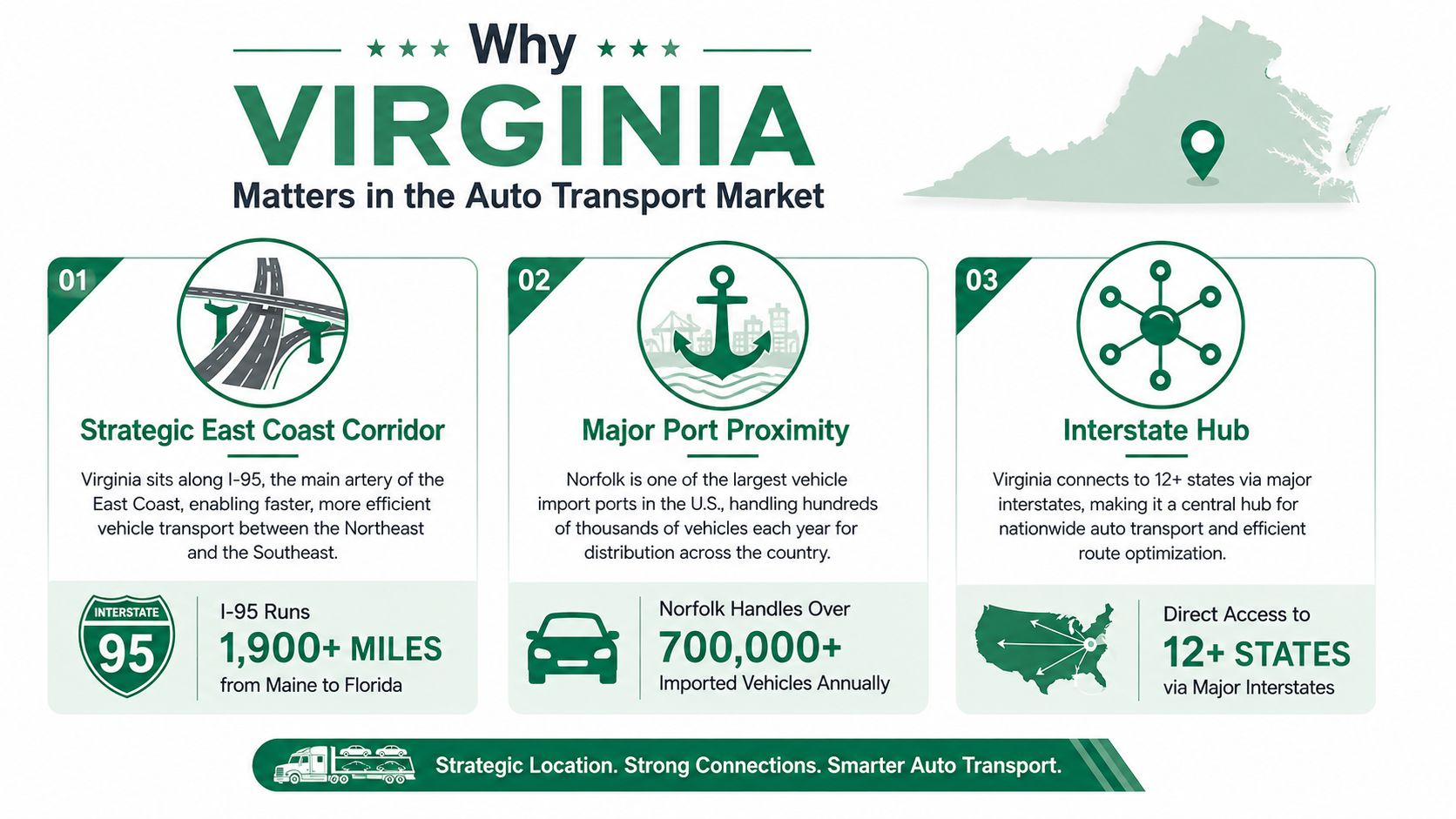
Virginia's value to carriers comes from lane density. Loads can move along I-95, I-64, and I-81, plus port-linked and metro-heavy demand, which helps trucks stay full and cuts deadhead miles. In plain terms, a carrier can usually match your car faster in Richmond or Northern Virginia than in a thinly served rural county, because the next profitable load is already nearby.
That is why Virginia is not a flat market. A pickup near the major corridors usually gives you more carrier options, cleaner dispatch timing, and less price spread. A pickup that is awkward, remote, or tied to a narrow window tightens the market fast, and the quote reflects that pressure before a truck ever rolls.
Practical rule: if your Virginia move stays near major corridors, expect more carrier options and steadier pickup timing. If the pickup point is remote or date-sensitive, expect the market to narrow quickly.
Virginia is not one pickup environment
Virginia Beach, Sterling, Stafford, Harrisonburg, Woodbridge, Richmond, and other submarkets do not behave the same way. Active carrier listings show operators spread across those areas, which supports better load matching and faster pickup windows, as shown in Virginia carrier listings. That spread explains why a shipper in Northern Virginia may see one set of options while someone in a rural county sees a different set entirely.
Route matters more than hype. A run that ties into a busy Virginia corridor can move cleanly, while a pickup that sits off the main freight paths often takes longer to confirm and may cost more because the truck has to work harder to get there. If you are choosing between two quotes, the one tied to easier access and a smarter lane usually wins.
Open vs Enclosed Carriers and When Each Makes Sense
A customer with a clean daily driver on a Virginia lane does not need to pay for enclosed protection just to feel cautious. Open transport handles most standard shipments well, and it is the right fit for ordinary sedans, leased vehicles, student moves, and family cars headed across state lines or into another metro area.
Use open transport for ordinary vehicles
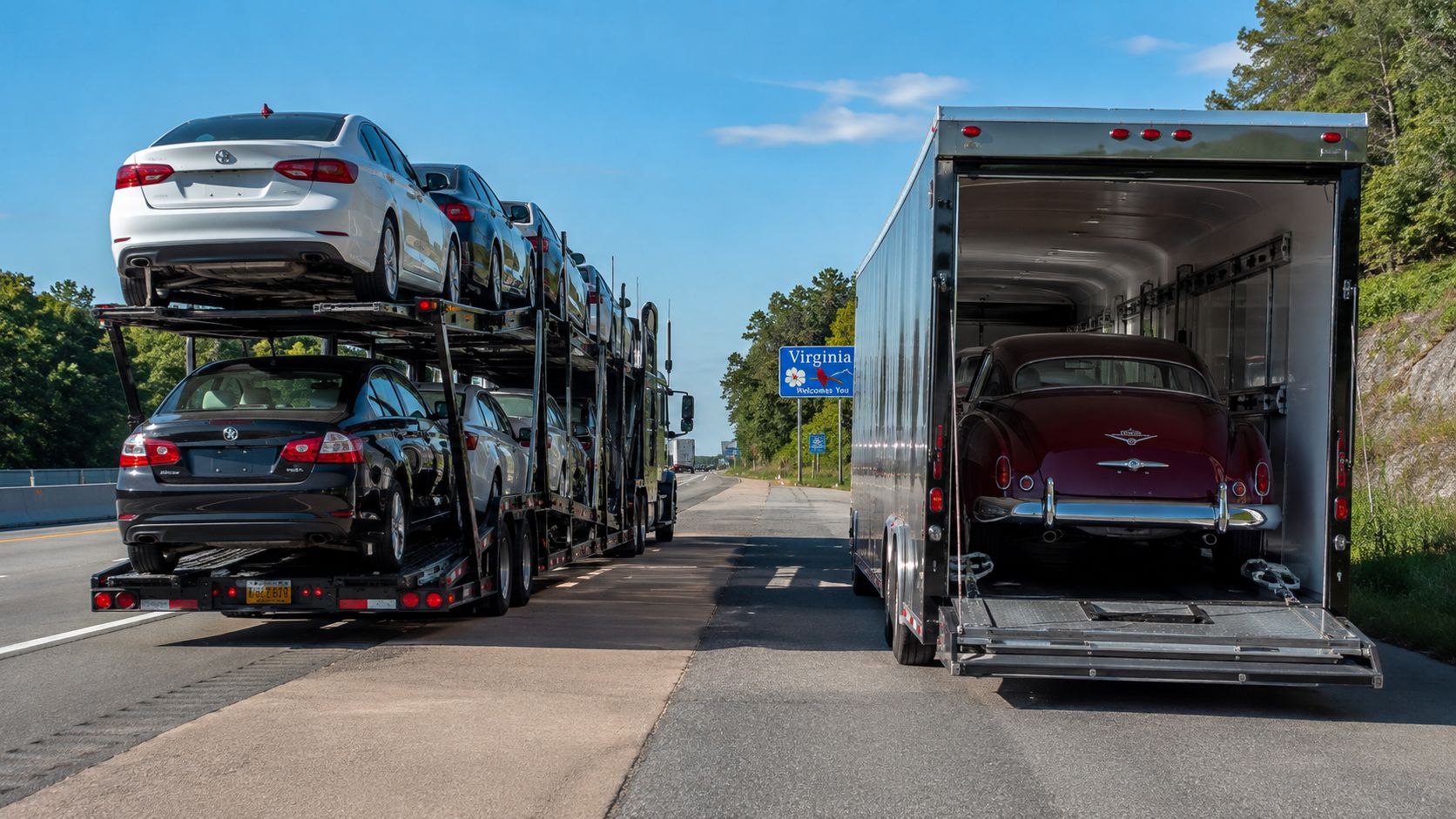
Open transport is the standard multi-car trailer you see on highways. It fits commuting vehicles, dealer inventory, military relocations, student shipments, and regular household moves. For Virginia customers, that is the practical choice when the goal is to keep the move efficient, keep the rate reasonable, and avoid paying for protection the car does not require.
Virginia pricing guides place open transport in the lower-cost range for common shipments, Virginia market pricing guide. If you are moving a Camry from Alexandria to Raleigh, or a Civic from Chesapeake to Atlanta, open transport is the straightforward answer. The lane is common, the equipment is common, and the market usually has enough capacity to keep the process moving.
Use enclosed transport when the car justifies it
Enclosed transport belongs on the vehicles where exposure is a primary concern. Classics headed to a show in Richmond or Virginia Beach, low-clearance exotics, restored muscle cars, luxury SUVs, and any vehicle you do not want sitting on an open deck for a long run belong in that category. If you need that level of protection, use National Car Transport's enclosed auto transport page to compare how a covered move is handled.
Virginia pricing guides put enclosed transport in a much higher range than open service, and that premium buys a covered trailer plus a more controlled loading setup. The point is not to spend more because the option sounds refined. The point is to match the trailer to the car.
A few things should drive the decision:
- Vehicle value: a rare or collectible car has a very different exposure profile than a commuter.
- Clearance and handling: low-slung vehicles are harder to load safely.
- Route conditions: long interstate runs make open transport common, but they also leave the car exposed to weather and road debris.
- Scheduling: enclosed capacity is thinner, so matching a truck often takes more effort.
Insurance doesn't erase a poor fit
Both transport types depend on proper loading and proper paperwork. Insurance matters, but it does not fix a carrier that is wrong for the job or a dispatch plan that ignores access, timing, or vehicle type. If the car does not need enclosed service, do not buy it just to feel better about the shipment. If the car does need enclosed service, do not cut corners.
If the car would sting to repaint, repair, or replace, enclosed deserves a serious look. If it is a dependable daily driver, open transport is usually the smarter play.
How Virginia Pricing Breaks Down by Route and Distance
Virginia pricing only makes sense when you break it lane by lane. A statewide average gives you a rough starting point, but it says little if you are comparing a short hop into Maryland with a coast-to-coast run to California. Route length drives the quote, and carrier dispatch math sets the rest.
Short regional moves are the cheapest because they are easy to slot into an existing run. Virginia to Maryland is estimated at $350 to $550 and 1 to 2 days, while Virginia to North Carolina runs about $400 to $600 and 1 to 3 days (Virginia route guide). Those lanes work well for carriers because pickup, loading, and linehaul all stay tight, and that cuts friction.
The same pattern shows up in broader distance bands. Short shipments under 500 miles average $523 to $811 (MoveBuddha Virginia shipping benchmarks). That is the range to keep in mind for regional Virginia moves and nearby Mid-Atlantic routes. If your car is staying close to home, pricing usually lands here.
Mid-range lanes cost more, but the increase is not dramatic compared with cross-country shipping. Once a move gets into the 500 to 1,500 mile band, pricing climbs to $874 to $1,107 (MoveBuddha Virginia shipping benchmarks). That is the lane for shipments into the Carolinas, the Midwest edge, or farther Southeast destinations. The carrier still has the same dispatch work, pickup, loading, and paperwork, but it also burns more fuel and time, so the quote moves up.
| Distance Band | Sample Route From Virginia | Estimated Price Range | Typical Transit |
|---|---|---|---|
| Under 500 miles | Virginia to Maryland | $350 to $550 | 1 to 2 days |
| 500 to 1,500 miles | Virginia to North Carolina | $400 to $600 | 1 to 3 days |
| Over 1,500 miles | Virginia to California | $1,400 to $1,900 | 7 to 10 days |
Long-haul shipping over 1,500 miles usually reflects real truck time, not just a bigger number on paper. Virginia to California is listed at $1,400 to $1,900 with 7 to 10 days transit in another route guide (Virginia to California route guide). For a fuller view of how those figures are built, a detailed breakdown of Virginia car shipping costs is the right place to look.
Do not compare a Virginia quote to a random price from a different state and call it a fair test. Compare the route type first, regional, mid-range, or coast to coast, then judge the number against the lane it belongs to. That is how you tell whether a quote is normal or padded.
Transit Times and Seasonal Demand on Virginia Lanes
Treat Virginia as a corridor state, not a flat market. A move from Virginia to Florida, Texas, California, or Washington is a different dispatch job on each lane, and transit time changes with carrier routing, pickup access, and how fast the truck can get loaded.
Distance sets the window, scheduling sets the exact day
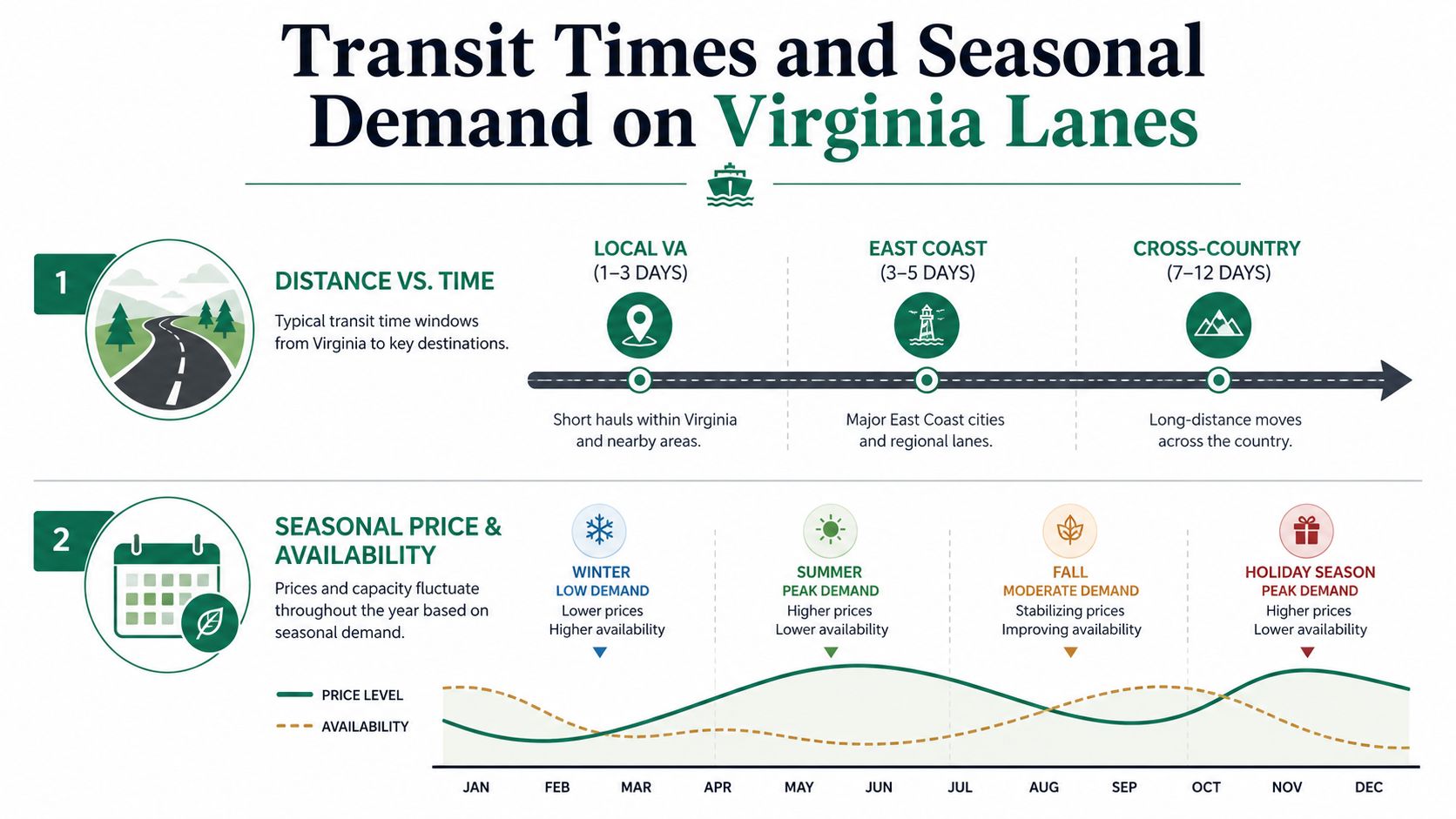
Virginia lane data shows how much route length changes the timeline. Virginia to Florida runs 630 miles with 0 to 3 days, Virginia to Texas runs 1,376 miles with 1 to 5 days, Virginia to California runs 2,723 miles with 4 to 9 days, and Virginia to Washington runs 2,960 miles with 4 to 10 days (Sherpa Virginia route data). The pattern is straightforward, longer lanes take longer, but dispatch still works inside a carrier window rather than around a guaranteed drop-off date.
A tight deadline creates trouble fast. The truck can be moving on schedule and still miss the date you expected because pickup access, load order, and the carrier's route plan all affect where your car falls in the run. If you need control, ask for the pickup window first and treat the delivery date as an estimate.
Snowbird lanes tighten when seasonal demand spikes
Florida and Arizona lanes get crowded when winter and spring demand pushes more cars south. One Virginia auto transport guide says snowbird season runs October to November and March to May, and that it can add 10 to 20% on Florida and Arizona routes (Virginia seasonal demand guide). The same Virginia-origin shipment can price differently depending on whether you book before the rush or during it.
Book early if your car is headed to Florida in those windows, and stay flexible on pickup. Virginia pricing already swings sharply by lane, from nearby-state moves to long cross-country shipments, so timing is part of the quote, not an extra detail.
Busy move periods create their own delays
Military relocations, college move-outs, and summer moves all compete for the same carrier space. The pressure shows up first on long-haul lanes and routes tied to major population shifts out of Virginia. Once capacity tightens, dispatchers have less room to work with, and last-minute bookings climb fast.
Flexible pickup windows save money more often than people expect. A shipper who can wait a day or two usually gets a better lane match than someone demanding immediate pickup.
Getting an Accurate Quote in Virginia
A real quote starts with real shipment details. Give the dispatcher the car's year, make, model, running condition, pickup and delivery cities, preferred dates, and whether you want open or enclosed transport. Leave out any of that, and the number gets fuzzy fast.
Flat-rate quotes beat vague ballparks
A flat-rate quote gives you a usable number under the terms you agreed to. A ballpark is only a starting point. Good dispatchers say which one you are looking at, and they tell you whether the price is locked or still open to change after a carrier is assigned.
Virginia routes make that difference matter. A unit that can be picked up near a major corridor usually costs less to move than one sitting on a street a truck cannot reach safely. If the company will not explain that before booking, move on.
Door-to-door doesn't always mean curbside
Buyers miss this all the time. In Northern Virginia, Richmond, Hampton Roads, and rural counties, “door-to-door” often means the truck gets as close as it safely can, then meets you near a main road or a truck-friendly spot. Low trees, tight streets, and truck restrictions make true curbside pickup impossible in many neighborhoods.
Large freight equipment needs room to turn, load, and stop without blocking traffic. The better companies tell you that upfront, before the driver is already trying to work the block.
Ask these questions before you pay
- Where will the truck meet me? You want a specific answer, not a vague promise.
- Is the price flat-rate or an estimate? That tells you whether the quote can move later.
- What happens if my pickup date shifts? Flexible dispatch matters on Virginia lanes.
- Who answers the phone after booking? Real human contact matters more than a slick form.
For customers who want broader nationwide coverage, National Car Transport's dealer logistics page is one example of a provider that coordinates transport for commercial and retail needs without pretending every pickup is the same.
Preparing Your Vehicle for a Virginia Shipment
Virginia weather and road conditions leave their own fingerprints on a vehicle. Winter salt in Northern Virginia, spring pollen across the Piedmont, and summer heat in Hampton Roads all create different cleanup and inspection issues. If you prep the car the right way, the handoff goes smoothly and you reduce pointless disputes later.
Start with the inside, then move outward
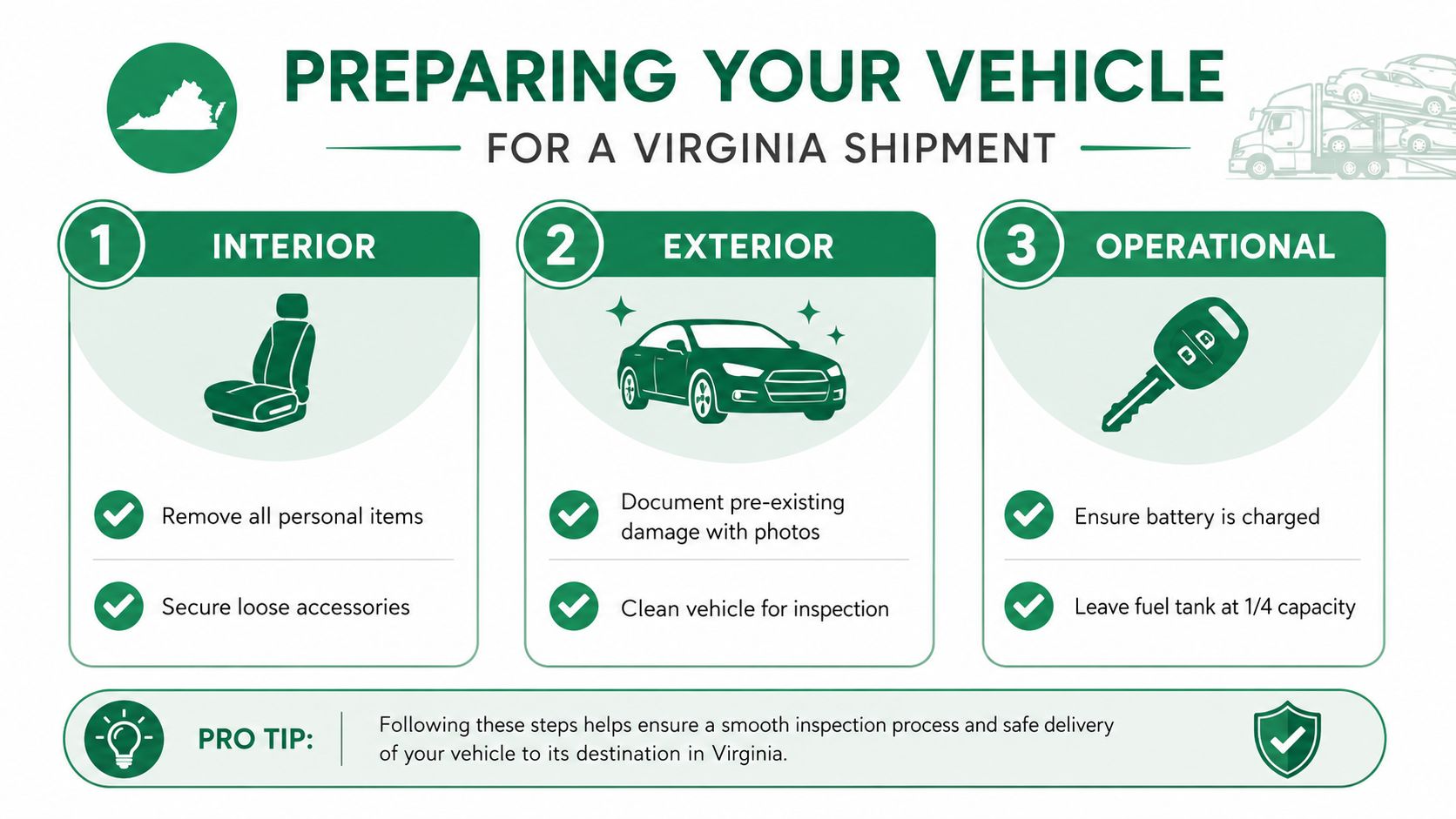
Take out personal items first. Loose chargers, sunglasses, toll passes, papers, and anything that can roll around should come out before the driver arrives. If you use an E-ZPass, remove it or secure it so it doesn't get lost, triggered, or damaged during transit.
The outside needs equal attention. Wash the vehicle so existing dents, scuffs, and chips are easier to document. Take clear photos from multiple angles before pickup, because that's your best record if someone later asks what was already there.
Keep the car operational but not overstuffed
Carriers generally want a vehicle that can be loaded without drama. That means a charged battery, enough fuel to move on and off the trailer, and no unnecessary weight inside the car. A near-empty cabin is easier for the driver to inspect and easier for you to verify later.
A simple pre-ship routine works:
- Remove personal items: empty the cabin and trunk of loose belongings.
- Document the exterior: take dated photos of all sides, wheels, and bumpers.
- Check the basics: charge the battery and leave the fuel tank around 1/4 capacity.
Match prep to the season
A clean car isn't just about looks. It helps a driver spot any issue during pickup, which keeps the bill of lading cleaner and your expectations clearer. In colder parts of Virginia, road grime and salt buildup can hide scratches. In warmer coastal areas, dust and pollen can do the same thing.
The point is to make the handoff fast and boring. That's what you want. The less time everyone spends arguing over small details at pickup, the faster the shipment gets moving.
Choosing a Reliable Virginia Car Shipping Company
A serious auto transport company should sound organized before you hand over a key. If the quote is vague, the deposit is heavy, or the person on the phone cannot explain the lane, keep looking. Virginia has enough carrier options that you do not need to accept sloppy sales behavior.
Start with the route and the pickup access. A company that understands Virginia as a corridor state will tell you whether your lane is a busy, quick-fill move or one that needs more time to place. That matters more than polished sales talk because pricing and pickup reliability change by corridor, not by state name alone.
Broker, carrier, and network are not the same thing
A broker arranges the move. A carrier physically hauls the car. Some companies do both coordination and dispatch well, which can shorten the time from quote to pickup on busy Virginia lanes because they already know where truck supply sits.
That network depth matters. Virginia carriers are spread across several metro areas, and a wider vetted network can help when a customer needs a quick pickup or a tight delivery window. It helps with dealership moves, student relocations, and military shipments, where timing and access usually matter more than a flashy promise.
Look for proof, not posture
An A+ BBB rating is a useful signal, but it is not enough by itself. You still want clear pricing terms, licensing, and a human who can answer real logistics questions. Ask how the company handles pickup access, carrier assignment, and route changes.
A network of 25,000+ vetted carriers gives dispatchers more room to place a car on a workable route, and National Car Transport says it operates with 25+ years of experience, transparent flat-rate pricing, and bilingual English and Spanish agents based in the USA. If you want a dealer-facing contact point, use their dealer shipping page to check how they handle repeat moves and pickup coordination.
Use that as a benchmark, not a sales pitch. A provider should explain its process plainly and answer route questions without hiding behind buzzwords.
Watch for red flags
- Large upfront deposits: these can create unnecessary risk before a carrier is assigned.
- Vague pricing: if nobody can explain what drives the number, expect surprises.
- No real human contact: dispatch problems get worse when nobody picks up.
- Too-good-to-be-true quotes: lowball rates often fail when it is time to secure a truck.
A quote that makes sense, comes from a real dispatcher, and matches the lane usually saves money in the long run. The cheapest number on the screen often turns into the most frustrating move on the calendar.
Putting It All Together for Your Virginia Move
Choose the route first, not the seller's headline. If your lane is short and regional, price should stay closer to the lower Virginia bands. If you're shipping cross-country, expect the quote to rise, and expect transit to move into the multi-day window that long-haul freight requires.
Then match the transport type to the car. Open transport is the default for ordinary vehicles. Enclosed only makes sense when the vehicle's value, clearance, or finish justifies the premium.
Your next move should be simple. Get a flat-rate quote, confirm whether pickup is curbside or a meet-near-route arrangement, and prep the vehicle before booking. That sequence keeps the process honest and keeps the truck moving.
If you want a straightforward quote, National Car Transport handles door-to-door vehicle shipping across Virginia, the rest of the mainland, and Puerto Rico with open or enclosed options and bilingual support. Visit National Car Transport to compare your lane, check pickup access, and get a real shipping plan before you commit.