

If you're staring at a move date, a job transfer, military orders, a college calendar, or a seasonal trip plan and wondering what to do with your car, you're in the same spot most first-time shippers hit. Driving out of Seattle sounds simple until you factor in ferry schedules, mountain weather, packed summer demand, and that a cross-country drive can eat days you don't have.
Seattle adds its own wrinkles. Some pickups are easy curbside handoffs. Others involve tight streets, condo loading zones, bridge access limits, or a nearby ferry leg that changes timing. Then there's the bigger jump that many city guides skip entirely: shipping a vehicle from Seattle or anywhere on the mainland to San Juan, Puerto Rico, where inland transport and ocean transport have to line up cleanly.
A good shipment usually comes down to a few practical decisions made early. Pick the right transport type, verify the company properly, prepare the vehicle the right way, and set a realistic budget and timeline. Every transport is different, but the process doesn't have to feel complicated when you know what matters and what tends to cause delays.
Table of Contents
- Your Guide to Shipping a Car in Seattle
- Choosing Your Transport Type Open Enclosed or Container
- How to Estimate Your Car Shipping Costs and Timeline
- Vetting Seattle Car Shipping Companies
- Preparing Your Vehicle and Paperwork for Transit
- Navigating Seattle and Puerto Rico Specific Logistics
Your Guide to Shipping a Car in Seattle
Seattle moves happen fast. A tech employee gets a relocation package and needs a car in Austin, Phoenix, or New York. A military family receives orders and can't spend days on the road. A snowbird wants the vehicle waiting on the other end without adding wear and mileage. In each case, the question isn't just who can move the car. It's who can move it with the fewest surprises.
Seattle also sits inside a larger national transport network. The U.S. vehicle shipping industry is projected to include 7,073 businesses with a $10.5 billion market size in 2026, and IBISWorld states that market reflects 7.0% CAGR between 2020 and 2025. The same industry summary notes a 1.3% CAGR for the specific vehicle shipping sector over that period, which points to steady demand rather than a passing spike in interest according to IBISWorld's vehicle shipping services industry report.
That scale matters for Seattle shippers because your route doesn't stay local for long. Your car may start in Ballard, Bellevue, Tacoma, or Everett, but once it gets on a carrier, it enters a national lane system that connects the lower 48, Alaska, Hawaii, and in some cases a Puerto Rico port move after inland transport.
The first decisions that shape the shipment
A smooth booking usually starts with four choices:
- Route type: In-state, cross-country, or mainland-to-island.
- Transport method: Open, enclosed, or container.
- Pickup style: Door-to-door when access works, or a nearby safe meeting point when it doesn't.
- Timing: Flexible dates usually help. Tight pickup windows tend to narrow options.
Practical rule: Car shipping goes more smoothly when you match the service to the route instead of shopping by price alone.
Why Seattle needs a little more planning
Seattle isn't hard to ship from, but it does reward preparation. Summer demand rises with relocations, especially local moves tied to employer transfers. Winter creates a different problem. Weather, mountain passes, and wet road conditions can change what transport type makes sense.
For people searching car shipping companies Seattle, the best starting point isn't a list of names. It's a clear plan for your route, your vehicle, and your timing. Once those are set, the right provider is much easier to identify.
Choosing Your Transport Type Open Enclosed or Container
The transport method changes both cost and risk. For mainland routes, the primary decision typically involves selecting between open and enclosed transport, but Seattle shippers heading to Puerto Rico also need to understand container service because ocean transit is a different operation than standard domestic car hauling.
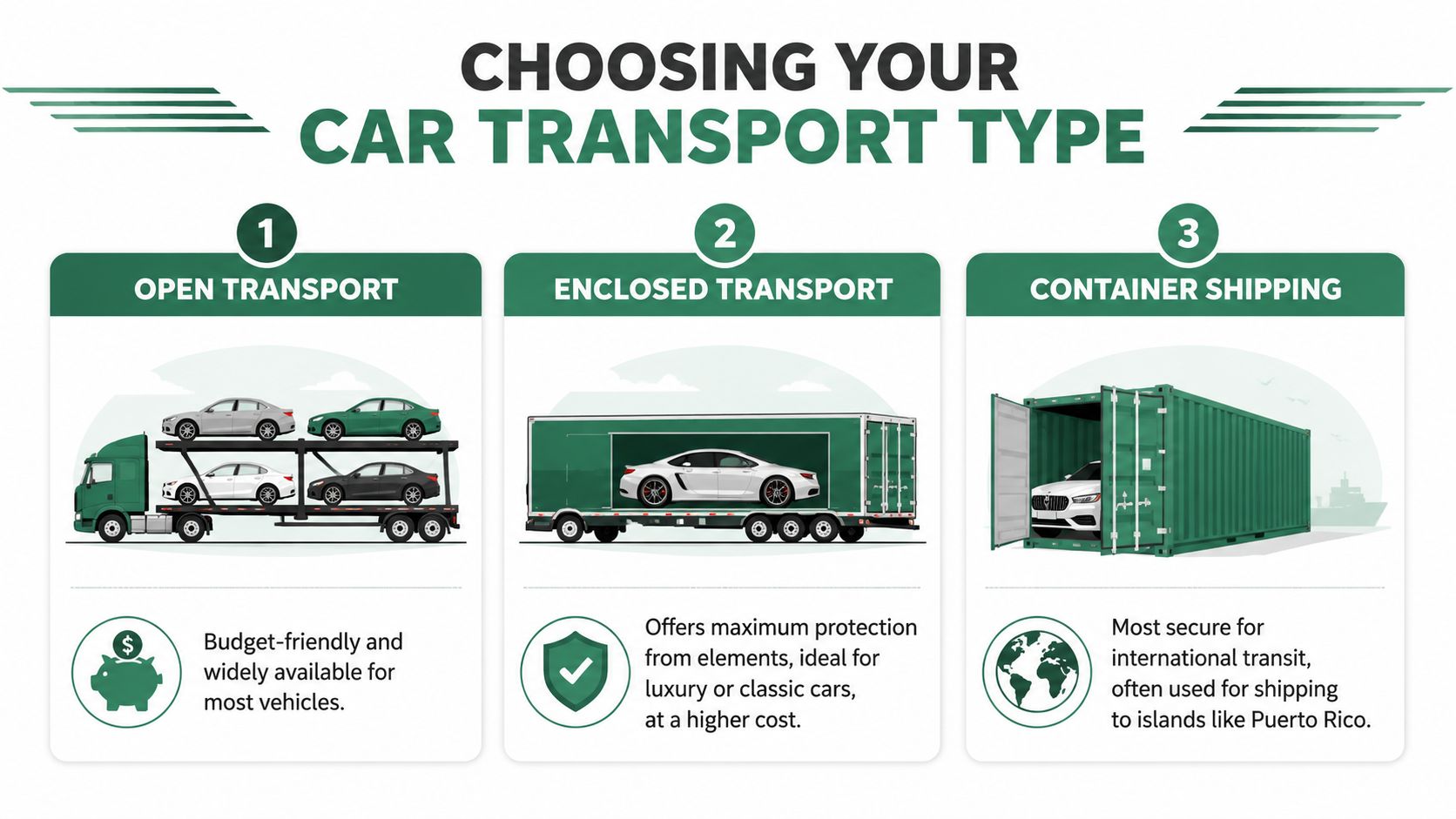
A quick visual makes the differences easier to sort out.
What open transport does well
Open transport is the standard option most drivers use. It's practical, widely available, and usually the easiest equipment to schedule on common routes. If you're moving a daily driver from Seattle to Los Angeles, Denver, Dallas, Miami, Chicago, Atlanta, Boston, or another major metro, open transport is often the first mode to check.
It works well for:
- Everyday vehicles: Sedans, crossovers, SUVs, and pickups used as primary transportation.
- Routine relocations: Job moves, student moves, military transfers, and seasonal travel.
- Most domestic routes: Especially within the lower 48 where carrier availability is broader.
If you're comparing service types, a good baseline is to review how open car transport works and then decide whether your vehicle and season justify paying more for extra protection.
When enclosed transport earns its higher price
Enclosed transport isn't only for exotics and classics. It also makes sense when weather exposure creates avoidable risk.
Seattle is one of those markets where season matters a lot. As noted in a Seattle-specific shipping guide, enclosed transport costs 30-60% more than open transport, yet for standard vehicles, the risk of rain, mountain snow, and road grime during Seattle's 6-month winter window (October-April) makes it a financial necessity rather than a luxury to mitigate unique debris and moisture hazards based on this Seattle transport guide.
That trade-off is easy to miss. In dry weather, open transport is usually enough. In wet winter conditions, especially on longer lanes that cross mountain regions, enclosed service can protect paint, trim, and surfaces that owners don't want exposed.
A simple way to think about it:
| Transport type | Best fit | Main trade-off |
|---|---|---|
| Open | Standard vehicles in normal conditions | More exposure to weather and road film |
| Enclosed | Luxury, collector, specialty, or winter-sensitive shipments | Higher price |
| Container | Ocean or island moves such as Puerto Rico | More handling steps and port coordination |
A video overview can help if you're still weighing the options.
Why container shipping matters for Puerto Rico
For Puerto Rico shipments, container service becomes part of the conversation because the move isn't just over the road. The vehicle first travels on land from the mainland origin or from a handoff point, then transitions into port operations and ocean transport before final release in San Juan, Puerto Rico.
Container shipping usually makes sense when:
- The route includes ocean transit: Mainland U.S. to Puerto Rico is the clearest example.
- You want a controlled shipping environment: Particularly for higher-value vehicles or more complex island moves.
- You need a coordinated multi-stage shipment: Inland pickup, port delivery, ocean booking, and final release all need to line up.
"For Puerto Rico, the transport type isn't just a preference. It's part of the route design."
How to Estimate Your Car Shipping Costs and Timeline
You approve a quote on Tuesday, then find out the truck cannot reach your Capitol Hill street, the pickup slips because the lane is tight, and the "five-day transit" never included the pickup window in the first place. That is a common first-time shipping mistake in Seattle. Cost and timing estimates are only useful when they match the actual route conditions.
Seattle pricing moves with season, lane demand, and access. Summer relocation traffic can tighten capacity around the city, and winter weather over Snoqualmie Pass or on longer inland routes can slow pickups and linehaul schedules. Ferry-served locations add another layer because many large car carriers will not board ferries, which means the handoff point matters before a truck is ever dispatched.

What your quote is really paying for
A good quote reflects the route, the equipment, and the pickup conditions, not just the mileage.
- Distance and lane demand: Seattle to Los Angeles usually prices differently than Seattle to a smaller inland market because carriers can fill common metro routes faster.
- Vehicle size and condition: Full-size trucks, oversized SUVs, and inoperable vehicles cost more because they take more space, add loading complexity, or require special equipment.
- Transport type: Open service is usually the lower-cost option. Enclosed service raises the price because there are fewer enclosed trailers and fewer vehicles per load.
- Season and weather exposure: Summer moves tied to relocations, student schedules, and tech hiring waves can push rates up. Winter storms can do the same by reducing available capacity and slowing routes.
- Pickup and delivery access: Narrow streets, steep grades, low branches, apartment loading zones, and ferry-only addresses often lead to a nearby meeting point instead of true door-to-door service.
For a plain-language breakdown of how these variables affect pricing, this guide to car shipping cost factors and rate estimates is a useful reference.
The biggest quoting mistake is comparing one low number to three realistic ones. Ask what is included, whether the quote is binding or estimated, and whether it assumes terminal pickup, residential delivery, or a street-accessible meeting point.
What transit time looks like in practice
Transit time has two parts. First comes the pickup window. Then comes the actual time on the truck.
On a busy Seattle lane, pickup may happen within a few days. On a thinner route, or during a weather disruption, that window can stretch. Cross-country moves usually take longer because the carrier is building a full route with multiple stops, rest requirements, and traffic delays across several states.
Seattle adds local timing issues that national calculators miss. Downtown congestion, port activity, bridge traffic, and limited truck access in dense neighborhoods can affect appointment planning even when the long-haul route is straightforward. If the vehicle is coming from Bainbridge Island, Bremerton, or another ferry-dependent location, assume an extra coordination step.
Puerto Rico moves need even more buffer. The vehicle may go by truck to a mainland port, wait for its booked ocean slot, move by vessel to San Juan, and then clear release procedures before final pickup or delivery. That is why a Puerto Rico shipment should be estimated as a multi-stage move, not as a simple Seattle departure with one transit clock.
Working rule: Ask for three dates, not one. The pickup window, the estimated road or ocean transit window, and the earliest realistic delivery or release date.
Flat-rate pricing helps when the company has already accounted for Seattle access limits, seasonal demand, and any port handling built into the route. If those details are missing from the quote, expect revisions later.
Vetting Seattle Car Shipping Companies
This is the step first-time shippers rush, and it's the one that causes the most avoidable trouble. The lowest quote isn't helpful if the company isn't authorized, can't verify insurance, or disappears once a deposit clears.
Seattle buyers need to pay attention here because broker quality varies a lot. One Seattle-focused review of the market states that 70% of auto transport complaints stem from unlicensed brokers, and it adds that legitimate brokers should have FMCSA-registered USDOT/MC numbers that consumers can check through the FMCSA Company Snapshot tool as explained in this broker verification guide for Seattle shippers.
Broker versus carrier
A carrier owns or operates the truck that physically moves the vehicle. A broker arranges the shipment by matching your order with a carrier.
Neither model is automatically better. What matters is whether the company is legitimate, transparent, and organized.
A dependable broker can help because:
- It has access to more routes: That matters on less common lanes and island moves.
- It can match equipment to the job: Open, enclosed, and port-related moves require different coordination.
- It acts as a single point of contact: Helpful when your route includes more than one stage.
A carrier can be a good fit when:
- The route is simple and direct
- The company clearly services your exact lane
- You can confirm authority, insurance, and communication standards
The FMCSA check you should always do
This should take only a few minutes. If a company hesitates, that's your answer.
- Ask for the USDOT number and MC number. A legitimate broker or carrier should provide them.
- Use the FMCSA Company Snapshot tool. Verify the business name matches what you're being told.
- Check operating authority status. Make sure the authority is active, not suspended or mismatched.
- Confirm the company type. The listing should indicate whether it's operating as a broker, carrier, or both.
- Compare records to the quote and website. If names, addresses, or service descriptions don't line up, pause the booking.
A polished website doesn't prove legal authority. FMCSA registration does.
What else separates a solid company from a risky one
After the authority check, look at how the company handles the basics.
- Insurance clarity: Ask what coverage applies during transit and who carries it.
- Quote structure: The cleaner the written quote, the fewer billing surprises later.
- Review pattern: Look for comments that describe pickup communication, condition reporting, and delivery follow-through.
- BBB standing: An A+ BBB rating doesn't replace verification, but it can support a stronger trust profile.
- Route knowledge: Seattle pickups can involve ferries, condo loading zones, and access restrictions. Puerto Rico moves add port timing and document handling.
Door-to-door service is still the most convenient format when access works. If you want a plain-language breakdown of that service model, this explanation of door-to-door auto transport is a useful reference.
For people comparing car shipping companies Seattle, the safest approach is simple. Verify authority first, then compare service details. Don't reverse that order.
Preparing Your Vehicle and Paperwork for Transit
Good prep speeds up pickup, protects you during inspection, and reduces the chance of a dispute at delivery. The carrier doesn't need a showroom-ready car, but they do need a vehicle that's easy to inspect, easy to load, and properly documented.
How to get the car ready
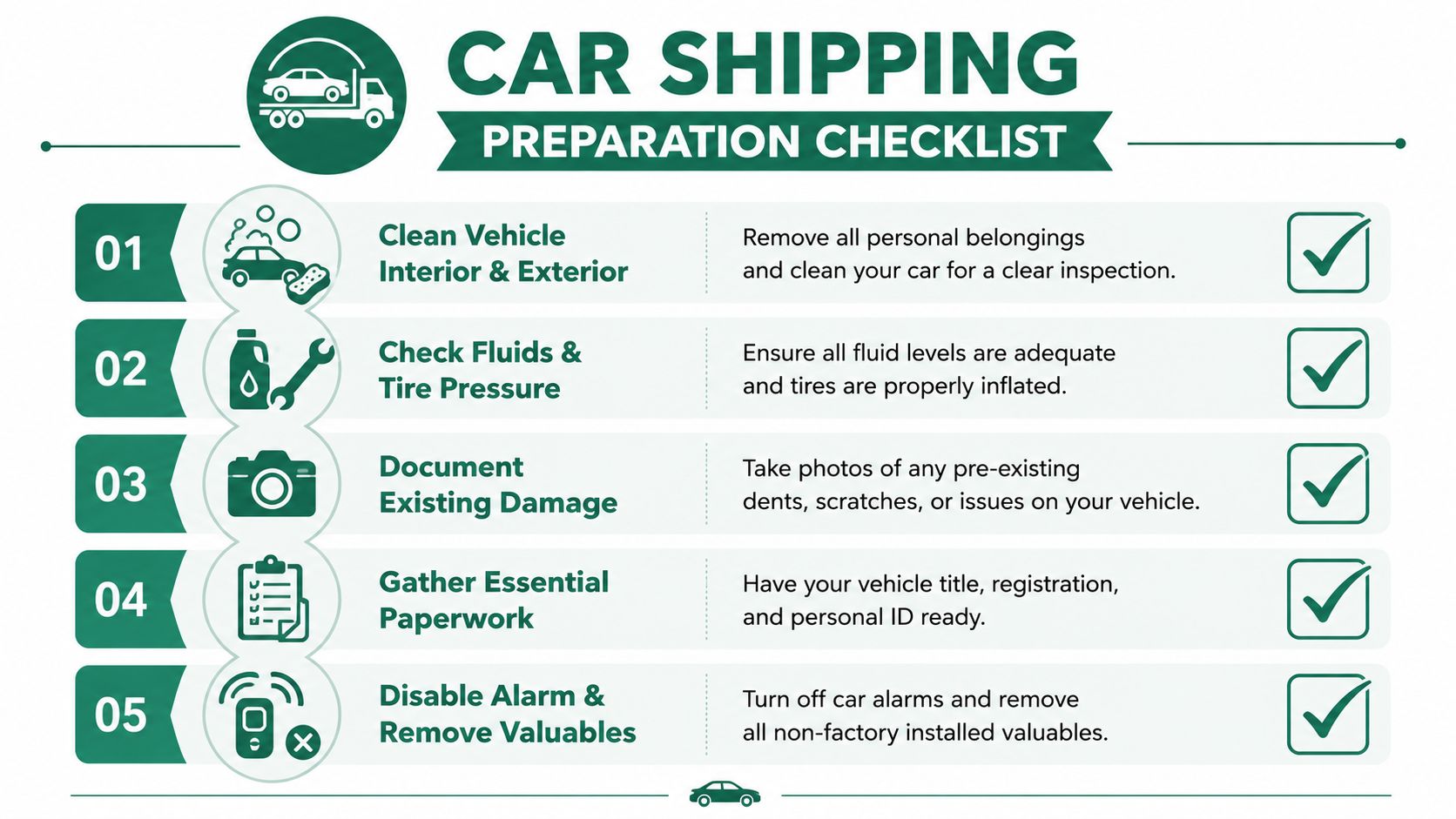
Use this checklist before pickup day:
- Clean the exterior: Dirt hides scratches, chips, and small dents. A clean surface makes the inspection report more accurate.
- Remove personal belongings: Carriers are moving the vehicle, not household goods. Loose items also shift during transit.
- Photograph existing condition: Take clear photos from multiple angles, plus close-ups of any visible damage.
- Check battery, tires, and fluids: The car should be able to load and unload safely unless you've booked a non-running shipment.
- Turn off alarms and toll devices: This prevents unnecessary battery drain and nuisance alerts.
- Remove custom accessories when possible: Detachable racks, spoilers, and fragile add-ons are better packed separately.
Some owners ask about fuel. A light amount is usually best. Enough to load and unload, not so much that you're adding unnecessary weight.
Paperwork for domestic moves and Puerto Rico shipments
The document stack changes based on destination.
For a domestic shipment within the lower 48, most customers should have:
- Government-issued photo ID
- Vehicle registration
- A full set of keys for the driver
- Booking confirmation or dispatch details
For a Puerto Rico shipment, expect additional document review because the move includes port handling and release requirements. The typical packet often includes:
- Photo ID
- Vehicle registration
- Vehicle title
- Keys
- Any port or shipment authorization forms provided by your transport coordinator
Bring documents together before the pickup window opens. Last-minute title searches and ID issues are one of the easiest ways to slow down an otherwise clean shipment.
If someone else is handing off or receiving the vehicle for you, make sure the company knows in advance and that the contact information matches the order.
Navigating Seattle and Puerto Rico Specific Logistics
A Seattle pickup scheduled for a dry July afternoon and a Seattle pickup scheduled during a wet January week are two different jobs. Add a Puerto Rico delivery on the back end, and timing, access, and paperwork all need tighter control than a standard mainland move.
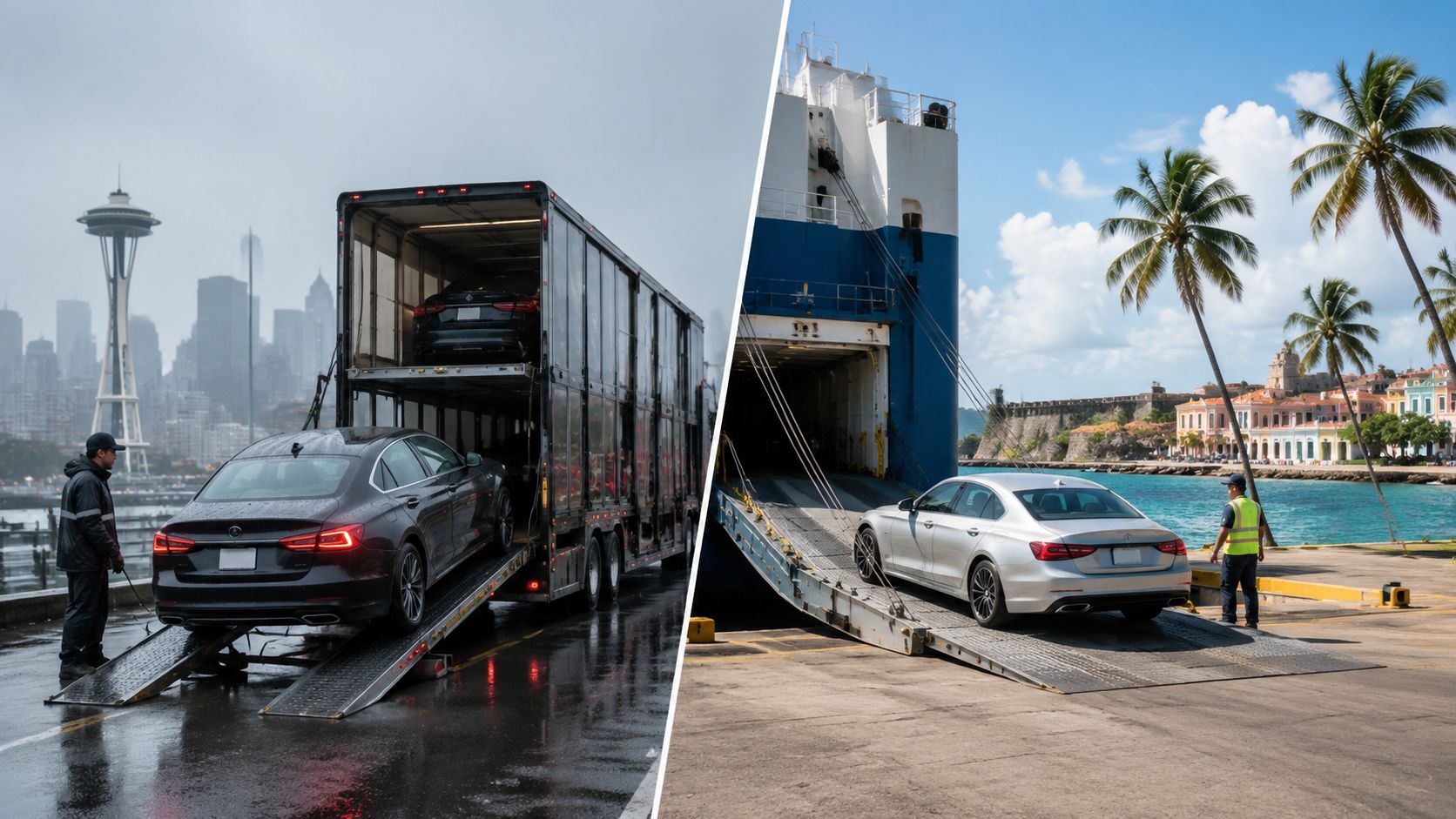
Seattle has a few local patterns that first-time shippers tend to underestimate. Summer gets busier as relocation traffic picks up around the region's tech employers and university cycles, which can tighten carrier availability. Winter creates a different problem. Rain, mountain pass conditions, and occasional ice can slow the trucks feeding in and out of the city even if your own neighborhood streets look fine.
Seattle timing and access issues
The biggest local mistake is assuming "door-to-door" always means a full-size carrier can pull up to your address.
In Seattle, pickup plans often change because of:
- Narrow residential streets and steep grades: Some neighborhoods do not work well for large transport trucks.
- Condos and apartment buildings with active loading rules: A driver may have only a short legal window to stop.
- Ferry corridors, port traffic, and bridge backups: Travel times can swing hard during peak periods.
- Weather-related rerouting: Winter conditions can affect the truck's path long before it reaches the city.
A good coordinator confirms the handoff point early. Sometimes that is your home. Sometimes it is a nearby grocery lot, a wider arterial road, or another truck-friendly meeting spot that saves hours of delay and missed calls.
How mainland to Puerto Rico shipping usually works
Puerto Rico shipments add a port leg, and that changes how the move is built. The vehicle usually goes through an inland carrier first, then into port processing, then onto an ocean vessel bound for San Juan. The Port of Seattle publishes vehicle and cargo terminal information that gives useful context on regional freight access, but Seattle to Puerto Rico vehicle shipments commonly route through mainland port partners set up for island service rather than sailing directly from Seattle.
The sequence usually looks like this:
- Pickup in Seattle or the surrounding area
- Inland transport to the assigned port staging location
- Document review and port acceptance
- Ocean transit to San Juan
- Release to the listed receiver after port processing is complete
That middle portion is where delays show up. If the name on the title, registration, ID, or release paperwork does not line up, the vehicle can sit until the discrepancy is corrected. I tell customers to treat Puerto Rico shipping as a two-part move with one file. The inland leg and the ocean leg need to match perfectly on names, dates, and destination instructions.
Container service can make sense on this route, especially for higher-value vehicles or shipments that need more controlled handling between the mainland and the island. Bilingual support also helps in practical ways. English and Spanish communication can reduce mistakes during document review, scheduling calls, and final release.
Who benefits most from guided coordination
Seattle to Puerto Rico is usually easiest for people working on fixed deadlines.
That includes:
- Military families with report dates and little room for delay
- Students trying to line up arrival with the semester
- Seasonal residents planning around departure and return windows
- Dealerships and business operators moving units into Puerto Rico inventory
- Households relocating from Seattle after a job change or family move
The route is manageable. It just has more handoffs than a typical domestic shipment, and each handoff creates one more place for timing or paperwork to slip.
National moves and Puerto Rico shipments go more smoothly when one experienced team handles the details from first quote to final delivery. National Car Transport brings 25+ years of experience, an A+ BBB rating, transparent flat-rate pricing, and a network of 25,000+ vetted carriers to routes across the mainland, Alaska, Hawaii, and Puerto Rico. Their U.S.-based bilingual agents speak English and Spanish, and they have over 20 years of experience in auto transport logistics service. That matters because no two vehicle shipments are alike. Having an agent guide the process, explain the trade-offs, and keep the move simple and quick is where strong service creates real value.