

You're probably looking at a car in a Minnesota driveway, a college parking lot, a dealership lot, or a military housing area and wondering how to move it without turning the process into a second full-time job. That's a common spot to be in, especially when weather, timing, and route access in Minnesota can change what looks like a simple shipment into a more technical decision.
Minnesota adds its own layer of complexity. A pickup in Minneapolis or St. Paul usually moves differently than one in Duluth, Mankato, Rochester, or a rural address off a county road. Winter road salt, snowbanks, spring potholes, and tight residential access all affect how carriers schedule loads, what equipment works best, and how you should judge quotes from car shipping companies in Minnesota.
If you're also comparing domestic transport with island shipping, the questions get bigger. Many people who ship within the lower 48 eventually ask about moving a vehicle to San Juan, Puerto Rico from the mainland, or arranging a return trip later. The good news is that the process becomes much easier when you understand who is moving the vehicle, what protection level makes sense, and which costs belong to trucking versus ocean transport.
Table of Contents
- How Minnesota Car Shipping Works
- Minnesota Cost and Transit Expectations
- Verifying Insurance and Licenses
- Seasonal and Route Considerations in Minnesota
- Questions to Ask and Common Pitfalls
- Packing and Inspection Checklist
- Getting a Quote and Next Steps
How Minnesota Car Shipping Works
Most Minnesota vehicle moves follow the same basic path. A shipper requests a quote, the transport is assigned to a carrier, pickup is scheduled, the vehicle is inspected at loading, then the car travels on a route with other vehicles before final delivery and another inspection.
The route is built around carrier efficiency
Car haulers don't usually move one vehicle like a private tow truck. They build a route. That means your pickup date depends on where the truck already is, where it's heading next, and whether your vehicle fits the load plan.
In Minnesota, that often favors metro areas first. Minneapolis and St. Paul are easier for carriers to reach than a cabin road in northern Minnesota or a farm address far from a highway. Duluth can also be straightforward on some runs, but weather and terrain can tighten scheduling.
A good way to think about it is this. Your car isn't booking a private flight. It's joining a well-planned bus route for vehicles.
Door-to-door doesn't always mean driveway-to-driveway
Most customers want door-to-door service because it's simpler and saves time. The industry term usually means the carrier gets as close to your address as it can safely and legally reach. If your street is narrow, icy, restricted for heavy trucks, or blocked by low branches, the driver may ask to meet nearby at a larger lot.
For a clear overview of how this works in practice, see door-to-door auto transport service.
Practical rule: If a full-size truck can't turn around safely on your street in February, your car probably won't be loaded there either.
Broker-matched versus direct-carrier service
Many readers find this confusing. Some companies own trucks. Others arrange transport by matching your shipment with a carrier. Both models exist nationwide, including across the lower 48, Alaska, Hawaii, and Puerto Rico-connected routes from mainland departure points.
The important question isn't which label sounds better. It's who is handling dispatch, who confirms the final carrier, and who carries liability during transport. A broker may help you access more route options. A direct carrier may give you more immediate clarity on which truck is doing the job. If you're shipping from Minnesota to major cities like Chicago, Dallas, Phoenix, Los Angeles, Miami, or to a port for San Juan, route density often makes matching easier than on remote Minnesota pickups.
Minnesota Cost and Transit Expectations
A Minnesota quote often looks simple at first. Then winter, pickup location, and route density start changing the math.
Distance still sets the baseline. After that, pricing shifts based on the season, your vehicle's size, the exact route, and whether you choose open or enclosed transport. Two shipments with similar mileage can price very differently if one starts in Minneapolis on a busy lane and the other starts outside Bemidji after a snowstorm.
According to Minnesota car shipping pricing data from MoveBuddha, the average cost to ship a car from Minnesota to another state in 2026 is approximately $1,158, with short-distance shipments under 500 miles ranging from $554 to $845, medium distances from 500 to 1,500 miles ranging from $839 to $1,125, and long distances over 1,500 miles ranging from $1,173 to $1,301. The same source notes a broader interstate range of $729 to $2,082 based on verified customer reviews, and says standard shipping windows are often 4 to 7 days.
Cost and transit examples for Minnesota routes
| Route Type | Distance Range | Price Range | Transit Time |
|---|---|---|---|
| Short-distance shipment | Under 500 miles | $554 to $845 | Often within the standard 4 to 7 day window |
| Medium-distance shipment | 500 to 1,500 miles | $839 to $1,125 | Often within the standard 4 to 7 day window |
| Long-distance shipment | Over 1,500 miles | $1,173 to $1,301 | Often within the standard 4 to 7 day window |
| Broader interstate estimate | Varies | $729 to $2,082 | Timing varies by route and season |
| California to Minnesota, open transport | Long-haul interstate | $999 to $1,199 | Timing varies by scheduling and weather |
| Minnesota to Wisconsin or Iowa regional move | Regional | $600 to $1,200 | Usually quicker than a cross-country move |
Why one Minnesota quote is higher than another
Route shape matters as much as route length. Shipping from the Twin Cities usually gives brokers and carriers more scheduling options because more trucks pass through those lanes. A pickup from a rural town can take longer to assign because the truck may need to leave its main corridor, much like a school bus leaving the regular route to reach one far-out stop.
Winter changes both cost and timing. Ice, blowing snow, road closures, and weight restrictions can slow loading and delivery even when the total mileage stays the same. Carriers also build in extra time during Minnesota cold snaps because a delayed truck in January is a safety issue, not just a scheduling issue.
Vehicle type changes the quote too. A full-size pickup, oversized SUV, or modified vehicle takes up more trailer space and can affect how the load is balanced. Enclosed transport costs more because capacity is tighter and the equipment serves a narrower group of vehicles, usually collector cars, exotics, or low-clearance models.
If you want to compare these variables before booking, this car shipping cost guide gives a useful breakdown of what changes a quote.
Transit times follow the same pattern. A dense lane from Minnesota to Chicago or Denver usually moves faster than a lane that starts in a rural county and ends in a smaller market. Broker-arranged shipments can sometimes find faster placement on common routes because the broker is checking a wider carrier network, while a direct carrier may only quote dates that fit its own trucks. That distinction matters in Minnesota, where route density changes sharply between metro pickups and outstate pickups.
A good way to read any estimate is to separate linehaul distance from route difficulty. Mileage tells you how far the car travels. Minnesota conditions tell you how easy it is to get a truck to your vehicle and keep that truck on schedule.
Verifying Insurance and Licenses
A clean-looking website doesn't tell you enough. Before you book with any of the car shipping companies Minnesota shoppers are comparing, verify the company's role, registration, and insurance.
Confirm whether you're hiring a broker or a carrier
Responsibility for your vehicle varies based on who arranged the move and who physically hauled the car. Ask the company to identify itself clearly. If it's a broker, ask when you'll receive the assigned carrier's legal name, DOT information, and proof of cargo coverage. If it's a direct carrier, ask whether its own truck will handle the route from pickup through delivery.
The market is large enough that you should expect established systems. IBISWorld industry coverage notes that Minnesota's vehicle shipping market includes brokers like Nexus Auto Transport with a 4.8-star rating and networks of over 30,000 carriers, which shows the level of scale and professionalism customers should expect from serious providers.
Check documents before your car is dispatched
Use a simple checklist:
- Company identity: Ask for the legal business name used on transport documents, not just the brand name on ads.
- Operating authority: Confirm the company can legally arrange or perform vehicle shipping.
- Cargo insurance: Request proof that active cargo liability coverage is in place for the carrier assigned to your order.
- Dispatch details: Ask who will call you for pickup, who signs the inspection report, and who handles damage reporting if a problem appears at delivery.
Read the insurance wording, not just the certificate
A certificate tells you coverage exists. It doesn't tell you how every kind of damage is treated. Ask how inspection reports are handled, when damage must be noted, and whether the broker adds any supplemental protection. That question becomes more important in Minnesota because road grime, slush, and winter residue can make pre-existing cosmetic issues harder to spot if the car isn't prepared well.
If a company hesitates to explain who is liable at pickup, in transit, and at delivery, pause the booking.
Seasonal and Route Considerations in Minnesota
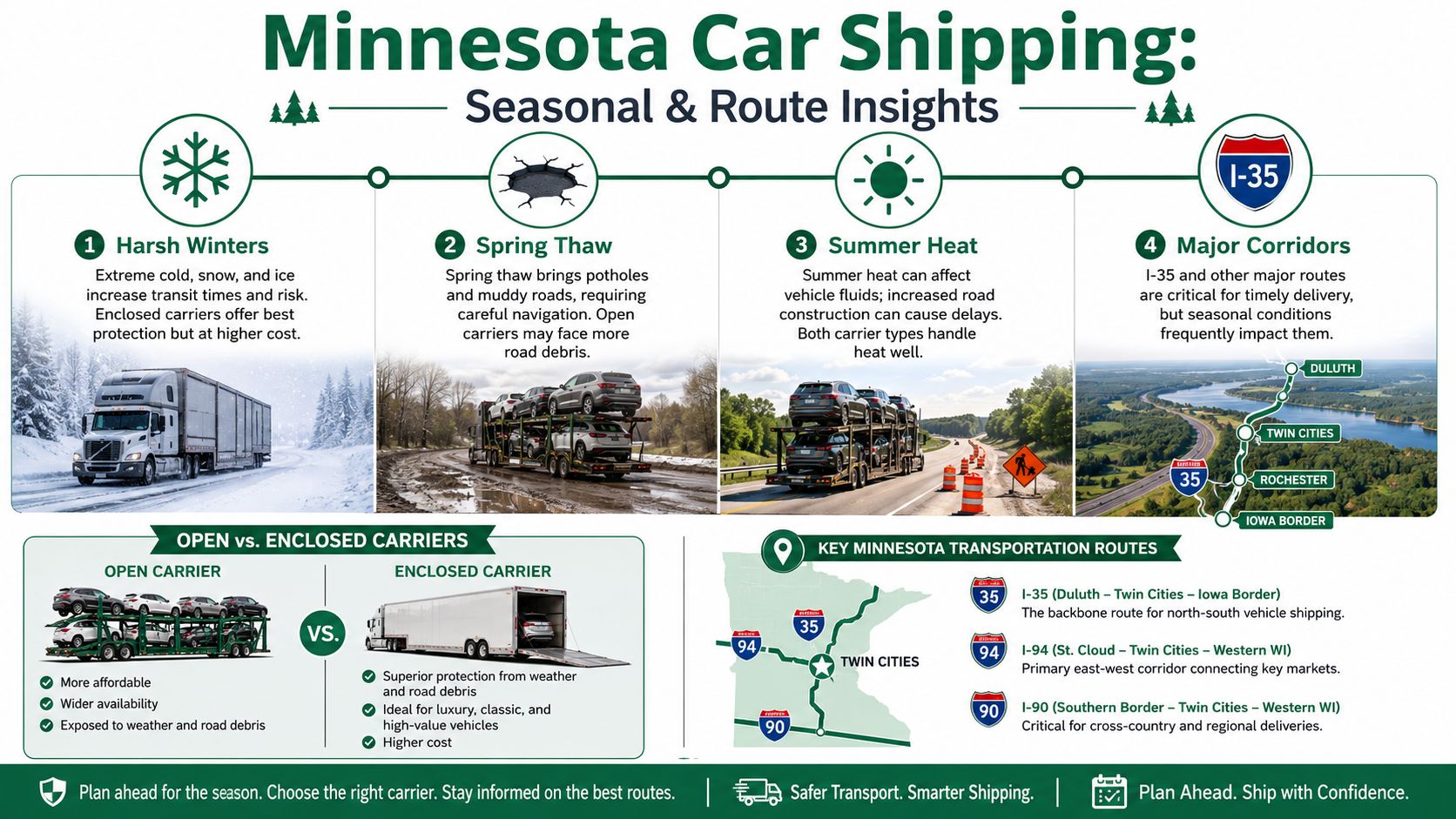
Minnesota shipping decisions change with the calendar. A July move and a January move may use the same highway numbers, but they don't carry the same exposure.
Winter changes the risk profile
The big split is open versus enclosed transport. According to Sherpa Auto Transport's Minnesota route page, enclosed carriers cost 30–40% more than open transport but shield vehicles from corrosive road salt, gravel, and moisture. That's especially relevant in Minnesota, where snow, slush, and de-icing residue can stay on roads for long stretches.
Open transport is still common because it's practical for everyday vehicles. But if you're moving a collector car, luxury vehicle, freshly restored classic, or low-mileage specialty model through winter conditions, enclosed shipping is easier to justify. It works like putting a vehicle in a garage that moves with it.
Main corridors versus rural access
Interstates such as I-35 and I-94 help carriers move in and out of Minnesota efficiently, but those corridors also collect the state's toughest winter traffic patterns. A carrier can make good time on a clear day and lose that rhythm quickly when visibility drops or road treatment changes.
Rural pickups create a different issue. The truck may need a safer meeting point if your road is soft during spring thaw, snow-packed in winter, or too narrow for a multi-car trailer. Duluth can present its own access challenges because terrain and weather interact differently there than in the Twin Cities.
Here's the practical comparison:
- Metro addresses: Easier scheduling, more carrier traffic, better odds of flexible pickup windows.
- Regional city routes: Usually workable, but may depend on how close the address sits to a main corridor.
- Rural Minnesota: More likely to need a nearby handoff location such as a large parking area.
Choose the transport plan that matches the season, not the one that looked cheapest on a sunny day quote.
Summer isn't risk-free
Summer removes snow and ice, but it doesn't remove delay risk. Road construction, heat, and heavy traffic can still affect delivery timing. For standard daily drivers, open transport usually remains the default choice. For rare vehicles, enclosed shipping still offers a cleaner trip with less exposure to weather and road debris.
That seasonal difference matters for customers shipping nationwide, whether the destination is Denver, Atlanta, Seattle, New York, Houston, Las Vegas, or a mainland port feeding a San Juan shipment.
Questions to Ask and Common Pitfalls
Minnesota customers often compare quotes without realizing they aren't comparing the same service model. That's where trouble starts.
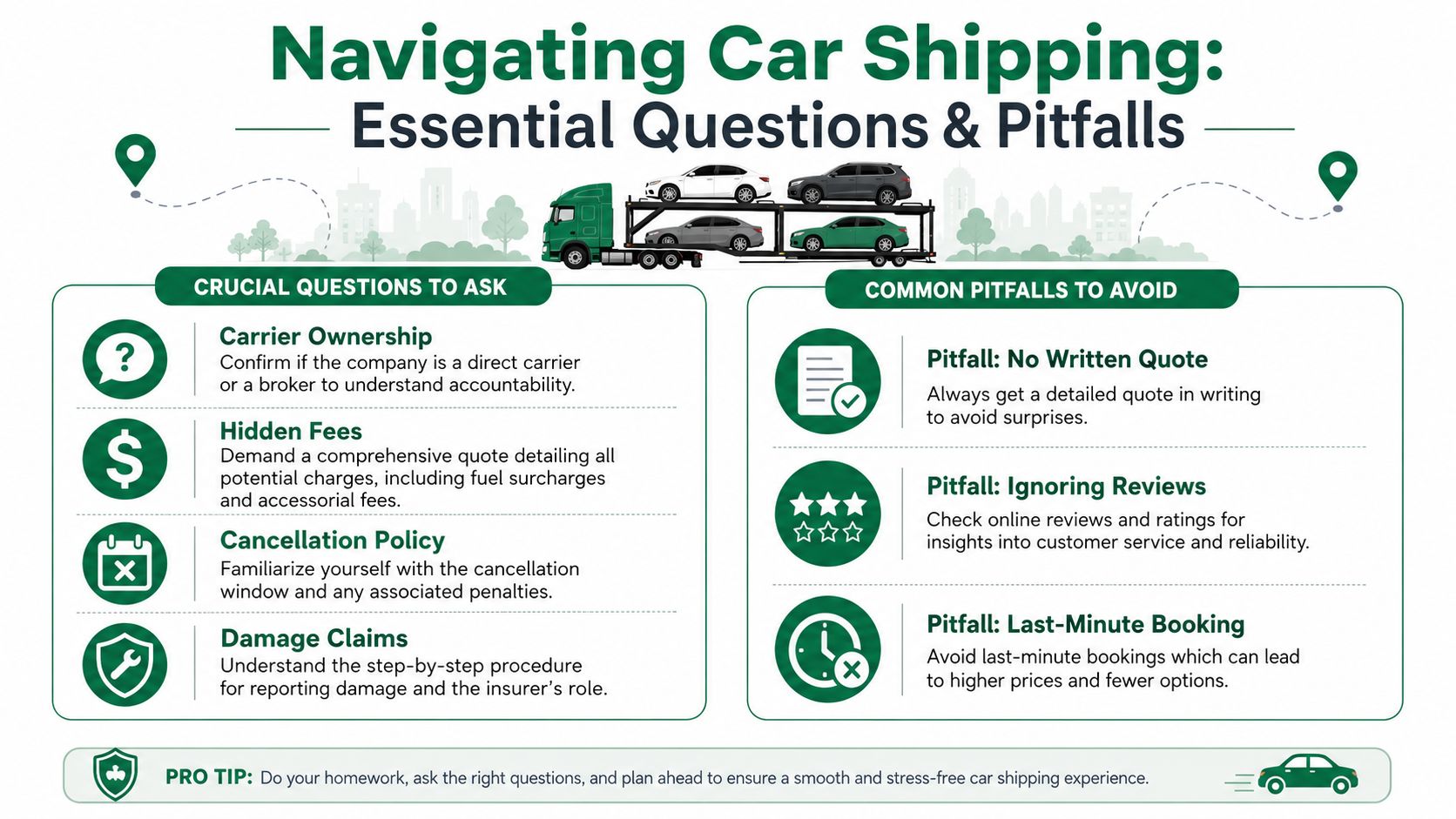
According to discussion summarized in this Minnesota shipping thread, approximately 70–80% of quoted "car shipping companies" in Minnesota are brokers, which helps explain why some shoppers run into hidden fees or quote changes when a carrier can't be secured at the original advertised rate.
Ask these questions before you book
- Are you a broker or a direct carrier? This tells you who is arranging the job and who is physically moving the car.
- Is the quote a flat rate or can it change during carrier assignment? If the answer is vague, pricing transparency may be weak.
- What happens if my street can't take a large truck? Minnesota winter access can force a change in pickup location.
- Who handles the claim if damage is found at delivery? You need a clear process before the vehicle is loaded.
- When do I receive the final carrier details? If those details come too late, you lose time to verify them.
A short explainer can help if you're sorting through terminology and process questions:
Common mistakes that cost people time
- Chasing the lowest number: A very low quote can be hard to honor if no carrier accepts it.
- Assuming “door-to-door” means any driveway works: Large trailers still need safe legal access.
- Skipping the written quote: If it isn't written down, it's hard to enforce later.
- Booking too late in a weather-sensitive season: Winter and peak relocation periods reduce flexibility fast.
Packing and Inspection Checklist
The prep work is where many successful shipments are won. A clean, documented vehicle is easier to inspect, easier to load correctly, and easier to protect if a claim ever becomes necessary.
Get the vehicle ready for loading
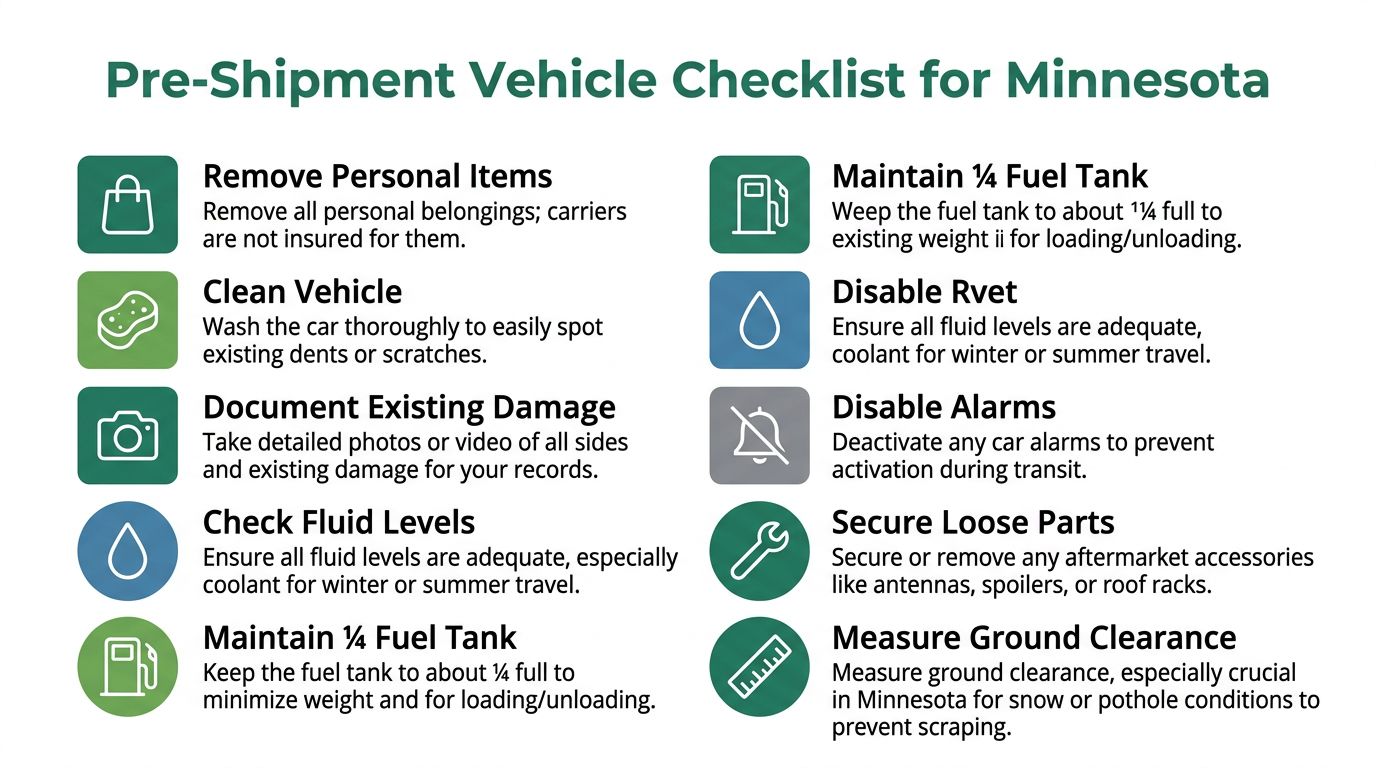
Use this checklist before pickup:
- Remove personal items: Carriers typically focus on the vehicle itself, not loose belongings inside it.
- Wash the exterior: Dirt hides scratches, chips, and winter wear.
- Photograph everything: Take clear photos of all sides, wheels, glass, roofline, and any existing damage.
- Check fluid condition: Look for leaks and make sure the vehicle is in basic running condition if operable.
- Leave about a quarter tank: Enough for loading, not so much that it adds unnecessary weight.
- Disable alarms: That prevents interruptions while the vehicle is in transit.
- Secure loose accessories: Antennas, detachable racks, and similar parts should be removed or tightened.
- Measure ground clearance: Minnesota potholes, snow buildup, and loading angles make this important for low cars.
Focus on winter-sensitive inspection points
Pay extra attention to the lower body, wheel arches, rocker panels, and under-bumper areas. Those spots collect salt and grime and are easy to overlook in a quick inspection. If you're shipping a collector or luxury vehicle, enclosed service may be worth considering for protection during harsh weather. For details on that equipment type, review enclosed auto transport options.
If you're also organizing a household move and want a practical packing reference, this guide to essential packing for your UK move is useful for thinking through protective materials and item preparation, even though vehicle transport follows its own rules.
Bring your photos to pickup and delivery. The inspection report is stronger when both sides can compare the same visual record.
Getting a Quote and Next Steps
A Minnesota quote often looks simple until the dispatcher asks a practical question: can a full-size truck safely reach your street after a fresh snowfall, or will pickup need to happen at a wider nearby lot? That is why the best quote is the one that matches the actual route, not just the lowest number on a screen.
Start by asking what the company is doing in the shipment. A broker arranges the move by finding a licensed carrier in its network. A direct carrier uses its own truck for at least part of the route. In Minnesota, that distinction matters because metro pickups around Minneapolis or St. Paul usually offer more scheduling flexibility, while rural routes can depend on limited truck availability, weather windows, and road access. If you live outside a major corridor, ask whether the quote assumes door-to-door service at your address or a nearby meeting point that is safer for loading.
Then confirm how the price is structured. Ask whether the rate is flat, what could change it, when payment is due, and which insurance documents you will receive before the vehicle is dispatched. A good quote should read like a clear winter travel plan. Pickup area, delivery area, vehicle size, operable condition, and timing should all be stated in plain language.
Puerto Rico moves need one more layer of planning. The truck portion and the ocean portion are separate services, and each has its own timing, paperwork, and fees. As noted earlier, ocean transport adds a substantial cost beyond mainland trucking. Shipments to San Juan can also involve port procedures, taxes, and registration steps that should be reviewed before you book, so the quote does not leave out part of the trip.
One factual option to compare is National Car Transport. The company handles shipments across all 50 states and Puerto Rico, offers flat-rate pricing, holds an A+ BBB rating, and coordinates transport through a network of vetted carriers. Its U.S.-based bilingual agents work in English and Spanish and bring 25+ years of auto transport logistics experience. That kind of support can help if your route includes a rural Minnesota pickup, a winter scheduling delay, or a handoff from truck transport to port service.