

You're probably juggling a move, a car purchase, or a deadline, and the shipping part feels like the piece that could go sideways. That's normal. In Georgia, the market is busy enough that you'll see plenty of carrier options, but it's also broad enough that quotes, pickup timing, and service types can vary a lot from one lane to another.
For people shipping a sedan to Atlanta, a family car out of Savannah, an SUV to Puerto Rico, or dealership inventory between states, the process gets much easier once you understand how the Georgia market works. Georgia sits inside a large, expanding national carrier ecosystem, with 7,073 businesses in the U.S. vehicle shipping services industry and a 7.0% CAGR from 2020 to 2025. State guides also show typical outbound pricing from Georgia around $760 to $1,376, with an average near $1,061 (IBISWorld industry data).
A seasoned agent matters here because not every shipment is alike. A student move, a snowbird schedule, a military relocation, and a dealer transfer each stress the network differently, and the right coordinator keeps those details from turning into delays. National Car Transport is one example of a provider that works this way, with long industry experience, flat-rate pricing, and bilingual agents who can walk customers through the choices without making the process feel technical or rushed.
Table of Contents
- Welcome to Georgia Car Shipping
- How Car Shipping Costs in Georgia Are Calculated
- Choosing Your Transport Type Open vs Enclosed
- Major Georgia Shipping Routes and Timelines
- How to Vet Car Shipping Companies in Georgia
- Preparing for Pickup and Delivery in Georgia
- Your Georgia Car Shipping Questions Checklist
Welcome to Georgia Car Shipping
A student moving into Atlanta usually needs the same basics as a military family headed toward Fort Stewart, and the same things a snowbird driving south from another state wants, clear pricing and a pickup that happens when promised. Dealerships and online buyers need that same reliability, just at a larger scale. Georgia handles those moves well because it sits inside a dense carrier network and serves as a practical gateway for regional and long-haul shipments.
The market is active, but it is not random. Quotes in Georgia rise and fall with distance, vehicle size, transport type, pickup access, and how easily a carrier can fill the lane. A quote that looks high next to a neighbor's can still be normal if the route is harder to cover or the schedule is tighter than it first appears.
Practical rule: the lowest quote only matters if the pickup window, insurance, and delivery plan fit the route.
Georgia also connects into a broader shipping system that reaches well beyond the Southeast. That matters for vehicles headed from the mainland to Puerto Rico, because the inland move, port staging, and handoff at the terminal all have to work together. A coordinator who understands both domestic trucking and port-bound moves can keep those steps from becoming separate headaches.
For buyers who want a direct way to compare options, National Car Transport pricing details give a useful starting point for understanding how route, vehicle type, and service level affect the quote. Georgia gives shippers enough carrier choice to reward careful booking, but not so much clarity that the details can be ignored.
How Car Shipping Costs in Georgia Are Calculated
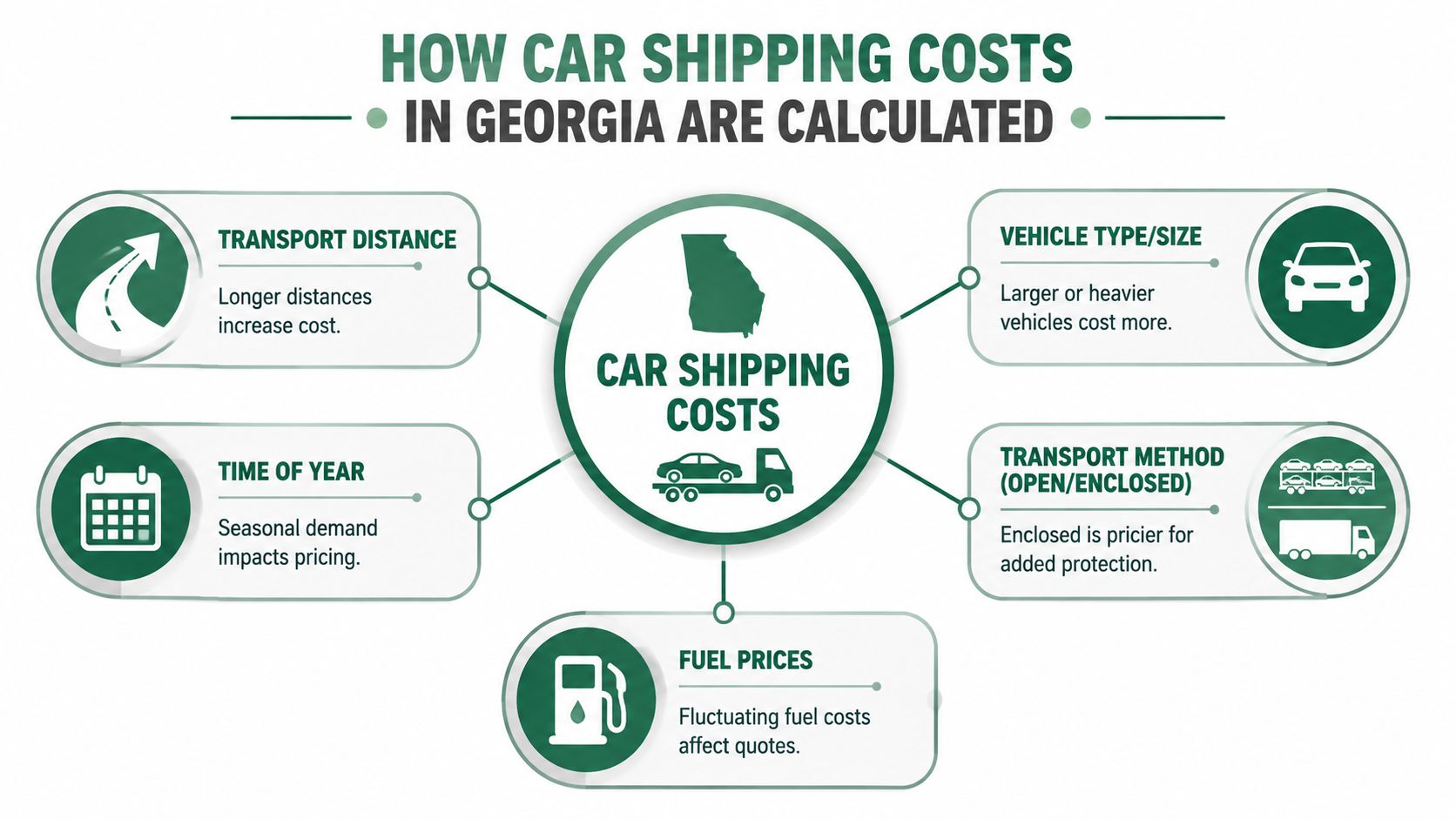
Georgia quotes make sense once you stop treating them like one fixed number. The final price is usually a blend of distance, vehicle size, transport method, seasonal demand, and fuel costs, with lane balance and carrier availability shaping what a dispatcher can sell on that route. A shorter move in a balanced lane can be cheaper than a longer move that's hard to fill, which is why two similar-looking quotes can land in very different places.
Why two Georgia quotes can diverge
The biggest misunderstanding is assuming mileage is the only variable. It matters, but it's not the whole story. Shippers asking for a single “Georgia car shipping cost” answer often get frustrated because the actual number depends on whether the lane is easy for a carrier to fill in both directions, and whether the pickup or delivery point adds operational friction.
One clear example is the difference between common regional and longer national routes. Georgia-to-Florida might be around $819 on an open carrier, while Georgia-to-California can range from $1,567 to $2,176 (MoveBuddha Georgia pricing). That spread isn't just distance, it also reflects how carriers balance their loads and how quickly they can match a driver to the route.
What changes the quote in real life
Vehicle size and condition matter because a larger SUV or a non-running vehicle takes more handling and more space on the trailer. Open vs. enclosed service changes the cost again, since enclosed capacity is lower and the equipment is more specialized. Seasonal demand can also push pricing up, especially when more people are trying to move at the same time.
A transparent flat-rate quote helps because it bundles those variables into one number instead of turning every extra detail into a surprise add-on. If you want a simple benchmark for what a full quote should cover, this car shipping cost guide is the kind of reference that can help you compare offers without getting lost in fine print.
A quote that's missing the transport type or pickup constraints is usually not a quote you can trust yet.
Choosing Your Transport Type Open vs Enclosed
Most Georgia shipments move on open carriers because they're the standard, widely available option for everyday vehicles. That's why the market skews heavily toward open transport, with 76.0% of car-shipping companies in Georgia offering it (IBISWorld Georgia market data). For a daily driver, commuter sedan, or family SUV, open service is usually the most practical balance of cost and availability.
Open transport fits most everyday moves
Open transport is the format you see most often on highways, with cars exposed to normal road conditions but handled within standard carrier procedures. It's a good fit when the vehicle doesn't need extra shielding and the owner wants broad carrier choice. The trade-off is simple, you save money, but you accept exposure to weather and road debris during transit.
For many Georgia customers, that trade-off is enough. A higher resale vehicle doesn't always need enclosed service, and a normal household move doesn't usually justify paying for specialized protection if timing and budget matter more. That's why the market defaults to open trailers, and why experienced agents often start there unless the car itself argues for a different setup.
Enclosed transport earns its premium on the right vehicle
Enclosed shipping makes more sense for classics, exotics, restored cars, and certain luxury vehicles where the owner wants lower exposure during loading, transit, and unloading. The premium is real, though, and Georgia pricing shows it clearly. A sample Georgia-to-Illinois quote was $1,236 open versus $1,607 enclosed, while Georgia-to-California reached $1,451 open versus $2,829 enclosed in another sample (FreightWaves Georgia pricing).
That gap is why the choice should be tied to the vehicle, not the emotion around the vehicle. If you're moving something that's sensitive to road exposure or hard to replace, enclosed service can make sense. If you're moving a standard car and the goal is value, open transport usually wins.
If you want a broader explanation of how open service works on real routes, open car transport details are worth reviewing before you commit. A provider like National Car Transport can also line up open and enclosed options through a vetted carrier network that spans both standard moves and higher-value shipments.
Major Georgia Shipping Routes and Timelines
A Georgia shipment can change in cost and timing before the truck even rolls. An Atlanta-to-Florida move usually benefits from dense carrier traffic and short distance, while Atlanta-to-California asks for more driver time, more fuel, and more scheduling discipline. Route tables matter because they show how the lane affects both the quote and the delivery window.
Common routes from Georgia
| Destination | Estimated Cost | Estimated Transit Time |
|---|---|---|
| Florida | $550 to $800 | 1 to 3 days |
| Tennessee | $450 to $650 | 1 to 3 days |
| Texas | $800 to $1,100 | 4 to 7 days |
| California | $1,300 to $1,700 | 6 to 9 days |
Those ranges line up with published Georgia route data showing Atlanta-to-Florida at 440 miles, Atlanta-to-Tennessee at 250 miles, Atlanta-to-Texas at 900 miles, and Atlanta-to-California at about 2,200 miles (A4 Auto Transport Georgia route data). The same source notes that most shipments to or from Georgia average 4 to 7 days overall, which matches the pattern dispatchers see on everyday lanes.
What the route table really tells you
Regional lanes can still move quickly, usually in about 1 to 3 days, while cross-country shipments often take 6 to 9 days and cost about 2 to 3 times more than nearby-state moves. A4 Auto Transport Georgia route data supports that spread, but the practical reason is simpler. Shorter lanes have more carrier options and fewer handoffs, while longer lanes tie up equipment and driver hours for much longer.
Puerto Rico adds a separate logistics layer. The Georgia leg usually ends at a mainland port, often Jacksonville, and the inland pickup has to line up with the vessel cutoff, not just the local pickup window. At the port, vehicles can sit in staging until the carrier checks them in, documents are matched, and space on the ocean leg is confirmed, so missed paperwork or a late arrival can push the whole shipment back. Families, students, military moves, and dealers do better when the inland transport and port handoff are planned together from the start, because the port does not wait for an irregular truck schedule.
For shippers who want to understand how those handoffs are managed at scale, Marketing automation insights for freight forwarders offers a useful view of how organized communication supports time-sensitive freight moves.
Mainland-to-island shipping works best when the inland pickup and port delivery are planned as one continuous move, not as two disconnected jobs.
How to Vet Car Shipping Companies in Georgia
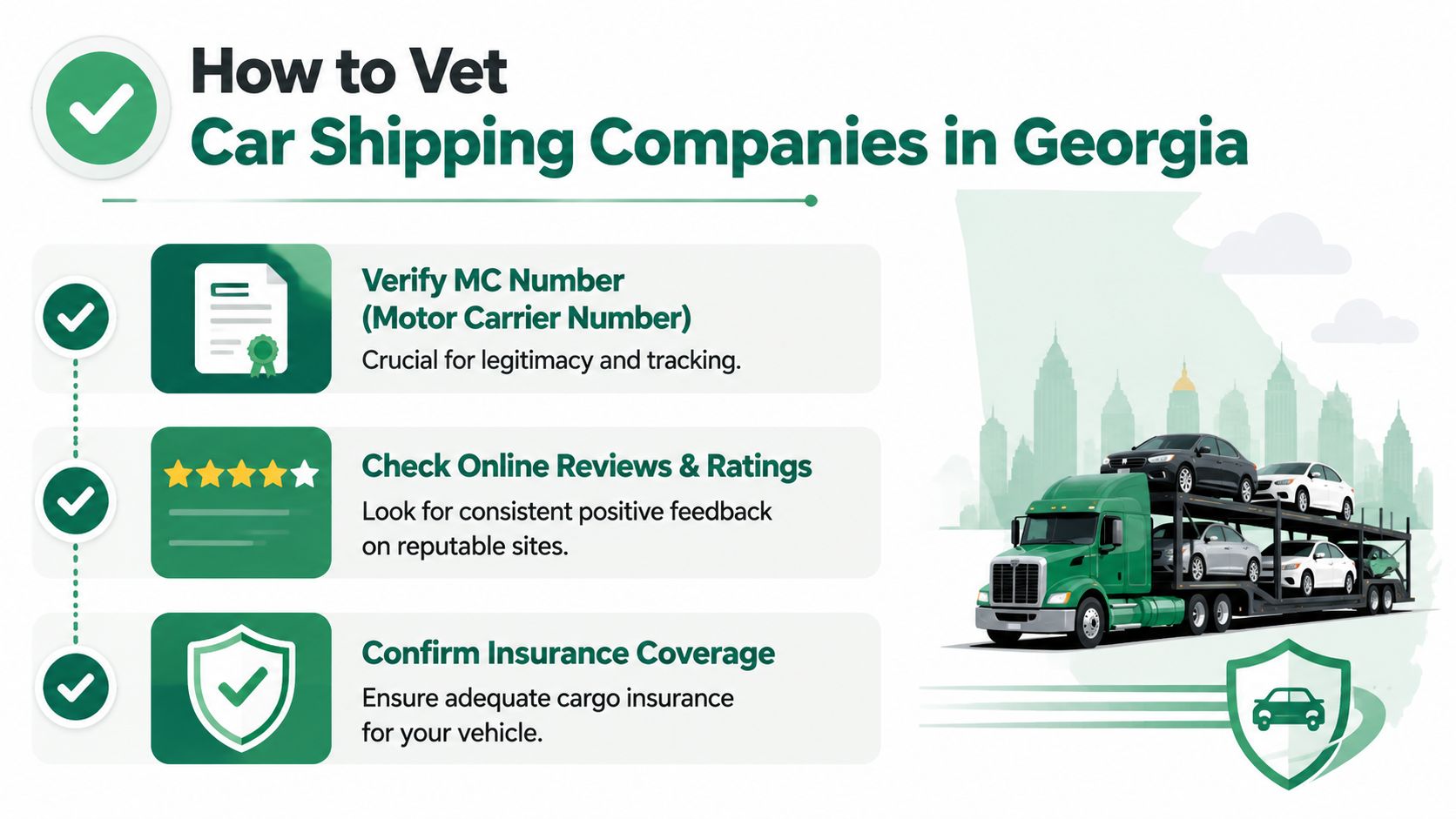
A good quote means little if the company can't prove it's legitimate. Start with the carrier's MC number, because that shows whether the company is operating under the right federal authority. Then ask for the cargo insurance certificate, and finally compare reviews on platforms that don't depend on the company's own marketing.
Three checks that should happen before booking
- Verify the MC number: Confirm the business is properly registered and the number matches what the company gives you.
- Check reviews on independent sites: Look for repeated patterns in service quality, not one flashy testimonial.
- Confirm insurance details: Ask what cargo coverage applies and whether there's a deductible.
Those three steps protect you from the most common booking mistakes. A company can sound polished and still be a poor fit if it won't show licensing, won't explain insurance, or hides how it handles pickup exceptions.
For operators who care about customer communication at scale, there's also a useful lesson in how they structure their workflows. Marketing automation insights for freight forwarders is a practical resource for understanding how organized follow-up, scheduling, and status messaging can support a smoother shipping experience without making the customer chase updates.
National Car Transport fits this vetting framework because it presents itself as a licensed, bonded provider with an A+ BBB rating and a large network of vetted carriers. That doesn't remove your responsibility to compare, but it does give you a clear benchmark for what a legitimate Georgia shipper should be able to document.
Preparing for Pickup and Delivery in Georgia
The easiest shipments are the ones where the customer prepares the vehicle correctly and the carrier isn't forced to guess. Clean the car enough to inspect it, remove personal items, and leave enough fuel for loading and unloading. Have the keys ready, along with registration or other paperwork the dispatcher asks for, and expect a walkaround before the car is loaded.
The Georgia pickup wrinkle
Georgia's carrier availability is concentrated around metro Atlanta, including Lithia Springs, Conley, and Duluth, which makes the area a major load-consolidation hub (Carshipio carrier directory). That concentration helps with matching, but it also means traffic, narrow streets, and access limits can become the main obstacle to door-to-door service. If the truck can't safely enter the street or turn around, a nearby meeting point may work better than forcing a bad pickup.
That's where an experienced agent earns their keep. A bilingual coordinator can explain the access issue, line up the driver, and keep both sides aligned without turning the pickup into a back-and-forth chain of phone calls. National Car Transport's English/Spanish support is a practical example of that kind of coordination for Georgia customers who want one point of contact.
For fleet managers and property teams, it's similar to how access control needs to be planned in advance. Programmatic gate control for fleets is a useful reference for understanding why door access, timing, and site rules matter before a truck arrives. The same logic applies to driveway pickups, if the access plan is wrong, the schedule slips.
Use the carrier's inspection sheet carefully at handoff. The Bill of Lading is the document that records the car's condition before and after transit, so it shouldn't be treated like a formality. If something looks off, note it before signing and take photos immediately.
If you want to see how coordinated pickup and delivery should be structured, door-to-door auto transport is the service model most customers in Georgia are requesting, even when they call it something simpler.
Your Georgia Car Shipping Questions Checklist
Before you book, ask the questions that separate a real shipping partner from a sales script. The right answers should feel specific, not vague. If the company can't answer these cleanly, keep looking.
The questions that matter
- Is this a flat rate or can the price change later? You want to know whether fuel, route changes, and pickup conditions are already included.
- What cargo insurance applies to my vehicle? Ask about the coverage details, not just whether the carrier is insured.
- Who handles communication during transit? You should know whether you'll speak with one agent or get passed around.
- What happens if pickup access is tight? This matters more in metro Atlanta and other dense areas.
- How does the company handle Puerto Rico shipments? Mainland moves to the island need tighter coordination than a standard interstate run.
A strong provider should answer those questions without hedging. That's the clearest sign the company understands car shipping as a logistics job, not just a sales process. It also tells you whether the agent is prepared to manage the job from booking through delivery instead of leaving you to resolve exceptions on your own.
Bottom line: the best Georgia shipper is the one that explains the route, the timing, and the insurance before you sign anything.
If you're comparing Georgia car shipping options right now, National Car Transport can help you sort open versus enclosed service, mainland-to-Puerto Rico routing, and pickup coordination without guesswork. Visit National Car Transport to talk with an experienced agent and get a clear quote that fits your route and your timeline.