

Shipping a car to Alaska usually runs $1,500 to $4,000 overall, and the move has to include an ocean leg from Seattle or Tacoma because there's no direct road connection to the mainland. If you're staring at a move to Anchorage, sending a truck back south for winter, or trying to move a family vehicle without surprise charges, that's the starting point.
The quote that looks simple on paper is usually hiding a truck-to-port handoff, a vessel booking, and a second delivery after the boat lands. That's where the delays, oversize fees, and personal-item questions show up, and that's where many get burned if they book on price alone.
Table of Contents
- Why Alaska Car Shipping Is a Different Kind of Move
- How Alaska Vehicle Transport Works
- Open Enclosed and Container Options Compared
- The Step-by-Step Alaska Car Shipping Process
- What Really Drives the Cost of Shipping a Car to Alaska
- Documents Inspection and Prep for Port Acceptance
- Choosing a Carrier and Timing Your Shipment Right
- Alaska Car Shipping Questions Real Customers Ask
Why Alaska Car Shipping Is a Different Kind of Move
A military family gets orders to Joint Base Elmendorf-Richardson. A snowbird wants the same SUV back in Arizona before winter sets in. A student or transplant is moving to Anchorage and needs the car there, not just a tracking number. Car shipping to Alaska is built for those situations, and it does not work like a normal Lower-48 haul.
The route is a chain, not a straight shot
There is no continuous road from the mainland into Alaska, so every move between Alaska and the lower 48 depends on an ocean leg and usually runs through West Coast ports like Seattle or Tacoma before final delivery inland or at the destination port as explained in Alaska's route structure. That means the shipment is really three jobs stitched together, inland trucking, port handling, and vessel transport. If one handoff is sloppy, the whole move slows down.
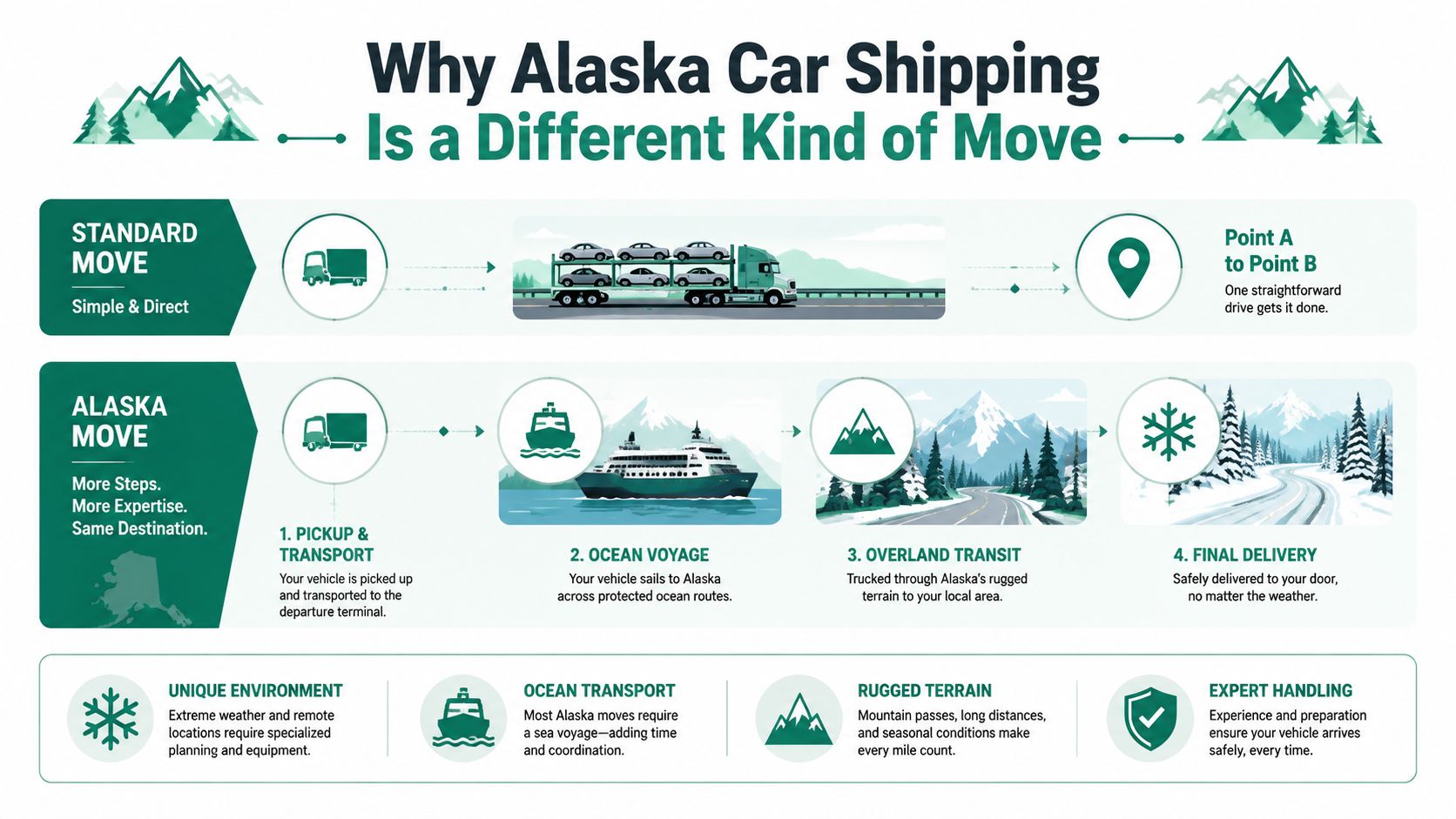
The quote should reflect that structure. If a provider talks only about mileage, they are selling you a fantasy because Alaska pricing is tied to port selection, vessel scheduling, vehicle size, and inland access rather than road distance alone as noted in Alaska pricing guides. That is why a move from Tacoma to Anchorage can price differently from a mainland pickup to the same Alaska destination.
Practical rule: ask exactly where the vehicle changes hands, who controls each handoff, and what happens if the port schedule slips.
If you are comparing options for Alaska drivers, a useful place to sanity-check route assumptions is state-specific savings for Alaska drivers. Use it as a benchmark, not a booking shortcut. The question is whether the quote covers the full chain or just the part that sounds cheapest.
How Alaska Vehicle Transport Works
Alaska vehicle transport runs as a multi-stage relay. One carrier picks up the car, a terminal team handles the port, an ocean vessel carries it north, and the receiving side finishes the handoff after discharge. The company you hire is coordinating those handoffs, and that coordination is what keeps the move from stalling.
Why Seattle and Tacoma matter
Most Alaska-bound vehicles funnel through Seattle or Tacoma because that is where the ocean carriers are set up to load efficiently as described in Alaska shipping route coverage. The car is trucked to the West Coast port, inspected, staged, and loaded onto the vessel. After the vessel arrives, the vehicle re-enters the local delivery chain for the final leg.
That port chain is why Alaska shipping prices are tied to the route setup, not just mileage. Moves from the Seattle area to Alaska can run $1,400 to $2,200, while longer lanes to the Gulf can reach $2,000 to $3,200 depending on origin and discharge point per Alaska shipping pricing guidance. A quote that ignores the port handoff and sailing piece is not a real quote. It is just a placeholder.
What happens at the port
Port work is where the shipment gets serious. The vehicle has to pass inspection, be ready for loading, and fit the vessel requirements. The dispatcher, terminal, and ocean carrier all need the same timing, condition, and paperwork before the car is accepted.
A good dispatcher does not just book a load. They control the pickup window, the port intake, the sailing spot, and the arrival handoff so you are not chasing three different companies.
The final delivery depends on how far the destination sits from the receiving port. A vehicle going to a nearby Alaska address usually moves without much trouble. A remote or hard-to-reach address adds inland trucking complexity, and that is where delays start to stack up. A strong coordinator keeps the whole chain visible instead of handing you off and disappearing.
If you want a practical example of how the inland side gets handled, a standard open-service reference like this open car transport guide is useful for comparing how the truck portion works before the port transfer. For broader context on export-style handoffs and vessel scheduling, the guiding US auto exports report shows why timing and handoff control matter so much on multi-leg moves.
Open Enclosed and Container Options Compared
Open transport is the economy seat. Enclosed is the hard-shell case. Container shipping is the private crate. For Alaska lanes, that comparison matters because you're not just buying protection, you're buying tolerance for weather, port handling, and vessel time.
Which method fits the vehicle
Open transport is the right call for most daily drivers. It's the standard choice because it's practical, widely available, and easier to price. For a commuter car, pickup truck, or family SUV, open transport usually makes the most sense, especially if you're balancing a full move or a military transfer. If you want a baseline reference for standard open service, this open car transport guide fits the lane well.
Enclosed transport makes sense when the vehicle has real value or low tolerance for exposure. It's typically 40 to 60 percent more than open transport, enclosed carriers usually carry about six vehicles versus ten on open, and the extra room plus hard-sided protection is why owners of classics, luxury cars, or low-clearance vehicles pay for it. Container shipping is the most protective option, but it's also the slowest and most expensive, so I only recommend it when the vehicle justifies the extra handling.
Alaska-specific tradeoffs
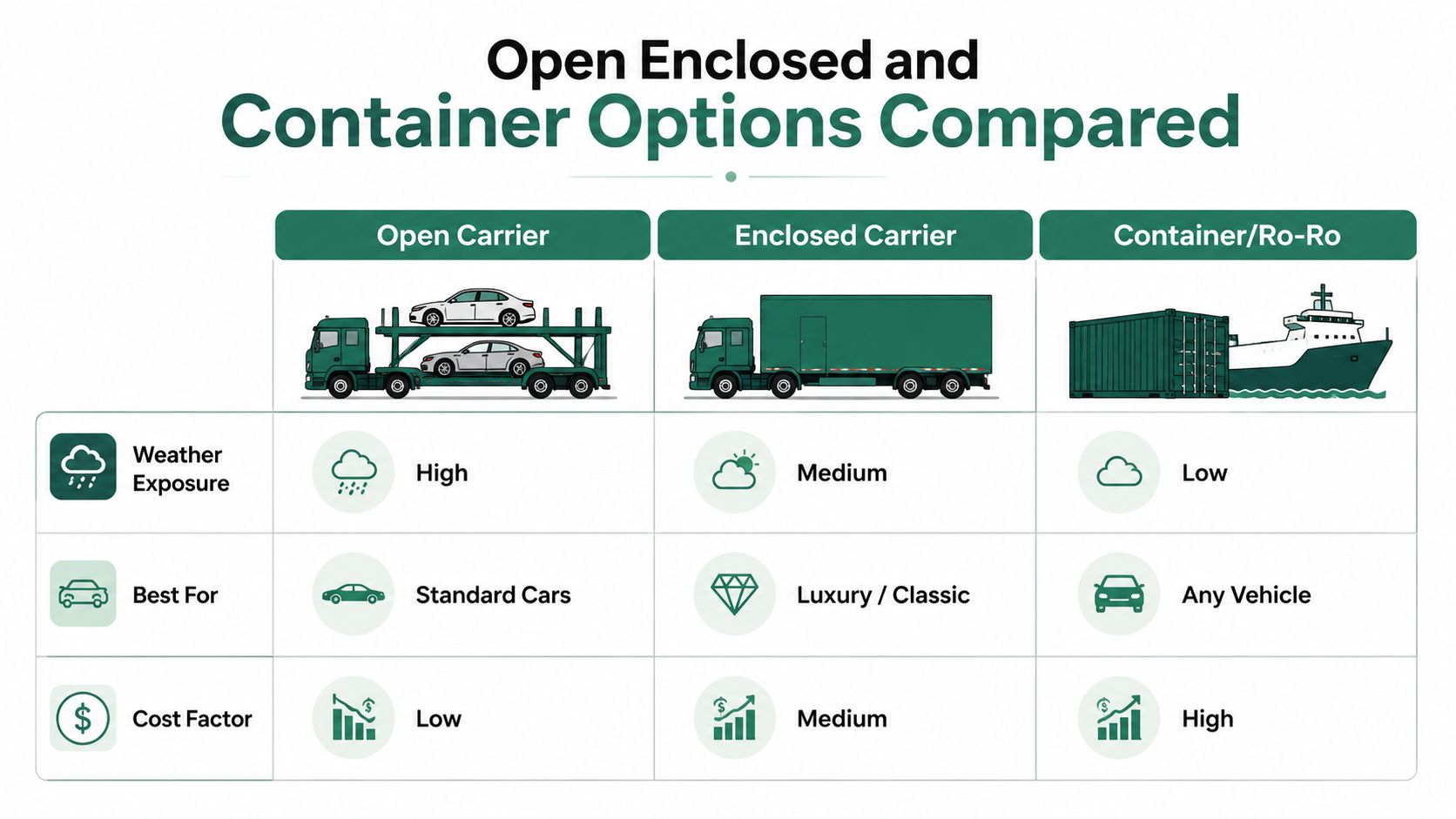
The biggest issue on Alaska routes isn't just weather on the road portion, it's how the vehicle gets handled at the port and on the vessel. Open transport exposes the car more during the inland leg. Enclosed transport gives you better protection before the ship, and container service gives the most separation from outside conditions.
For readers who want to understand the export-side logic behind these choices, Coreties' guiding US auto exports report is a useful context piece. It reinforces the basic truth here, method choice should follow vehicle value, route exposure, and how much handling you can tolerate, not just the first quote that lands in your inbox.
My recommendation: if it's a normal driver, don't pay for enclosed just because Alaska sounds remote. Save that money for the move itself. If it's a classic, a luxury vehicle, or something low and delicate, upgrade without arguing with yourself.
The Step-by-Step Alaska Car Shipping Process
The cleanest Alaska booking starts with one honest quote and ends with one final inspection. The process is simple on paper, but each checkpoint matters because a missed detail at the beginning shows up later as a port delay or a rebooking fee.
From quote to vessel booking
The first step is getting a flat-rate quote that separates inland transport from the ocean leg. That matters because it lets you compare true apples to apples instead of mixing port fees, pickup costs, and sailing charges into one number. Once you approve it, the booking is confirmed with a deposit that reserves the vessel space and locks the dispatch plan.
From there, the pickup window gets scheduled and the vehicle is inspected before loading. The dispatcher should update you when the carrier is assigned, when the vehicle is loaded on the vessel, when the vessel departs, and when it arrives. Providers like National Car Transport monitor those milestones around the clock and keep the shipment moving through the handoffs instead of leaving the customer to chase status on their own.
Delivery on the Alaska side
Once the vessel reaches Alaska, the car clears the receiving process and moves into the final delivery stage. Depending on the booking, that might mean door delivery or drop-off at the nearest accessible road. If the route uses a terminal handoff, the final leg is usually the part most customers underestimate.
Real-world advice: ask for the exact delivery point before you pay the deposit. “Door-to-door” can still mean the nearest safe access point if the truck can't physically reach your address.
For customers comparing delivery styles, this door-to-door auto transport guide helps clarify what that promise usually means in practice. The best shipments aren't the ones with the fanciest wording. They're the ones where the dispatcher owns every checkpoint and doesn't let the move drift between disconnected vendors.
What Really Drives the Cost of Shipping a Car to Alaska
The price isn't driven by one number. It's driven by the vehicle, the route, the port, and the amount of handling required to get the car there safely. If you want a fair quote, stop asking for a single all-in number and start asking how the carrier breaks out the ocean leg from the inland leg.
Size and route set the floor
Matson's published 2026 Tacoma-to-Anchorage tiers show how size changes the bill. Small vehicles under 68 inches high and 260 inches long are priced at $2,541.25, medium vehicles under 84 inches high and 260 inches long at $3,175.00, and large vehicles under 102 inches high and 275 inches long at $4,646.25 per published Alaska vehicle rates. That's the clearest proof that Alaska pricing is built around dimensions, not just distance.
Door-to-door pricing adds the inland trucking on each end, so the ocean leg is only part of the total. If a quote hides that split, it's not helping you compare. A good dispatcher will show you the port cost and the land cost separately so you can see where the money goes.
Sample price anchors
| Vehicle Size | Matson Tacoma to Anchorage | Typical Alaska Lane Range | Notes |
|---|---|---|---|
| Small | $2,541.25 | $1,400 to $4,000 overall | Size tier sets the ocean freight baseline. |
| Medium | $3,175.00 | $1,400 to $4,000 overall | Inland trucking changes the total depending on origin and drop-off point. |
| Large | $4,646.25 | $1,400 to $4,000 overall | Oversize handling can push the final bill higher. |
I use that table as a reality check, not a promise. The smart move is to ask for a quote that clearly separates the vessel cost from the pickup and final delivery legs. That makes comparison honest, and it's the only way to know whether you're paying for real service or just a padded estimate.
For readers comparing quote structures, this car shipping cost guide is a solid place to see how pricing gets built. It helps you spot the difference between a legitimate route-specific quote and a generic number that won't survive the booking stage.
Documents Inspection and Prep for Port Acceptance
Port acceptance is a gate, not a suggestion. If the vehicle isn't ready or the paperwork is incomplete, the shipment stops before it starts. That's why prep matters more on Alaska lanes than on most mainland routes.
What the car has to pass
The vehicle must be operational, clean enough for inspection, free of leaks and major defects, and within the usual size limits of 21.5 feet long, 7 feet wide, and 7 feet tall per Alaska transport requirements. It also needs no more than a quarter tank of fuel for safety. Those limits exist because the car has to be safe to drive, safe to stage, and safe to load.
If the car doesn't meet those standards, it may need a separate quote or a different handling plan. That's especially true for older vehicles, tall SUVs, lifted trucks, or anything with a mechanical issue. The port won't bend the rules just because the customer is on a deadline.
The paperwork side
For normal domestic moves, proof of ownership and photo ID are the starting point. For foreign or imported vehicles, the Alaska DMV requires U.S. Customs and Border Protection Entry Summary Form 7501, EPA and DOT compliance documents, and the Vehicle Transaction Application Form V1 as listed by the Alaska DMV. That paperwork is part of getting the vehicle titled correctly, so it's not optional busywork.
Get the title, ID, and compliance documents ready before pickup. If the paperwork lags, the car may sit at the port while fees and delays pile up.
Personal items need attention too. If you leave belongings in the car, talk about it in advance and expect the rate to change. The cleaner move is usually a vehicle-only shipment, because it keeps the billing simple and keeps your insurance exposure from getting messy.
Choosing a Carrier and Timing Your Shipment Right
On Alaska lanes, carrier selection matters more than it does on a routine mainland move. There are more handoffs, more schedule pressure, and more places where a sloppy operator can lose time. I'd rather book with a company that knows the lane than chase a cheap rate and hope for the best.
What to check before you book
Look for FMCSA licensing, a real BBB rating, and a vetted driver network that can cover pickup and port coordination without scrambling. Ask how the company handles insurance, in writing, and make sure you know what's covered while the car is in transit. If the provider offers bilingual U.S.-based agents, that helps too, especially when families are coordinating moves from outside the country or prefer Spanish-language support.
Timing beats guesswork
Transit time for Alaska shipments commonly lands in a 1 to 3 week range, with some lanes tightening to 5 to 9 days depending on route and method per practical shipping timelines. That spread reflects the difference between port timing, vessel departure, and final delivery access. If you book late, you usually give up flexibility first.
Season matters, but not in a vague way. Summer fills up fast, winter can be tougher on access, and shoulder periods often give you more breathing room. That doesn't mean every off-season move is cheap, it means the schedule is less crowded and the dispatcher has more room to work.
For insurance questions, Duncan & Associates' auto transport guide is a useful reference point. Use it to confirm the basics, then ask your carrier to put the specific coverage terms in writing before pickup.
A provider with 25+ years of experience and a network of 25,000+ vetted carriers isn't just selling a bigger logo. It's selling redundancy, which matters when a missed vessel or late truck can ripple through the whole move.
Alaska Car Shipping Questions Real Customers Ask
Personal items come up first because everybody wants to know if they can just load the trunk and go. Sometimes items are allowed, but they need to be discussed in advance, they change the rate, and they can affect insurance exposure, which is why a vehicle-only shipment is usually the cleaner choice. If you're shipping a household move too, split the jobs instead of stuffing everything into the car and hoping for the best.
Oversized and non-running vehicles need separate attention. They often require a separate quote because port handling, loading method, and size all change the economics. Same-day pickup on Alaska lanes is possible in some cases, but I wouldn't count on it as the plan. Book early if you want options instead of scrambling for a last-minute slot.
Cancellation and rescheduling are usually easier when you've booked with a provider that keeps one dispatcher in charge of the whole move. The more handoffs involved, the more important it is to get schedule changes in writing and confirm whether the vessel spot can be moved. That's where a lot of customers get surprised, because they treat Alaska like a normal state move when it isn't.
Bilingual English and Spanish agents are available 365 days a year for customers who want clearer communication during the booking and tracking process. That matters when you're coordinating from another state, another market, or another language. Simple answers save money on this lane.
If you're ready to move a vehicle to or from Alaska without guessing at the handoffs, talk to National Car Transport about your exact route, vehicle size, and timing. They coordinate Alaska shipments across the mainland, port, and vessel legs, and they'll give you a quote built around your specific move, not a generic mainland shortcut.