

You're probably looking at a few online quotes right now and wondering why they don't line up. One company shows a price that seems almost impossible. Another comes in much higher. A third won't clearly say whether the number is final or just a placeholder. That confusion is normal in auto transport, especially when you're juggling a household move, a college relocation, a dealership transfer, a military assignment, or a seasonal move to or from Puerto Rico.
The problem isn't just price. It's transparency. Car shippers rates depend on real operating factors, but many quote forms flatten those details into a single number without explaining what changed, what's included, or what could still move later. That's where people get burned.
Practical guidance matters. Whether you're shipping between major cities in the lower 48, moving a vehicle from Los Angeles to Miami, sending inventory from Dallas to Chicago, or arranging transport from Florida to San Juan, Puerto Rico, the smartest move is understanding why the rate is what it is before you book.
Table of Contents
- Understanding Car Shipping Rates Can Be Confusing
- The Core Factors Driving Your Shipping Rate
- Beyond the Basics Other Key Rate Influencers
- Sample Car Shipping Rates and Scenarios for 2026
- How to Get a Reliable and Accurate Quote
- Special Shipping Needs Military Classic Cars and Puerto Rico
- Ship Your Vehicle with Confidence and Clarity
Understanding Car Shipping Rates Can Be Confusing
A customer might enter the same sedan, the same pickup ZIP code, and the same delivery ZIP code into three quote forms and still get three very different answers. That doesn't always mean someone is dishonest. Sometimes one quote assumes open transport, another assumes a tighter pickup window, and another isn't binding at all. But from the customer side, it feels like guesswork.
That gets more stressful when the route is time-sensitive. Students often need a vehicle to arrive near the start of a semester. Snowbirds are planning around seasonal travel. Military families are trying to line up household timing with official orders. Businesses and dealerships need reliable scheduling because a delayed unit affects a sale or a delivery commitment. Puerto Rico shipments add another layer because ocean coordination, port timing, and mainland pickup all have to line up.
The cheapest quote on screen often isn't the cheapest shipment in real life.
A practical way to think about car shippers rates is to separate the base transportation cost from the conditions attached to that cost. The base comes from route length, vehicle size, and service type. The conditions come from where the driver has to go, how flexible your dates are, and whether the quote is fixed or can change after booking.
Most frustration starts when those conditions stay hidden until late in the process.
That's why experienced shippers ask sharper questions than “What's your price?” They ask what type of trailer is included, whether the vehicle is operable, how exact the addresses need to be, and whether the number is an estimate or a written binding agreement. Those questions protect your budget better than chasing the lowest headline rate.
The Core Factors Driving Your Shipping Rate
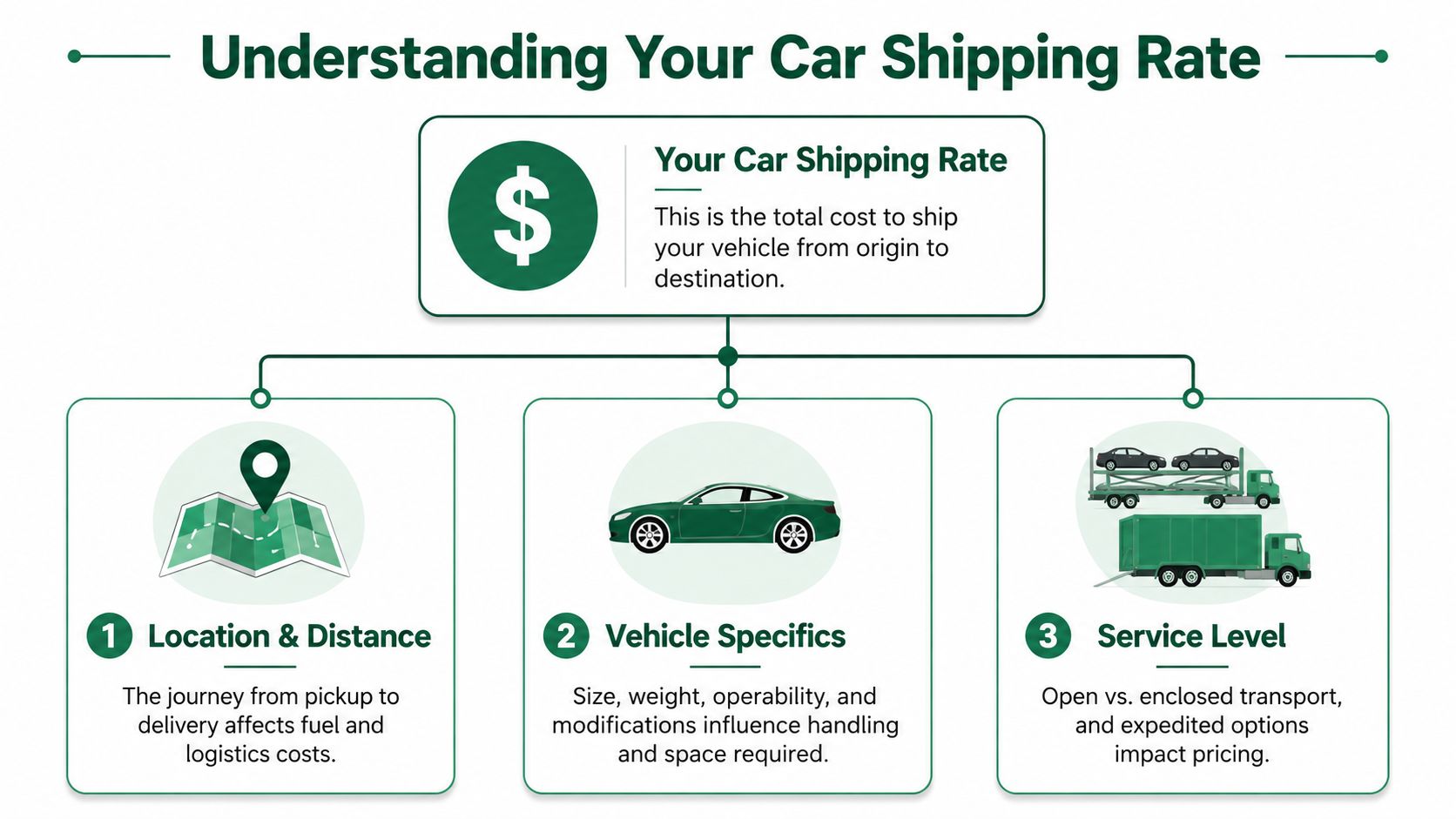
Three inputs usually set the base rate before a carrier looks at rural access, seasonal swings, or timing pressure. They are distance, vehicle size and weight, and whether you choose open or enclosed transport. If you understand how those three work, quotes stop looking random and start looking operational.
Distance changes the rate, but lane efficiency changes it more
Customers often expect pricing to rise in a neat line with mileage. Carrier pricing rarely works that way. A 300-mile move can carry a high per-mile cost because the truck still has to be dispatched, loaded, inspected, and scheduled. A 1,500-mile run spreads those fixed operating steps across far more miles.
According to Montway's car shipping cost guide, projected 2026 open transport pricing averages $1.85 per mile for 1 to 500 miles, $0.91 per mile for 500 to 1,500 miles, and $0.59 per mile for 1,500+ miles.
That is the part many online calculators fail to explain. The route is not priced only by length. It is priced by how efficiently a carrier can place your vehicle on a lane that already makes business sense.
This matters even more on complex moves. Puerto Rico, for example, is not a simple long-distance quote. It is a combined inland and ocean move, with port handling, vessel schedules, and mainland trucking coordination affecting the total rate. A low number that ignores one of those steps is usually an estimate with holes in it, not a quote you can budget around.
Vehicle size and weight affect trailer capacity
Carriers sell space on a trailer, not just miles on a road. A compact sedan is easy to fit. A lifted truck, large SUV, long-wheelbase van, or heavy EV can take up more room, reduce loading options, and change axle weight distribution for the whole load.
UShip's guide to vehicle shipping costs by distance and weight notes that large or bulky vehicles can incur 20 to 50 percent premiums, and vehicles over 5,000 to 7,000 lbs can trigger surcharges because of equipment and fuel impact. The same source cites an average per-mile rate of $1.02 for a 1,000-mile shipment.
The practical takeaway is simple. Give exact specs early, including trim, modifications, oversized tires, lift kits, roof racks, or anything that changes height or weight. If the truck arrives and the vehicle is larger than advertised, the original number often stops being valid.
Service level changes both price and quote reliability
Open transport is the standard for daily drivers because capacity is broader and rates are lower. Enclosed transport costs more because fewer trailers offer it, fewer cars fit on each load, and the service is usually reserved for vehicles where condition matters as much as delivery.
Enclosed service often runs materially higher than open service across the same lane. The reason is straightforward. You are paying for scarcer equipment, lower trailer capacity, and extra protection.
Practical rule: Ship ordinary commuter vehicles open. Use enclosed for classics, exotics, high-value restorations, and any vehicle where paint condition or collector value justifies the premium.
This is also where customers should press hard on quote type. A binding quote spells out what is included and what can change. A non-binding estimate can shift if the broker failed to price the vehicle correctly, missed a port fee on a Puerto Rico move, or used a lane assumption that does not hold in the live market. Service level affects rate, but quote structure affects what you pay.
For buyers comparing domestic transport with import-side costs, DreamBid: ile kosztuje transport auta z USA adds useful context on how U.S. vehicle movement costs fit into the larger shipping picture.
Beyond the Basics Other Key Rate Influencers
A quote can look reasonable on paper and still miss the actual cost drivers. I see this most often when the lane itself is fine, but the pickup conditions, timing, or port logistics make the move harder to cover cleanly.
Metro routes behave differently than rural ones
Carriers price efficiency. A vehicle moving between major hubs gives dispatch more options, more backhaul potential, and a better chance of filling the trailer in both directions. A vehicle sitting outside a small town, down a narrow road, or far from a common corridor can require extra miles and extra time that do not show up in the route map.
The Federal Motor Carrier Safety Administration explains that practical access limits matter for commercial vehicle operations, including where large trucks can safely travel and stop. That is one reason rural or restricted locations often cost more than a nearby metro handoff. See the FMCSA consumer guidance for household goods and transportation planning.
For customers, the useful question is simple. Is true door service worth paying for, or would a meeting point near a highway, large retail lot, or truck-friendly city save money and reduce delays?
A common fix is to meet the carrier closer to a major corridor. That can turn a difficult route into a standard one.
Timing flexibility changes what a carrier can do with your order
The cheapest quote is often tied to flexibility, not luck. If dispatch has a wider pickup window, they can place your vehicle on a truck that is already building through your lane instead of forcing a special stop or paying a premium to cover the order fast.
This matters even more if you are comparing a binding quote with a non-binding estimate. A binding quote should spell out the pickup window, service type, access assumptions, and any surcharge triggers. A loose estimate may look competitive until the carrier learns the address is outside the normal route, the apartment complex does not allow truck access, or the Puerto Rico move needs port handling the first quote did not clearly include.
Customers who want a lower price should give dates as a range, not a single day, and ask one direct question: "What assumptions is this quote based on?" That one question catches many avoidable surprises.
Route flow, local constraints, and Puerto Rico details still move the rate
Seasonal demand affects price, but local operating friction matters just as much. Snowbird traffic tightens capacity on north-south lanes. Auction and dealer volume can crowd out retail shipments on certain corridors. Access problems also change the economics of a job fast. Low branches, tight cul-de-sacs, HOA rules, downtown loading limits, and apartment complexes with no truck space can force a change in meeting point after the order is booked.
Puerto Rico adds another layer. The inland carrier leg and the ocean leg have to line up. Port cutoff times, vessel schedules, terminal fees, and document requirements can all affect the final number. These factors often lead to customer frustration, because a non-binding estimate may skip over those details early and leave room for later price changes. A well-built binding quote for Puerto Rico should identify the mainland port, destination port, booking assumptions, and any charges tied to vehicle size or running condition.
Two practical mistakes cause trouble again and again:
- Waiting until the last minute, which reduces carrier options and usually weakens your negotiating position
- Assuming any address in the same state prices the same, even if one location sits on a major lane and the other requires a long detour
- Overlooking site access, which can force a re-dispatch or a different pickup point after the truck is already scheduled
Customers who understand these trade-offs make better decisions. Instead of chasing the lowest number without context, they choose what matters most, price, pickup speed, exact location, or quote certainty, and build the order around that priority.
Sample Car Shipping Rates and Scenarios for 2026
A customer moving from Miami to San Juan can get a quote that looks competitive on day one, then learn later that the number did not fully account for port timing, vehicle size, or terminal handling. That is why sample rates are useful only when they are tied to a real shipping scenario, not treated as flat-price promises.
Use the examples below as budgeting markers. They show how pricing tends to behave on common lanes in 2026, but they do not replace a quote built around your vehicle, route, timing, and service level. The biggest difference in practice is often whether you received a binding quote or a non-binding estimate.
2026 Estimated Car Shipping Rates
| Route | Distance (Approx.) | Standard Sedan Cost | Large SUV/Truck Cost |
|---|---|---|---|
| East Coast to West Coast | Long-distance | $1,375 | $1,625 |
| East Coast to Midwest | Mid-distance | $875 | $1,000 |
| New York City to Miami | Approx. route basis | $1,100 to $1,400 | Qualitatively higher based on vehicle size |
| San Francisco to Washington, D.C. | Approx. route basis | $1,225 to $1,650 | Qualitatively higher based on vehicle size |
| Jacksonville, FL to Puerto Rico | Port route | $1,202 for vehicles under 82" wide and 76" high | $1,302 for vehicles up to 100" high |
The long-haul and regional mainland figures come from Move.org's 2026 vehicle transport cost data, which lists about $1,375 for a sedan moving from the East Coast to the West Coast and about $1,625 for an SUV or pickup on the same lane. The same guide lists about $875 for a sedan from the East Coast to the Midwest and about $1,000 for larger vehicles.
For major city lanes, Sherpa Auto Transport's 2026 guide lists $1,100 to $1,400 for New York City to Miami and $1,225 to $1,650 for San Francisco to Washington, D.C..
For Puerto Rico port pricing, TOTE Maritime's Puerto Rico vehicle page lists $1,202 from Jacksonville to Puerto Rico for vehicles under 82 inches wide and 76 inches high, and $1,302 for vehicles up to 100 inches high.
What these scenarios actually mean
Mainland lanes are usually easier to benchmark because the truck move is the whole job. Puerto Rico is different. The final price depends on how the inland pickup, port delivery, vessel booking, and destination release fit together.
That difference matters when you compare quotes.
A low non-binding estimate for Puerto Rico can leave out assumptions that later affect the bill, such as the exact mainland port, whether the vehicle is oversized, or how the handoff to the ocean carrier is handled. A binding quote should spell out those details. If it does not, the number is not firm in any practical sense.
Vehicle size also changes the math quickly. On a truck trailer, a full-size SUV or pickup takes more deck space and adds weight. On Puerto Rico moves, height and width can trigger a higher ocean rate bracket, which is why port-based pricing often breaks out measurements instead of just saying sedan or SUV.
The route itself matters too. New York City to Miami is a dense corridor with regular traffic, so the market usually gives customers more pricing consistency than a less balanced lane. San Francisco to Washington, D.C. covers a long distance and crosses multiple freight regions, so the rate range is wider.
One practical way to use sample rates is to test whether a quote is plausible. If a mainland cross-country quote comes in far below the published market range, ask what assumptions make that possible. If a Puerto Rico quote looks light, ask whether it includes port fees, size-based ocean pricing, and the exact terminals on both ends. Those questions save customers from the most common pricing surprise in this part of the market.
How to Get a Reliable and Accurate Quote
A solid quote starts with clean information. A bad quote usually starts with missing information, or with a company avoiding details because it wants to win the booking first and sort out the actual price later.
Start with the right shipment details
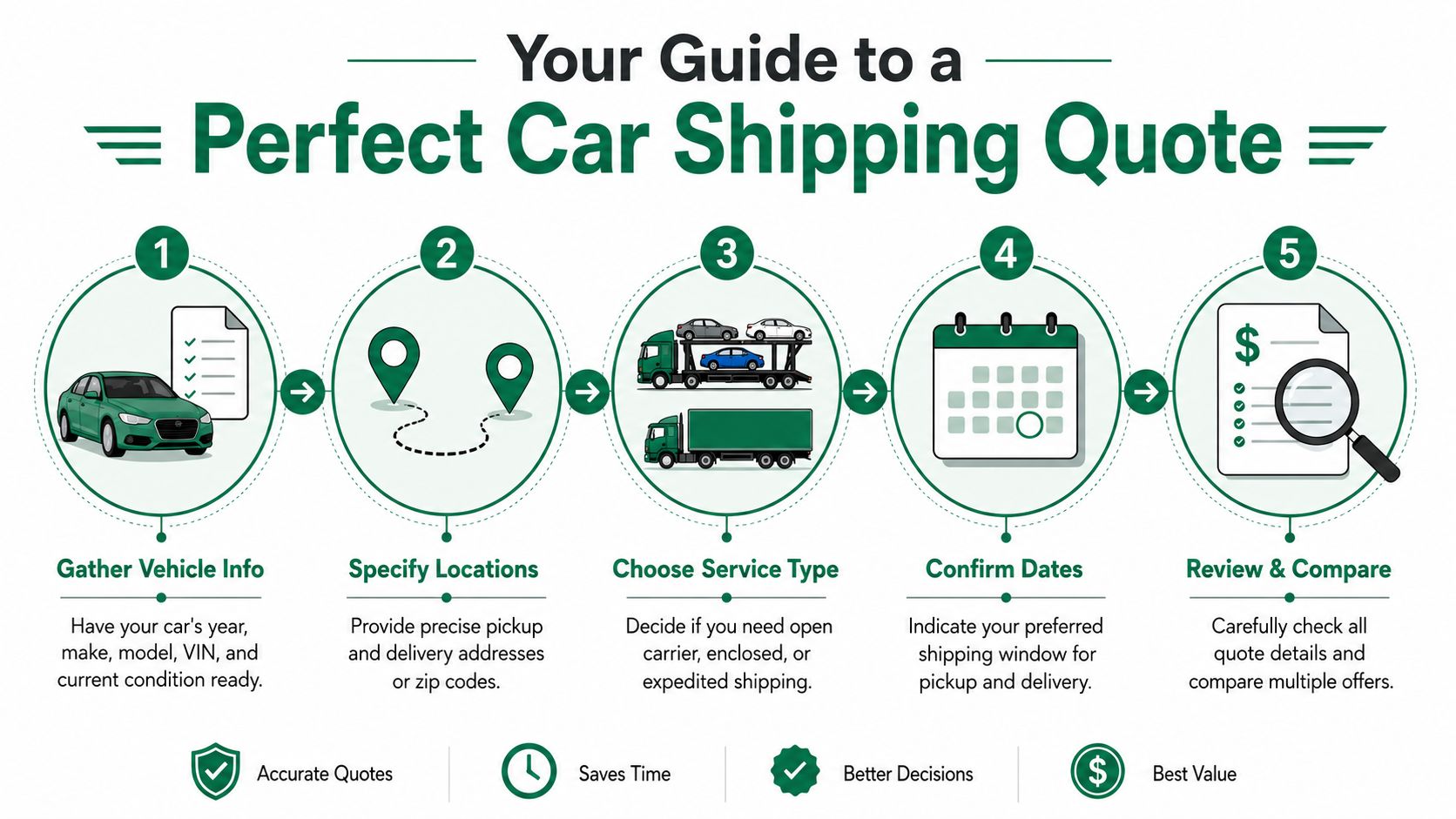
Before you request pricing, gather the facts a dispatcher needs:
- Vehicle basics: Year, make, model, and whether it runs, steers, and brakes.
- Pickup and delivery points: Exact addresses are best. ZIP codes are the minimum.
- Vehicle dimensions when relevant: Important for oversized trucks, lifted vehicles, vans, and some Puerto Rico bookings.
- Service preference: Open, enclosed, and whether you need port-to-port or door service.
- Timing: Your first available date and how much flexibility you have.
The cleaner the input, the better the quote. Customers often leave out modifications, inoperable condition, or difficult access because they're worried the rate will rise. What happens is worse. The issue appears later, when the vehicle is being matched to a carrier.
Ask the binding quote question early
This is the most important pricing question in the industry, and too many people ask it too late.
A useful rate isn't just competitive. It needs to be reliable. WC Shipping's consumer guidance on common mistakes reports that 68 percent of negative shipping reviews stem from non-binding quotes that inflated post-confirmation, and that consumers can face 20 to 40 percent price hikes after booking if they don't demand a written, binding agreement.
“Is this quote binding, in writing, or is it only an estimate?”
Ask that exactly. Then wait for a direct answer.
If the response gets vague, that's information. If the company says the market may require adjustments later, ask what circumstances would trigger a change and whether those circumstances are already visible from your route, vehicle, or dates.
What a dependable quote process looks like
A trustworthy quote process usually includes these steps:
Verification of the shipment details
A real advisor checks the route, the vehicle class, and any access problems before discussing final pricing.A clear service recommendation
If your car is a daily driver, open transport may be the right call. If it's a collector car, enclosed may be worth the premium. If it's headed to Puerto Rico, the inland and port portions should be coordinated as one plan.Written terms
The quote should show what service is included and whether the number is fixed.Carrier compliance checks
Customers should verify operating credentials and make sure the company can explain how carrier assignment works.Human support when the route is complicated
Puerto Rico, military timelines, student moves, dealership transfers, and non-running vehicles are not “instant quote” situations. They benefit from an experienced agent.
This is where experienced coordination matters. National Car Transport has 25+ years of experience, an A+ BBB rating, transparent flat-rate pricing, and a network of 25,000+ vetted carriers. Its USA-based bilingual agents, in English and Spanish, have over 20 years of experience just in auto transport logistic service, which matters because not one vehicle transport is alike. Having an agent guide the shipment and keep the process simple and quick is often what prevents misunderstandings later.
Special Shipping Needs Military Classic Cars and Puerto Rico
Some shipments shouldn't be treated like standard commuter-car moves. The rate may still follow normal pricing logic, but the handling, paperwork, and planning discipline need to be better.
Military and relocation shipments need coordination
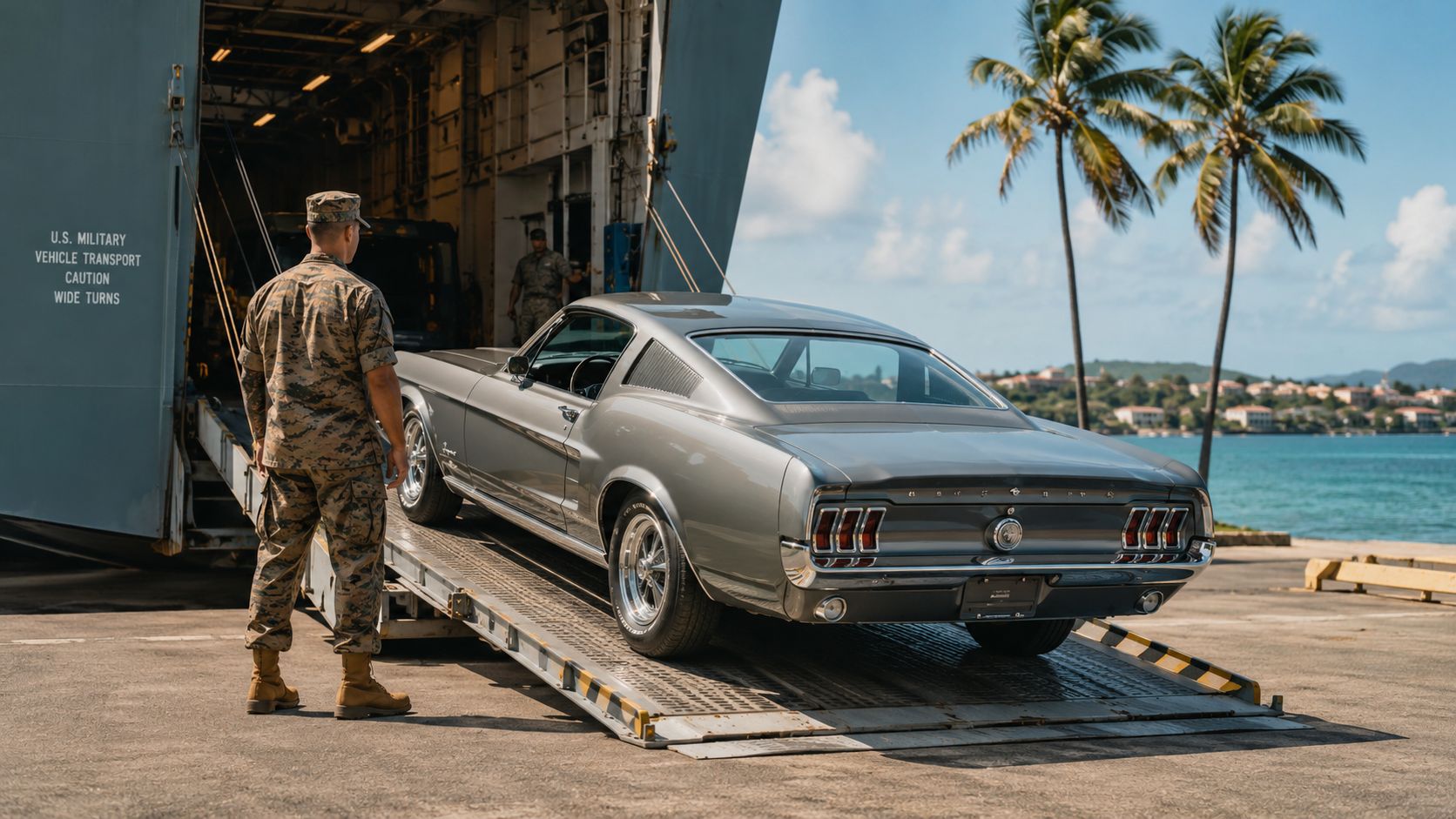
Military customers usually care about timing, documentation, and handoff clarity more than anything else. PCS moves don't leave much room for vague scheduling. The same is true for students trying to arrive before a term begins and for snowbirds moving around a narrow seasonal window.
The operational priority is coordination. Pickup availability, contact names, backup contacts, and delivery readiness all need to be confirmed early. A strong transport plan also accounts for what happens if the customer flies out before the truck arrives or if the delivery location can't accept a large carrier.
Classic and luxury vehicles need a different standard
Classic, exotic, and high-value vehicles deserve a different conversation. Price still matters, but protection matters more. Owners should discuss ground clearance, restoration status, tire condition, leak risks, loading angle, and enclosed availability before booking.
A useful rule is simple:
- Use enclosed transport when finish protection and reduced exposure matter.
- Disclose modifications because low front ends, oversized wheels, and custom bodywork affect loading.
- Document condition carefully at pickup and delivery.
That's also true when the vehicle has sentimental value, not just market value.
Puerto Rico moves involve a second logistics layer
Puerto Rico shipping isn't just “regular car shipping plus water.” It combines inland transport, port processing, vessel scheduling, and island delivery planning. That's why generic mainland advice often falls short.
Puerto Rico Car Transport's pricing overview explains that international car shipping to Puerto Rico from mainland ports has a base rate for standard passenger vehicles, but the final price is adjusted for fuel costs, vessel availability, and market demand, and it requires a specialized port-to-port or door-to-door service structure.
That's the key point. Puerto Rico routes have a second logistics layer. You're not only hiring a truck. You're coordinating truck-to-port, port handling, ocean movement, and final release or delivery in San Juan.
For many customers, that means asking better questions:
- What documents are required before port delivery?
- Is this port-to-port or door-to-port?
- Who handles the mainland portion and who handles the island portion?
- What happens if the vessel schedule changes?
When those answers are clear, Puerto Rico shipping becomes manageable. When they aren't, customers end up chasing updates across multiple parties.
Ship Your Vehicle with Confidence and Clarity
The best way to control car shippers rates isn't hunting for the lowest number. It's understanding what drives the rate, what can change it, and which questions expose a weak quote before you commit. Distance, vehicle size, service type, route access, scheduling flexibility, and quote structure all shape the final result.
The biggest customer mistake is still the simplest one. Booking on price before confirming whether the quote is binding.
If you're shipping a collector vehicle, it also helps to understand your car's documented value before choosing service level and insurance approach. Resources like Total Loss Northwest classic appraisals can be useful for owners who want a clearer handle on valuation before transport planning.
For everyday drivers, family relocations, student moves, military shipments, dealership transfers, and Puerto Rico routes, clarity beats hype every time. A good transport experience usually starts with a quote that matches the actual shipment, not just the sales pitch.
If you want a transparent quote backed by real experience, National Car Transport is a strong place to start. With 25+ years in auto transport, an A+ BBB rating, transparent flat-rate pricing, and a network of 25,000+ vetted carriers, the company handles domestic moves across all 48 states, Alaska, Hawaii, and Puerto Rico. Its USA-based bilingual agents in English and Spanish have deep auto transport logistics experience and help make complicated moves feel straightforward. Whether you're shipping a family sedan, a classic car, dealership inventory, or a vehicle to or from San Juan, Puerto Rico, you can get guidance that's simple, quick, and built around your actual route.