

A typical mainland U.S. car movers quote lands around $1,215, and a 1,000-mile open-transport shipment often runs $650 to $800. For Puerto Rico, a door-to-door move commonly lands in a wider lane-specific range, because ocean routing, port handling, and mainland origin all change the price.
You're probably here because you've got a car that has to move, and you want a number that won't fall apart later. Good instinct. A common mistake is treating the first price you see like a final bill, then getting blindsided when dispatch, carrier matching, or accessorial charges change the math.
Table of Contents
- What a Car Movers Quote Actually Is
- The Six Factors That Drive Your Quote Price
- Binding vs Non-Binding Estimates Explained
- How to Request an Accurate Quote
- Sample Quotes for Common Routes
- Hidden Fees and Price Hikes to Watch For
- Comparing Quotes Like a Pro
- Tips and Frequently Asked Questions
What a Car Movers Quote Actually Is
You've got the vehicle, you've got the lane, and now you need a number that means something. That's where a car movers quote comes in, but the word matters more than most shoppers realize. A quote is usually the starting point for carrier matching, not a promise carved in stone.
The Federal Motor Carrier Safety Administration says movers must provide a written estimate that includes all charges such as transportation, accessorial, and advance charges, and it also says a mover's “rate quote” is not the same as an estimate. Both parties must sign the estimate, with a dated copy provided at signing, which is exactly why the paper matters as much as the number itself. A quote that isn't written, itemized, and signed is just a sales conversation.
That distinction is the difference between a clean booking and a surprise on delivery day. If the document says the price can move with market conditions, route changes, or added services, then that risk is on you unless the carrier has locked it down in writing. If you're comparing providers like a containerization partner for NVOCCs might compare freight options, you need the same discipline here, because the wording controls the final cost.
Practical rule: don't ask only, “What's the price?” Ask, “Is this a written estimate, a binding quote, or a non-binding estimate, and what can change it?”
A proper quote should also fit the shipment you have, not a generic sedan on a perfect highway lane. The more your vehicle, timing, and pickup location differ from the easy default, the more the quote has to be treated as a live logistics document, not a casual number on a screen.
The Six Factors That Drive Your Quote Price
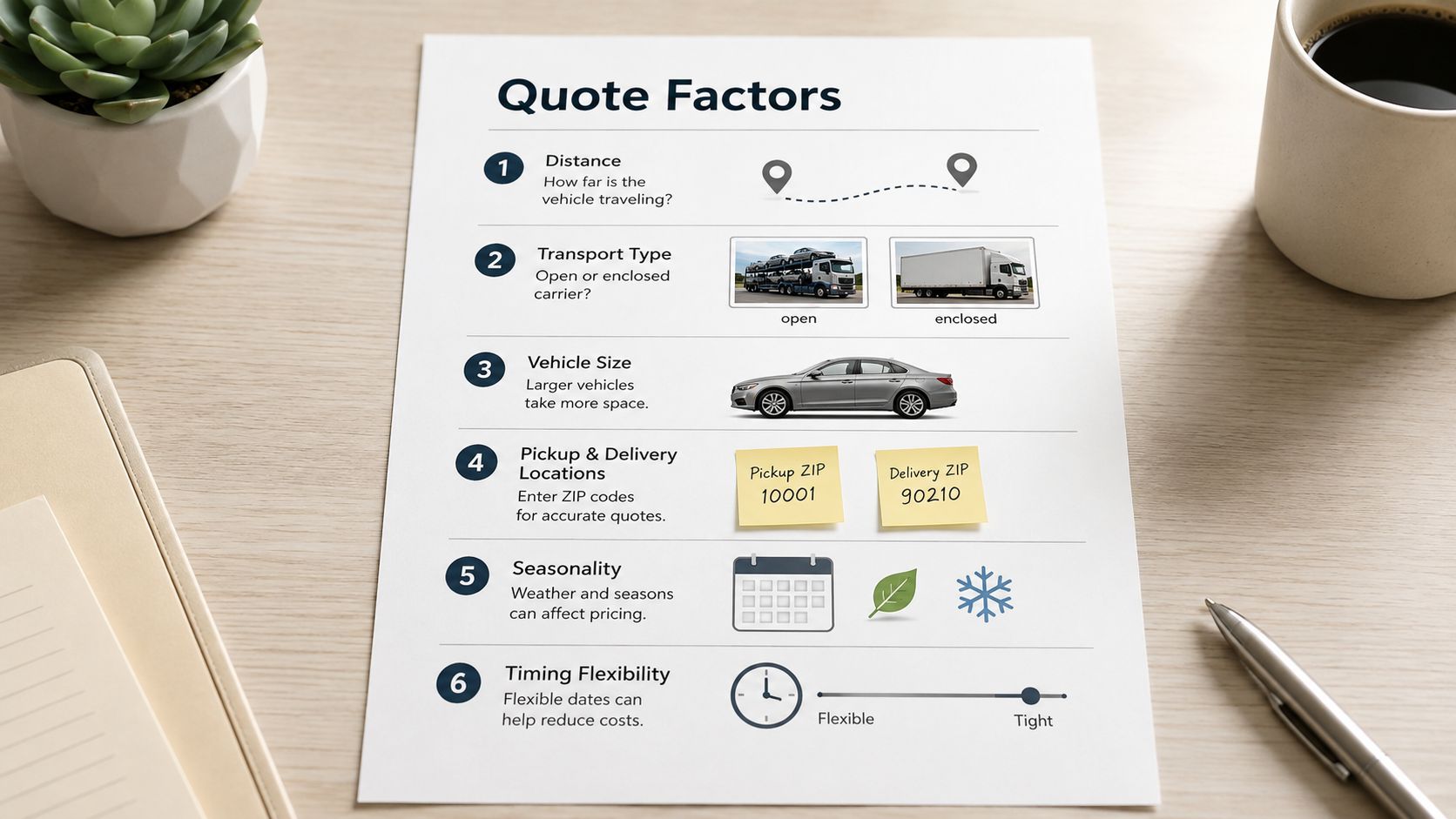
Distance is the obvious lever, but it's only one lever. In actual dispatch work, the quote moves because six inputs shape how hard it is to match your car to a carrier, not just how far the car has to go. If you understand those six inputs, you can tell within seconds whether a quote is tight or padded.
Distance and route density
Longer lanes usually bring a lower price per mile because fixed pickup, loading, and carrier-matching costs get spread over more miles. That's why short routes can look expensive on a per-mile basis, while longer lanes often look cleaner. The route itself matters too, because major metro corridors are easier to fill than thin rural lanes.
Transport type
Open transport is the default for most standard vehicles, while enclosed transport costs more because it carries fewer cars and adds protection. A 1,000-mile open-transport estimate often lands around $650 to $800, while enclosed transport on the same lane is commonly $1,000 to $1,200 (Road Runner Auto Transport car shipping calculator). If your car doesn't need enclosed protection, don't pay for it.
Vehicle size and operability
Dispatchers need the year, make, model, and whether the car runs. An inoperable vehicle needs special loading equipment, and larger vehicles take more deck space and can change trailer compatibility. That's why two cars on the same lane can get very different prices even when the miles are identical. National Car Transport's car shipping cost page is useful because it shows how those inputs affect the actual rate conversation.
Pickup and delivery ZIP codes
ZIP code matters because a quote isn't just about highway distance, it's about where the truck can get in and out. Tight urban blocks, gated communities, and remote rural addresses all change dispatch complexity. If you leave out the exact pickup and drop-off ZIP codes, you're inviting a lowball number.
Season and timing
Pricing shifts when trucks get full and routing gets tight. Peak moving windows usually put more pressure on rates, and flexible dates help carriers build cleaner loads. The more rigid your pickup window, the less room dispatch has to find a good fit.
Trailer preference and added constraints
Enclosed, oversized, modified, and inoperable shipments all reduce the carrier pool. Every added constraint narrows matching, and that's where quote inflation starts. If your car is a normal daily driver, keep the shipment simple and you'll usually keep the price cleaner too.
Bottom line: the biggest quote swing usually comes from how hard your vehicle is to match, not just how far it's going.
Binding vs Non-Binding Estimates Explained
A quote that looks cheap can still be expensive if it isn't locked properly. The market is full of estimates that sound firm until the carrier shows up with a different number. That's why you need to know whether you're holding a binding price or a non-binding one.
A binding estimate is meant to lock the amount in writing, while a non-binding estimate can change if the shipment details, market conditions, or service terms change. The FMCSA rule matters here because a real shipping document should spell out all charges, including transportation, accessorial, and advance charges, and it must be signed. If a company won't put the full price structure in writing, it's leaving itself room to revise the bill later.
What a transparent quote should show
A clean quote should separate the core transport charge from anything extra. That means you want to see the transportation line, any fuel-related language, accessorial fees, and how insurance is handled. If the quote only gives you a headline price and no terms, you don't have enough information to compare it fairly.
A binding quote often comes with a deposit that reserves the rate and the carrier match. A non-binding one may ask for less upfront, but you're trading certainty for flexibility. That tradeoff is fine only if you understand it before you book.
A flat-rate quote is the simplest option for most customers because the final number is spelled out clearly. It's especially useful for families, students, military moves, and dealerships that can't afford a moving target. If you're shipping an enclosed vehicle and want the pricing structure spelled out more carefully, this enclosed transport resource is the right place to compare what higher-protection service should include.
Practical rule: if the quote doesn't say what happens when the carrier changes, fuel changes, or the pickup window shifts, you don't have a protected quote yet.
The person reading the form should be able to answer one question immediately, “What exactly will I pay, and under what conditions can that change?” If the answer takes a phone call, the quote isn't doing its job.
How to Request an Accurate Quote
A good quote starts before the form is submitted. If you want a number that holds, give the dispatcher the same detail you'd expect a carrier to know on load day. Vague requests produce vague prices.
Gather the shipment details first
Have the pickup and delivery ZIP codes, vehicle year, make, and model, whether the car is operable, and whether it has modifications like lift kits, oversized tires, or lowered clearance. Add the earliest pickup date and your flexible window, because that changes how easily a carrier can slot your vehicle into a route. If someone will need to meet the driver, say that upfront too.
Say the job out loud the right way
A simple script works better than a long explanation.
“I need a quote for a [year/make/model] running car from [ZIP] to [ZIP]. I'm flexible on pickup within a few days, and I want the total amount in writing, including any accessorial charges, before I book.”
That wording forces the company to tell you whether the number is flat, or just a starting point. If they dodge the total or won't confirm the details in writing, move on.
Watch for lowball behavior
The biggest red flag is a price that feels too easy, especially if the rep pressures you to book fast. Another warning sign is a quote that ignores operability, trailer type, or exact ZIP codes. Those omissions usually mean the number will get corrected later, and not in your favor.
For door-to-door service specifics, this National Car Transport door-to-door guide is worth checking because door-to-door is only simple when the access points are realistic.
A clean quote request is not complicated. It's just complete. The more exact your shipment details are, the less room there is for the final number to drift.
Sample Quotes for Common Routes
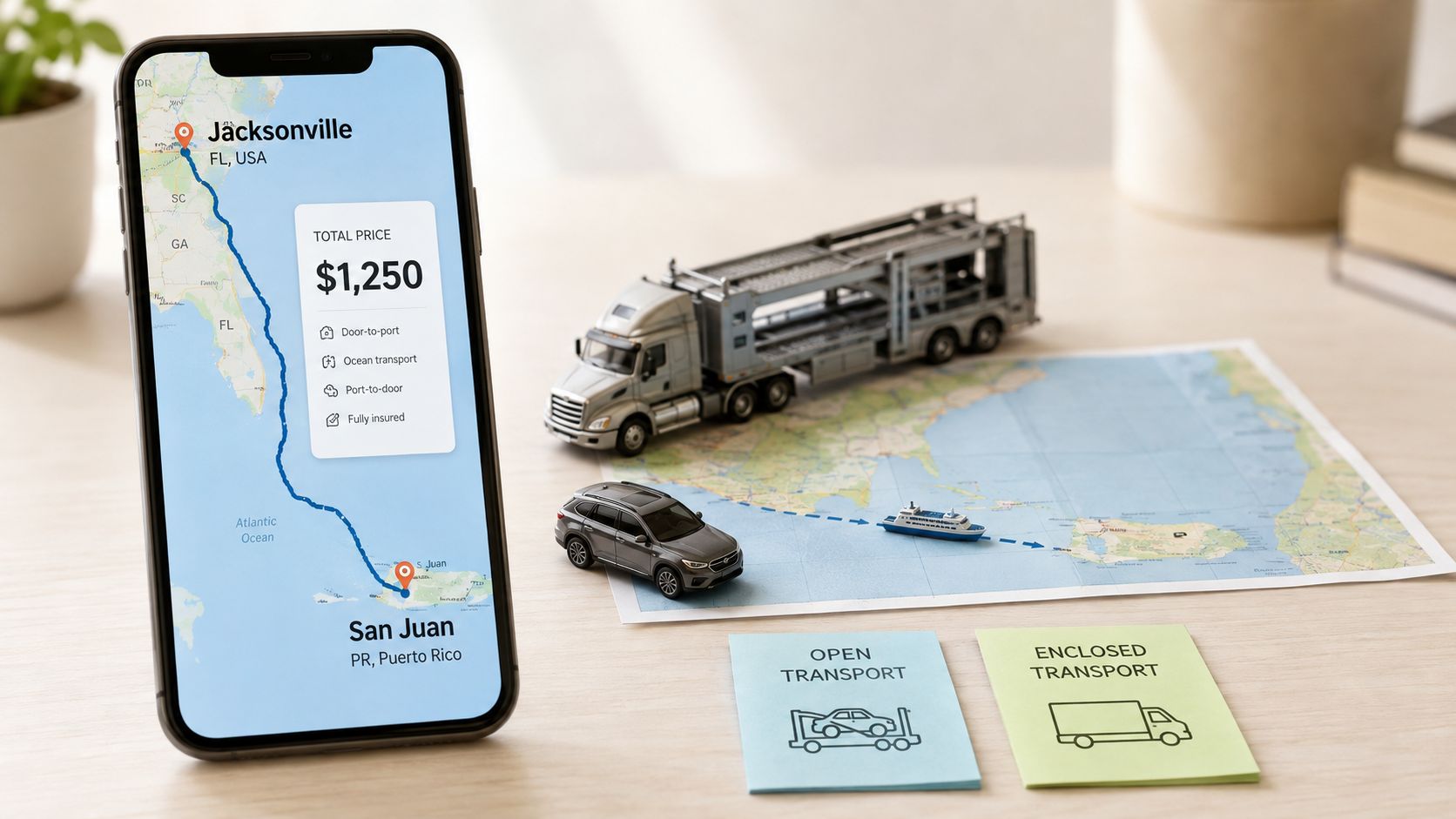
Route matters more than the headline quote. A busy metro-to-metro lane gives dispatchers more carrier options, faster matching, and less deadhead, so pricing usually stays tighter. A thin lane with awkward timing does the opposite, and that is where the invoice starts drifting after booking.
A long interstate shipment is still the cleanest way to judge whether a quote makes sense. On a well-traveled open lane, the market often sits in the low hundreds for standard vehicles, while enclosed service runs materially higher because the carrier gives up space and flexibility. The test is whether the number matches the lane you asked for, not whether it sounds cheap on a screen.
Short lanes behave differently. Fixed dispatch work, pickup calls, and carrier coordination do not shrink just because the mileage does, so a short-haul quote can look high relative to the distance. Add a rural pickup, a narrow delivery window, or a location that forces extra deadhead, and the rate moves fast.
Mainland route examples that shoppers actually compare
A sedan on a dense mainland corridor usually gets more favorable treatment than a truck on the same lane because the carrier can fit more efficiently and fill the trailer with less compromise. Open transport remains the default for everyday vehicles, while enclosed service is reserved for cars that justify the extra protection and lower load capacity. If a quote comes in far under what the lane normally supports, something was probably left out.
Dispatch discipline matters. The quote has to match the vehicle, the lane, and the carrier type the dispatcher can place, or the first number becomes a placeholder instead of a real booking price. That gap is what burns shoppers later.
Puerto Rico follows a different playbook. A mainland-to-island move depends on ocean transport and usually runs through San Juan as the main port point (Allied car shipping guidance). Port handling, sailing schedules, and mainland pickup all shape the quote, so island shipments need a different setup from the start.
For a broader reality check, use market benchmarks to see whether a quote is wildly off, then compare them with the exact lane you want. A useful way to think about the sticker shock problem is the same way you would look at unexpected used car expenses. The first number is rarely the whole bill, and shipping quotes work the same way.
Do not compare a Puerto Rico quote to a mainland interstate quote and call one of them high. The move type is different, so the logistics are different.
The right benchmark is the lane you are shipping, the transport type you want, and the pickup timing you can live with.
Hidden Fees and Price Hikes to Watch For
Shoppers get burned when a quote looks clean at the start and the invoice grows after booking. A dispatcher, broker, or carrier can still adjust the job if the original request left room for it, and that is usually where the trouble begins. Move.org says the final bill can land 25% to 50% higher than the first quote, which is exactly why a cheap headline number deserves a hard look (Move.org vehicle transport costs).
Where the extra money comes from
The usual suspects are fuel changes, route density, deadhead miles, seasonal demand, carrier substitutions, and vehicle details that were left out of the original request. If a shipper prices a sedan as a basic operable car, then later the carrier learns it is oversized or nonrunning, the rate can move. A remote pickup point creates another problem, since the carrier may need extra time and mileage to reach it, and that cost has to show up somewhere.
Surcharge language buried in fine print causes a lot of anger later. Some quotes sound flat until the carrier adds accessorial charges for special handling, access issues, or schedule changes. The wording on the estimate matters more than the screen price.
For a wider view of how hidden costs show up after the first number, the unexpected used car expenses guide from AutoProv is a useful reminder that the sticker number is rarely the full story. Shipping works the same way. The headline is not the whole deal.
If you need enclosed protection for a high-value or weather-sensitive vehicle, compare that against enclosed auto transport options before you ask for a quote. Enclosed service costs more, and pretending otherwise only creates a bad quote.
How to keep the quote from drifting
Choose open transport for a standard vehicle if you do not need enclosed protection. Keep your pickup window flexible so the dispatcher has room to build a better route. Skip remote rural origins when you can, because they add deadhead and access costs that usually come back to you.
A real quote protector is transparency. The shipper should tell you what is included, what can change, and when payment is due. If the company cannot explain that clearly, the low price is probably doing more marketing than math.
Rule I use in dispatch: if the number looks unusually cheap and the rep sounds rushed, expect the price to change or the pickup to slip.
The move from quote to invoice should be boring. If it feels clever, confusing, or urgent, something is wrong.
Comparing Quotes Like a Pro
Shoppers lose money when they compare only the headline number. Compare the structure of the quote, the payment timing, and the protection terms. A slightly higher flat-rate quote can cost less than a cheap quote that climbs later.
| Quote Element | Binding Quote | Non-Binding Quote | Flat-Rate Quote |
|---|---|---|---|
| Price Certainty | Locks the rate in writing | Can change with shipment conditions | Guarantees the final amount |
| Deposit Required | Usually requires a deposit to secure the rate | May use a smaller or refundable hold | Often uses a modest reservation fee |
| Insurance Coverage | Coverage limits should be spelled out clearly | Coverage can vary and needs verification | Coverage is stated in writing |
| Cancellation Policy | Refunds are limited by signed terms | Often more flexible to cancel | Written cancellation terms are clear |
| Fuel Surcharges | May or may not be included | Often added after booking | Included upfront |
| Transit Window | Can shift with carrier availability | Flexible but less protected | Realistic window is locked with delay terms |
Ask every company for the same quote type, then verify that the shipment details match line for line. Use the same ZIP codes, the same vehicle details, the same transport type, and the same pickup window. Industry guidance says customers should get at least three quotes and compare like for like.
A flat-rate structure is usually the easiest to trust because it reduces the number of surprise charges. That matters when a company has a broad vetted carrier network and can match loads without turning the process into guesswork.
If you are pricing a higher-value or weather-sensitive vehicle, compare the quote against enclosed auto transport options before you commit. Enclosed service costs more, and pretending it should price like open transport is how bad quote decisions start.
The true test is not “cheapest versus most expensive.” It is which quote tells the truth first.
Tips and Frequently Asked Questions
The same quote traps show up over and over. Dispatchers see them every day, a shipper leaves out transport type, ZIP codes, operability, trailer choice, or timing flexibility, then wonders why the final bill climbs. If any of those details are missing, the number is a guess, not a quote. For Puerto Rico, port handling and ocean routing belong on the list too, because that shipment follows a different model from mainland moves.
How long does a quote stay valid?
Online quotes move fast. If the price is not put in writing, treat it as a live number that can change before you book.
Are deposits refundable?
Read the signed terms before you pay. Refund rules depend on the company and the quote type, and that is written in the cancellation language, not in the sales pitch.
How does insurance work during transit?
Ask for the coverage details in writing. Do not assume the quote includes the protection you want unless the policy terms spell it out clearly.
What makes a Puerto Rico quote different?
It usually depends on ocean transport and routing through San Juan, so the price turns on port logistics and sailing timing, not just highway miles.
If you want someone to walk through the details in English or Spanish, National Car Transport has bilingual agents in the U.S. who handle quote requests every day and can help you compare the terms without turning it into a sales pitch.
If you want a quote built for your vehicle, your lane, and your timing, visit National Car Transport and request a flat-rate shipping number. You will get a clearer read on what your move should cost, whether you are shipping across the mainland or to and from Puerto Rico.