
Yes. More than 80% of franchised dealerships offer home delivery and can arrange shipping, usually through a licensed third-party carrier rather than the dealer's own truck. The dealer sells and prepares the vehicle, while a transport company handles the miles between the lot and your door.
You may be looking at a vehicle several states away, buying online because the right model isn't available locally, or arranging a move for a student, service member, snowbird, or family member. The question sounds simple, but “can a dealership ship a car to you” really involves several separate tasks: carrier scheduling, payment, title and registration paperwork, tax handling, insurance, and delivery inspection.
The good news is that dealership delivery is now a normal part of vehicle retail. A 2026 industry summary reports that more than 80% of franchised dealerships offer home delivery, reflecting the broader shift toward online car buying and direct shipment to customers. The dealership shipping overview explains why dealers increasingly coordinate transport as part of a sale instead of treating it as an unusual favor.
This guide applies to domestic vehicle transport across the 48 contiguous states, including routes involving major cities such as New York City, Los Angeles, Chicago, Houston, Phoenix, Philadelphia, San Antonio, San Diego, Dallas, Jacksonville, Miami, Atlanta, Denver, Seattle, Boston, Detroit, Las Vegas, Portland, and other metropolitan areas. It also covers the distinct process of shipping vehicles between the U.S. mainland and San Juan, Puerto Rico.
The important distinction is that the dealership usually acts as a coordination hub. It may request a quote, arrange pickup, provide documents, and communicate with the carrier, but the actual transportation is normally performed by an independent licensed company.
Table of Contents
- Introduction Can a Dealership Ship a Car Directly to Your Door
- How Dealership Car Shipping Actually Works
- How Long Dealership Shipping Takes and What It Costs
- Paperwork Inspections and Delivery Responsibilities You Should Know
- Dealership Arranged Shipping Versus Booking a Third Party Shipper
- Shipping a Car From a Dealership to and From Puerto Rico
- Final Checklist Before You Authorize Dealership Delivery
Introduction Can a Dealership Ship a Car Directly to Your Door
A buyer in Boston finds the exact used SUV they want at a dealership in Dallas. The price works, the vehicle history looks acceptable, and the salesperson says the paperwork can be completed online. The remaining concern is practical: how does a car travel from Texas to Massachusetts if the buyer can't fly out to collect it?
The dealership can usually arrange delivery. In many cases, the sales department adds transportation to the purchase process, collects the destination details, and assigns the vehicle to a carrier that already serves the route. The dealer doesn't normally send an employee across the country in a dealership truck.
That arrangement resembles booking a flight through a travel agent. The dealership organizes the trip, but the carrier operates the equipment and manages the journey. You still need to understand the itinerary, timing, documents, and conditions before agreeing to the shipment.
The key distinction: A dealership may arrange your shipment without actually being the company transporting your vehicle.
The same pattern applies whether the car is moving from Los Angeles to Phoenix, Chicago to Atlanta, New York to Miami, or a smaller community near a major market. Dealer-arranged shipping can be convenient because the seller already has access to the vehicle and can prepare it for pickup. It can also leave buyers uncertain about the carrier's name, insurance, delivery window, or final charge if those details aren't confirmed in writing.
Out-of-state buyers should ask more than “Do you ship?” Ask who will transport the vehicle, whether the quote includes all transport charges, how damage will be documented, and when the title package and temporary tags will arrive. Those questions matter for individuals, dealerships, businesses, military families changing duty stations, students leaving for school, and snowbirds moving between seasonal homes.
Puerto Rico adds an ocean leg and port procedures, so the seller may coordinate mainland trucking and vessel booking separately. The basic principle remains the same: identify each party's responsibility before the vehicle leaves the dealership.
How Dealership Car Shipping Actually Works
A dealership usually works like a logistics coordinator, not a private trucking company. It may contact a carrier network, provide the vehicle's location and dimensions, confirm the buyer's destination, and schedule a pickup window. The carrier then dispatches a driver, completes the transport, and obtains delivery approval.
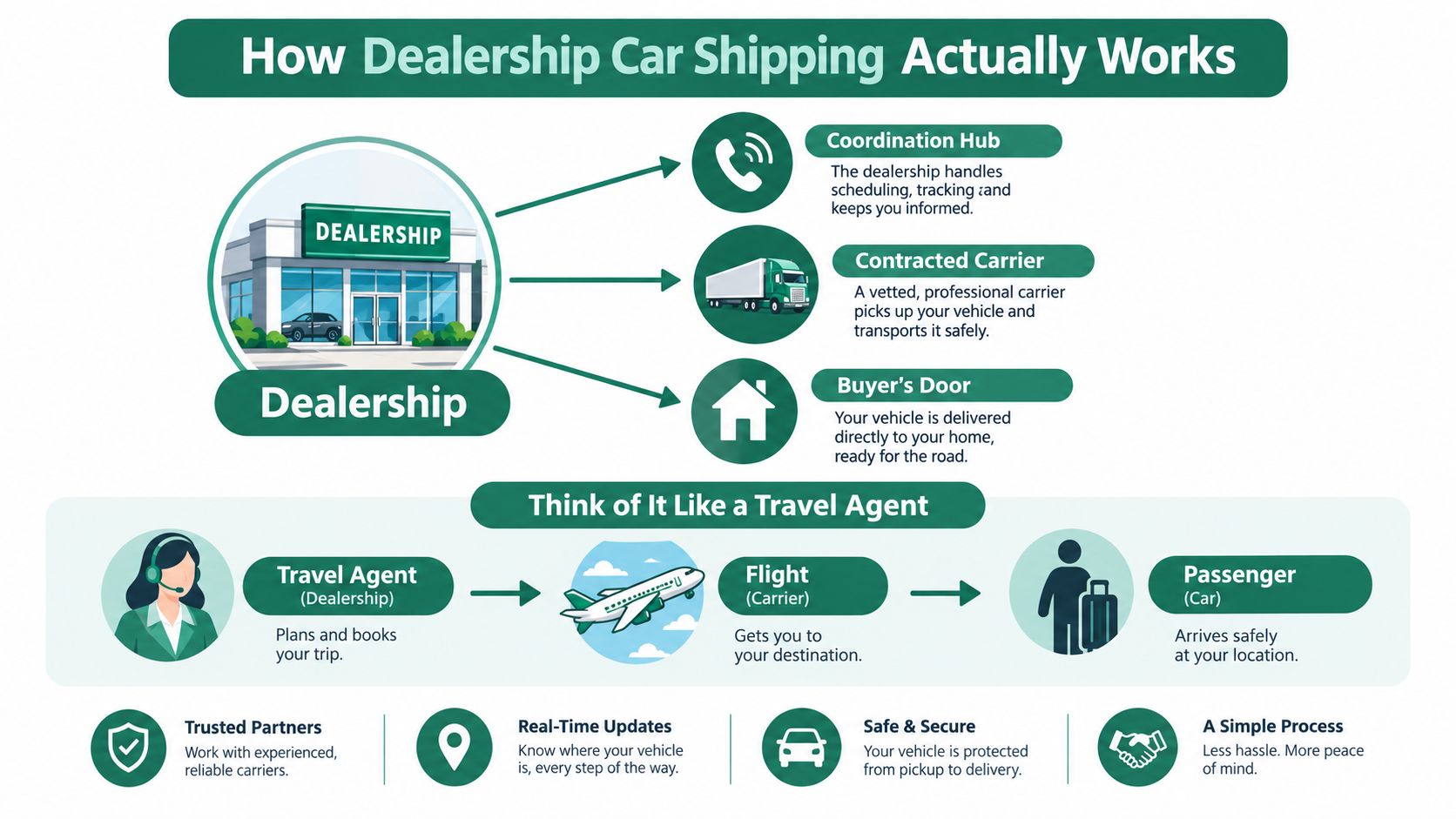
Think of the dealership as a travel agent booking a flight. The vehicle is the passenger, the carrier is the airline, and the buyer is waiting at the destination. The analogy isn't perfect, but it makes the responsibilities easier to separate.
Who handles each part
The dealership normally prepares the car, confirms that it can be released, supplies the pickup address, and handles the sale documents. It may arrange the carrier directly or pass the job to a transport provider. If the dealer promised delivery as part of the purchase, ask whether that promise covers only coordination or also the transport charge.
The carrier supplies the truck, driver, cargo coverage, pickup inspection, and delivery inspection. The carrier controls the actual route and must report delays caused by weather, traffic, mechanical issues, or scheduling changes. A dealership can help communicate, but it can't always control the driver's exact arrival time.
The buyer provides accurate delivery information, makes sure someone can receive the vehicle, reviews the condition report, and signs only after checking the car. If the destination is a narrow street, gated community, apartment complex, military installation, or rural property, explain the access limits before dispatch.
For door-to-door service, confirm whether the truck can safely reach the exact address. If not, the driver may use a nearby public location that can accommodate a large carrier. Door-to-door auto transport details can help you understand why “door-to-door” refers to the closest practical location, not necessarily a guaranteed stop in a restricted driveway.
Why the bill of lading matters
The bill of lading is the central handoff document. It records the vehicle's condition at pickup and delivery, along with relevant details such as visible damage, mileage, accessories, and signatures. At delivery, inspect the paint, glass, wheels, body panels, interior, and included equipment before signing.
A clean signature can make it harder to establish that damage occurred during transport. If you find a problem, write a clear exception on the bill of lading, take photographs, and notify the carrier and dealership promptly.
The video below provides another visual explanation of the dealership delivery process.
How Long Dealership Shipping Takes and What It Costs
Transit time depends on more than the distance between two ZIP codes. Carrier availability, route density, pickup access, weather, vehicle size, and the difference between an estimated pickup window and a guaranteed appointment all affect the schedule.
One industry guide reports that dealer-to-dealer transfers move at roughly 2,500 vehicles per day, with more than 80% completed within a week. The same guide gives these distance-based planning ranges:
| Distance Band | Typical Transit Time | What Affects Timing |
|---|---|---|
| Under 500 miles | 1–3 loaded transit days | Local carrier availability, pickup access, and route density |
| 500–1,500 miles | 3–5 loaded transit days | Dispatch timing, traffic, weather, and driver routing |
| Over 2,500 miles | 7–10 loaded transit days | Cross-country scheduling, distance, and carrier capacity |
These are transit estimates after loading, not necessarily the total time from purchase to delivery. A dealer may need time to finish financing, title paperwork, vehicle preparation, and carrier assignment before the truck arrives.
What changes the price
Open transport usually provides the practical choice for ordinary cars, SUVs, and trucks. The vehicle rides on an exposed multi-car trailer. Enclosed transport places it inside a protected trailer and is more appropriate when weather exposure, road debris, or privacy is a significant concern, particularly for classic, luxury, or specialty vehicles.
Door-to-door service reduces terminal handling, while terminal arrangements may be more flexible in some markets. A vehicle that doesn't run, has unusual dimensions, or requires special loading equipment can also need a different quote.
The same industry guide says dealers can save about 30% compared with other transport methods. Dealer-to-dealer transport guidance connects that efficiency to high-volume logistics and established market lanes. A consumer shouldn't assume the dealer's quote automatically includes that advantage, however. Compare the stated transport charge with the purchase contract and ask whether administrative fees, fuel adjustments, storage, tolls, or special handling are separate.
For a practical quote, give the shipper the exact pickup city, destination city, vehicle year and model, operating condition, preferred service type, and earliest available date. Car shipping cost factors can help organize the information you'll need before requesting pricing.
Before authorizing delivery, confirm:
- Total price: Ask whether the amount is flat-rate or subject to later adjustments.
- Pickup timing: Determine whether the date is estimated or guaranteed.
- Insurance: Ask what carrier coverage applies and how claims are handled.
- Service type: Confirm open, enclosed, door-to-door, terminal, or port service.
- Included work: Verify whether loading, unloading, storage, and paperwork coordination are included.
Paperwork Inspections and Delivery Responsibilities You Should Know
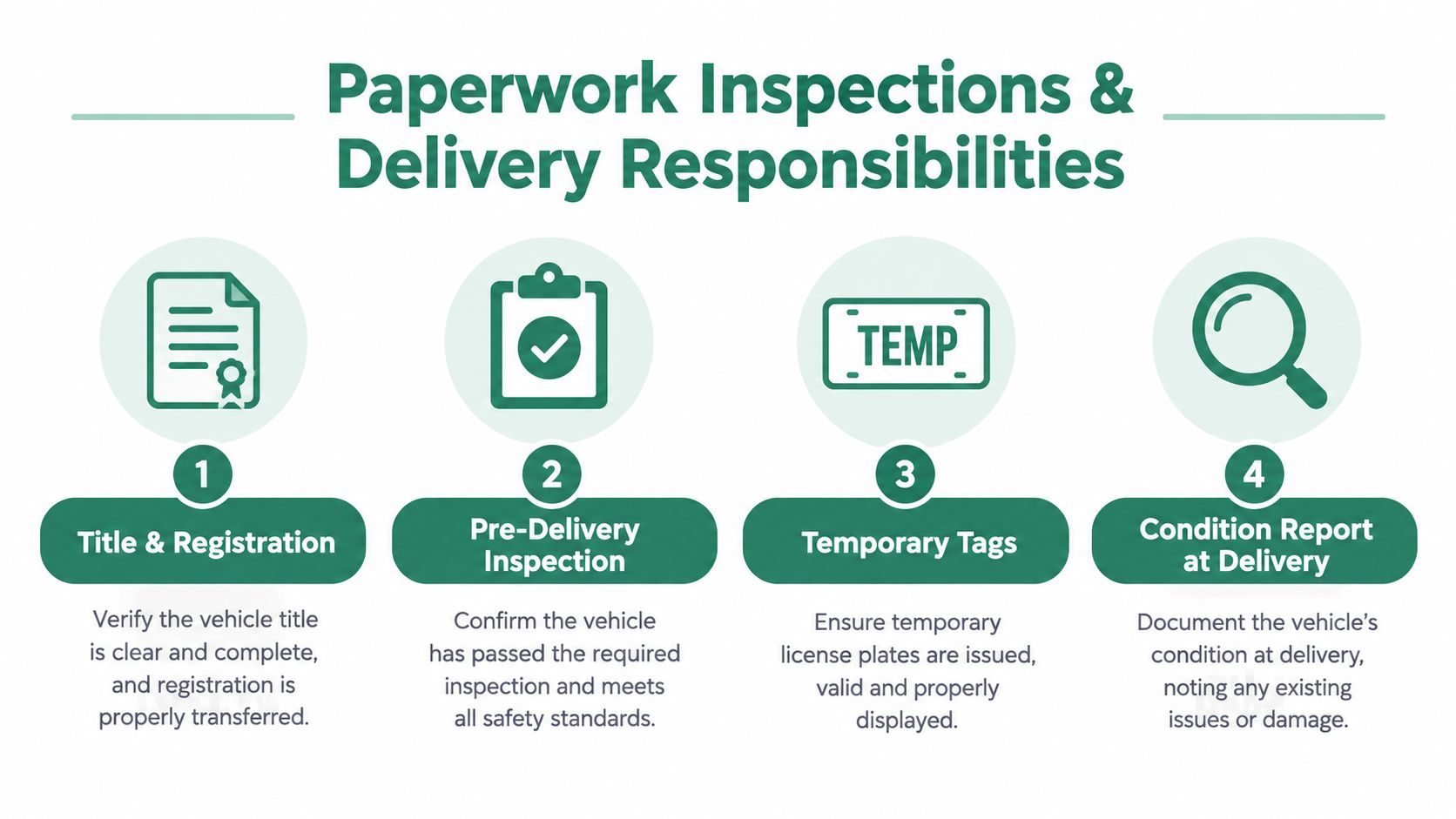
Shipping the vehicle and transferring ownership are related, but they aren't the same event. The carrier moves the automobile. The dealership and buyer still have to complete the title, registration, tax, and temporary-tag requirements that allow the vehicle to be legally used at its destination.
Title and registration timing
State rules control the paperwork. California provides a useful example. A dealer must properly endorse, date, and deliver the title and registration to the buyer. If the dealer has received full payment, the title generally must be mailed, transferred, or delivered within 15 business days. Missing that deadline can result in a $25-per-day penalty, up to $2,500, under the cited California guidance. California title and registration guidance explains why shipment doesn't eliminate the dealer's documentation duties.
The exact rule differs by state. For an out-of-state purchase, ask the dealer whether it will complete the title package, issue temporary tags, provide an odometer disclosure, and send the documents to you or the destination motor-vehicle agency. A car can arrive physically before the registration packet is ready, which may leave you unable to drive it legally.
Tax treatment also needs written clarification. Neutral tax guidance states that buyers generally owe tax where the vehicle is registered, but shipping directly out of the selling state can affect whether the selling dealer must collect that state's tax at delivery. Out-of-state vehicle tax and temporary-tag guidance explains why the delivery location can affect whether tax is collected upfront, paid later at registration, or handled differently under the applicable rules.
Practical rule: Treat the physical vehicle, the title packet, the temporary tag, and the tax receipt as four separate delivery items.
Inspect before signing
At pickup, the carrier and dealership should record the vehicle's condition. At delivery, repeat the inspection in good light before signing the bill of lading.
Check the following:
- Exterior condition: Look at paint, bumpers, wheels, glass, mirrors, lights, and body panels.
- Interior and equipment: Confirm seats, screens, keys, floor mats, charging cables, and other promised accessories.
- Mileage and operation: Compare the mileage with the paperwork and note whether the vehicle starts and moves normally.
- Documents: Verify temporary tags, title-related documents, and any items the dealer promised.
- Exceptions: Write every new or disputed issue on the delivery document before signing.
Independent transport guidance emphasizes that dealers often use third-party carriers for online and out-of-state buyers. It also warns that signing the bill of lading without exceptions may mean accepting the vehicle in its delivered condition. Dealer-arranged customer shipping guidance provides practical context for documenting condition at both ends.
If you find damage, photograph it from several angles, note it specifically on the bill of lading, keep copies of the documents, and contact the carrier and dealer immediately. Don't rely on a verbal promise that the paperwork can be corrected later.
Dealership Arranged Shipping Versus Booking a Third Party Shipper
Dealer-arranged delivery is convenient, but it isn't automatically the right choice for every buyer. The better option depends on how much control you want over the carrier, price format, service type, and communication.
| Factor | Dealer Arranged Shipping | Direct Third Party Shipper |
|---|---|---|
| Convenience | One contact through the sales process | Buyer requests and manages transport directly |
| Carrier choice | May be selected through the dealer's network | Buyer can compare providers and service options |
| Pricing | May be bundled into the vehicle deal | Usually presented as a separate transport quote |
| Communication | Dealer may relay updates | Buyer communicates directly with the transport provider |
| Custom timing | Depends on the dealer's schedule | More flexibility to discuss dates and routing |
| Puerto Rico service | Dealer may coordinate port arrangements | Shipper can organize land and ocean legs together |
A dealer arrangement makes sense when the dealership has a trusted transport relationship, the price is itemized, the pickup schedule fits your needs, and you prefer one point of contact. It can also simplify vehicle release because the sales team already controls the keys and documents.
Direct booking can be more useful when you want enclosed service, a specific pickup window, a mainland-to-Puerto Rico plan, or clear separation between vehicle price and transport cost. A dedicated provider may also explain each charge before dispatch instead of leaving you to interpret a single dealership invoice.
A simple decision matrix
- Choose dealer arrangement when convenience matters most and the dealer gives you the carrier name, insurance details, price, and inspection procedure in writing.
- Choose direct booking when you need independent comparison, more communication control, or a specialized route.
- Ask for a new quote if the dealership's offer doesn't identify whether the transport is open, enclosed, door-to-door, port-to-port, or subject to additional fees.
For dealership groups, auctions, and commercial buyers, transport also involves repeat scheduling and freight documentation. A resource explaining how to automate freight agreements with BoloSign may be useful when multiple parties need consistent agreement workflows.
National Car Transport offers dealership-focused coordination, including transport scheduling for sold vehicles and inventory movements, through its dealership auto transport service. Its stated service model includes transparent flat-rate pricing, an A+ BBB rating, more than 25 years of experience, and a network of more than 25,000 vetted carriers. Buyers should still compare the written scope of service, because no two vehicle transports have identical pickup, access, paperwork, or timing requirements.
Shipping a Car From a Dealership to and From Puerto Rico
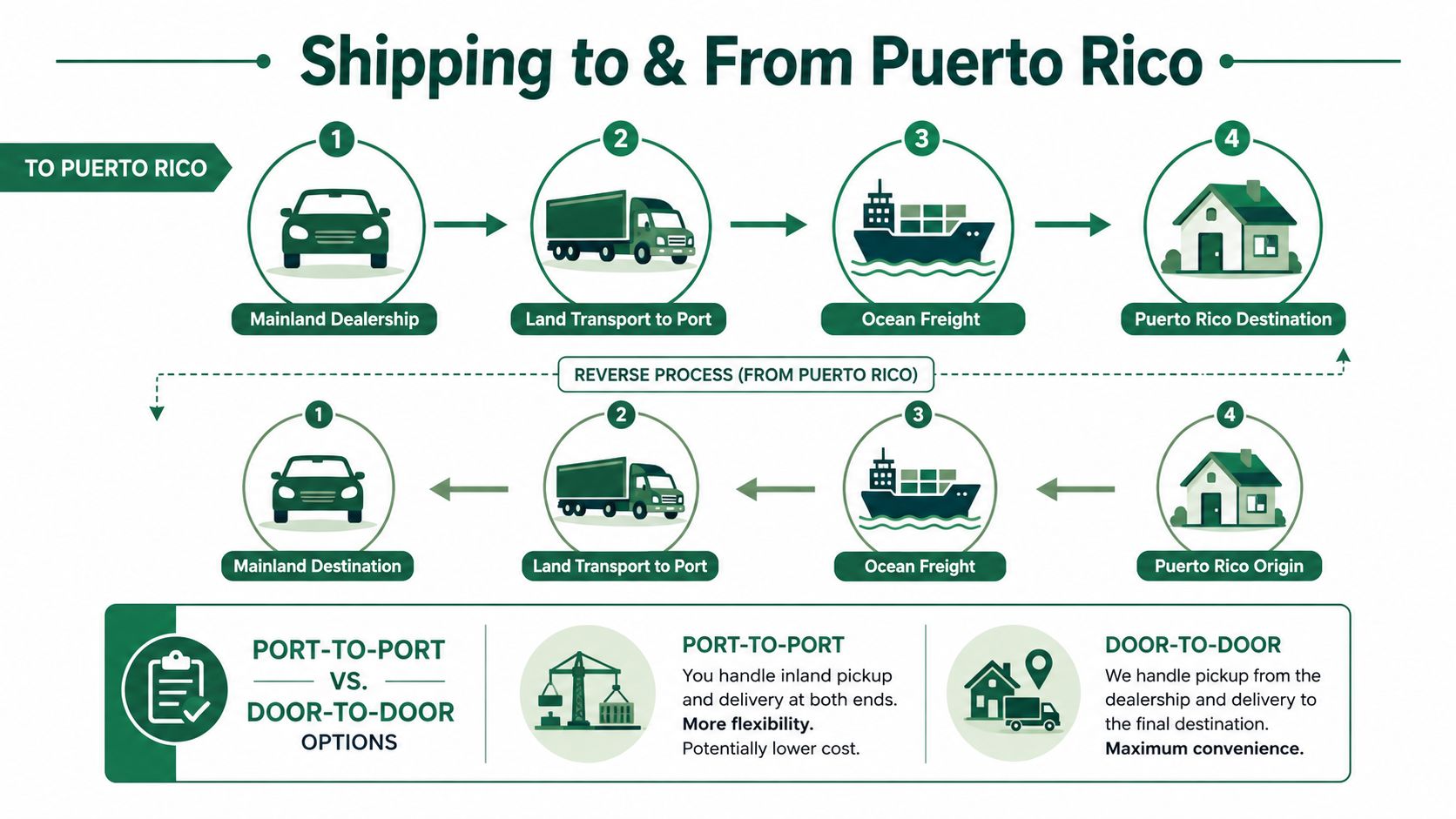
Puerto Rico shipping adds a second logistics layer. A dealership on the mainland may prepare the vehicle and arrange inland transport, but the car must also reach a port, clear the carrier's booking requirements, travel by vessel, and be collected in Puerto Rico. The reverse process applies when a vehicle moves from San Juan to the mainland.
Crowley identifies Jacksonville, Florida, and Eddystone, Pennsylvania as the two main U.S. mainland ports used for vehicles shipped between Puerto Rico and the mainland. It also identifies the Isla Grande Terminal in San Juan as a key Puerto Rico drop-off point and recommends booking ahead because demand is high. Crowley's mainland and Puerto Rico vehicle shipping guidance provides those port details.
Door-to-port or port-to-port
Port-to-port means the vehicle is delivered to the mainland port and collected at the Puerto Rico terminal, or the reverse. This structure is usually more economical, but the buyer or dealership must arrange transportation at each end.
Door-to-port adds mainland pickup and trucking before the ocean leg. One industry guide says this added mainland portion can take 3–7 days before the vehicle reaches the sailing process. Puerto Rico vehicle transport guidance outlines the difference between the two service structures.
Vehicles generally travel by roll-on/roll-off service or container shipping. Roll-on/roll-off service is designed for vehicles to be driven onto and secured within the vessel's vehicle area. Container shipping places the vehicle inside a container and may suit certain shipments that need a different loading arrangement.
Transit depends on the departure port and the mainland pickup location. One neutral guide reports typical mainland-to-San Juan ocean transit of about 7–10 days from Florida ports and 10–14 days from New Jersey ports, with additional mainland time when door-to-port service is required. Puerto Rico shipping timing guidance gives those planning ranges.
A specific customs point also matters. Crowley states that vehicles shipped to the U.S. mainland from Puerto Rico don't need a U.S. Customs and Border Protection inspection. Crowley's Puerto Rico shipping information addresses that rule, although other documents, port requirements, and destination registration obligations still need attention.
For a mainland dealership selling to a Puerto Rico buyer, ask who handles inland trucking, port delivery, ocean booking, terminal release, and final delivery in San Juan. A single coordinator can reduce confusion, but the written quote should identify every handoff.
Final Checklist Before You Authorize Dealership Delivery
Before you approve shipment, slow the process down long enough to verify the details. A rushed “yes” can leave you unclear about who is responsible for a delay, missing document, or delivery-condition dispute.
Confirm the transport arrangement
Ask the dealership or shipper for the carrier's legal identity, licensing information, insurance details, pickup location, destination, vehicle description, and service type. Confirm whether the truck will be open or enclosed, whether delivery is door-to-door or terminal-based, and whether a port is involved for Puerto Rico service.
Confirm the money
Get the complete transport amount in writing. Ask whether the price is a flat rate, whether it includes pickup and delivery, and whether storage, special loading, tolls, port handling, or destination services can be added later. Keep the transport quote separate from the purchase contract so you know which party charged each amount.
Confirm the documents
Make sure the dealer explains:
- Title delivery: When and how you'll receive the title or title package.
- Registration: Which agency receives the paperwork and what you must complete.
- Temporary tags: Whether tags are issued, when they expire, and whether you can legally drive while waiting.
- Sales tax: Whether tax is collected at purchase or handled at destination registration.
- Odometer and condition records: Whether the disclosures match the vehicle being shipped.
Confirm the inspection
Take photographs before loading if you're present, and request the pickup condition report if you aren't. At delivery, inspect the vehicle before signing, record mileage and accessories, and write every concern on the bill of lading.
A careful inspection is faster than a dispute. Use the delivery document while the driver and vehicle are still present.
No two vehicle transports are alike. A mainland move to a major city such as Miami, Atlanta, Denver, Seattle, or Los Angeles has different access and scheduling concerns than a rural delivery, a dealership transfer, or a port shipment to San Juan. National Car Transport has bilingual English and Spanish agents based in the United States, with more than 20 years of auto transport logistics experience among its agents. That human guidance can make a complicated shipment simpler and quicker, particularly for military families, snowbirds, students, dealerships, and Puerto Rico buyers.
Ask your agent to review the route, documents, vehicle condition, delivery access, and total charge before dispatch. A short planning call can help you secure a suitable sailing or carrier assignment at a sensible value.
If you're buying from a distant dealership or moving a vehicle between the mainland and Puerto Rico, visit National Car Transport to request a clear transport plan and quote. Its bilingual U.S.-based agents can coordinate open or enclosed vehicle shipping, port logistics, and delivery details while keeping the process organized from pickup inspection through arrival.