

Boat transport rates usually fall between $1.50 and $4 per mile, and the total price depends on your boat's size, the distance, and the transport method. Short moves often cost more per mile, while longer hauls usually bring the per-mile rate down.
If you're looking at a boat in another state, moving south for the season, or trying to figure out whether hauling your boat to Puerto Rico is even practical, the hard part is usually not the move itself. It's getting a quote that makes sense. Most owners don't mind paying a fair rate. They just don't want surprises after the truck is booked or the vessel reaches the port.
That's where boat transport pricing gets confusing. A small center console on its own trailer is one job. A taller cruiser that needs route planning, port coordination, and extra handling is a different job entirely. The same is true in vehicle transport across the mainland and on Puerto Rico routes. Snowbirds, military families, students, dealerships, and businesses all run into the same issue. No two shipments are exactly alike.
Table of Contents
- Your Guide to Understanding Boat Shipping Costs
- The Core Factors That Determine Your Boat Transport Rate
- Typical Boat Transport Costs with Examples
- Beyond the Base Rate Understanding Additional Fees
- Shipping Your Boat to or from Puerto Rico
- How to Get an Accurate Quote and Reduce Your Costs
Your Guide to Understanding Boat Shipping Costs
You buy a boat in one state, or you need yours moved to a new marina, and the first number you hear sounds reasonable. Then important questions begin. Is the trailer usable? Can the truck reach the pickup point? Is this a straight overland move, or does Puerto Rico put port handling and ocean freight into the mix?
That is why boat shipping costs can feel hard to pin down at the start. The first quote is usually a baseline, not the final price, because the actual cost depends on how the boat, the route, and the loading conditions fit together in the field. A small center console going from Tennessee to Florida is one kind of job. A boat heading from the mainland to San Juan is another. We handle both, and the difference matters.
What owners usually want is not the cheapest number on the page. They want a quote that matches the actual move and does not fall apart once dispatch starts confirming equipment, permits, marina access, or port timelines.
A useful starting point is simple:
- Can the boat travel on its own trailer, and is that trailer road-ready?
- Are the dimensions exact, especially beam and total height on the trailer?
- Will pickup or delivery require coordination with a marina, forklift, or travel lift?
- Is this a mainland overland haul or a Puerto Rico shipment, where the job includes both land and water segments?
One detail changes the whole job. I have seen a move stay in a standard pricing range because the owner had a solid trailer and easy yard access. I have also seen the same size boat cost more because the beam pushed it into permit territory or the marina only allowed loading during a narrow service window.
The fastest way to get a usable quote is to give exact specs up front. Length, beam, overall height, dry weight if available, trailer condition, and the specific pickup and delivery addresses. Those details let a carrier price the move accurately instead of correcting the quote later.
Insurance is part of the planning too. Before scheduling transport, many owners also review their policy or get boat coverage so they know what protection applies during loading, transit, port handling, and delivery.
For owners comparing a domestic haul with a Puerto Rico shipment, the main difference is complexity, not just mileage. Overland transport is usually built around truck, trailer, permits, and access. Puerto Rico moves add booking windows, port procedures, and handoffs between inland and ocean carriers. The goal in both cases is the same. A fair rate, clear paperwork, and no surprises halfway through the move.
The Core Factors That Determine Your Boat Transport Rate
Boat transport rates don't come from one single formula. Carriers build a quote from a handful of factors that affect equipment, route planning, labor, permits, and schedule flexibility.
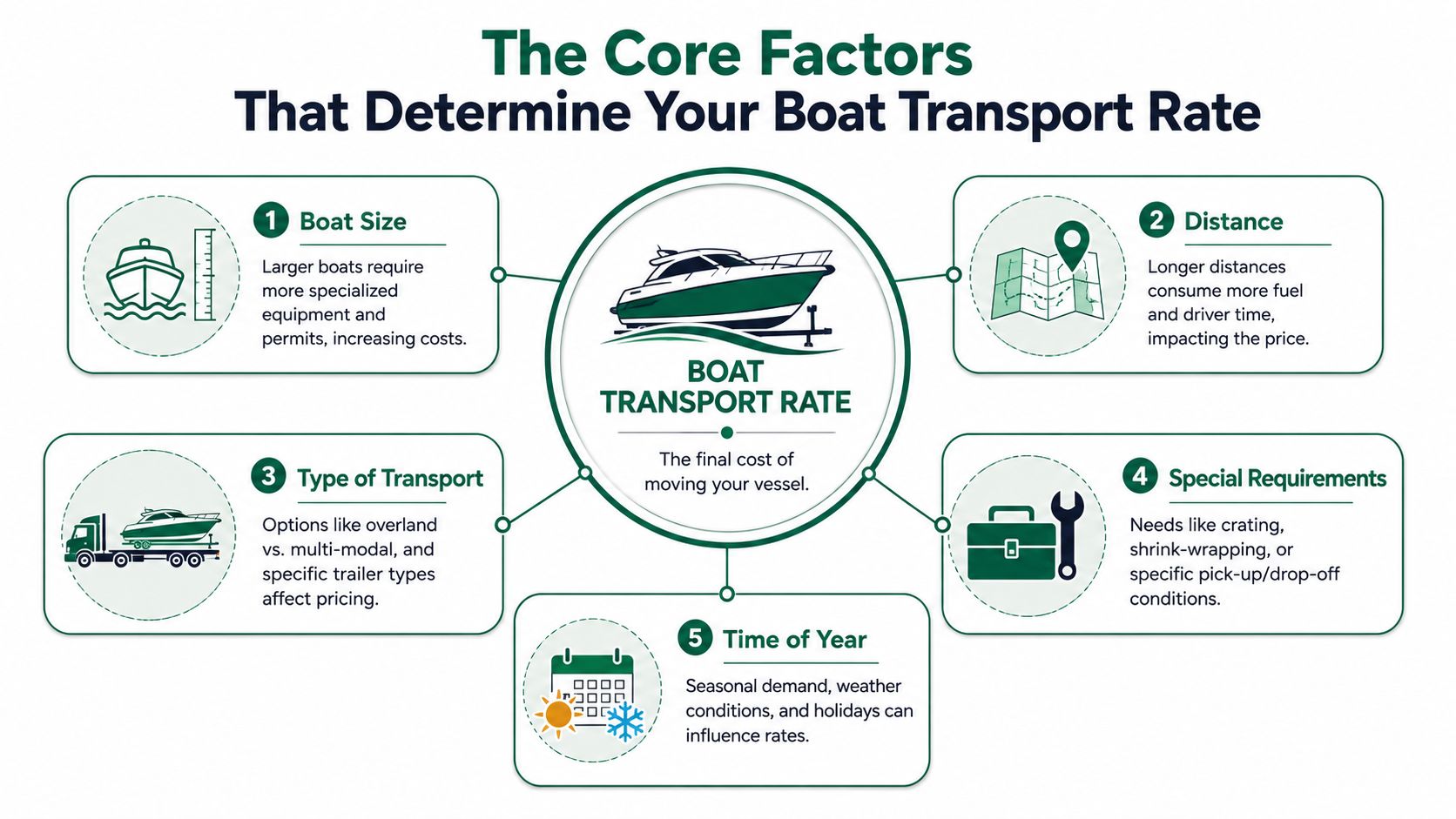
Size changes everything
The first thing a carrier wants is the boat's true dimensions. Not brochure dimensions. Real transport dimensions.
A boat can be short enough to seem simple, but still become expensive because of beam or height. Think of transport like fitting luggage through an airport scanner. Length matters, but width and height often decide whether the item moves through standard handling or gets kicked into a specialty process. Boats work the same way on the road.
Based on 2025 to 2026 boat transport pricing trends, local boat transport usually falls between $1.50 and $4 per mile. That same source notes that short trips can run $3 to $6 per mile, while long-distance moves often fall between $1.50 and $3 per mile because fixed loading and unloading costs are spread across more miles. It also reports that small boats under 25 feet often cost $1.50 to $3 per mile, mid-size boats in the 30 to 40-foot range typically cost $2 to $4 per mile, and oversized boats over 40 feet may cost $3 to $7 per mile or more, with permits and escorts pushing some large yacht moves beyond $10,000 and sometimes to $20,000 or higher.
Distance and route shape the quote
Mileage matters, but route quality matters almost as much.
A clean interstate lane is easier to price than a route with low clearances, marina time restrictions, narrow county roads, or delivery points far from major corridors. A short haul into a difficult pickup location can cost more per mile than a longer interstate run. That catches owners off guard when they compare quotes only by total miles.
Here's what usually affects the route side of the quote:
- Interstate access: Easier highway access usually means simpler dispatch and fewer delays.
- Rural pickup or delivery: Remote areas can limit available equipment and add repositioning time.
- Marina or yard coordination: Some moves require timed access, lift scheduling, or staff coordination.
- Urban delivery constraints: Tight turns, low trees, and neighborhood restrictions can change trailer choice.
A cheap quote on a difficult route usually means somebody missed a detail.
Transport method and timing matter
Some boats travel on their own trailer. Others need a carrier-supplied trailer, cradle support, or a flatbed setup. That choice changes both price and risk management.
Timing also shifts the quote. Peak seasonal demand can reduce carrier availability on popular north-south lanes. Flexible scheduling gives dispatch more room to match the right truck and avoid a rushed booking. The same principle shows up in auto transport across the mainland, whether someone is shipping a family car between Phoenix and Seattle or coordinating enclosed service for a classic car headed from New Jersey to South Florida.
For buyers, dealers, and relocating families, the practical takeaway is simple:
- Measure the load correctly
- Describe access accurately
- Ask how the boat will travel
- Leave room in the schedule when possible
That's how you get a quote that holds up when the carrier arrives.
Typical Boat Transport Costs with Examples
A boat owner in Ohio buying a 19-foot center console in Alabama usually wants one answer first. What should this move cost if the quote is honest?
The useful answer is a range, not a single number. On straightforward domestic moves, smaller boats on shorter routes often price lower than many owners expect. Once the boat gets into the mid-size category, crosses multiple states, or needs carrier-supplied equipment, the spread gets wider fast. Puerto Rico moves widen it even more because the job includes both mainland handling and ocean-side port logistics.
A practical rate table
Use the table below as a planning tool, not a promised tariff. It helps you sort normal quotes from numbers that are too low to be credible.
| Boat Size | Regional Transport (approx. 500 miles) | Cross-Country Transport (approx. 2000 miles) |
|---|---|---|
| Small Boats | $600 to $1,500 | $3,000 to $6,000 |
| Mid-Size Boats | $1,000 to $2,000 | $4,000 to $8,000 |
| Large or Oversized Boats | Custom quote | Can exceed $10,000 and sometimes reach $20,000 or higher |
What these ranges look like in real jobs
A 17-foot fishing boat moving a few hundred miles on its own roadworthy trailer usually lands toward the lower half of the range. That kind of job is relatively simple if pickup and delivery both happen at easy-access homes, marinas, or dealers.
A 26-foot bowrider moving from Texas to Florida is different. The boat may still look manageable at first glance, but overall height on the trailer, loaded weight, and interstate routing can push the rate up quickly. Mid-size boats are often where owners realize the quote is being driven by transport setup, not just hull length.
A 34-foot cruiser is rarely a simple mileage calculation. At that size, beam, height, permits, route restrictions, and loading plans start driving the job. A quote that looks cheap on a large boat often means somebody left out a real operating cost.
Puerto Rico adds another layer. A boat might need overland transport to the port, port handling, ocean freight, and then final delivery on the island or back on the mainland. That is why a boat move between Florida and San Juan should never be compared directly to a domestic highway-only shipment.
Use examples like these to pressure-test a quote. If one carrier is far below the rest, ask what equipment, permits, port handling, or support steps are missing.
The same pricing logic shows up in specialty car shipping. A low quote can look attractive until the equipment, protection level, or scheduling reality catches up. Owners comparing higher-care options can see a similar pattern with enclosed auto transport for premium vehicles. Boats just expose bad assumptions faster because the dimensions and handling requirements leave less room for error.
Beyond the Base Rate Understanding Additional Fees
A base rate only tells part of the story. The final invoice can change when the transport requires more than a standard pickup, linehaul, and delivery.
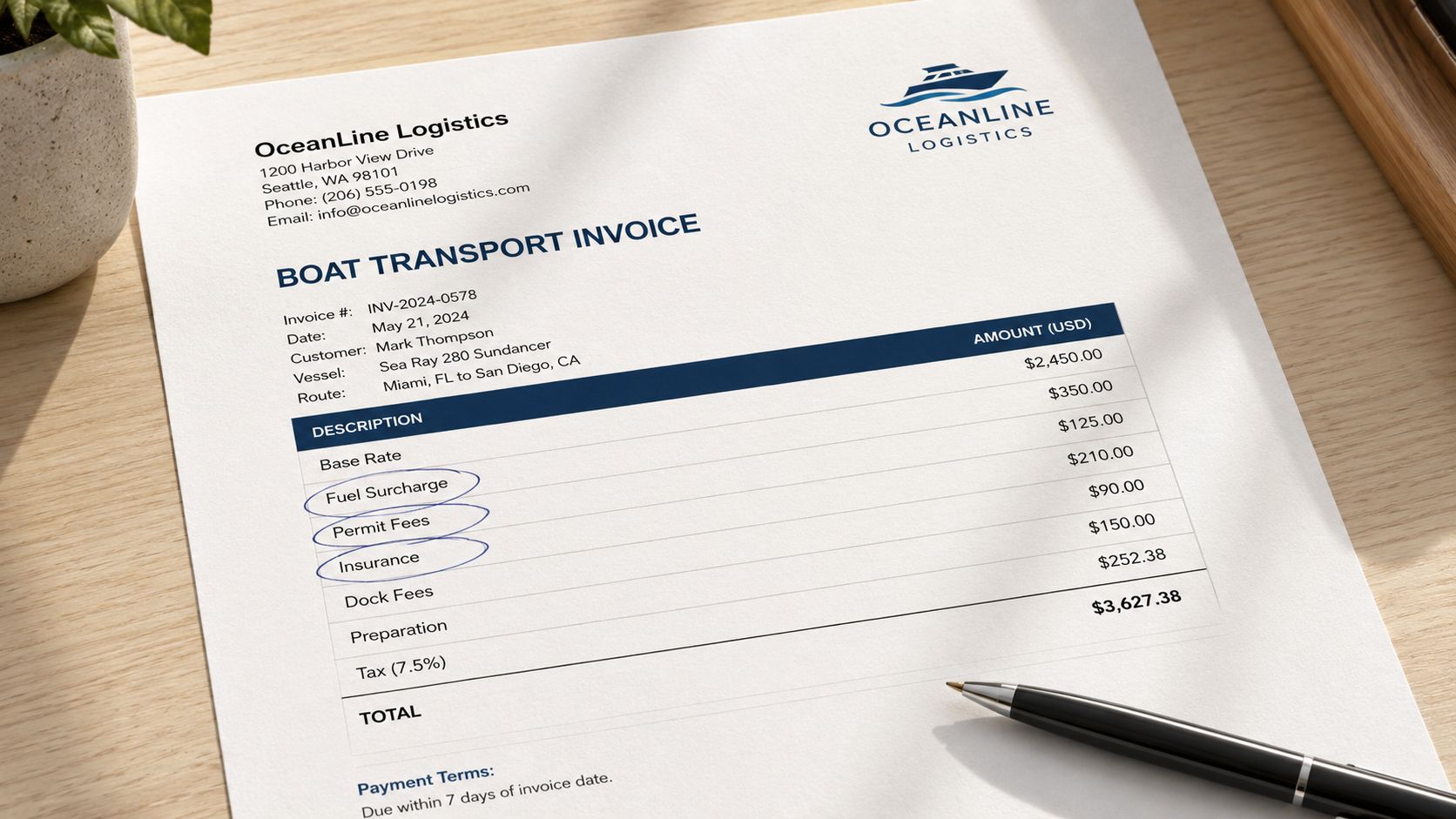
What can show up beyond the linehaul rate
The most common extra charges are tied to complexity, not padding. If a boat needs oversize permits, escort vehicles, custom cradling, shrink-wrapping, or added loading coordination, those items usually reflect a real operational requirement.
Typical add-ons may include:
- Oversize permits: Required when the load exceeds standard legal dimensions on a given route.
- Escort or pilot cars: Sometimes necessary for wider or taller loads.
- Lift or crane coordination: Marinas and yards may charge separately for haul-out or loading help.
- Protective prep: Shrink-wrap, padding, or custom support can make sense on longer or harsher routes.
- Fuel-related adjustments: Some carriers build this in. Others break it out.
If you've dealt with premium vehicle shipping, the logic will feel familiar. Boats that need more protection or stricter handling often fall into a specialty lane, much like enclosed auto transport for higher-value vehicles rather than standard open service.
Why clear quoting matters
The best quote isn't the cheapest one. It's the one that correctly accounts for the move before dispatch.
This video gives a useful visual sense of how transport planning and handling details can affect the final bill.
A clean quoting process usually includes a few essential elements:
- Exact dimensions on the trailer
- Photos of the boat and trailer
- Pickup and delivery access notes
- Disclosure of anything removable or fragile
- A written explanation of what is and isn't included
That last point matters most. Many pricing disputes don't happen because the carrier was dishonest. They happen because the original quote was built on incomplete information. If the dispatcher expected a standard road-ready trailer and finds dry-rotted tires, inoperable lights, or a boat that sits taller than reported, the move has changed.
For consumers shipping cars, trucks, or SUVs across the 48 states or to San Juan, the same lesson applies. Flat-rate pricing only helps when the specs are accurate from the start.
Shipping Your Boat to or from Puerto Rico
Puerto Rico boat shipping is a different category of move. It isn't just a longer domestic haul. It's a multi-modal shipment that combines overland transport with port handling and ocean freight.
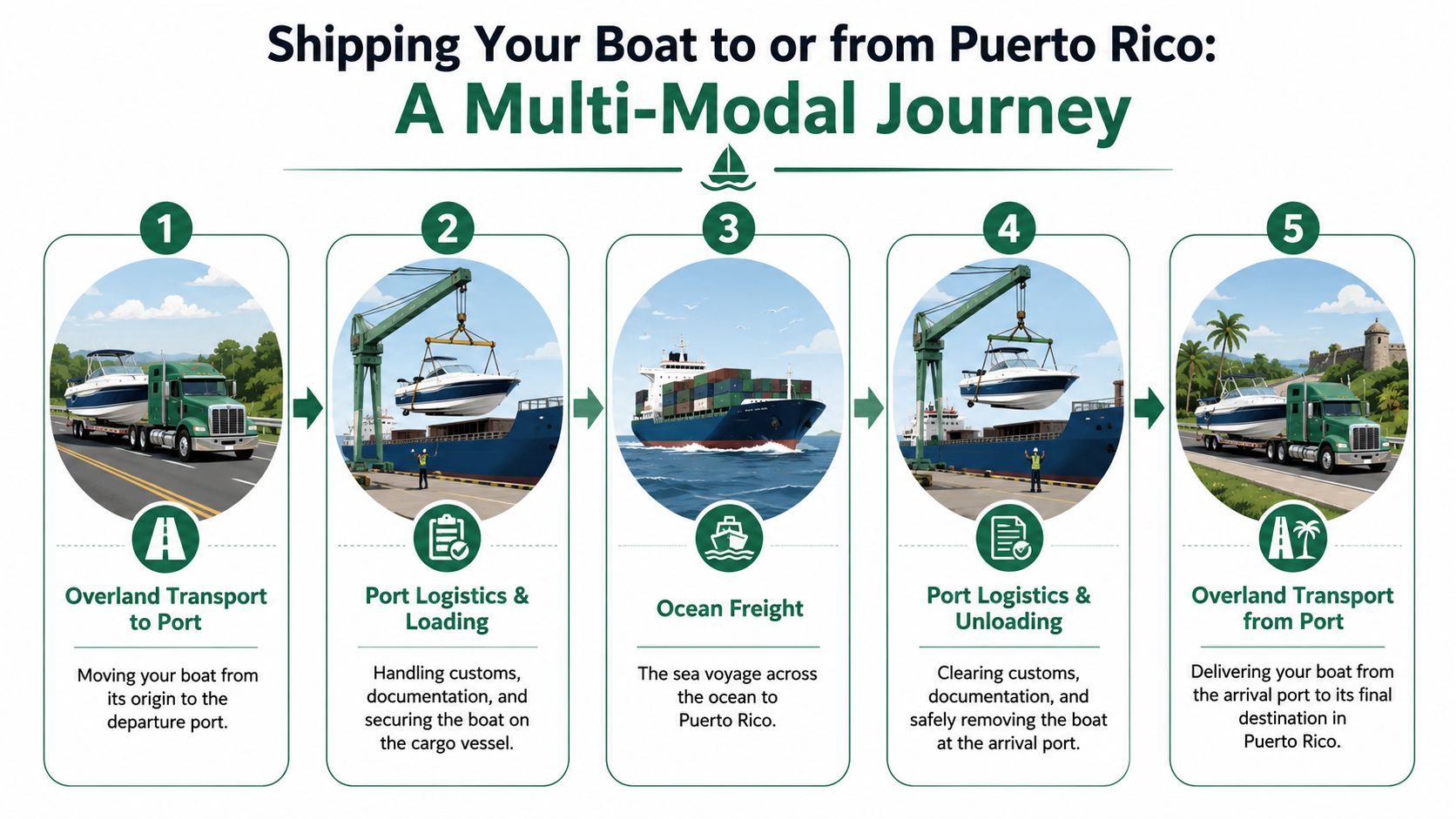
How the Puerto Rico process usually works
For most mainland-to-island moves, the boat first travels by truck to a departure port. After that, it's processed for port handling, loaded for ocean transport, shipped to San Juan, unloaded, and then either released locally or moved onward within Puerto Rico.
That workflow is close to how vehicle shipping works to the island. For example, car shipping from Orlando or Miami to San Juan shows how island pricing differs from mainland transport. That source states that shipping a standard passenger vehicle from Orlando, FL to San Juan, PR covers 1,609 miles, takes 8 to 9 days, and costs $1,649, while Miami, FL to San Juan spans approximately 1,181 miles and takes 9 to 11 days. The point isn't that a boat will match those figures. It won't. The point is that ocean freight and port handling change the economics.
For boats, carriers usually need more detailed planning than they do for passenger vehicles because dimensions, loading method, and securing requirements vary more widely.
Why island moves feel different from mainland hauling
A Puerto Rico move introduces steps that don't exist on a typical overland boat shipment.
You're dealing with documentation, port schedules, loading windows, and local release procedures. If the move includes inland pickup from anywhere in the mainland U.S., the quote also has to connect the domestic trucking leg with the port leg cleanly. That's where experience matters. A missed appointment at the port or a paperwork issue can turn into storage time and rebooking headaches.
Vehicle shipping rules help show the structure. On southbound routes from Jacksonville to Puerto Rico, Totem's Puerto Rico personal vehicle pricing lists $1,210 for standard vehicles under the stated width and height limits and $1,310 for taller vehicles in the next size tier. The same source lists $845 and $945 for northbound returns, and notes mandatory insurance at $25 per $1,000 of declared value for vehicles under 7 years old. Boats don't fit those exact tiers, but the underlying lesson does carry over. Dimensions affect pricing thresholds, and island shipments often include layered fees that mainland customers don't expect.
A second useful parallel is how standard-rate eligibility works. Puerto Rico car transport rate guidance explains that base pricing applies from a mainland port to San Juan and that oversized or overweight units require custom quotes. Boats almost always live in that custom-quote world, especially once beam, height, and cradle needs are involved.
For people already researching vehicles to the island, it helps to compare service structures side by side with Puerto Rico car shipping options. The same logistical principles show up in both categories, even though the equipment and handling requirements differ.
Puerto Rico shipping works best when one coordinator manages the mainland leg, the port process, and the island handoff as a single move.
Who benefits most from guided logistics
This kind of shipment isn't only for yacht owners. Plenty of practical customers need it.
- Snowbirds moving seasonal vehicles and watercraft between the mainland and the island
- Military families handling relocation timelines and documentation
- Students and relocating households sending a car while also arranging specialty items
- Dealerships and marine businesses juggling repeat shipments, schedule sensitivity, and port deadlines
In those cases, bilingual support matters. English and Spanish communication helps with paperwork, local coordination, and reducing avoidable confusion. That's especially true when one shipment involves multiple handoffs and multiple parties.
How to Get an Accurate Quote and Reduce Your Costs
A good quote starts with precision. A better final price starts with timing and preparation.
The easiest way to control boat transport rates is to remove uncertainty before the carrier prices the move. That means giving exact information, not rough estimates, and being flexible where flexibility helps.
What to gather before you request a quote
Before you request pricing, pull together the details that affect dispatch and routing:
- Exact boat dimensions: Length, beam, and full loaded height matter more than owners expect.
- Trailer condition: Say whether the trailer is road-ready, needs service, or won't be used.
- Pickup and delivery facts: Include marina name, storage yard, residential access, gate rules, and any scheduling restrictions.
- Photos: Clear pictures save time and help prevent re-quoting later.
- Destination paperwork needs: Puerto Rico shipments often involve more documentation and planning than mainland moves.
Season and timing matter on island routes too. Puerto Rico shipping timing guidance notes that rates fluctuate seasonally, off-peak seasons can offer lower rates, advance booking may yield discounts, import taxes must be considered, and carriers typically require the vehicle VIN for logistics management. Boats aren't processed the same way as cars, but the planning lesson is the same. Book early, expect seasonal shifts, and have identifying details ready.
Ways to keep your total cost under control
You usually can't change the size of the boat or the geography of the route. You can change how efficiently the move is set up.
A few cost-saving habits work consistently:
- Book ahead when you can. Last-minute moves limit equipment options.
- Stay flexible on pickup dates. A wider window helps dispatch build a better route.
- Prepare the boat properly. Loose gear, avoidable delays, and access problems create billable complications.
- Ask what's included in writing. That's how you catch handling gaps before they become invoice disputes.
- Review protection before the move. Many owners also get a boat insurance quote so they know their policy position ahead of transit.
If you're shipping a vehicle along with the boat, compare service level to need. Standard routes often work well with open car transport for everyday vehicles, while specialty vehicles may need more protection. Keeping those decisions separate helps you avoid overpaying on one asset and underplanning the other.
The cheapest way to move a boat is usually not the lowest quote. It's the quote that avoids rehandling, missed appointments, and preventable add-ons.
Owners who get the best outcomes tend to do the same few things. They measure carefully, disclose everything upfront, give the dispatcher room to work, and make sure the boat is ready on pickup day. That approach saves time, reduces friction, and usually leads to the cleanest invoice.
Need help moving a boat, a car, or both across the mainland or to Puerto Rico? National Car Transport brings 25+ years of experience, an A+ BBB rating, transparent flat-rate pricing, and a network of 25,000+ vetted carriers to complex vehicle logistics across the U.S., including San Juan and routes from major cities nationwide. Our USA-based bilingual agents in English and Spanish have over 20 years of experience just in auto transport logistics service, and that guidance matters because not one vehicle transport is alike. If you want a fair quote, clear communication, and a process that feels simple and quick, National Car Transport is a reliable place to start.