
Boat hauling rates in 2026 run from $600 for short hauls to $15,000 or more for large yachts on cross-country or ocean routes. Short local moves often land around $600 to $900, while bigger boats, longer routes, and specialized handling push pricing much higher.
If you're trying to move a boat, you're probably asking the same questions people ask when they need to ship a car: What will it cost, what affects the quote, and how do you avoid surprises? Those are the right questions.
Boat transport pricing looks simple from the outside, but it rarely is. A trailerable fishing boat moving a few hundred miles is one kind of job. A wide sailboat that needs permits, escorts, port scheduling, and extra prep is something else entirely. The same logic applies in vehicle transport, especially on complicated routes that involve ocean legs to places like San Juan, Puerto Rico, Alaska, and Hawaii.
That overlap matters. The best transport planning always starts with dimensions, route realities, timing, and handling requirements. Whether the cargo is a center console headed across state lines or a sedan moving from the mainland to Puerto Rico, the quote only makes sense when the logistics behind it are clear.
Table of Contents
- Demystifying Boat Hauling Rates in 2026
- The Ultimate Guide to Boat Hauling Cost Factors
- How to Calculate Your Estimated Boat Transport Cost
- Comparing Your Boat Transport Options
- Shipping Your Boat to Puerto Rico Alaska and Hawaii
- Actionable Tips to Save on Your Boat Transport
- Your Boat Shipping Checklist and Final Questions
Demystifying Boat Hauling Rates in 2026
A customer calls after getting three quotes for the same boat. One looks suspiciously low, one feels high, and one sits in the middle with a lot more questions attached. That spread usually comes from scope, not guesswork. Boat hauling rates change fast once the carrier prices the actual work instead of the basic route.
Across the U.S., boat transport can run from a few hundred dollars for a short, simple move to five figures for larger vessels that need special equipment, permits, or port handling. The gap is wide because a 19 foot runabout on an easy trailer-ready pickup is a different job from a 42 foot boat leaving a tight marina or heading to an island destination.
Why quotes vary so much
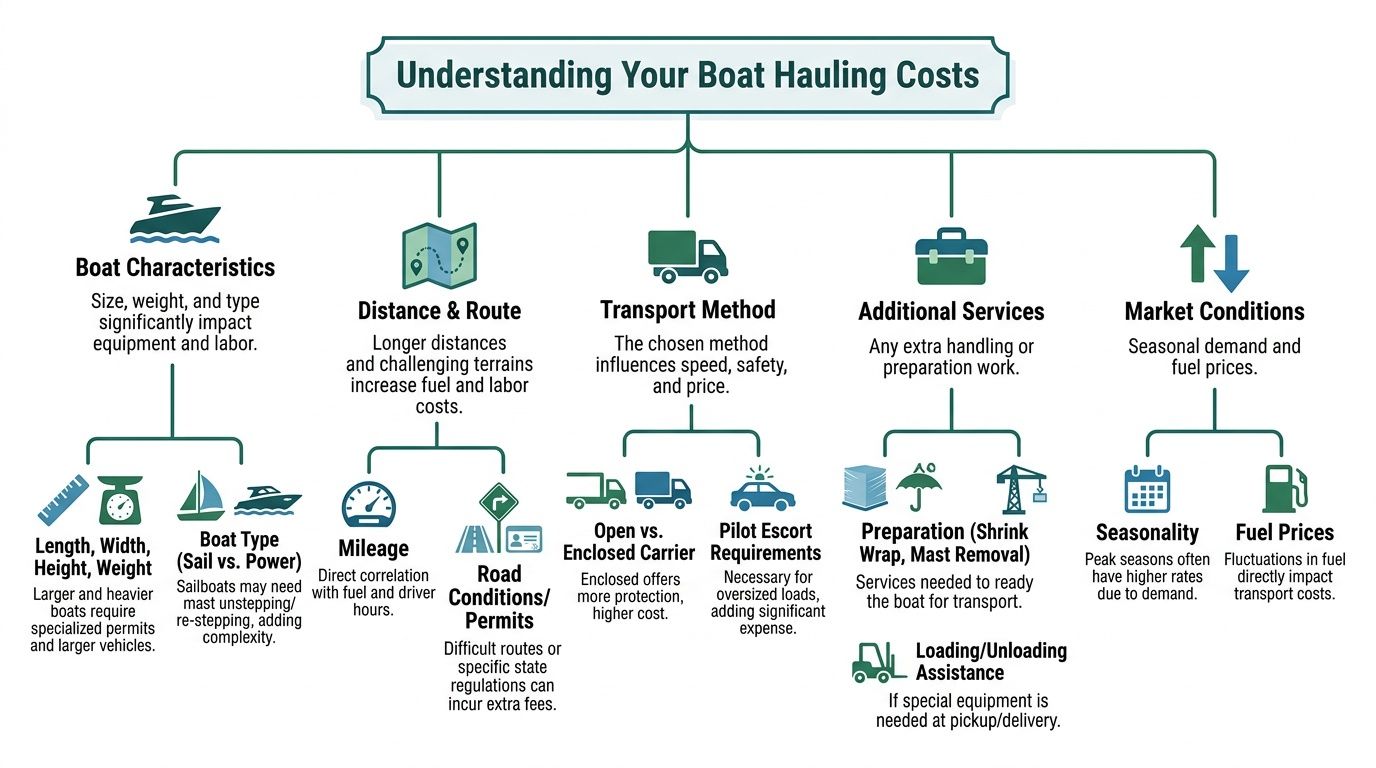
Carriers do not price boats by mileage alone. They price access, loading time, trailer compatibility, height, beam, permit exposure, route restrictions, and delivery conditions. A quote gets more accurate as those details get clearer.
I see the same pattern on vehicle shipments every day at National Car Transport, especially on Puerto Rico moves. A sedan going terminal to terminal is predictable. A lifted truck going from an inland town to San Juan with a narrow pickup location and a port deadline takes more coordination, more checks, and less room for error. Boat hauling works the same way.
That is why the lowest number on your screen often turns into the highest final bill.
A carrier may quote aggressively before confirming whether the boat sits on a roadworthy trailer, whether the hardtop pushes legal height, or whether the marina can load with commercial equipment. Once those answers come in, the price changes. Good pricing starts with good information.
Practical rule: Generic estimates are useful for rough budgeting. Final quotes depend on the details that affect equipment, permits, labor, and access.
Insurance and compliance also affect pricing, especially on heavier commercial routes. For readers who want a clear example of how operators price risk on work trucks, the Coverage Axis dump truck insurance guide is a useful comparison point.
Boat hauling follows the same logic as complex auto shipping
Boat shipping and auto shipping share the same core pricing logic. Clean lanes between major hubs usually book faster and price more consistently. Rural pickups, island routes, port appointments, and oversized units create extra steps that raise the cost.
That is especially true for moves tied to Puerto Rico, Alaska, and Hawaii. Customers often expect one standard process from the mainland. In practice, the route, port schedule, paperwork, and local delivery setup all shape the quote.
The best quote is the one that matches the actual job on day one. That is how expensive surprises get avoided.
The Ultimate Guide to Boat Hauling Cost Factors
A 32 foot boat moving 150 miles can price tougher than a 32 foot boat moving 900 miles. I see that surprise all the time on complex vehicle and vessel lanes. The short run sounds simple until the job still needs the same dispatch work, loading window, securement time, and delivery coordination as a much longer haul.
Per-mile pricing is still the starting point. According to this long-distance boat transport pricing breakdown, projected 2025 to 2026 boat hauling rates often fall in these ranges: $3.00 to $6.00 per mile for trips under 500 miles, $1.50 to $3.00 per mile for moves over 1,000 miles, and $2.00 to $4.00 per mile for many 28 to 40 foot vessels. Those numbers help with budgeting, but the actual quote depends on what the carrier has to do before the wheels turn.
Distance changes the cost structure
Distance affects more than mileage. It changes how fixed operating costs get spread across the job.
On a short haul, the truck still has to arrive, inspect, load, strap, document condition, and unload. That is why the per-mile number climbs fast on local and regional moves. On a long haul, those same fixed steps are spread across more miles, so the rate per mile often comes down even while the total invoice goes up.
That pricing pattern is very familiar in auto transport too, especially on port work and island shipments. A vehicle going to Puerto Rico may have a clean long-haul lane into the port, but the final price still reflects staging, terminal timing, paperwork, and handoff requirements. Boat hauling works the same way.
Size determines how specialized the move becomes
Dimensions change the job faster than distance does.
A boat's length, beam, height, and weight determine whether the carrier can use standard equipment or needs a more specialized setup. Once the load pushes past routine legal limits, the quote can expand to include permit planning, route review, extra labor, and equipment that is harder to schedule.
Height is one of the biggest trouble spots. A hardtop, flybridge, or tall trailer stance can turn an otherwise routine move into a clearance problem. Beam matters too. Wider boats may require permits and stricter routing, which reduces flexibility and raises cost.
Sailboats add their own handling issues. Mast removal, padding, storage, and reload coordination all take labor and time, and each extra touchpoint creates another cost line.
Here are the details that usually move the price first:
- Beam width: Wider loads often require permits and narrower routing options.
- Overall loaded height: Height limits can force detours or different equipment.
- Weight: Heavier boats reduce trailer choices and can change axle requirements.
- Pickup and delivery conditions: Tight marina access, soft ground, and limited loading equipment add labor.
Access, timing, and paperwork are where quotes change
This is the part first-time shippers miss most often. The boat itself may be priced correctly, but the pickup or delivery conditions are not.
A marina with no travel lift, a seller with a non-roadworthy trailer, or a delivery site with tight residential turns can all change the plan. In my experience, these are the same quote-breakers we watch for on difficult auto transport jobs to Alaska, Hawaii, and Puerto Rico. The route is only one piece of the shipment. Access and handoff conditions often decide whether the original number holds.
Fuel, permits, and seasonal demand can also raise the final bill. Peak-season surcharges and access-related extras can meaningfully increase pricing, as noted earlier in the article. That is why accurate dimensions, photos, and loading details matter before booking, not after dispatch.
Insurance review should be part of that check. High-value loads deserve clear cargo coverage, equipment documentation, and liability terms before pickup day. On the commercial trucking side, the Coverage Axis dump truck insurance guide gives a useful reference for how specialty operators structure risk, even though it is not specific to boats.
The quote that wins is the one built around the real load, the real route, and the real pickup conditions.
How to Calculate Your Estimated Boat Transport Cost
A solid estimate starts with one question: is this a short run, a regional move, or a long-distance shipment? Once you know that, you can use per-mile pricing as a rough framework and then pressure-test it against the boat's size and handling needs.
This boat and yacht shipping statistics page for 2026 notes that short hauls average $1.25 to $2.00 per mile, while long-distance shipments fall between $0.50 and $0.85 per mile. It also shows how sharply price changes by scenario: a 30 to 36 foot boat transported over 1,000 miles costs $1.90 per mile, but under 100 miles it costs $12.00 per mile.
A simple estimating framework
Use this sequence:
- Measure the boat accurately. Get overall length, width, height, and weight.
- Classify the distance. Local and short-haul pricing behaves very differently from longer routes.
- Pick the likely transport mode. Standard road haul, specialized oversized haul, or ocean freight.
- Add route complexity. Marinas, ports, permit states, and restricted access all matter.
- Treat the result as a ballpark. A real quote should account for operational details.
If you're estimating a 32-foot boat going about 1,500 miles, don't use a local short-hop rate. Use the pricing logic for a longer lane and then consider whether the dimensions push it into a more specialized category.
Sample boat hauling rates per mile
| Boat Size (Length) | Cost Per Mile (< 500 miles) | Cost Per Mile (500-1500 miles) | Cost Per Mile (1500+ miles) |
|---|---|---|---|
| Under 12 feet | Higher than long-haul pricing, often steep on very short moves | Moderates as distance increases | Long-haul pricing can approach the lower end of market ranges |
| 20 to 30 feet | Often aligns with short-haul market premiums | Typically settles into mid-range per-mile pricing | Often benefits from better long-haul efficiency |
| 30 to 36 feet | Up to $12.00 per mile under 100 miles | Depends on route and access | Around $1.90 per mile over 1,000 miles |
| 28 to 40 feet | Often fits the benchmark $2.00 to $4.00 per mile range depending on job details | Same benchmark often applies | Same benchmark often applies on many lanes |
The point of the table isn't false precision. It's to show that boat hauling rates are highly sensitive to both size and trip length.
If your estimate seems too low, check whether you used the right distance band. That's the mistake people make most often.
For customers used to auto transport, this should sound familiar. A sedan running between major mainland cities is often easier to price than a vehicle moving from Denver, Orlando, Boston, San Diego, Nashville, Charlotte, or Minneapolis to San Juan, Puerto Rico because the ocean segment changes the workflow. Boats behave the same way. Once port handling or oversize planning enters the job, a rough calculator stops being enough.
Comparing Your Boat Transport Options
The right transport method depends on what you're moving, how fast you need it, and how much risk you're willing to manage yourself. This isn't just a cost decision. It's a control decision.
DIY towing versus hiring a hauler
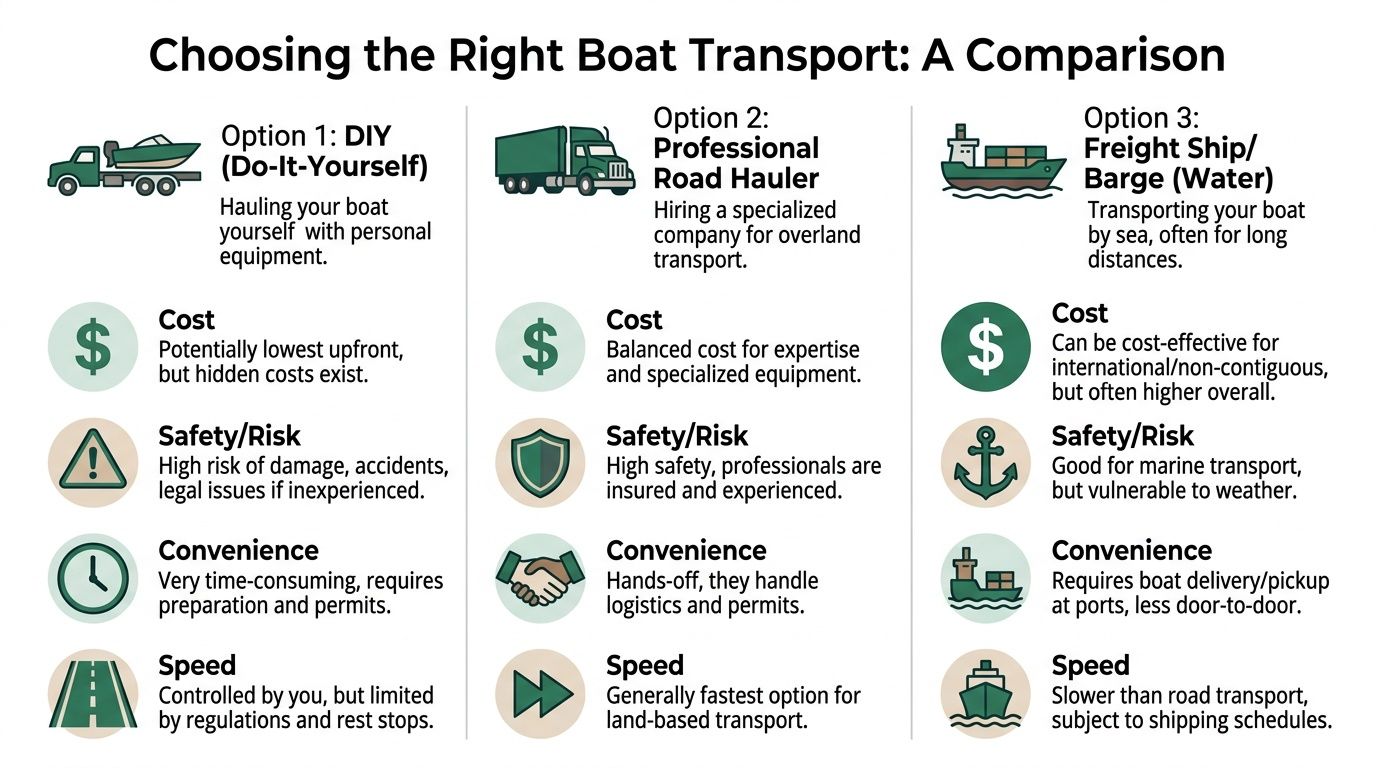
Some owners can tow their own boat safely. Some shouldn't. The difference usually comes down to equipment, route knowledge, comfort with trailer handling, and whether the load stays within manageable dimensions.
DIY can work when the boat is small, the trailer is road-ready, and the route is uncomplicated. It tends to go wrong when people underestimate braking distance, clearance, tie-down requirements, marina loading issues, or state permit rules.
If you're considering towing it yourself, this expert how-to for boat owners is worth reading because it covers practical trailering basics that many first-timers miss.
A quick comparison helps:
| Option | Best fit | Main upside | Main downside |
|---|---|---|---|
| DIY towing | Small, manageable boats and experienced owners | Direct control | More responsibility and higher risk of mistakes |
| Professional road hauler | Most overland moves | Equipment, permits, and logistics handled for you | Higher upfront cost than doing it yourself |
| Freight ship or barge | Island, non-contiguous, or specialty water routes | Necessary for some destinations | Port coordination and schedule dependency |
Road transport versus ocean shipping
Road hauling is usually the practical choice for mainland moves. It's faster to schedule, easier to track operationally, and often more flexible on pickup and delivery windows.
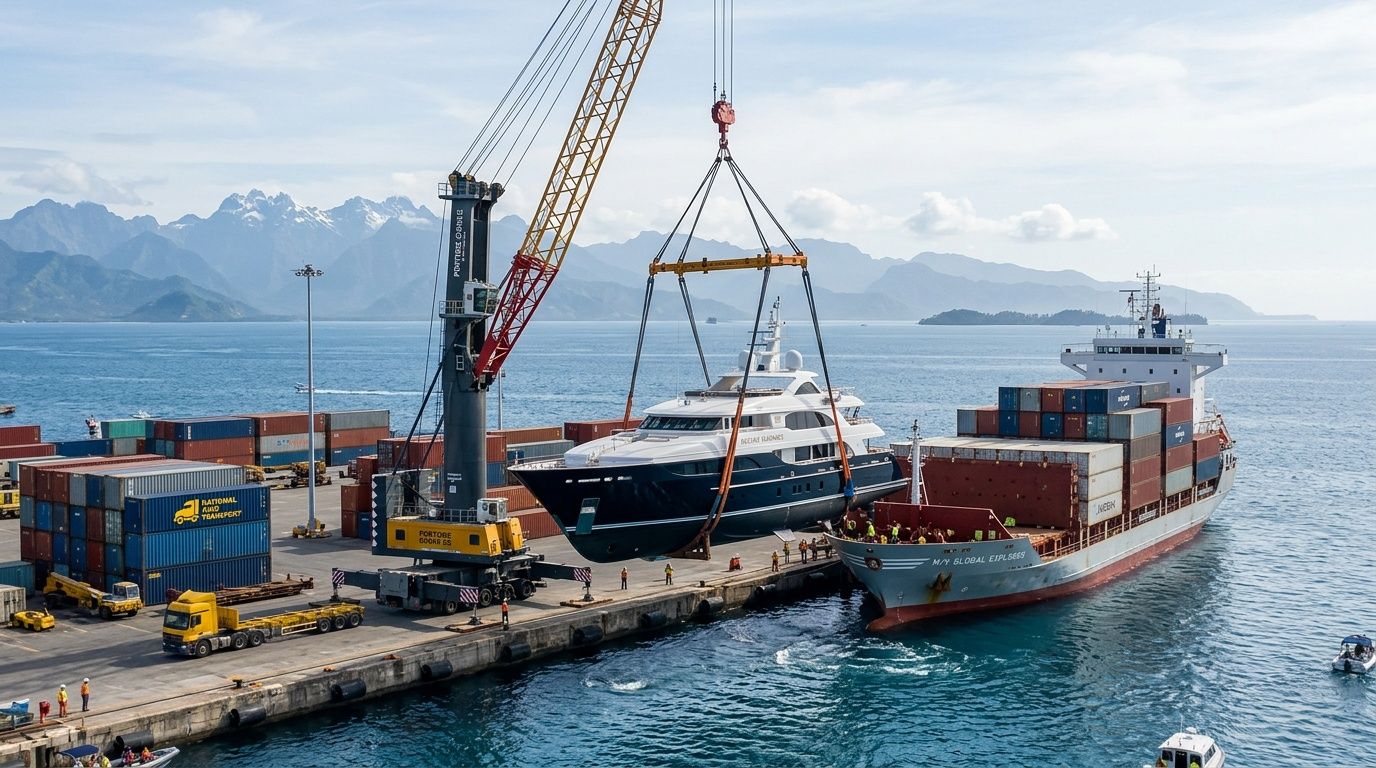
Ocean shipping enters the picture when geography leaves no alternative, especially for Puerto Rico, Alaska, Hawaii, and some international movements. It works, but it changes everything. Now the shipment depends on port cutoffs, vessel schedules, terminal procedures, and handoff timing.
Professional hauling isn't just truck capacity. It's paperwork, routing, timing, and knowing when a simple-looking shipment isn't simple.
For vehicle owners, that distinction is familiar. Mainland car transport across the 48 states often stays door-to-door. A route involving San Juan usually becomes a coordinated chain of inland pickup, port processing, ocean movement, and final release.
Shipping Your Boat to Puerto Rico Alaska and Hawaii
Non-contiguous routes are where transport experience shows. The move stops being a straight line and becomes a sequence of handoffs. That's true for cars and it's even more obvious with boats.
Why island and non-contiguous routes are different
A mainland road shipment usually revolves around pickup, transit, and delivery. Puerto Rico, Alaska, and Hawaii add terminal rules, ocean schedules, and documentation checks. For boats, those demands can include yard coordination, staging windows, and port-side loading requirements.
Auto transport offers a useful comparison. According to this Puerto Rico car shipping pricing reference, shipping a standard sedan from Miami, FL to San Juan, Puerto Rico costs between $1,879 and $2,179, with transit time of 9 to 11 days, and TOTE Maritime explicitly charges $1,210 for a standard vehicle from Jacksonville to Puerto Rico, including all surcharges.
Those figures are for cars, not boats, but they show how island shipping is priced differently from ordinary domestic transport. The ocean segment creates a port-to-port structure, and that structure affects planning long before cargo reaches the dock.
For customers moving vehicles from mainland cities such as Miami, Orlando, Tampa, Atlanta, Charlotte, Washington, Philadelphia, Newark, Houston, Dallas, Austin, Los Angeles, San Diego, Sacramento, Las Vegas, Phoenix, Albuquerque, Denver, Salt Lake City, Chicago, Detroit, Cleveland, Indianapolis, Nashville, Louisville, St. Louis, Kansas City, Minneapolis, Omaha, Seattle, Portland, or San Francisco to San Juan, the same rule applies. The route is not one carrier, one road, and one handoff.
What customers often miss on Puerto Rico shipments
People usually focus on the ocean leg and forget the prep. That's backwards. Most problems start before the port.
For boats, common trouble spots include incomplete measurements, loose gear left onboard, marina access limits, and assumptions about delivery timing after arrival. For vehicles, similar issues show up in title paperwork, release requirements, and terminal instructions.
A strong coordinator helps because the shipment has moving parts on both the mainland and island side. That's especially valuable for military families on orders, students relocating for school, snowbirds, dealerships moving inventory, and businesses handling repeat shipments. It also helps when the support team is bilingual. English and Spanish communication can make port and customer coordination much cleaner.
A short visual walkthrough helps if you're planning a port-based move:
The same lesson applies across Alaska and Hawaii. The route isn't harder because it's mysterious. It's harder because it has more checkpoints.
Actionable Tips to Save on Your Boat Transport
Saving money on boat hauling rates isn't about squeezing the carrier. It's about making the shipment easier to execute. Carriers price risk, delay, and complexity. Remove some of that, and you usually get a better quote.
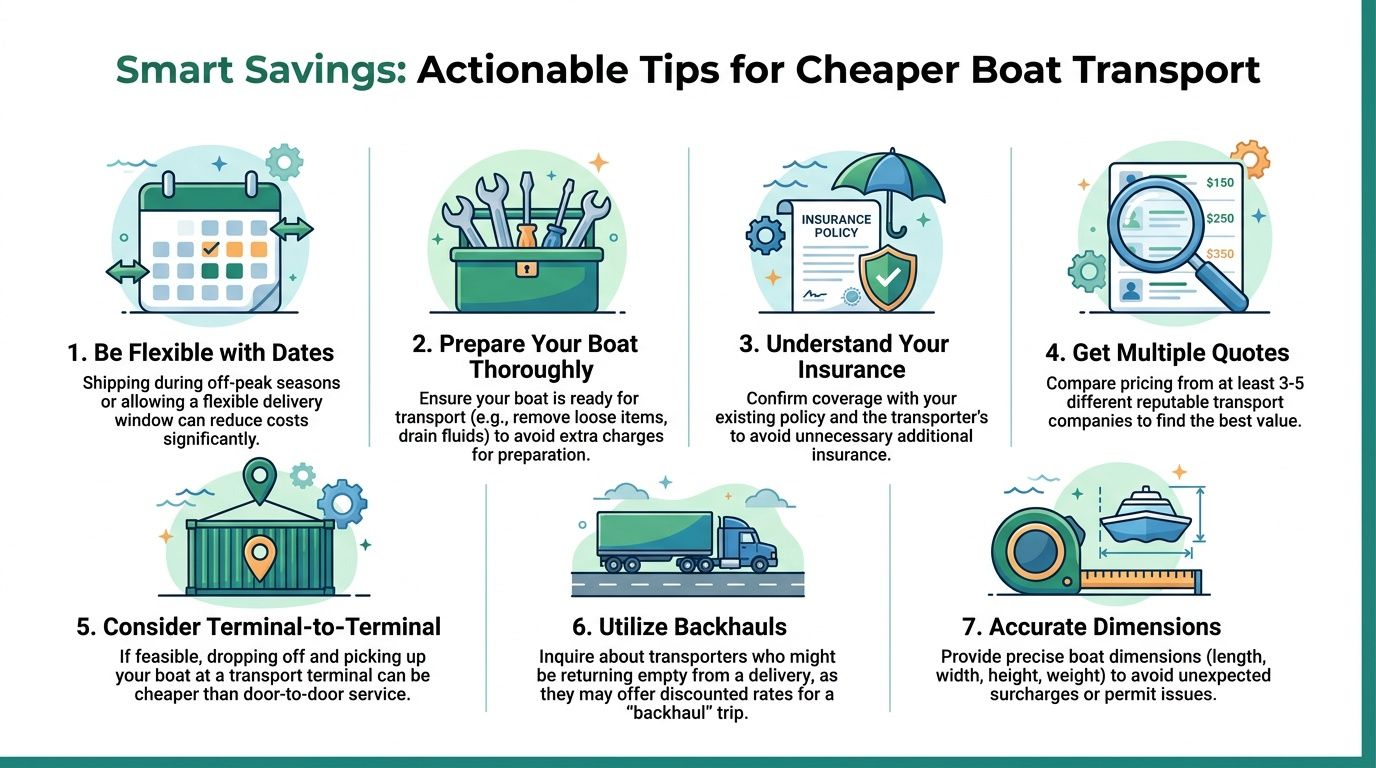
Savings that usually work
- Be flexible with dates: If your pickup and delivery windows have some room, dispatch can often match your job to a better schedule.
- Provide exact dimensions: Wrong measurements create bad quotes. Accurate length, width, height, and weight help from the start.
- Prepare the boat early: Remove loose gear, reduce preventable delays, and make sure the boat is ready when the truck arrives.
- Ask about terminal options: In some situations, dropping at a workable location instead of forcing a difficult access point can lower the hassle factor.
- Review insurance before booking: Clear expectations prevent last-minute add-ons and confusion.
What usually backfires
The cheapest quote can become the expensive one if key details were omitted. That's common when someone books based on a rough online form without discussing beam, trailer condition, marina constraints, or permit exposure.
Trying to rush the shipment can also raise cost. Carriers can handle tight timelines, but flexibility often gives dispatch more room to place the load efficiently.
Cheap pricing isn't the same as controlled pricing. The best savings come from reducing friction before pickup day.
This logic carries over to car shipping. A smooth mainland route from one major city to another is one thing. A move involving Puerto Rico adds enough operational detail that flat-rate clarity matters more than chasing the lowest initial number.
Your Boat Shipping Checklist and Final Questions
The easiest way to avoid problems is to get organized before the first quote request. Most shipping delays trace back to missing information, incomplete prep, or unrealistic assumptions about access and timing.
Checklist before you book
Use this list before you commit:
- Measure the full boat setup: Include anything that affects transport height or width.
- Photograph the boat clearly: Good pre-shipment photos help document condition.
- Secure or remove loose items: Electronics, canvas, and removable gear should be addressed early.
- Confirm pickup and delivery access: Don't assume a large commercial rig can enter every marina or neighborhood.
- Ask what prep is required: Mast work, shrink wrap, draining, and battery procedures should be clarified upfront.
- Review loading basics if you're using a trailer: This Van Dyke Outdoors' loading guide is a helpful practical reference for trailer handling and loading awareness.
Final questions people ask
What documents do I need?
That depends on the route and transport method. Mainland overland jobs are usually simpler than port-based or island shipments. Ask for a document checklist before booking.
Should I leave gear inside the boat?
Only if the carrier allows it and the items are secured properly. In many cases, less is better.
How should I prepare my boat for shipping?
Think in terms of transport readiness, not marina readiness. The boat needs to be safe to load, legal to move, and accurately described.
Does the same planning logic apply to car shipping?
Yes. It's especially true for moves to and from Puerto Rico from anywhere in the U.S. mainland. Customers moving vehicles between major cities across the 48 states and San Juan do best when they work with an experienced agent instead of relying on assumptions.
For people shipping vehicles rather than boats, that guidance matters even more because not one vehicle transport is alike. A knowledgeable coordinator can make the process simple and quick, especially for snowbirds, military families, students, dealerships, and businesses. Having bilingual English and Spanish agents based in the USA, with deep experience focused just on auto transport logistics, makes complicated routes much easier to manage.
If you need help shipping a car anywhere in the U.S. mainland or coordinating vehicle transport to or from Puerto Rico, National Car Transport is a reliable option with 25+ years of experience, an A+ BBB rating, transparent flat-rate pricing, and a network of 25,000+ vetted carriers. Their U.S.-based bilingual agents in English and Spanish have over 20 years of experience in auto transport logistics, and that kind of guidance matters because no two shipments are exactly alike.