

Door-to-door open transport is typically the best way to ship a standard car across the country, averaging about $1,150 for 1,000 miles. Island routes are different, because vehicles must connect with ocean freight before reaching Puerto Rico, Hawaii, or other noncontiguous destinations.
But is the cheapest quote really the lowest-cost option once you count fuel, hotels, meals, depreciation, tire wear, and the time required to drive coast to coast? That question matters to relocating families, snowbirds, military members, students, dealerships, and businesses moving vehicles between the mainland and Puerto Rico.
The right method depends on your route, vehicle, schedule, and tolerance for exposure. A standard sedan moving between major mainland cities usually belongs on an open carrier. A classic car may justify an enclosed trailer. A Puerto Rico shipment needs coordinated inland trucking, port handling, documentation, and ocean transport. The practical goal isn't to choose a service that sounds premium. It's to match protection and convenience to the actual move.
Table of Contents
- Understanding the Best Way to Ship a Car Across Country
- Comparing Open versus Enclosed Auto Transport
- Navigating Puerto Rico Vehicle Shipping Routes
- The Step-by-Step Car Shipping Process from Booking to Delivery
- Why Professional Agents Matter for Cross-Country Moves
- Real-World Scenarios for Specific Vehicle Types
Understanding the Best Way to Ship a Car Across Country
Which shipping method fits your vehicle, route, and schedule without paying for protection or service you do not need? For a standard car, door-to-door open transport is usually the practical starting point. Open carriers handle about 85% to 90% of U.S. vehicle shipments and typically load 7 to 10 vehicles per trailer, spreading equipment and operating costs across several customers. That capacity suits daily drivers, family SUVs, student cars, and dealership inventory. The industry transport data on open-carrier capacity documents this operating model.
Door-to-door service means transport between locations near your requested addresses, not a guaranteed stop in front of your home. Large car haulers need space to turn, avoid low branches, and comply with local restrictions. If your street is too narrow or difficult to access, the carrier will normally use the nearest safe parking lot, commercial area, or wide road for pickup or delivery, as explained in this guide to door-to-door auto transport access.
Build the decision around four variables
- Route density: Major corridors linking New York, Atlanta, Dallas, Denver, Los Angeles, Seattle, Chicago, Miami, and Phoenix give carriers more chances to combine loads. Rural endpoints may require a flexible meeting location.
- Vehicle requirements: A running daily driver generally fits open transport. A restored, high-value, or unusually delicate vehicle may justify enclosed protection.
- Schedule: A flexible pickup window gives the dispatcher more options to match your car with a truck already serving the route. A fixed date can require a different carrier or service level.
- Destination type: Mainland moves rely on highway transport. Puerto Rico moves add inland trucking, port handling, documentation, and ocean freight, so the plan must cover both land and sea legs.
Puerto Rico routes deserve separate cost planning, especially for snowbirds, military relocations, and families moving between the mainland and the island. Electric vehicles also require advance confirmation of loading procedures, battery condition, and carrier acceptance, rather than an assumption that every truck handles them identically.
Price depends on more than mileage. The 2026 U.S. average is around $1,100 to $1,200 per shipment, while Forbes Advisor reports about $1.15 per mile and $1,150 total in its market summary. KBB lists approximately $751 for 500 miles, $1,020 for 1,000 miles, and $1,406 for 2,500 miles, showing how fixed logistics costs become less significant on longer routes. Review the Forbes Advisor auto shipping cost data when comparing those figures.
A coast-to-coast move can cost more overall while costing less per mile than a shorter shipment. Compare the service type, carrier credentials, pickup conditions, insurance terms, delivery assumptions, and whether the quote covers the full route.
Comparing Open versus Enclosed Auto Transport
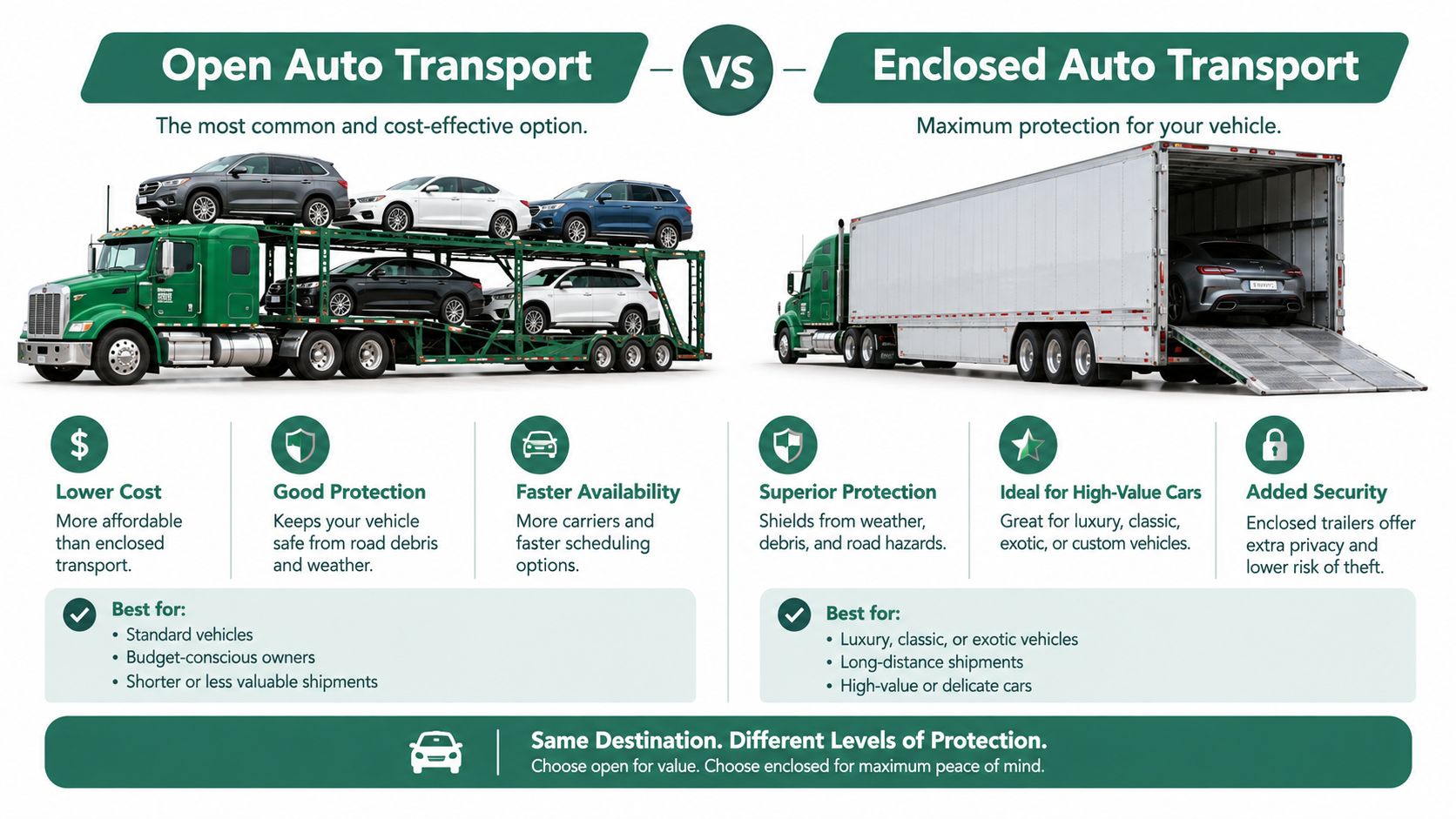
Which trailer type fits the vehicle, route, and risk you are willing to accept? Open transport prioritizes capacity and value, while enclosed transport prioritizes protection from weather and road debris. The right choice depends on the car, not a blanket rule.
| Transport method | Practical advantages | Trade-offs | Best fit |
|---|---|---|---|
| Open carrier | Higher capacity, broad availability, lower operating cost | Vehicle is exposed to normal road weather and debris | Daily drivers, family vehicles, student cars, standard SUVs |
| Enclosed carrier | Covered loading area and greater environmental protection | Fewer vehicles per trailer and higher pricing | Classic, collectible, luxury, restored, or unusually valuable cars |
Open carriers move several vehicles on one trailer, which keeps operating costs down and supports wider route coverage. That makes open service the practical default for daily drivers, family vehicles, student cars, and standard SUVs. A sedan or working SUV moving to a new home usually does not need the added expense of a covered trailer.
Review the provider's open car transport service when comparing loading arrangements and trailer availability. Open transport still exposes the vehicle to ordinary highway weather, dust, and road debris, so inspect the car before loading and document its condition.
Enclosed transport changes the risk calculation for vehicles with high replacement value or finishes that are difficult to repair. A restored classic with fresh paint, a luxury vehicle with delicate surfaces, or a collector car that rarely travels on public roads may justify the higher charge. Enclosed transport generally costs 40% to 60% more than open transport, according to transport guidance comparing carrier types and capacity. It also offers less trailer capacity, which can reduce availability on some routes.
Practical rule: Use open transport for a normal daily driver. Choose enclosed transport when protection matters more than minimizing the shipping bill.
Before booking, confirm whether the vehicle runs, rolls, steers, and brakes normally. Non-operational vehicles need different equipment, and the carrier must know before accepting the load. Ask about loading instructions, lift-gate needs, insurance coverage, cancellation terms, pickup expectations, and delivery documentation.
The lowest quote may create a delayed pickup if it does not attract a carrier. An unnecessarily expensive service can also consume budget without addressing a real risk. Match the trailer to the vehicle's condition and value, then compare providers on service terms rather than price alone.
Navigating Puerto Rico Vehicle Shipping Routes
Puerto Rico shipping isn't just a longer mainland route. Your vehicle travels by truck to a port, enters an ocean freight process, and then continues through destination-side handling and delivery. The cleanest plan separates the move into those legs instead of treating the shipment as one ordinary door-to-door trip.
Two primary mainland port destinations serve many Puerto Rico vehicle moves. Jacksonville, Florida, is commonly used for southern and southeastern connections, while Eddystone, Pennsylvania, supports routes serving New York, New Jersey, and much of the Northeast, according to Crowley's Puerto Rico vehicle shipping guidance.
Choose the right handoff points
A mainland customer may select door-to-port service, where a truck collects the vehicle and delivers it to the designated port. A customer returning from Puerto Rico may use port-to-door, with the vehicle released at the mainland port and transported onward by truck. Door-to-door coordination can still be arranged, but the ocean segment means the carrier can't drive directly from a mainland address to a Puerto Rico address.
The most useful questions to ask before booking are:
- Which port will handle this origin and destination?
- Who coordinates the inland truck leg?
- What documents must be provided before port acceptance?
- Where does the vehicle inspection occur?
- Who handles destination release and final delivery?
- What happens if the vehicle arrives before the receiving party is ready?
Documentation should be prepared early. Expect to discuss the vehicle title or registration, identification, proof of insurance, authorization for anyone acting on the owner's behalf, and any port or customs paperwork required for the specific shipment. Requirements can vary by route and ownership situation, so the agent should give you a written checklist rather than relying on informal advice.
San Juan is the principal customer-facing destination for many Puerto Rico moves, but the booking should still identify the exact port process and final delivery location. A neighborhood in San Juan may be accessible to a local delivery vehicle even when a large mainland hauler cannot reach the address. The final handoff may therefore happen at a safe nearby location.
Island moves reward preparation. Confirm the port, paperwork, vehicle condition, and final delivery plan before the car reaches the terminal.
Puerto Rico pricing is route-specific. A mainland quote for a conventional cross-country move should not be used as a Puerto Rico estimate because port handling and ocean freight introduce separate logistics. Ask for a written total that distinguishes inland transport, ocean movement, terminal charges, delivery, and any optional service.
For bilingual households, military families, snowbirds, and Puerto Rico dealerships, communication is part of the logistics. National Car Transport's Puerto Rico vehicle shipping service is one example of a provider coordinating mainland and island transport. A bilingual English and Spanish agent based in the United States can reduce confusion when documents, pickup instructions, and destination contacts involve multiple parties.
The Step-by-Step Car Shipping Process from Booking to Delivery
A smooth shipment follows a predictable sequence. Problems usually start when the customer books on price alone, leaves the vehicle condition undocumented, or assumes a large truck can reach any address.
Request a route-specific quote. Provide the origin, destination, vehicle year and model, operating condition, preferred transport type, and pickup window. For Puerto Rico, identify whether the move is mainland to island or island to mainland and ask which port will be used.
Review the terms before approving the order. Check the quoted service, payment timing, cancellation terms, insurance information, pickup expectations, and delivery conditions. A quote should make clear whether the price covers one continuous service or separate land and ocean legs.
Match the vehicle with a carrier. A broker or transport coordinator searches for a carrier whose equipment and route fit the order. Confirm the carrier's DOT and motor carrier numbers before booking, a credential check recommended in Consumer Reports' auto transport advice. The carrier should also confirm whether the vehicle is operational.
Prepare the car and complete the pickup inspection. Remove personal belongings, disable alarms, secure loose accessories, and leave only the fuel needed for loading and unloading. Wash the exterior if possible, photograph every side, record existing scratches or dents, and make sure the driver includes them on the bill of lading.
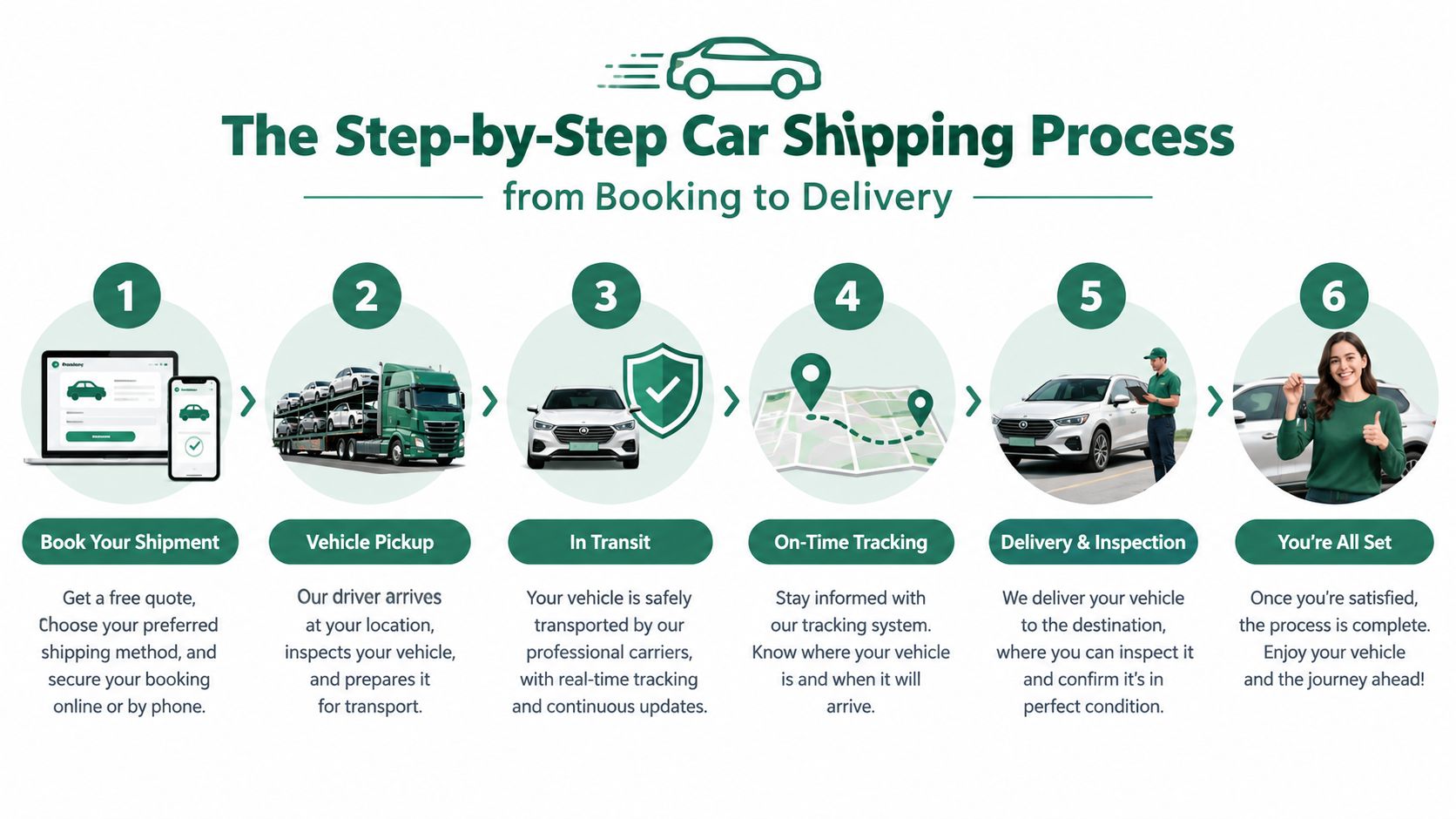
Track communication during transit. Long-distance transport doesn't always provide a live map, but a good coordinator should keep you informed about pickup completion, route progress, delays, and the delivery appointment. Weather, traffic, port schedules, and equipment issues can change timing, so maintain reachable phone access.
Inspect before accepting delivery. Compare the vehicle with the pickup condition report in daylight or strong lighting. Check the body, glass, wheels, roof, and accessible lower panels. If you identify new damage, photograph it immediately and record it on the delivery bill of lading before signing.
The damage rate is low but not zero. Industry guidance places the share of shipped vehicles sustaining damage at below 5%, while enclosed transport can reduce exposure by about 60% compared with open transport, according to uShip's carrier considerations and inspection guidance. The paperwork matters because the condition report is the primary evidence used if a claim becomes necessary.
The process also changes for a non-operational vehicle. Tell the coordinator if the car can't start, roll, steer, or brake. The carrier may need a winch or specialized loading equipment, and hiding that condition can cause a failed pickup or a revised charge.
Here is a visual walkthrough of the workflow:
Why Professional Agents Matter for Cross-Country Moves
You can contact carriers yourself, but the work doesn't end when someone answers the phone. You still need to compare equipment, verify credentials, coordinate pickup access, handle condition reports, follow the route, and solve problems if the original truck becomes unavailable.
A professional agent acts as the coordination point between the customer and the carrier. That matters most when a move involves a rural address, a tight relocation schedule, a non-running vehicle, an island port, or several vehicles moving together. The agent can also explain which part of the quoted service is highway transport and which part involves terminal or ocean logistics.
What an experienced advisor handles
- Carrier verification: Confirm the carrier's registration, operating authority, and insurance information before the vehicle is assigned.
- Route planning: Identify practical pickup and delivery locations when a large hauler can't safely access a residential street.
- Document control: Keep the order details, condition report, contact information, and special instructions aligned.
- Exception management: Respond when weather, traffic, port operations, or equipment changes affect the original plan.
- Customer communication: Give the owner one dependable contact instead of forcing them to chase several parties.
National Car Transport® is a U.S.-based auto shipping company offering door-to-door vehicle transport across all 50 states, Puerto Rico, Alaska, and Hawaii. Its stated service profile includes 25+ years of experience, an A+ BBB rating, transparent flat-rate pricing, and no upfront charge until a vehicle is matched with a carrier, as described on the National Car Transport company page.
That model can be useful for individuals, snowbirds, military families, students, dealerships, auction buyers, and businesses that need more than a one-time phone number. A nationwide network is particularly relevant when the move starts in one state, uses a port in another, and ends with local delivery in Puerto Rico.
Bilingual support also has practical value. National Car Transport has bilingual English and Spanish agents based in the United States, with agents bringing more than 20 years of auto transport logistics experience. Not one vehicle transport is alike, and an agent who can explain each step clearly can make the process simpler and faster, especially when the owner, driver, dealership, and receiving contact are not in the same place.
A reliable coordinator doesn't remove every variable. The coordinator makes each variable visible early enough to manage.
Ask any provider who will be your point of contact, how updates are delivered, what happens if pickup access changes, and whether the final price can change after booking. Clear answers are more useful than a polished sales pitch.
Real-World Scenarios for Specific Vehicle Types
A daily driver, a restored classic, an electric vehicle, and a large work truck may all travel between the same cities, but they shouldn't receive the same booking instructions.
Consider an EV moving from the mainland to Puerto Rico. The coordinator needs the exact model, operating condition, battery status, loading requirements, and port plan. The vehicle may need to be moved through more than one handoff, so the owner should provide charging equipment only when requested and follow the carrier's instructions for safely securing the car. Electric vehicles can also be heavier than comparable gasoline vehicles, making accurate vehicle details important for equipment planning.
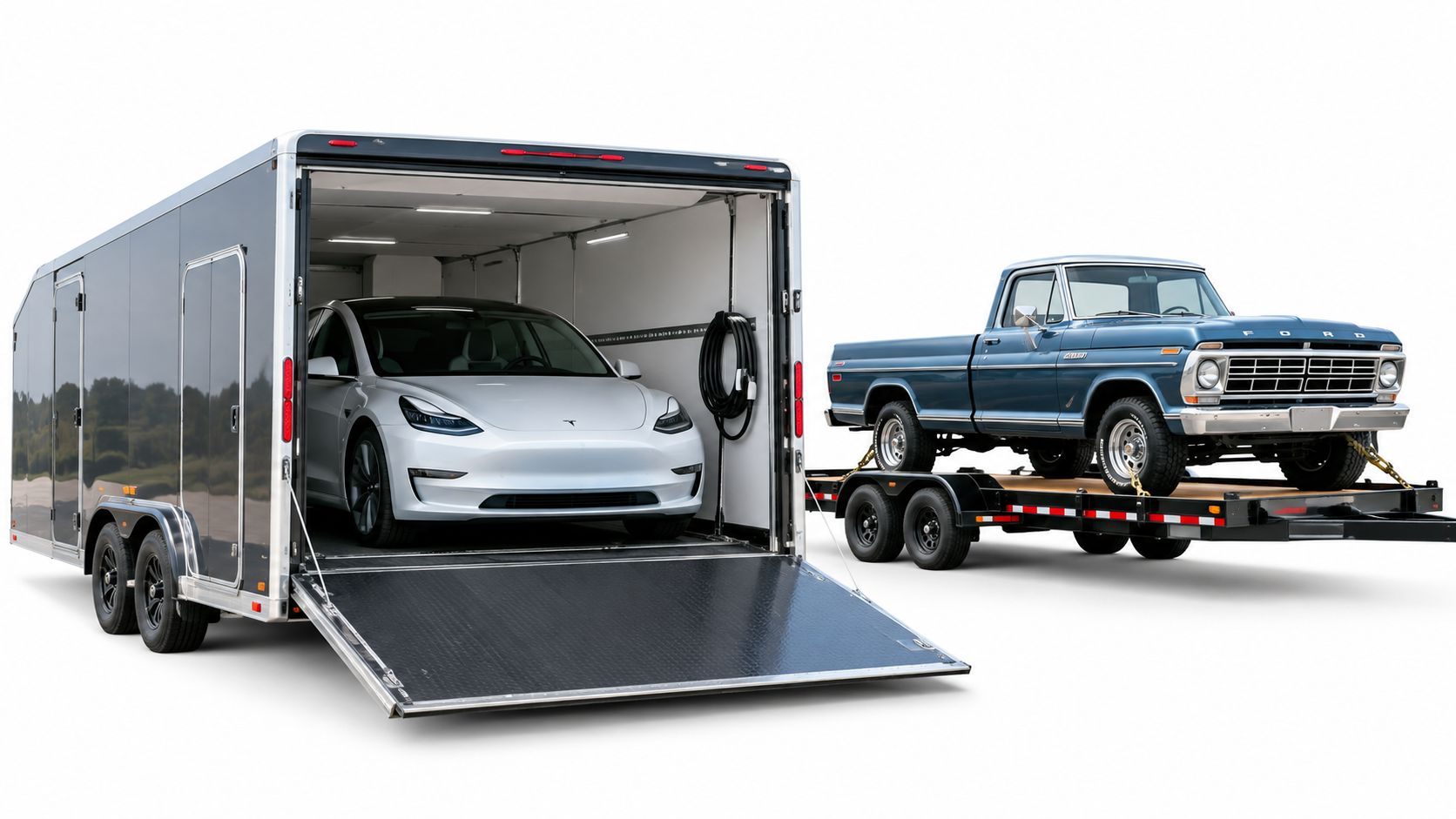
A classic vehicle deserves a different conversation. The owner should disclose ground clearance, modifications, alarm systems, fluid leaks, tire condition, and whether the car starts and rolls under its own power. Enclosed transport is often the sensible choice when the owner wants additional protection from exposure. Review the requirements for classic car shipping before selecting equipment.
Larger vehicles and storage gaps
An oversized SUV, pickup, or commercial vehicle can require more trailer space and careful route planning. Give the coordinator the vehicle's exact dimensions, lift, roof accessories, oversized tires, and running condition. A truck that fits a standard open trailer in one configuration may need different planning after modifications.
Storage can also affect the move. If the destination home isn't ready, arranging indoor and outdoor vehicle storage gives you a place to keep the vehicle after delivery rather than forcing the carrier to wait at the curb. Confirm access hours, security arrangements, and whether the facility can receive a transport truck.
For snowbirds, the seasonal direction matters. A vehicle moving between northern and southern states may face different carrier availability depending on the route and time of year. Military families should provide duty-station deadlines and contact details for both locations. Students often need a flexible pickup plan near a campus rather than a narrow residential street. Dealerships and businesses should provide lot access instructions, receiving hours, stock numbers, and a single person authorized to sign.
The common thread is simple. Give the transport professional accurate vehicle and destination information before the quote is finalized. That is how you avoid the wrong trailer, an inaccessible pickup point, a missed port cutoff, or a delivery that arrives before anyone can receive it.
National Car Transport offers open and enclosed transport across the mainland, plus container and ocean shipping coordination for Puerto Rico, Alaska, and Hawaii. Visit National Car Transport to request a route-specific quote and speak with a bilingual English or Spanish agent about your vehicle, schedule, pickup location, and final delivery plan.