

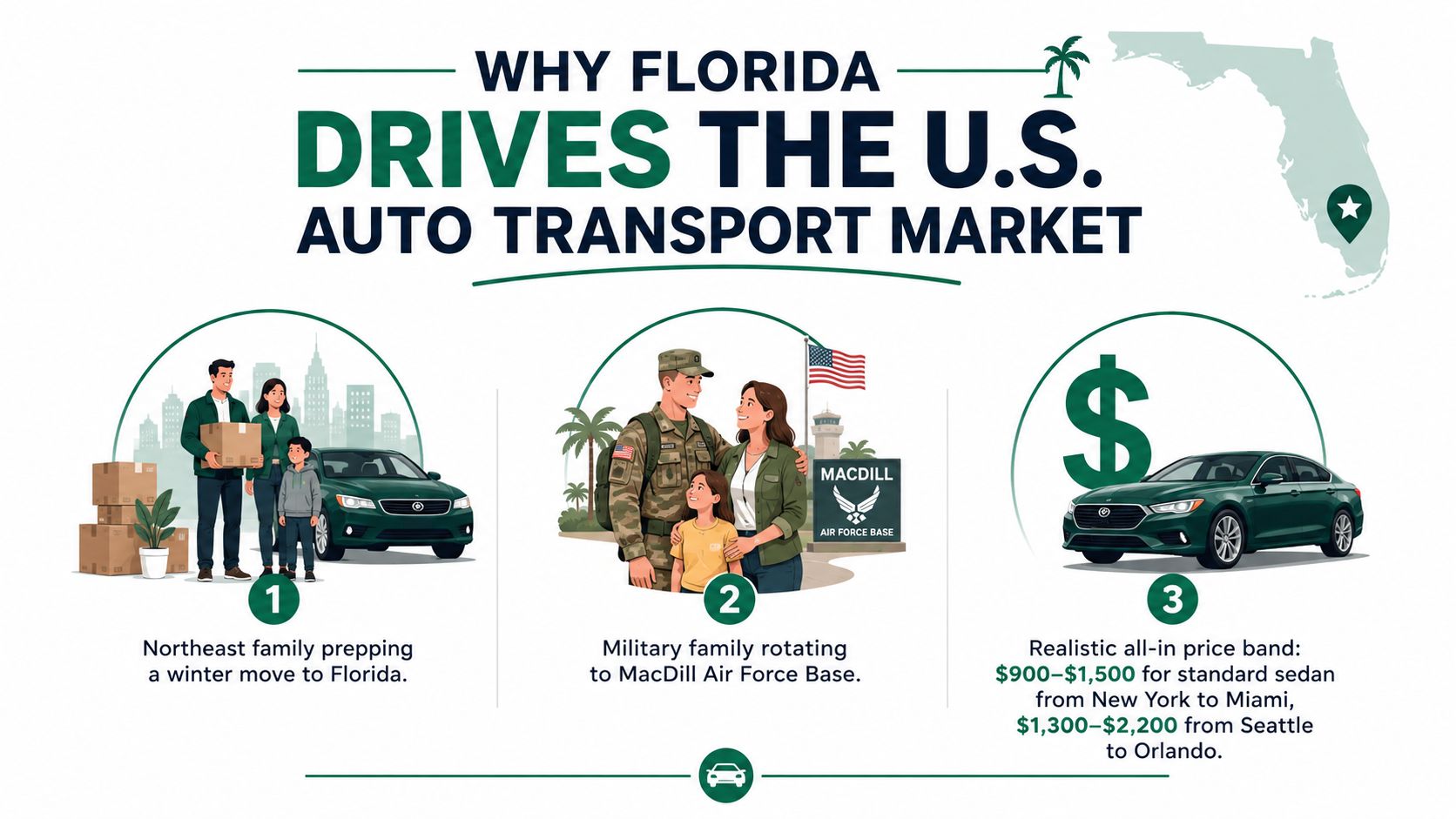
For a standard sedan, auto transportation to Florida usually lands around $837 to $1,377 from the Northeast, about $1,000 from the Midwest, and $1,300 to $1,750 from the West Coast. That range is real, and the rest of the job is figuring out what pushes you to the low end or the high end.
A family leaving New Jersey for Naples, a military household rotating to MacDill, or a snowbird sending a second car south all run into the same market: Florida is not a random destination. It's a high-volume lane, and the quote you get reflects distance, season, pickup access, vehicle condition, and how much you help the dispatcher make the load easy to move.
Table of Contents
- Why Florida Drives the U.S. Auto Transport Market
- Open vs. Enclosed Transport and What Florida Roads Demand
- What Moves the Price on a Florida Quote
- The Florida Booking Workflow From Quote to Delivery
- Florida Paperwork, Registration, and Tax Considerations
- Insurance, Carrier Vetting, and Red Flags to Walk Away From
- Seasonal Timing, Snowbird Strategy, and Getting an Accurate Quote
Why Florida Drives the U.S. Auto Transport Market
Florida moves differently from most states because people rely on cars more heavily there than they do in a lot of other places. FDOT reported that nearly 90% of all person trips made by Floridians are by automobile, a share slightly above the national average, and that matters because it turns personal vehicles into the default mobility tool for residents, seasonal movers, and visitors alike. FDOT also recorded growth between 2009 and 2018 in population, licensed drivers, and vehicle miles traveled, which shows a road system that kept expanding on several fronts at once. FDOT's transportation trends archive makes it plain that roadway activity is a core operational issue in the state, not a side note.
A dispatcher sees the result of that every winter. Florida-bound cars stack up on the same corridors, and the state keeps attracting long-haul shipments because the move south is usually part of a repeating seasonal pattern rather than a one-time event.
The lanes are predictable, and that's why carriers like them
Florida is one of the easiest states to plan around because the demand repeats. Route guidance for Florida shipments shows that New York to Florida is typically about 1,250 miles, Illinois to Florida about 1,275 miles, and Washington to Florida about 3,083 miles, with transit windows that run from a few days to more than a week depending on the lane. Montway's Florida car shipping route guide also notes that winter shipments into Florida rise about 15% above the yearly average, which is exactly what every seasoned dispatcher expects to see when snowbird season hits.
If you want the cheapest clean move, don't fight Florida's schedule. Book early, keep the pickup flexible, and let the carrier fit your car onto a lane they're already running.
That's the rule for most customers. If you're moving a daily driver, you're not buying special treatment, you're buying space on a truck that already wants to go south. If you're moving a classic, a low-clearance car, or a vehicle tied to a tight arrival date, you're paying for more control and less risk.
Open vs. Enclosed Transport and What Florida Roads Demand
Open carrier is the right answer for most Florida shipments. It's what I'd book for a commuter sedan, a family SUV, or a dealership unit that doesn't need special handling. Enclosed transport makes sense when the car is worth protecting from road debris, weather exposure, and the extra wear that comes with long-distance highway travel.
Here's the clean way to decide. Compare the vehicle's value, the route length, and your tolerance for exposure. If the car is replaceable and the lane is a normal Florida route, open transport is the practical choice. If the car is expensive, collectible, or low to the ground, enclosed is the safer call, even if the bill goes up.
| Factor | Open Carrier | Enclosed Carrier |
|---|---|---|
| Vehicle value | Good for most daily drivers | Better for exotics, classics, and high-value units |
| Weather exposure | Exposed to road and weather conditions | Protected from the elements and road debris |
| Cost | Lower | Higher |
| Florida fit | Strong fit for I-95 and I-75 lanes | Better for premium vehicles and sensitive loads |
| Risk tolerance | Fine when you want value and speed | Better when protection matters more than price |
A practical rule works better than a generic sales pitch. Open transport is fine for most cars heading to Florida. Enclosed is worth paying for only when the vehicle itself justifies the extra protection.
The worst mistake is overpaying for enclosed on a car that doesn't need it, or saving a little on open when the vehicle can't take the exposure.
If you want to see how open service is typically described, the carrier explanation at National Car Transport's open car transport page matches the standard industry split between affordability and protection. The lane doesn't change the logic. Florida's roads are busy, the weather can be rough, and the right trailer type depends on what you're shipping, not on what sounds premium in a quote email.
For most customers, the answer is simple. Daily driver, open carrier. Classic, luxury, low-clearance, or freshly restored, enclosed carrier. That's how you avoid paying for features you don't need, or skipping protection you'll regret later.
What Moves the Price on a Florida Quote
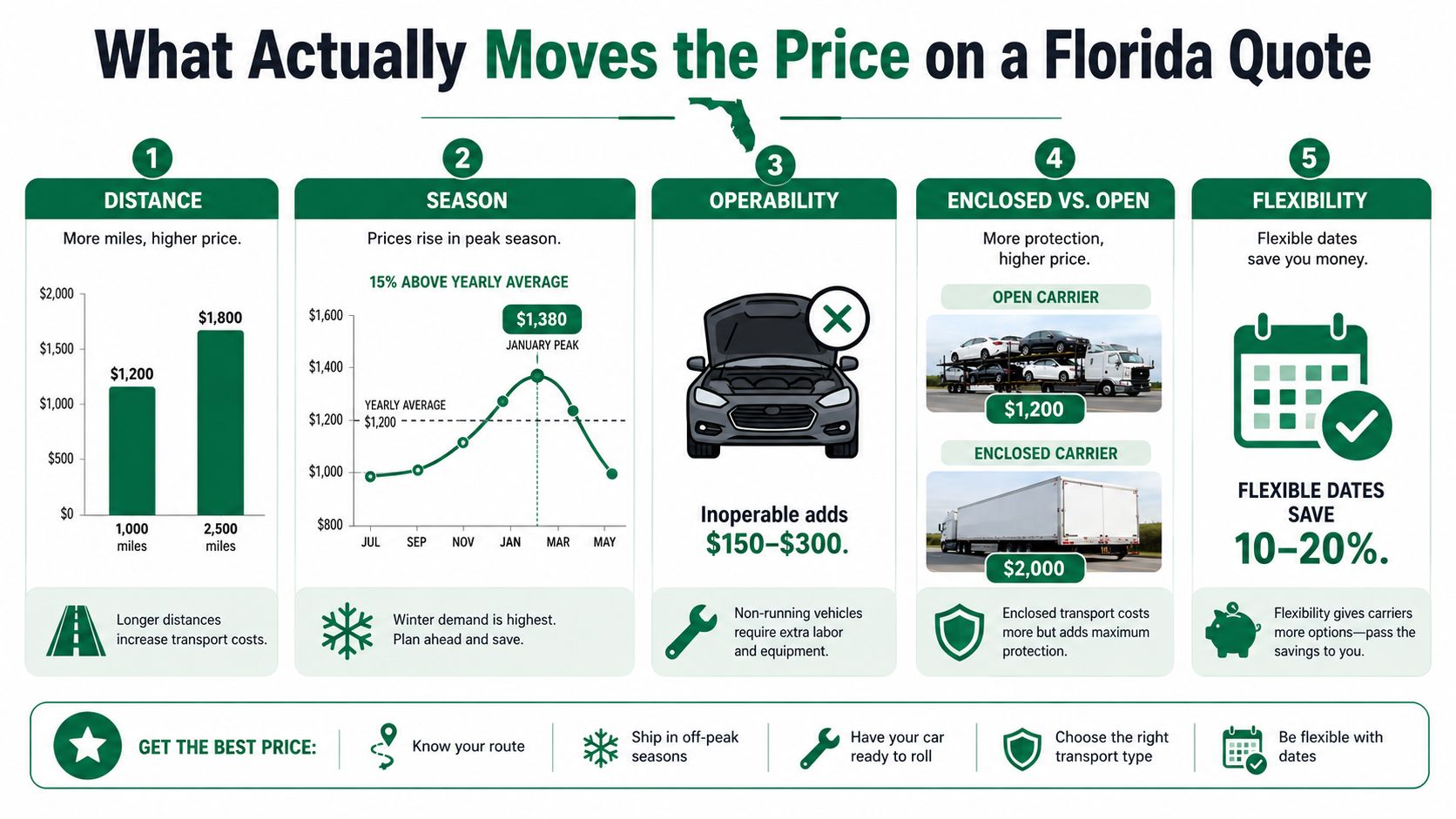
Every Florida quote breaks down into a handful of levers, and the dispatcher is looking at them whether the customer sees them or not. Distance is the anchor, season is the pressure point, vehicle condition changes the handling load, and pickup flexibility often decides whether you get the better lane or the more expensive one. If you understand those pieces, the number stops looking random.
Florida pricing pages show why the spread is so wide. Typical published estimates for Illinois to Florida are around $1,000, New York to Florida is roughly $837 to $1,377, and Washington to Florida is $1,300 to $1,750. Long-haul transit windows also vary by lane, which is why the same vehicle can receive very different quotes depending on where it starts.
Season is the biggest short-term swing
Winter is expensive because everyone wants the same trucks at the same time. Route guidance for Florida shipments shows a clear winter surge, and that pressure shows up fastest on the most popular snowbird lanes. If you wait until the market is already tight, you are paying for scarcity, not service.
Flexibility is where you can save
A flexible pickup window can cut the price by 10 to 20% on the same lane because it lets the carrier slot your car into an existing route instead of making a special arrangement. Booking 4 to 6 weeks ahead also helps you avoid the congestion that hits in mid-October and early April around snowbird demand. MoveBuddha's New York to Florida guide is blunt about that, and it lines up with what dispatchers see every season.
Vehicle condition changes the job
A running car is easier to load, easier to move, and cheaper to ship. An inoperable car needs more handling, more equipment, and more time. The quote should reflect the extra labor, not just the route length.
If two Florida quotes are far apart, the cheap one usually left something out. Compare the included service, not just the headline rate.
The practical move is to ask for a fully written estimate and compare what each company is including. A clear breakdown from National Car Transport's car shipping cost page is useful because it pushes the customer toward route clarity, trailer type, and timing instead of treating every shipment like a generic line item.
The Florida Booking Workflow From Quote to Delivery
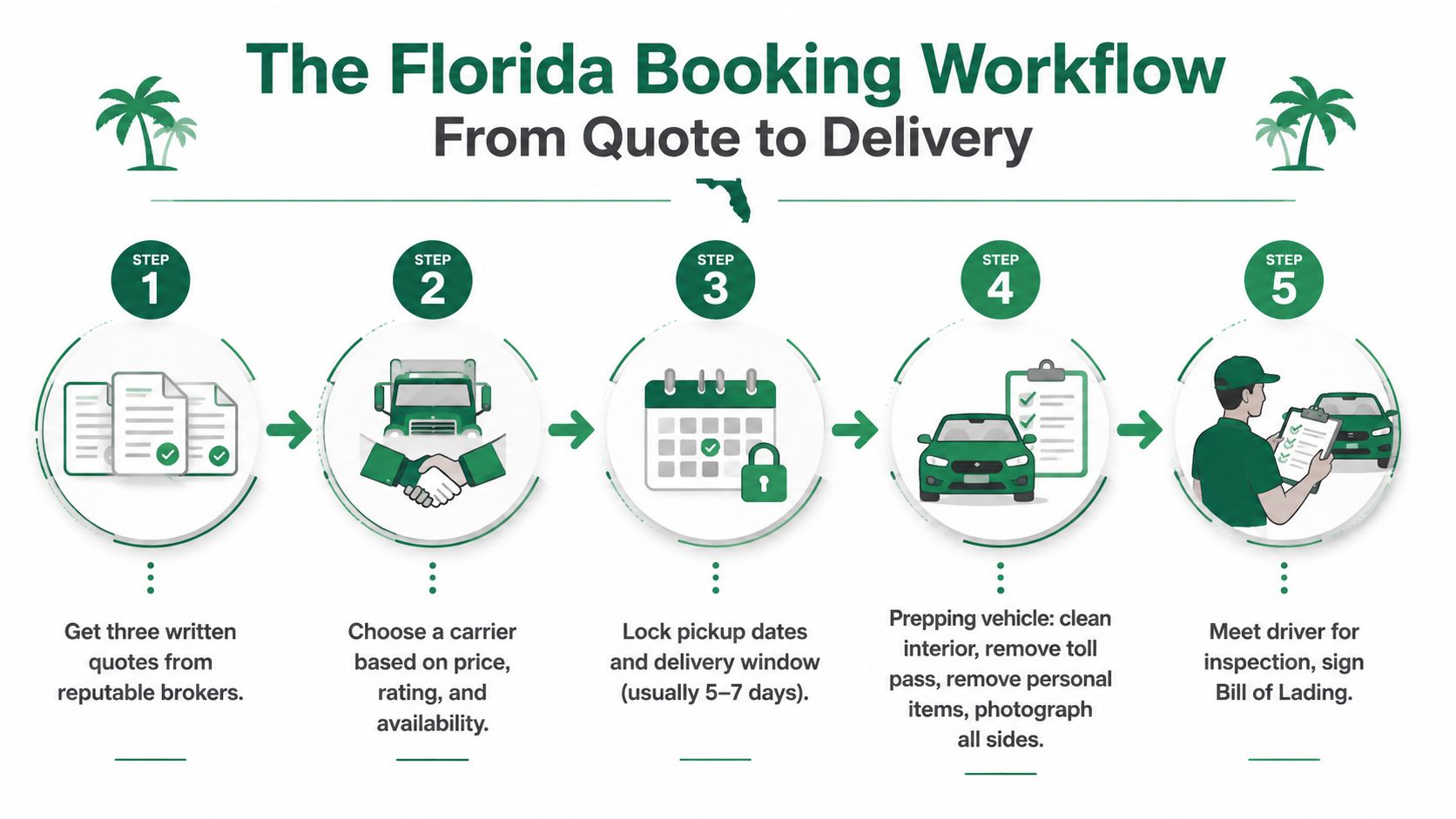
The cleanest Florida shipment starts with good information. Give the broker or carrier the origin, destination, vehicle year, make, model, whether the car runs, and whether you want open or enclosed service. If you leave out the details, you force the quote to float, and floating quotes usually come back higher once the carrier sees the actual job.
Get the quote right before you argue about price
Ask for three written quotes so you can compare route assumptions, not just numbers. FreightWaves' consumer guidance says that rural or off-highway locations, inoperable vehicles, and enclosed transport all increase handling complexity, which is exactly why vague phone quotes are useless. FreightWaves' car shipping calculator guidance is consistent with what a dispatcher would tell you on the phone.
Once you choose a carrier, lock the pickup window and get the inspection process clear. Florida carriers can usually move quickly, but only if the pickup point is workable and the customer is ready when the truck arrives.
Prep the car like you want the driver to load it fast
Clean the vehicle enough to inspect it, remove toll tags, remove personal items, and photograph all sides before pickup. The driver should do a walkaround with you and note existing damage on the Bill of Lading. That paperwork is the backbone of the shipment because it shows the car's condition at handoff and again at delivery.
Practical rule: if the driver can't safely reach your exact address, don't panic. The job usually moves to a nearby lot, a wider street, or another legal meeting point.
That edge case comes up constantly in Florida. Gated communities, condos, narrow streets, ports, and HOA rules can make door-to-door service impossible at the last second, even when the quote says door-to-door. National Car Transport's door-to-door auto transport page reflects the standard expectation, but the world often requires a handoff point a few blocks away.
Expect a delivery walkaround, not a mystery drop
When the car comes off the truck, check the exterior before you sign. If something looks off, note it on the delivery paperwork before the driver leaves. That doesn't mean you're being difficult. It means you're protecting yourself the way experienced shippers always do.
The good workflow is boring. Clear quote, confirmed schedule, clean vehicle, documented inspection, and a delivery check before release. That's how Florida transport should run when everybody does their job.
Florida Paperwork, Registration, and Tax Considerations
The carrier needs simple documents, and you should have them ready before pickup. For domestic shipments, the usual set is vehicle registration, proof of insurance, driver's license, and the Bill of Lading. For a standard U.S. shipment, proof of ownership is generally not required, which keeps the pickup simpler than most first-time customers expect. Ship A Car Inc.’s Florida shipping guide covers that basic paperwork set clearly.
Florida also has a practical advantage over states that require routine inspection steps before registration. Current shipping and logistics explainers note that Florida does not require routine emissions or safety inspections for vehicles under current guidance cited in recent material, so mainland-to-Florida moves don't usually involve a pre-registration inspection hurdle. MoveBuddha's California to Florida guide is one of the places that points this out.
The shipping job ends before the registration job begins
That's the part too many people blur together. The truck gets the car there. The owner handles the title transfer, registration timing, and whatever local DMV or county process applies after arrival. If you're a new resident, treat the delivery as the start of the paperwork phase, not the end of it.
Florida's tax side matters too. New residents should expect the state's six-percent plus county sales or use tax framework on vehicles brought in, so the bill doesn't stop at transport. If you're pricing a move, that tax exposure belongs in the budget from day one, not after the car arrives.
Don't wait until delivery day to gather documents. A driver can't solve a missing registration or insurance card at the curb.
The clean checklist is simple. Have the carrier documents ready, keep your ownership and registration records organized for your own DMV step, and know that the transport company's job is to move the vehicle, not to finish the registration process for you. That separation keeps the whole move from getting messy.
Insurance, Carrier Vetting, and Red Flags to Walk Away From
Not every quote deserves a callback. A Florida haul can run from a short interstate move to a cross-country shipment, and the risk profile changes with every mile. If the company can't prove who's moving your car, what insurance is attached, and how the handoff works, the low price is just bait.
Start with federal registration. Every legitimate interstate carrier or broker should have an active FMCSA record and a USDOT number you can verify. Then ask for the cargo insurance certificate, not a verbal promise, because the policy matters more than the pitch. Snowbird guidance from the earlier section also recommended checking verified reviews across more than one platform, and that still holds.
The fastest vetting script is the one you actually use
Ask these questions in order:
- FMCSA status: Is the company registered, and what USDOT or MC number can I verify?
- Cargo insurance: What are the limits, and can you send the certificate in writing?
- Contract terms: Will I get a written agreement before pickup?
- Deposit terms: How much is due before the vehicle is matched?
- Review pattern: Are the reviews consistent across outside platforms, not just on the company site?
If the quote is dramatically below the market range, walk away. That usually means the carrier plans to add fees later, delay the pickup until you agree to more money, or sell the lead to someone else who will renegotiate the job. The better companies keep the process clear from the beginning.
National Car Transport is one option people compare because it advertises 25+ years of experience, an A+ BBB rating, transparent flat-rate pricing, and a network of 25,000+ vetted carriers. That doesn't make it the only choice, but it does make it the kind of provider worth putting in the same comparison set as any other serious Florida shipper.
A strong vetting process doesn't slow you down. It keeps you from buying a problem with four wheels.
Seasonal Timing, Snowbird Strategy, and Getting an Accurate Quote
Florida rates move with the calendar. When snowbird traffic starts building in the fall, the market tightens fast, and the cleanest prices go to the people who book early. The practical window is usually 4 to 6 weeks ahead, because the load boards fill up and dispatchers have less room to bargain once the route gets crowded. That pressure shows up hard around the fall and spring peaks.
Get the quote from the people who can move the car
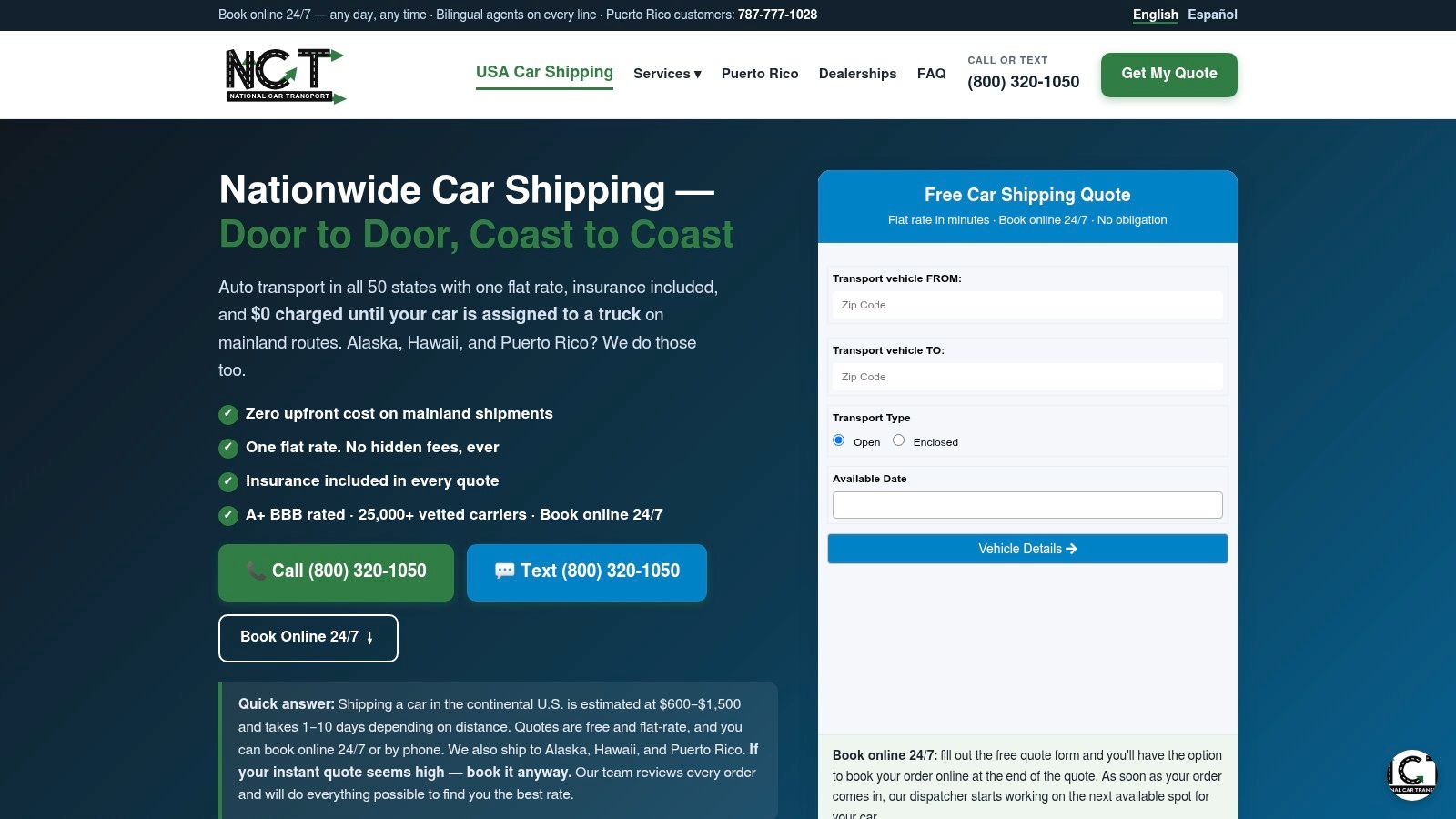
The fastest way to get a tight quote is to give complete information up front. State the exact origin and destination, the vehicle details, whether it runs, whether you want open or enclosed transport, and whether the pickup point has access problems like a gate, narrow street, port access, or condo restrictions. If you are moving into or out of Puerto Rico, or comparing mainland and island logistics, that access detail matters even more because the handoff can involve different shipping modes and more coordination.
National Car Transport is useful for this part because it offers bilingual English and Spanish agents based in the USA, which helps when a customer wants a straight answer instead of a canned script. The company also says it provides transparent flat-rate pricing, which is the kind of setup that helps customers see whether they are paying for access, timing, or vehicle handling.
Ask the questions that expose hidden cost
Do not stop at, “What is the price?” Ask what happens if the pickup window shifts, whether the quote includes door-to-door access or a nearby meeting point, and whether the carrier can handle a non-running vehicle without restarting the whole booking. Those questions tell you whether the company understands Florida's real pickup problems or is just reading from a generic rate sheet.
The right comparison questions also protect snowbirds, students, military families, dealerships, and businesses that cannot afford guesswork. If the company can explain the schedule, the route, and the pickup access in plain English, you are in good shape. If it cannot, keep calling.