
The popular advice is simple: use a tow dolly when you want to save money, and hire auto transport when you want convenience. That advice is incomplete, and it has led plenty of owners into drivetrain damage, roadside trouble, and a trip that costs more than professional shipping would have.
A dolly can be the right tool for a short move with a properly rated tow vehicle and a compatible front-wheel-drive car. It can also be the wrong tool for a long relocation, an AWD vehicle, a hybrid, an EV, a luxury car, or anyone who hasn't managed a loaded trailer before. The decision comes down to mechanical compatibility, trip distance, liability exposure, and equipment readiness, not the rental price alone.
Table of Contents
- Why the Real Choice Is Not What You Think
- How Each Method Actually Works
- Side-by-Side Comparison of Cost, Safety, and Effort
- Drivetrain Compatibility and What Can and Cannot Be Dolly Towed
- Liability, Safety, and the Rules Most Owners Miss
- When the Route Includes Puerto Rico and Why a Dolly Stops Making Sense
- Matching the Method to Real Situations
- The Clear Recommendation and Questions Worth Answering
Why the Real Choice Is Not What You Think
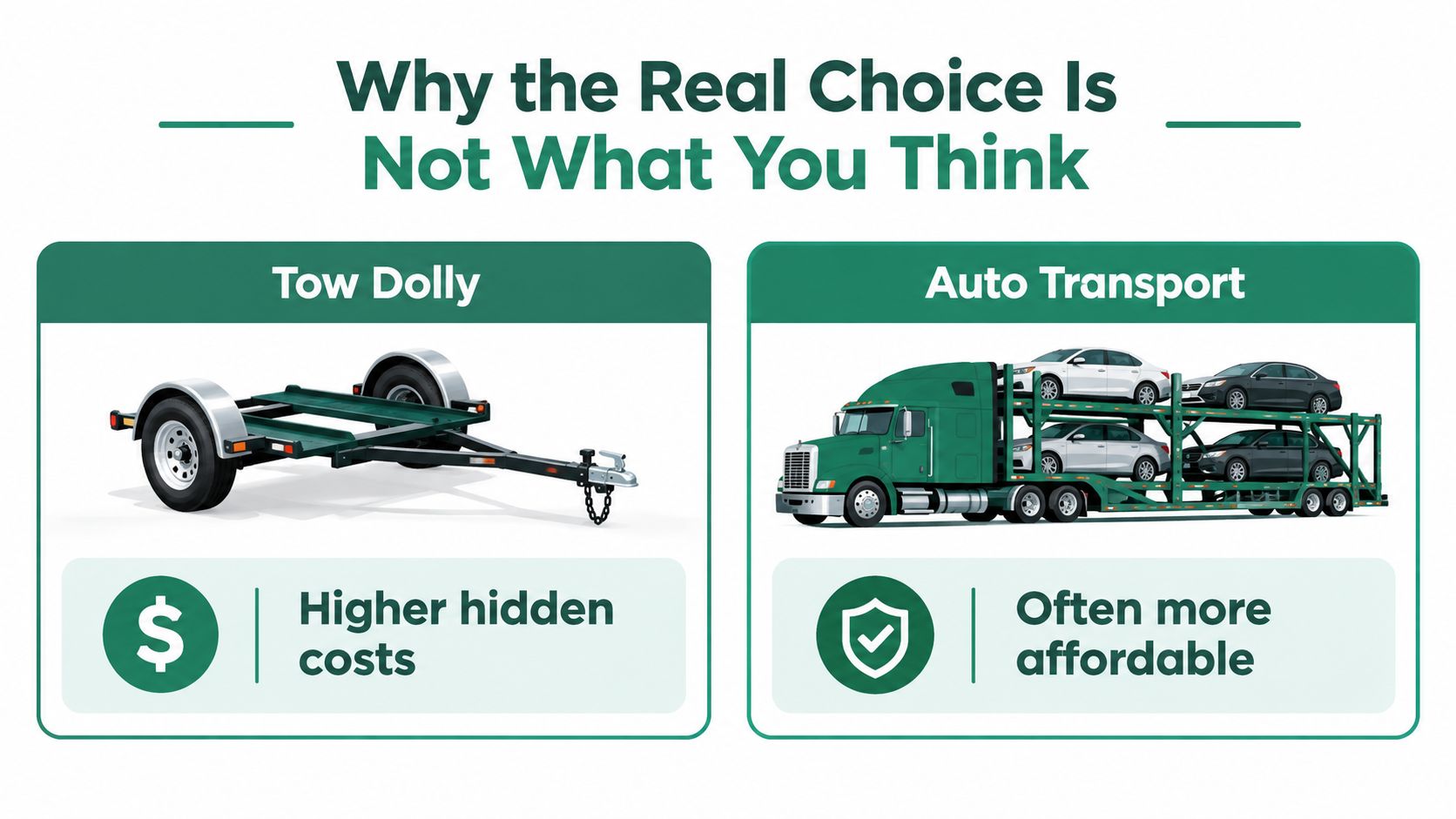
A tow dolly looks inexpensive because the invoice usually starts with equipment rental. That number doesn't show the fuel used by the tow vehicle, the added mileage on both vehicles, possible lodging, the driver's time, or the cost of recovering a combination that develops sway, loses a strap, or suffers a tire problem. It also doesn't account for drivetrain damage when the vehicle isn't approved for partial-load towing.
AAA recommends driving at least 10 mph below the posted speed limit, increasing following distance, avoiding sudden turns, and adjusting speed on hills and inclines when using a tow dolly. Those aren't casual suggestions. They reflect the fact that a dolly changes braking, cornering, acceleration, and downhill control. The transported vehicle's rear tires continue rolling on the road, while the tow vehicle must control a longer and heavier combination.
The four questions that matter
Compatibility comes first. Can the exact year, drivetrain, transmission, transfer case, and powertrain be towed with the driven wheels on the ground? Physical fit isn't the same as manufacturer approval.
Distance changes the equation. A short local move gives a competent driver fewer hours of exposure to traffic, hills, weather, equipment checks, and fatigue. A long interstate trip magnifies every weak point.
Liability follows the method. With a dolly, the owner supplies the tow vehicle, hitch, securement, lighting, driver, route decisions, and much of the risk. With carrier transport, a commercial operator handles loading and vehicle movement under a different insurance and equipment structure.
Equipment readiness matters. The tow vehicle needs the right tow rating, hitch components, braking capability, mirrors, lighting, safety chains, and breakaway protection. A rental counter can't make an incompatible vehicle combination safe.
For domestic moves across the 48 contiguous states, professional auto transport uses a freight network built for moving vehicles. For mainland-to-Puerto Rico shipments, the road journey to a port is only one part of the process, and a dolly can't solve the ocean leg. The smart choice is the method that controls total risk, not the method with the smaller first number.
How Each Method Actually Works
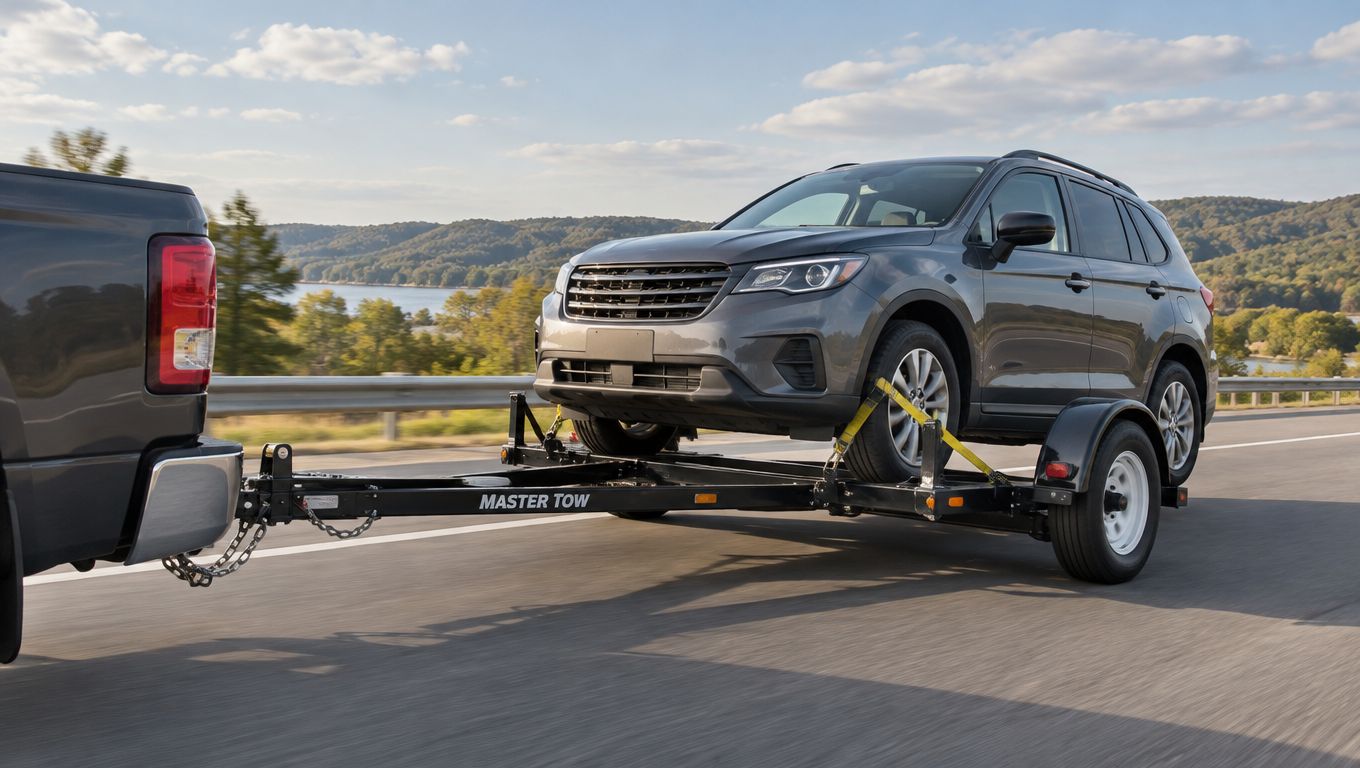
A tow dolly is a small trailer that lifts the front wheels of the transported vehicle while its rear wheels remain on the road. The owner connects the dolly to a tow vehicle, drives the car onto the wheel platforms, secures it with straps and chains, checks the lights, and drives the entire combination.
That setup means the owner remains responsible for the move. The tow vehicle must have a suitable hitch and adequate capacity, the dolly must be rated for the car, and the driver must manage speed, braking, turns, hills, lane changes, and inspections. The rear axle and tires of the transported car keep accumulating road mileage.
U-Haul lists a representative tow dolly at 740 pounds empty, with 4,080 pounds of maximum cargo and a 4,820-pound gross weight. Its auto-transport trailer is listed at 2,210 pounds empty, with 5,290 pounds of cargo capacity and a 7,500-pound gross weight. You can review those specifications on U-Haul's tow dolly equipment page.
A carrier changes who does the work
A professional auto transport carrier loads the vehicle onto commercial equipment designed to move automobiles. An open carrier typically carries multiple vehicles, while an enclosed carrier provides added protection for classic, luxury, exotic, and particularly vulnerable vehicles. The transported car's four wheels leave the road, and the owner doesn't drive a trailer combination across the country.
That distinction is more than a comfort feature. Carrier transport transfers driving, route planning, loading, securement, and much of the roadside-risk burden to a professional operator. The owner still needs to prepare the vehicle, inspect it at pickup and delivery, and provide accurate access information, but the owner isn't acting as the truck driver.
For customers comparing door-to-door auto transport with self-towing, the practical question is simple: do you want to manage the equipment and road exposure yourself, or do you want a carrier to manage the vehicle's long-distance movement?
AAA's vehicle towing guidance reinforces the handling demands. Lower speeds, longer following distances, smoother turns, and careful hill driving are necessary because partial-load towing behaves differently from ordinary driving.
Side-by-Side Comparison of Cost, Safety, and Effort
The auto transport vs tow dolly decision becomes clearer when you compare the whole job rather than the rental line. A dolly reduces trailer weight and can offer direct control. A carrier removes the owner from the driving operation and uses equipment intended for vehicle freight.
| Criterion | Tow Dolly | Auto Transport Carrier |
|---|---|---|
| Cost structure | Equipment rental, fuel, added mileage, driver time, and possible roadside expenses | Shipping charge for carrier capacity, route, vehicle type, and service |
| Equipment weight | U-Haul lists 740 pounds empty and 4,820 pounds gross weight | U-Haul lists 2,210 pounds empty and 7,500 pounds gross weight for its auto-transport trailer |
| Vehicle fit | Primarily suited to compatible front-wheel-drive cars, compact vehicles, sedans, small SUVs, and crossovers | Open or enclosed equipment can carry all four wheels and accommodate more vehicle configurations |
| Mileage added | Rear tires of the transported vehicle remain on the road, and the tow vehicle also travels the route | The transported vehicle isn't driven across the route |
| Liability exposure | Owner manages hitching, straps, chains, lights, braking, loading, route, and roadside decisions | Carrier manages commercial loading, transport operations, and carrier-side procedures |
| Driver effort | High, especially on long interstate routes, hills, traffic, and changing weather | Lower for the owner, who arranges pickup and delivery instead of driving the combination |
U-Haul's ratings show the trade-off clearly. The dolly weighs approximately 1,470 pounds less when empty than the listed auto-transport trailer, which can help the tow vehicle accelerate and maneuver. Its lower 4,080-pound cargo rating, however, excludes many heavier SUVs, trucks, and luxury vehicles. Always compare the transported vehicle's curb weight with the trailer's gross rating and the tow vehicle's maximum tow rating, not just the vehicle's advertised payload.
Freight service versus self-operated towing
The federal freight network makes carrier transport practical for long-distance vehicle movement. The Federal Highway Administration reports that U.S. highways supported nearly 3 trillion vehicle miles of travel in 2009, and trucks carried more than 70% of freight by both tonnage and dollar value. Earlier Bureau of Transportation Statistics data recorded approximately 27,000 miles per truck in 2002, compared with 19,000 miles in 1980, while total truck vehicle miles rose from 108 billion in 1980 to 216 billion in 2003. These figures appear in the Federal Highway Administration freight overview.
The practical dividing line: a tow dolly is a self-operated towing method. Auto transport is a freight service that shifts driving, route planning, loading, and roadside risk to a professional carrier.
That doesn't make a dolly automatically wrong. A skilled driver with a correctly rated tow vehicle, compatible car, sound equipment, and a short route may prefer direct control. For hundreds or thousands of interstate miles, the lower-risk choice is often to ship the vehicle and let the carrier handle the road exposure.
To evaluate the shipping side without guessing, use a detailed car shipping cost guide that separates the service from the hidden costs of self-towing.
Drivetrain Compatibility and What Can and Cannot Be Dolly Towed
Vehicle compatibility is the point owners skip most often. They see the front wheels lifted, confirm that the car fits the platforms, and assume the drivetrain is protected. That assumption can be expensive.
The correct question isn't “Will the car roll?” It is “Does the manufacturer approve this exact vehicle configuration for dolly towing?” Check the owner's manual and manufacturer towing instructions before renting equipment. Confirm the model year, driven wheels, transmission, transfer case, hybrid system, and EV procedures.
Start with the driven wheels
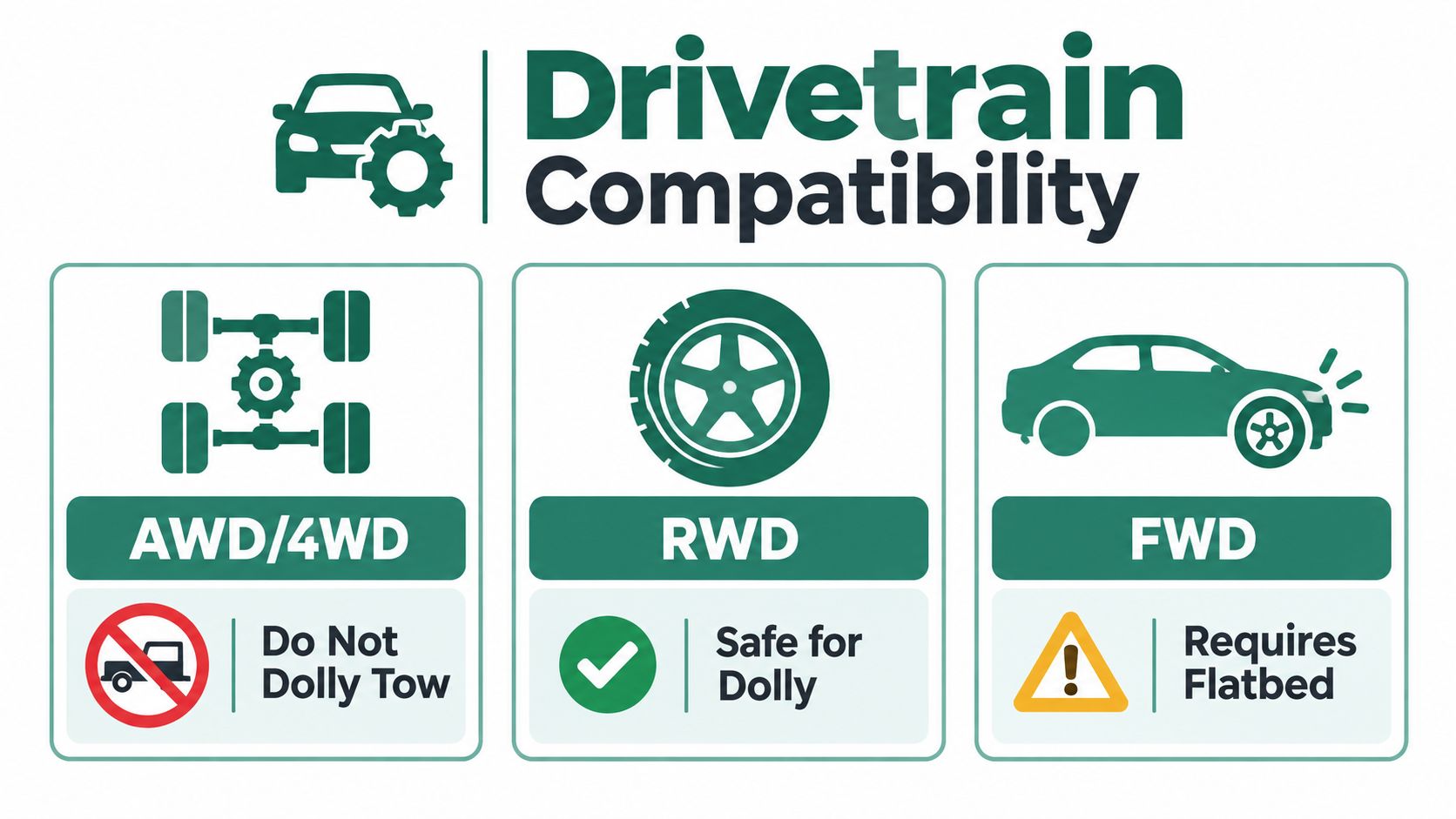
Front-wheel drive is the usual starting point for dolly use because lifting the front wheels removes the driven wheels from the road. U-Haul identifies its dolly primarily for front-wheel-drive cars, compact vehicles, sedans, small SUVs, and crossovers. Even then, verify ground clearance, curb weight, tire size, steering requirements, and the manufacturer's instructions.
Rear-wheel drive requires more care. The rear wheels remain on the road when the front wheels sit on the dolly, so the driveshaft and transmission may continue turning. Some vehicles require a driveshaft disconnect, transmission procedure, or a different transport method. If the manual doesn't clearly approve the setup, don't rely on a general rule.
All-wheel drive and four-wheel drive are where casual advice fails. Lifting only one axle can force components in the drivetrain to rotate at different speeds or in an unintended way. A GM service bulletin warns that dolly towing an AWD vehicle may cause premature rear-drive-module failure. The NHTSA tow dolly guidance also frames a dolly as a motor vehicle designed to tow another vehicle and makes clear that state requirements sit outside its federal guidance.
Hybrids, EVs, and low-clearance vehicles
Hybrids and EVs need separate review. Regenerative systems, traction motors, battery-related procedures, and low-voltage requirements can affect how the vehicle should be moved. A car that appears to be in neutral may still have towing restrictions. Low ground clearance can also cause the front fascia, underbody, or battery-area components to contact ramps or road transitions.
Use this check before considering a dolly:
- Identify the drivetrain. Confirm whether the vehicle is FWD, RWD, AWD, or 4WD.
- Read the exact manual. Look for recreational towing, emergency towing, wheel-lift towing, or dolly instructions.
- Verify the driven axle. Determine which wheels remain on the pavement.
- Check powertrain procedures. Follow transmission, transfer-case, driveshaft, hybrid, or EV instructions precisely.
- Confirm physical limits. Compare curb weight, tire dimensions, clearance, and the dolly's ratings.
- Stop if approval is unclear. Use a full trailer or professional transport instead.
The critical distinction is mechanical. A dolly can be physically possible and still mechanically wrong. Professional transport is often the rational choice when the owner can't obtain clear manufacturer approval.
Liability, Safety, and the Rules Most Owners Miss
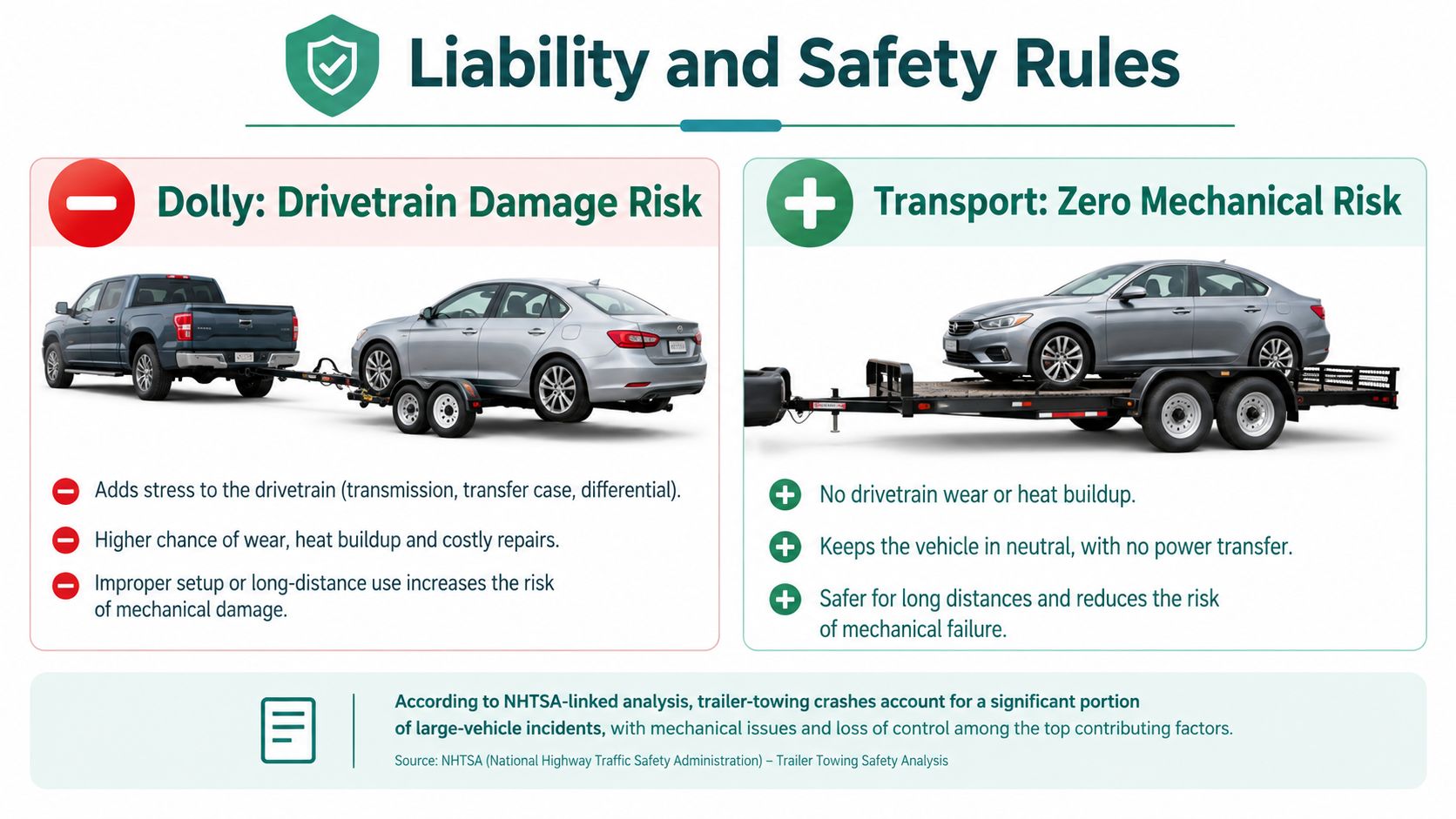
A private owner who rents a tow dolly takes on more than driving. The owner becomes responsible for assembling a safe towing combination and monitoring it throughout the trip. That includes hitch compatibility, tongue weight, tires, straps, safety chains, lights, mirrors, brakes, breakaway protection, and the condition of the towed vehicle.
A 2023 analysis using NHTSA crash datasets reported approximately 69,389 police-reported passenger-vehicle trailer-towing crashes, 427 fatal crashes, 500 fatalities, and 25,054 estimated nonfatal injuries. The analysis identified detachment, safety-chain failure, sway, and improper loading as major preventable contributors. The figures and findings are presented in this NHTSA crash-data towing analysis.
The questions behind the risk
Before a dolly move, answer these questions in writing:
- Who pays if a strap loosens? Rental coverage, personal insurance, and roadside plans may treat the dolly, transported car, and tow vehicle differently.
- Who pays for tire or undercarriage damage? The car's owner may face a dispute if the damage results from incorrect loading, clearance, or drivetrain instructions.
- Does the tow vehicle meet the requirements? Capacity, hitch components, braking ability, and lighting must match the combination.
- Does the route cross different state rules? NHTSA states that dolly and trailer requirements vary by state, so compliance can't be assumed from the departure state.
- Can another driver see the signals? Equipment that obscures required rear signals may need additional lighting.
FMCSA rules require commercial vehicles to meet applicable brake, coupling, and emergency-brake requirements. Under 49 CFR 393.42, brakes generally must be operable and act on all wheels, subject to limited exceptions for certain trailers, dollies, and driveaway-towaway operations. The rules also require a towing motor vehicle pulling a braked trailer to have a way to stop the towing vehicle if the trailer breaks away. The FMCSA safety-planning guidance explains the relevant framework.
FMCSA guidance also addresses rear turn signals when a converter dolly obscures the towing vehicle's signals. A standard car tow dolly isn't identical to a commercial converter dolly, but the principle is useful: even partial blockage can affect required visibility. Review the FMCSA lighting guidance and the rules for the exact equipment and route.
A compatible car can still be a poor dolly choice if the owner can't accept responsibility for every connection and every mile.
For owners tracking a vehicle during a professional shipment, real-time GPS car tracking can provide useful visibility into location and movement. Tracking doesn't replace carrier vetting or inspection, but it can reduce uncertainty during a long move.
When the Route Includes Puerto Rico and Why a Dolly Stops Making Sense
A tow dolly works on a road. It doesn't cross the ocean. That distinction matters for anyone moving a vehicle from the mainland to San Juan, Puerto Rico, or shipping one from Puerto Rico to the mainland.
U.S. Customs and Border Protection states that the movement of a used self-propelled vehicle between the continental United States and Puerto Rico isn't an export under 19 CFR 192.2, because Puerto Rico is included in the Customs territory of the United States. The normal 72-hour advance presentation of ownership documents required for certain vehicle exports doesn't apply to these mainland-to-Puerto Rico shipments. The exemption doesn't remove all requirements, however. Electronic Export Information must still be filed through the Automated Export System, and the VIN or PIN must be entered. CBP also confirms that vehicles remain subject to inspection. Review the CBP Puerto Rico vehicle ruling.
Port logistics are different from interstate towing
For a move between major mainland cities such as New York, Boston, Philadelphia, Washington, Atlanta, Miami, Chicago, Dallas, Houston, Denver, Phoenix, Los Angeles, Seattle, or San Francisco and San Juan, the vehicle needs a coordinated road and ocean plan. The owner must get the vehicle to the correct port, complete the required information, meet inspection and acceptance requirements, and arrange ocean movement.
CBP's Automated Export System guidance states that mainland-to-Puerto Rico shipments are exempt from normal advance EEI filing time frames that apply to many exports. The applicable Internal Transaction Number, exemption citation, or in-bond number must still be provided to the carrier by the time the shipment arrives at the port of unlading. The exemption applies to the United States and Puerto Rico, not shipments involving the U.S. Virgin Islands or foreign countries. Those distinctions appear in the CBP AES FAQ.
A dolly leaves the owner responsible for the entire road trip to the port and doesn't handle the ocean segment. Professional auto transport can coordinate mainland pickup, port delivery, ocean freight, and destination arrangements as one logistics process. For people comparing those options, Puerto Rico car shipping is a more direct path than trying to recreate a port logistics operation around a rental dolly.
National Car Transport handles mainland pickup, ocean movement from Jacksonville to San Juan, and bilingual coordination for island shipments. Its advertised model uses flat-rate pricing, but customers should still confirm what the quote includes, which documents they must provide, and where inspection and delivery occur.
Matching the Method to Real Situations
A family moving from Chicago to Los Angeles for a new job should usually choose auto transport. The route is long, the tow vehicle accumulates substantial use, and the owner has enough moving work without driving a loaded combination across multiple states. Open carrier service is generally the practical fit for a standard operable vehicle, while enclosed service makes more sense for a valuable or unusually vulnerable car.
A snowbird moving one compatible front-wheel-drive sedan from the Northeast to Florida has a more credible dolly case. If the tow vehicle is properly rated, the car is specifically approved for dolly towing, the driver has trailer experience, and the route and schedule are manageable, self-towing can provide direct control. It still requires careful loading, securement, lighting, tire checks, and conservative driving.
Relocations and duty-station moves
A military family completing a Permanent Change of Station move should favor professional transport when the vehicle is AWD, heavy, low-clearance, or needed at the destination without adding a long drive to the family's travel burden. Military schedules create enough uncertainty without adding trailer recovery or drivetrain questions. A carrier also makes it easier to coordinate the vehicle separately from household travel.
A dealership moving inventory between auctions needs repeatable handling and predictable responsibility. A dolly may work for a single compatible vehicle and a short repositioning move, but it isn't a substitute for carrier capacity when several vehicles need movement or when employees aren't equipped for long-distance towing. Commercial transport keeps the dealership's staff focused on inventory and sales operations.
For a classic or luxury vehicle, enclosed transport is the clear recommendation. The owner is paying to protect condition, and leaving tires on the road adds unnecessary exposure to debris, weather, road vibration, and handling mistakes. A low-clearance vehicle may also be difficult to load safely on a dolly, even when its weight appears acceptable.
When a dolly is genuinely appropriate
There is a narrow but legitimate dolly use case:
- Short route: The move doesn't create unnecessary long-distance driving exposure.
- Correct drivetrain: The manufacturer approves the exact vehicle configuration.
- Rated tow vehicle: The tow vehicle, hitch, brakes, tires, and mirrors meet the combination's demands.
- Prepared operator: The driver knows how to load, strap, inspect, turn, brake, and reverse safely.
- Acceptable vehicle condition: The owner understands that the rear tires remain on the road.
If one of those conditions fails, professional transport becomes the sensible option. The cheaper-looking method isn't a bargain when the owner has to arrange roadside recovery or repair a powertrain.
The Clear Recommendation and Questions Worth Answering
Use this decision order:
- Drivetrain compatibility. If the manufacturer doesn't clearly approve dolly towing, don't dolly tow.
- Trip distance. Short, controlled moves favor self-towing more than long interstate routes.
- Operator experience. If you've never managed a loaded combination, hire a carrier.
- Total cost. Compare fuel, mileage, time, lodging, equipment, risk, and potential damage, not just rental price.
Choose a dolly only when the vehicle is approved, the tow vehicle is properly rated, the equipment is ready, and the route is suitable. Choose professional auto transport for AWD and 4WD vehicles without explicit approval, hybrids and EVs with unclear procedures, classic and luxury cars, long relocations, military moves, dealership logistics, and mainland-to-Puerto Rico shipments.
National Car Transport serves all 50 states plus Puerto Rico, offers flat-rate pricing, uses a network of 25,000-plus vetted carriers, and has bilingual English and Spanish agents based in the United States with more than 20 years of auto transport logistics experience. Every vehicle move is different, and an experienced agent can simplify the decisions around equipment, route, timing, inspection, and delivery.
Questions owners should answer first
Can dolly towing void a powertrain warranty?
It can create a warranty problem if the manufacturer prohibits the method or the owner ignores required towing procedures. The GM warning about premature rear-drive-module failure on an AWD vehicle shows why the exact manual and manufacturer guidance matter more than a generic dolly rule.
Does personal auto insurance cover dolly damage?
Don't assume it does. Ask the insurer how it treats the tow dolly, transported vehicle, tow vehicle, loading mistakes, drivetrain damage, detached equipment, and roadside recovery. Rental protection and roadside plans may have separate terms.
What documents are needed for a shipment to San Juan?
CBP states that the normal export presentation rule doesn't apply to mainland-to-Puerto Rico vehicle movements, but EEI filing through AES, VIN or PIN entry, and inspection requirements still apply. Confirm the ITN, exemption citation, or in-bond information and provide it to the carrier by the required port timing.
National Car Transport can arrange door-to-port or door-to-door vehicle shipping across the mainland and to San Juan, with open or enclosed carriers and coordination for Puerto Rico ocean service. Visit National Car Transport to compare the safe shipping method for your vehicle, route, and schedule with a bilingual transport advisor.