
A relocation offer starts next week, but your car can't make the trip with you. You need it at your new address, you can't drive it there yourself, and you're not sure whether “on demand” means a truck will arrive today or that you can book without choosing a fixed weekly route.
Auto transport on demand means booking a carrier to move your vehicle on the date or pickup window you need, often within days or even the same day. The carrier and shipment still need to be matched, so speed depends on the route, the vehicle's readiness and whether the handoff is organized.
Table of Contents
- What On-Demand Auto Transport Is and What It Costs
- What Changes Your Price and Pickup Timing
- How to Book and Track a Shipment, Step by Step
- When Same-Day Pickup Works and When It Backfires
- Shipping a Car to or From Puerto Rico
- EVs, Classics and Military Moves Need Extra Planning
- Decide Whether On-Demand Booking Fits Your Move
What On-Demand Auto Transport Is and What It Costs
A relocating professional needs a car moved from New York to Miami before the first day at a new job. Driving it down costs two days and a hotel stay. Booking on-demand transport means requesting a pickup window that fits the move date, often within days, instead of waiting for a fixed weekly route. National Car Transport is a U.S.-based company that runs door-to-door vehicle transport across all 50 states, Puerto Rico, Alaska, and Hawaii, with open or enclosed carriers matched through a nationwide driver network.
The booking triggers a match. The dispatcher starts working on the next available spot for the car, looking for a truck already moving near the origin or arranging capacity when the route is less common. Speed is a choice you verify. Same-day pickup saves waiting only when the car, keys, paperwork, and handoff person are ready at the stated location.
| On-demand auto transport options at a glance | Typical Cost | Transit Time | Best Fit |
|---|---|---|---|
| Open carrier, flexible pickup window | $800 to $1,000 for an SUV, New York to Miami (estimate) | Route-dependent, confirmed after carrier assignment | Budget moves with flexible dates |
| Enclosed carrier | 40 to 60 percent above the open rate on the same route (estimate) | 1 to 10 days for classic cars | Classic, luxury and exotic vehicles |
| Same-day pickup | Quoted at booking | Pickup on the requested day if a carrier is available | Urgent handoffs when the vehicle is ready |
| Puerto Rico, port-to-door or door-to-port | Quoted at booking | Typically 7 to 14 days | Mainland to San Juan moves |
Every figure is an estimate, not a guaranteed quote or delivery promise. Route, vehicle type, season, carrier availability and the pickup window can all change the price or schedule. Readers who want wider context can read this partner explainer on understanding logistics beyond booking transportation.
Start with the date you can accept. Decide whether you need a fixed pickup date, can offer a flexible window or truly need same-day pickup. That choice often affects the price more than any other single factor.
What Changes Your Price and Pickup Timing
The pickup window is the lever you control most directly. A carrier already heading toward your origin can add a stop for a small amount of money and time. A truck routed specifically for your car carries the full cost of that trip, and the quote reflects it. Flexible dates let a dispatcher shop your vehicle against trips that already exist. A fixed date asks dispatch to reserve capacity for one specific morning, and that reservation has a price.
Remote pickup locations narrow the pool in the same way. Fewer trucks pass nearby, so the wait for a match stretches and the rate rises to make the detour worth a carrier's while. A common first assumption is that a fixed date costs more because it is more specific. The reason is capacity: you are competing for a truck that has to be held rather than one that is already moving.
| Factors that move price and timing | Effect on Price | Effect on Timing |
|---|---|---|
| Flexible pickup window | Widens the carrier pool and can lower cost | Faster match to a carrier already on the route |
| Fixed date or remote origin | Needs reserved capacity and can raise cost | Longer wait for a match |
| SUV, crossover or pickup truck | Quoted on request, not at the sedan rate | Confirmed when a suitable carrier is matched |
| Two cars on the same route | Multi-car discount applies | Coordinated pickup and delivery for both vehicles |
| High-value vehicle | Appraised value sets the carrier coverage needed | Carrier matched to coverage first |
Vehicle size and condition follow the same logic. An SUV, crossover or pickup is quoted on request rather than at the sedan rate, and enclosed transport to Puerto Rico is quoted the same way. A vehicle that doesn't run, or one with modifications, may need different equipment, which moves it into a smaller carrier pool. Two cars traveling the same route often qualify for a multi-car discount because the carrier fills two spots on a single trip. Headcount works much the same way in other kinds of transport: comparing airport transfer costs for groups shows how the number of passengers changes both the vehicle and the price.
Enclosure changes the arithmetic more than most first-time shippers expect. On a given route, enclosed transport typically runs 40 to 60 percent above the open rate for sedans, compact cars, SUVs and pickups. Transit length depends on the route and the trailer, and classic car shipments, which travel on enclosed trailers with soft tie-downs and hydraulic loading, run 1 to 10 days. For a high-value vehicle, the appraised value determines the coverage a carrier must hold, so send it with your quote request and the match happens against the right policy instead of a generic one.
Our car shipping cost guide walks through how each of these inputs feeds into a quote, from vehicle type to route and date.
If an instant quote looks high, you can still book. We work to find a better rate, especially when you can offer a flexible pickup window. The more flexibility you give on dates, the more options you have on price.
How to Book and Track a Shipment, Step by Step
A smooth shipment starts with accurate details and a clear handoff plan. Here's what to do from quote through delivery.
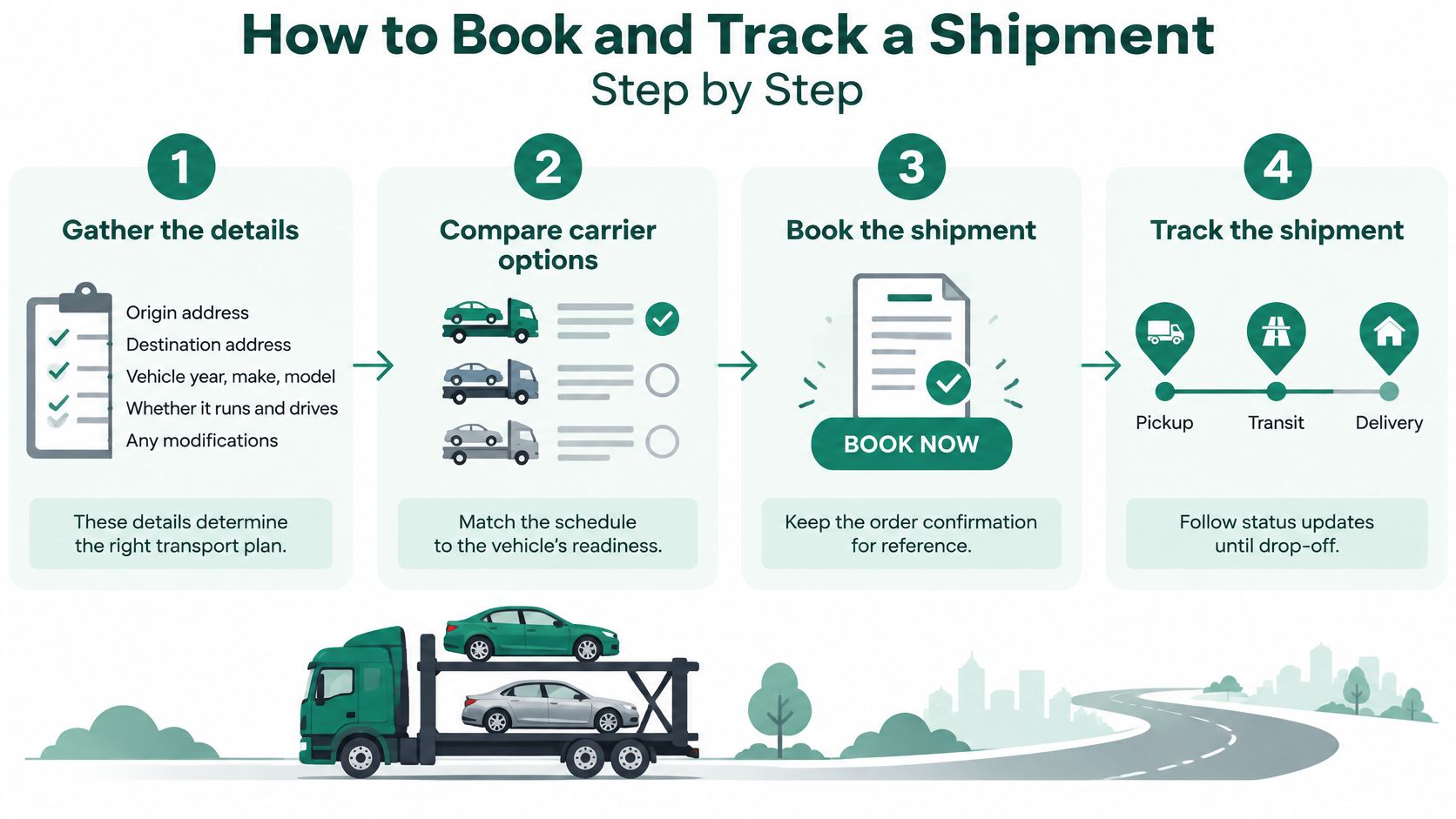
Gather the route and vehicle details. Write down the pickup and delivery addresses, vehicle year, make and model, whether it runs and drives, and any modifications. Those details help determine which carrier type and transport plan fit.
Request a quote and choose a pickup window. State the earliest date you can hand over the keys and how much flexibility you have. A wider window gives dispatch more options for matching the route.
Book when you're ready. Customers can book online 24/7 by completing the free quote form and choosing to book at the end. After the order comes in, the dispatcher starts working on the next available spot for the car.
Confirm carrier assignment. On mainland routes, no money is charged until the car is assigned to a truck. Make sure you know when the assignment is confirmed and how you'll receive the carrier and pickup details.
Prepare the vehicle. Remove personal items, take clear photos of existing damage, keep the fuel level low and make the keys available. Tell the dispatcher about anything that could affect loading, such as a flat tire, a dead battery or a low-clearance modification.
Review the pickup inspection. Walk around the car with the driver and check the condition report on the Bill of Lading, including its supporting photos. Sign only after the report accurately reflects the vehicle's condition.
Stay in contact during transit. Your advisor monitors the shipment and provides updates from pickup through delivery. Keep your phone available in case the carrier needs help confirming access or the drop-off point.
Inspect before signing at delivery. Compare the vehicle with the pickup record and note any new damage on the Bill of Lading before signing. Keep a copy of the completed document.
Door-to-door service means pickup and delivery at your home, office or the nearest safe landmark, with no terminal visit required. The address still needs to work for a large carrier, so let your advisor know if a narrow street, low branches, parking restrictions or other access issues could prevent a truck from reaching the property.
Keep three things together: the signed Bill of Lading, the carrier's contact information and your advisor's number. They're useful if you need to confirm timing or review the vehicle's condition.
When Same-Day Pickup Works and When It Backfires
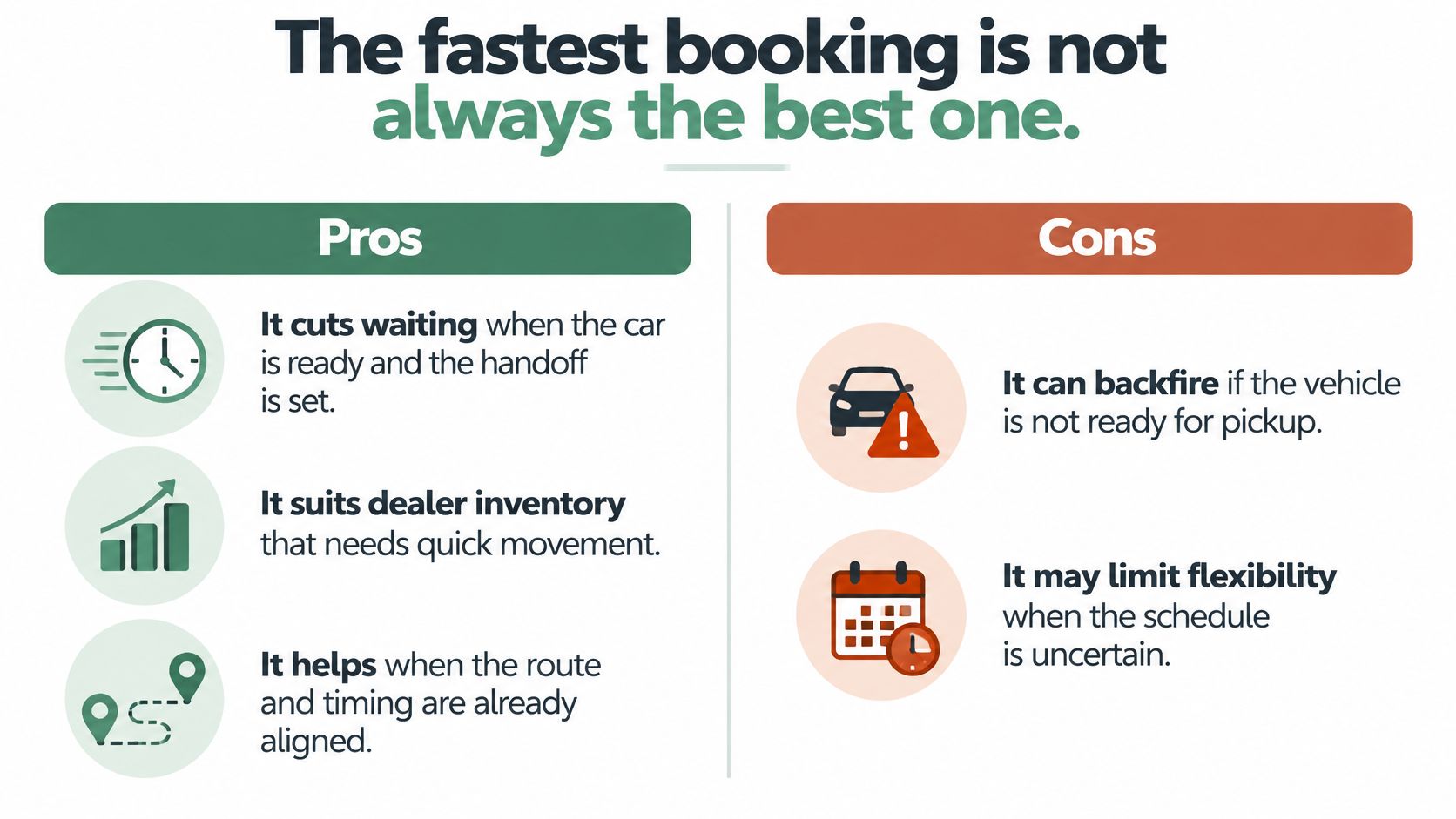
The fastest booking isn't always the best one. Same-day pickup can cut waiting, but only when the vehicle, keys, documents and handoff are ready. If one piece is missing, an urgent slot may create more coordination pressure than it saves.
Pros
- Less waiting: It can help when the car is ready and the pickup handoff is set.
- Useful for urgent moves: It can suit dealer inventory moves and relocations with a firm start date.
- Potentially fewer extra costs: A quick handoff may save a rental or storage day.
Cons
- Readiness problems: If the seller, keys, title, inspection or paperwork isn't ready, the truck may have to leave and the car may wait a day or more.
- Difficult pickup access: The pickup address may not have safe parking or room for a carrier.
- Limited carrier positioning: Same-day availability depends on where a suitable truck is and can differ by route.
Remote vehicle purchases make this trade-off especially clear. A 2026 report says 95% of car buyers research online before purchasing. A separate 2026 consumer survey found that 37% of buyers who purchased more than 100 miles away had the vehicle delivered or shipped, compared with 13% overall, according to Tech Times' report on online car buying and delivery.
Before a remote purchase, get each party's responsibilities clear. The buyer should arrange payment and an independent inspection; the seller should confirm keys, access and vehicle readiness. The marketplace or dealer should clarify payment release and title or temporary-tag timing, while the carrier needs a confirmed handoff contact, address and pickup window. A private seller, dealer and auction may each handle those details differently, so don't assume the same process applies to all three.
Choose same-day pickup only when the car, keys, paperwork, inspection and handoff are confirmed. Otherwise, a two- to three-day window is safer.
Shipping a Car to or From Puerto Rico
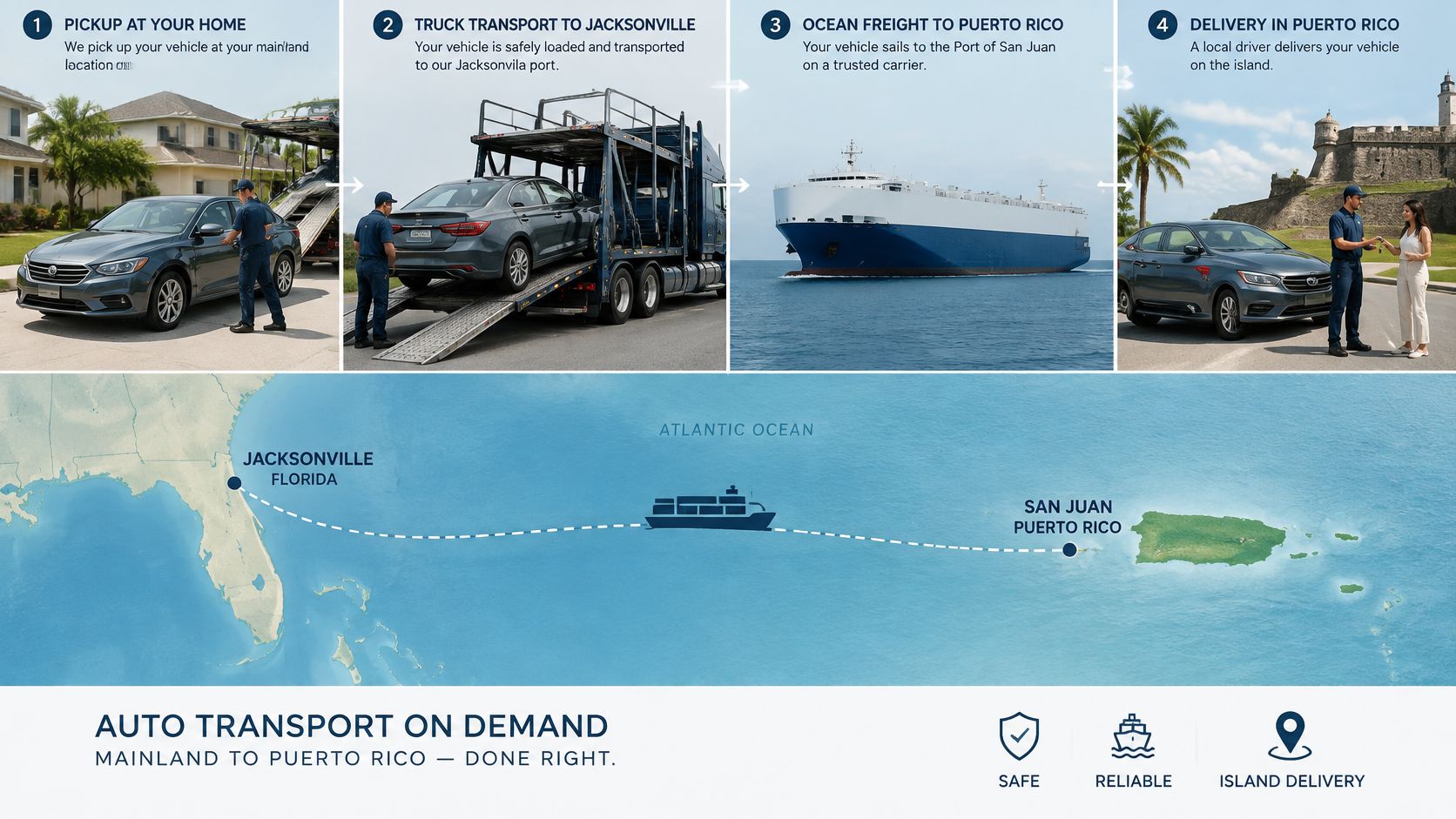
A mainland-to-Puerto Rico shipment behaves like two moves stitched together: a truck leg and an ocean leg. A common path is pickup on the mainland, truck transport to a Jacksonville port, port processing, a sailing to the Port of San Juan and delivery on the island. For the reverse direction, port-to-door service delivers a vehicle shipped from Puerto Rico to your mainland address.
The ocean leg has its own rules. The Maritime Administration explains that the Jones Act generally requires a vessel carrying merchandise between U.S. points to be U.S.-built, U.S.-owned and coastwise endorsed. The move therefore needs coordination among inland pickup, port processing, vessel scheduling, ocean transport and delivery; the Department of Homeland Security can issue waivers in specified circumstances, but those are exceptions rather than the usual planning assumption, according to the Maritime Administration's domestic-shipping guidance.
Same-day pickup can shorten the mainland truck leg when the car, keys, paperwork and handoff are ready. It does not make the sailing leave sooner. Speed on the island leg is a schedule you verify before you commit.
A used self-propelled vehicle moving between the continental United States and Puerto Rico isn't treated as an export under 19 CFR 192.2, according to a U.S. Customs and Border Protection ruling. The standard export procedure requiring ownership documents 72 hours before export doesn't apply to that route. However, Electronic Export Information still must be filed through the Automated Export System with the vehicle identification number. The title state and title number aren't required in that filing, and the vehicle remains subject to inspection.
Puerto Rico also charges an excise tax called arbitrios on vehicles arriving on the island. Transit time depends on the route, the sailing schedule and how the vehicle is handled at each port. A vehicle coming from a foreign country is a different case: CBP has described foreign-origin vehicles that did not meet U.S. safety or emissions requirements, so identify the vehicle's origin and import status before booking.
For a San Juan move, confirm the port, sailing schedule, accepted vehicle condition and VIN details before committing to a delivery date. Also confirm the current arbitrios amount and departure port with your advisor, since those details depend on the route and aren't set by the mainland carrier. Ask for a quote on an SUV, truck or enclosed unit, since those don't use standard sedan pricing. If the move includes a longer stay, browse Condado properties while you plan the island side of the trip.
For shipment options and a route review, see our Puerto Rico car shipping service.
EVs, Classics and Military Moves Need Extra Planning
An EV seller accepts a deposit, then mentions the car is at 100% charge and the charging cable is missing. The car runs, but the shipment now needs a carrier that will accept that battery state, and the pickup date may move while the buyer confirms it. Special vehicles turn a normal booking into a sequence of checks.
Electric vehicles need their own plan, especially when an ocean leg is involved. A lithium-ion battery is not like a fuel tank that can be drained for shipping. It stores energy even when the car is off. State of charge is the dashboard battery percentage. Maryland fire-safety guidance says EVs are most hazardous when fully charged and notes that shipping companies commonly target a 20% to 50% state of charge for marine transport. That range is a planning target, not a guarantee. Ask the carrier what charge level it requires before the pickup date is set.
Before booking an EV, disclose whether it runs, whether the battery or vehicle is damaged, and whether it has been flooded or involved in a collision. Ask whether the carrier can accept its condition and whether the route requires container or ocean transport. A carrier that takes a running EV on a domestic truck may decline the same car for an ocean move. The vehicle's condition and the route both have to clear.
Speed is a choice you verify. Same-day pickup can work for an EV when the charge level, keys and handoff paperwork are ready. If the battery condition is unclear, trading a flexible window for speed usually backfires: the dispatcher finds a truck, then the carrier rejects the load.
Classic and collector vehicles need care during loading and inspection. Enclosed transport uses soft tie-downs and hydraulic low-clearance loading, which can help protect a low or delicate vehicle. A photo-supported inspection on the Bill of Lading records the car's condition at pickup. See details about classic car shipping before arranging a move.
For high-value vehicles, provide the appraised value up front. National Car Transport matches the vehicle with a carrier whose coverage fits that value, so the carrier selection reflects the car's worth.
Military families moving a privately owned vehicle should use the official military transportation process rather than treating a government-funded shipment as a standard retail booking. U.S. Transportation Command advises service members to receive counseling before going to a Vehicle Processing Center, since some destinations restrict particular vehicles or features. If delivery misses the required date, contact a personal property shipping office counselor or use the designated contractor's tracking and claims resources, as explained in U.S. Transportation Command's vehicle-shipping guidance.
Prepare these disclosures before requesting a quote:
- EV: Battery condition, charge level, running status and any damage.
- Classic or collector car: Ground clearance, modifications, condition and appraised value.
- Military move: Destination, vehicle eligibility and whether counseling is complete.
Decide Whether On-Demand Booking Fits Your Move
On-demand booking works like a standby ticket. It moves fast when everything is ready, and it stalls when one detail is missing. A running car with keys, paperwork, and a reachable contact at both ends is ready to assign. A fixed closing date, a non-running car without disclosure, or an unanswered phone call calls for a fixed window instead.
Start with shipment type. A standard mainland move follows one path. A Puerto Rico route, an EV, a classic, or a military transfer follows another set of steps around ocean service, battery condition, value coverage, or official procedure. Confirm those requirements before you ask for dates.
Gather origin and destination, vehicle year, make and model, running condition, and acceptable pickup window before requesting a free quote. National Car Transport is U.S.-based, with 25+ years of experience, an A+ BBB rating and a network of 25,000+ vetted carriers. It offers transparent flat-rate pricing, and no money is charged on mainland routes until the car is assigned. Bilingual English- and Spanish-speaking agents based in the United States can help review the route, Puerto Rico requirements and enclosed options.
We offer door-to-door, open and enclosed auto transport, same-day pickup and classic car shipping nationwide. Speed helps only after readiness checks out.
Request a quote from National Car Transport with your route, vehicle details and preferred pickup window. Our advisors can help you compare mainland, Puerto Rico, open, enclosed and expedited options, then guide you through the process from dispatch to delivery.