

Basic carrier liability is included in every shipment, while optional supplemental coverage typically adds $50 to $500 per vehicle, depending on declared value and shipping distance. For commercial haulers, insurance budgeting is a different question, with core coverage commonly running about $700 to $1,500 per truck per month, and higher-risk operations reaching $1,500 to $2,500 or more.
You may be comparing quotes for a relocation, a seasonal move, a military transfer, a dealership purchase, or a shipment between the mainland and Puerto Rico. The number at the top of the estimate looks simple, but the insurance portion often isn't. A customer might see “fully insured” and assume every scratch, delay, weather event, and personal item is protected. That assumption can become expensive at delivery.
The practical question isn't only, “How much does auto transport insurance cost?” It's also, “Which policy pays, what limit applies, what deductible comes out first, and what losses remain my responsibility?” The answers depend on the carrier, vehicle value, transport method, route, declared value, and coverage exclusions.
Table of Contents
- What Auto Transport Insurance Cost Really Means
- The Two Layers of Coverage on Every Shipment
- What Drives the Price of Transport Insurance
- Real Cost Examples for Common Shipments
- How to Read and Compare Insurance on a Quote
- Filing a Claim When Something Goes Wrong
- Smart Ways to Lower Cost Without Losing Protection
What Auto Transport Insurance Cost Really Means
Maya was moving from Austin to Denver for a new job and shipping her 2022 Honda Civic for $1,050. She expected insurance to appear as a completely separate charge. Instead, her quote showed a $75 supplemental coverage line she hadn't requested.
That line didn't necessarily mean the carrier had added a mystery surcharge. It reflected a choice between the carrier's built-in protection and an optional layer designed to fill possible gaps. Basic carrier liability is generally part of the shipping service, while supplemental coverage is usually purchased separately, as explained in this consumer guide to auto transport insurance.
Three numbers hide inside the insurance question
When customers use the phrase auto transport insurance cost, they often mean three different amounts:
- The carrier's commercial insurance cost, which the carrier pays and usually builds into the transport quote.
- Optional supplemental or gap coverage, which the customer may buy when the carrier's limits, exclusions, or deductible don't fit the vehicle.
- The deductible, which is the amount that may remain with the customer or carrier before an insurer contributes to a covered claim.
The transport price and the insurance premium aren't the same number, but both can appear on the same invoice. A carrier's route, equipment, claims history, cargo exposure, and policy limits help shape the freight price. Your add-on coverage, if you choose it, is priced around the vehicle's declared value and the trip's risk profile.
Practical rule: Never judge an insurance line by its label alone. Ask what it covers, who provides it, and what happens before a payout begins.
For a deeper explanation of commercial policy structure and carrier requirements, the Duncan & Associates carrier insurance guide is a useful reference. The rest of the decision becomes easier once you separate the carrier's protection from the optional coverage you might add.
The Two Layers of Coverage on Every Shipment
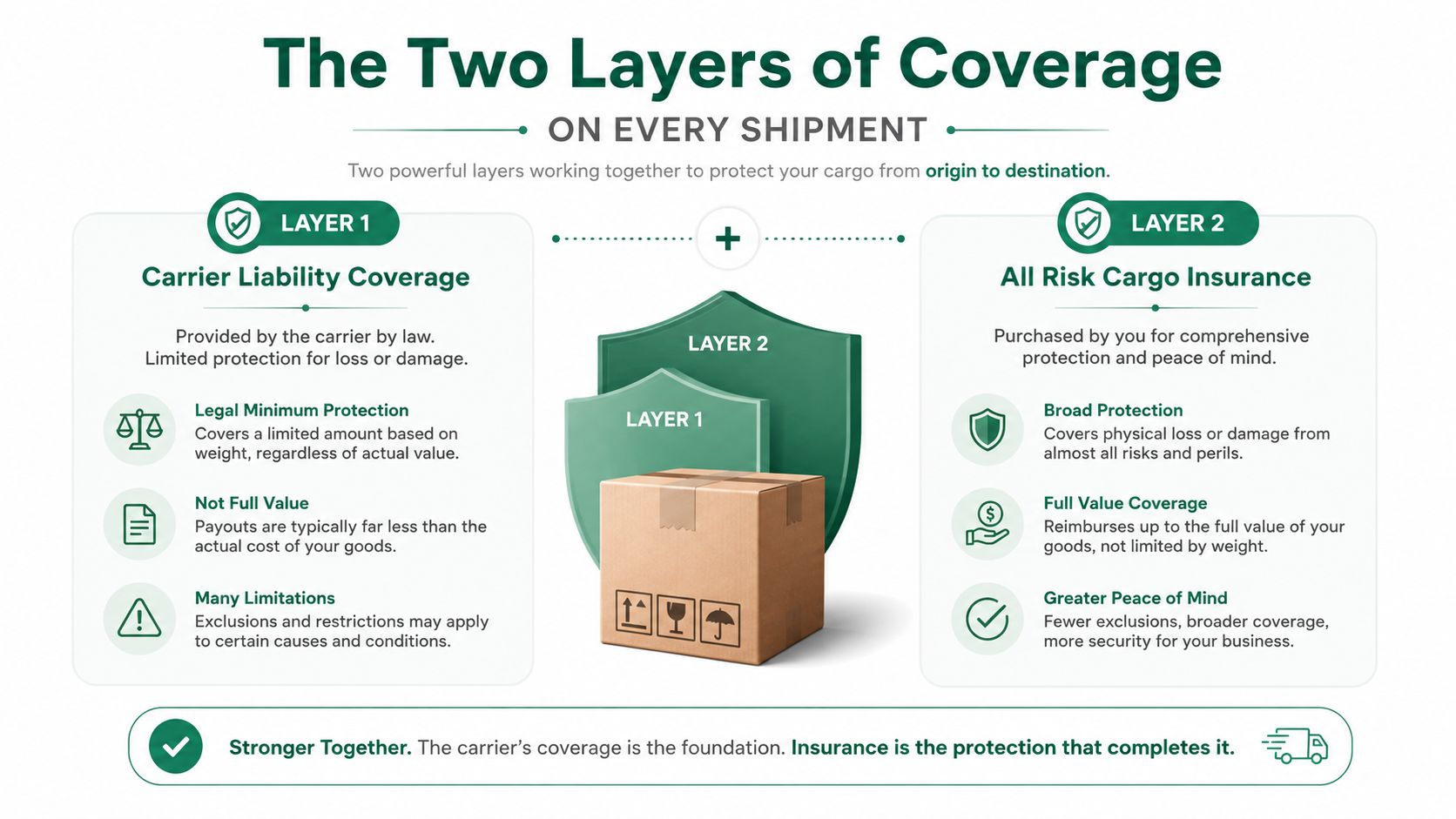
A legitimate interstate vehicle shipment usually involves two distinct layers, but they protect different interests. Carrier liability addresses damage the carrier causes to people or property. Cargo insurance is the layer that directly relates to the vehicle being transported. Federal financial-responsibility rules set a $750,000 minimum public-liability baseline for many for-hire property carriers, while a broker's $75,000 surety bond or trust requirement is not cargo insurance (FMCSA-related carrier insurance explanation).
Layer one is the carrier's built-in protection
The carrier's cargo policy generally applies while the vehicle is in the carrier's care, including loading, transit, and unloading. Market guidance commonly places open-carrier cargo limits around $100,000 to $250,000 per load, although the actual limit, deductible, and exclusions must be confirmed with the assigned carrier (auto transport insurance coverage guidance).
That limit may apply to the entire load, not automatically to each vehicle at its full declared value. A customer shipping a valuable automobile should therefore ask whether the policy limit is per vehicle, per occurrence, or per load. The policy may also calculate a covered loss differently from the owner's preferred replacement price.
Layer two is optional gap coverage
Supplemental coverage is an add-on. It can help address a shortfall between the vehicle's declared value and the carrier's available protection, or it may offer terms that better fit a high-value, classic, exotic, or modified vehicle. Industry guidance places this add-on at roughly $50 to $500, based on declared value and distance (auto transport insurance guide).
A rental-car analogy helps. Think of carrier coverage as the basic protection included in the rental rate. Supplemental coverage resembles the upgrade offered at the counter. It may raise the protection ceiling or reduce the amount exposed to a deductible, but it still has terms and exclusions.
Your personal auto policy can add another layer, but you shouldn't assume it does. Ask your insurer whether full coverage or collision protection remains active during professional transport. Weather, theft, mechanical problems, personal belongings, delay, and pre-existing damage may be treated differently from direct physical damage caused during handling. Read the actual policy language before pickup.
What Drives the Price of Transport Insurance
Insurance pricing follows the vehicle and the shipment, not just the destination. A daily driver on an open carrier generally presents a different underwriting profile from a modified classic traveling in an enclosed trailer. The six variables below help explain why two customers can receive different protection costs for apparently similar routes.
| Pricing Variable | Effect on Premium | Why It Matters |
|---|---|---|
| Declared vehicle value | Higher value generally raises the insurance portion | The insurer has more exposure if the vehicle is damaged or declared a total loss. |
| Transport type | Enclosed transport generally costs more than open transport | Enclosed equipment protects higher-value vehicles and carries its own operating and underwriting considerations. |
| Distance and route | Longer or more complex routes can increase exposure | More time in transit, highway exposure, terminal handling, and an ocean leg can create additional risk points. |
| Carrier selection | Policy limits and claims history can change the price | A larger fleet, an owner-operator, and a specialist carrier may structure risk differently. |
| Season and weather | Challenging lanes can affect pricing and availability | Winter conditions and storm-prone routes may receive closer underwriting attention. |
| Deductible | A higher deductible can reduce the premium | You accept more of the initial loss in exchange for a lower insurance charge. |
Declared value is the first figure to verify
The declared value should reflect the vehicle's realistic value, not an artificially low number chosen to reduce the quote. If the vehicle is worth more than the cargo limit, the cheapest option may leave a serious gap during a total loss. A classic, luxury, or modified car may also need valuation documents because ordinary market pricing doesn't always reflect its replacement cost.
Equipment and lane risk work together
Open transport is often practical for ordinary sedans, pickups, and SUVs. Enclosed transport can make more sense for a collectible or high-value vehicle because it reduces exposure to road debris and weather, although it usually carries a higher price. Customers considering enclosed service can review enclosed auto transport options while comparing cargo limits and deductibles.
Puerto Rico shipments add port handling and an ocean segment to the logistics chain. Insurance questions should therefore cover the handoff at the mainland port, the sea movement, arrival handling, and final delivery in or around San Juan. A policy that applies only while a truck is moving on a mainland highway may not answer every part of that journey.
Transportation insurance has also become more expensive over time. One historical industry analysis found that premium cost per mile rose 47% over 10 years, from 5.9 cents to 8.7 cents, while separate reporting cited a 9.4% increase in commercial auto premiums during 2025 (transportation insurance cost analysis). Those trends help explain why carriers may scrutinize deductibles, equipment, route exposure, and cargo limits rather than offering one universal rate.
Real Cost Examples for Common Shipments
The examples below illustrate how the insurance portion can sit beside the transport price. The figures are planning examples, not guaranteed quotes, and the customer should confirm the actual carrier policy before booking.
| Shipment Type | Vehicle Value | Base Transport Cost | Carrier Liability Included | Supplemental Insurance Cost | Total Insurance Spend | Customer Out-of-Pocket Risk |
|---|---|---|---|---|---|---|
| 400-mile open transport | $20,000 sedan | About $500 | Yes | About $50 | About $50 optional spend | Deductible, exclusions, and any value above the applicable limit |
| 1,800-mile enclosed transport | $75,000 luxury SUV | About $1,800 | Yes | About $300 | About $300 optional spend | Higher exposure if limits, deductibles, or exclusions don't match the declared value |
| Puerto Rico ocean route | $30,000 pickup | Not specified | Confirm with the carrier | About $400 | About $400 optional spend | Port, ocean, and delivery terms must be confirmed in writing |
Short open shipment
A $20,000 sedan moving about 400 miles on an open carrier might receive a base transport quote of about $500, with carrier protection already included. An optional supplemental policy could add about $50, producing roughly $50 in optional insurance spend, not a second full transport bill.
The customer's remaining exposure depends on the policy's deductible, the treatment of pre-existing damage, and whether the carrier's cargo limit is sufficient for the load. An ordinary sedan may not need the add-on, but the decision should follow the coverage terms rather than the vehicle's age alone.
Long-distance enclosed shipment
A $75,000 luxury SUV traveling about 1,800 miles in an enclosed trailer might carry a transport price near $1,800 and supplemental coverage near $300. The add-on is tied to the higher declared value and longer exposure, not to the word “enclosed.”
The customer should confirm whether the carrier's cargo limit applies to the entire trailer and how the deductible works. A policy with a high limit can still leave a meaningful claim burden if the deductible is large or if the loss falls under an exclusion.
Mainland to Puerto Rico
For a $30,000 pickup moving by ocean route to Puerto Rico, port handling and the extended chain of custody can make optional supplemental insurance relevant. A planning figure near $400 may apply to supplemental protection, but the base transport, port, documentation, and final-delivery charges must be quoted separately.
One major carrier states that cargo insurance for shipping a car to Puerto Rico isn't required by law, but optional tiers such as $25,000 or $50,000, both with zero deductible, can be purchased at additional cost (Puerto Rico vehicle shipping insurance information). That optional cargo coverage shouldn't be confused with the insurance you'll need after registration in Puerto Rico.
For broader planning, compare the transport components in this car shipping cost guide, then request a written insurance breakdown for your exact route.
How to Read and Compare Insurance on a Quote
A quote should tell you more than the total charge. Start at the insurance line and identify whether it says carrier liability included, cargo coverage included, or supplemental coverage available. Those labels don't mean the same thing, and a quote that combines them without limits can make comparison difficult.
Ask four questions before paying
Use this script with the broker or carrier:
- What is the maximum payout for my vehicle? Ask whether the limit is per vehicle, per load, or per occurrence.
- Is the deductible per claim or per vehicle? A shared loss can produce a different result from a single-vehicle incident.
- Does coverage apply during loading, port handling, ocean movement, unloading, and final delivery? This matters especially for Puerto Rico routes.
- What documents do you need at pickup? Confirm the bill of lading, condition photos, declared value evidence, and any appraisal requirements.
The carrier, not usually the broker, owns the cargo policy. Guidance for auto haulers commonly describes cargo coverage as the protection for physical damage during loading, transit, and unloading, with common market limits around $100,000 to $250,000 per load and some contracts requiring $1,000,000 in coverage (cargo insurance guidance for auto transport).
Normalize the competing quotes
Suppose one quote has a lower base price but a lower declared value and a higher deductible. Another quote costs more but covers the vehicle at its realistic value and clearly states the claim process. Those aren't comparable until you align the declared value, deductible, coverage trigger, and exclusions.
For an unusual, classic, or modified vehicle, an appraisal can help establish a defensible value. The why an appraisal from Auto Appraisal Expert resource can help owners understand the role of valuation documentation before they request coverage.
Before booking, save the written quote and confirm:
- Coverage limit: The maximum amount available for the vehicle and the load.
- Deductible: The amount applied before payment and who must pay it.
- Coverage window: The exact point when protection starts and ends.
- Exclusions: Weather, personal belongings, mechanical issues, delay, and pre-existing damage.
- Claim contact: The carrier, insurer, broker, or supplemental provider responsible for the first notice.
Filing a Claim When Something Goes Wrong
A damage claim becomes easier when you treat the bill of lading as a condition record, not a routine signature. The pickup inspection establishes what already existed. The delivery inspection establishes whether a new issue appeared while the vehicle was in transit or in the carrier's care.
Start at pickup
Wash the vehicle when possible and photograph every side, wheel, glass panel, bumper, and visible blemish. The driver should record pre-existing scratches, dents, chips, and other conditions on the bill of lading. Compare the driver's notes with your photographs before signing.
The clearer the baseline, the less room there is for an argument about when damage occurred. Keep the photos and paperwork together until the shipment is fully resolved.
Inspect before accepting delivery
At delivery, inspect the vehicle before the driver leaves and before you sign a clean bill of lading. Check body panels, mirrors, lights, wheels, windshield, bumpers, and the areas under the hood and around the vehicle where practical.
If you find new damage, write it on the bill of lading in specific language. Take close photographs and wider photos showing the vehicle's position and the carrier equipment. Signing a clean delivery document without inspecting the vehicle can be treated as acceptance in good condition, making recovery much harder.
At delivery, document first and sign second.
File with the correct party
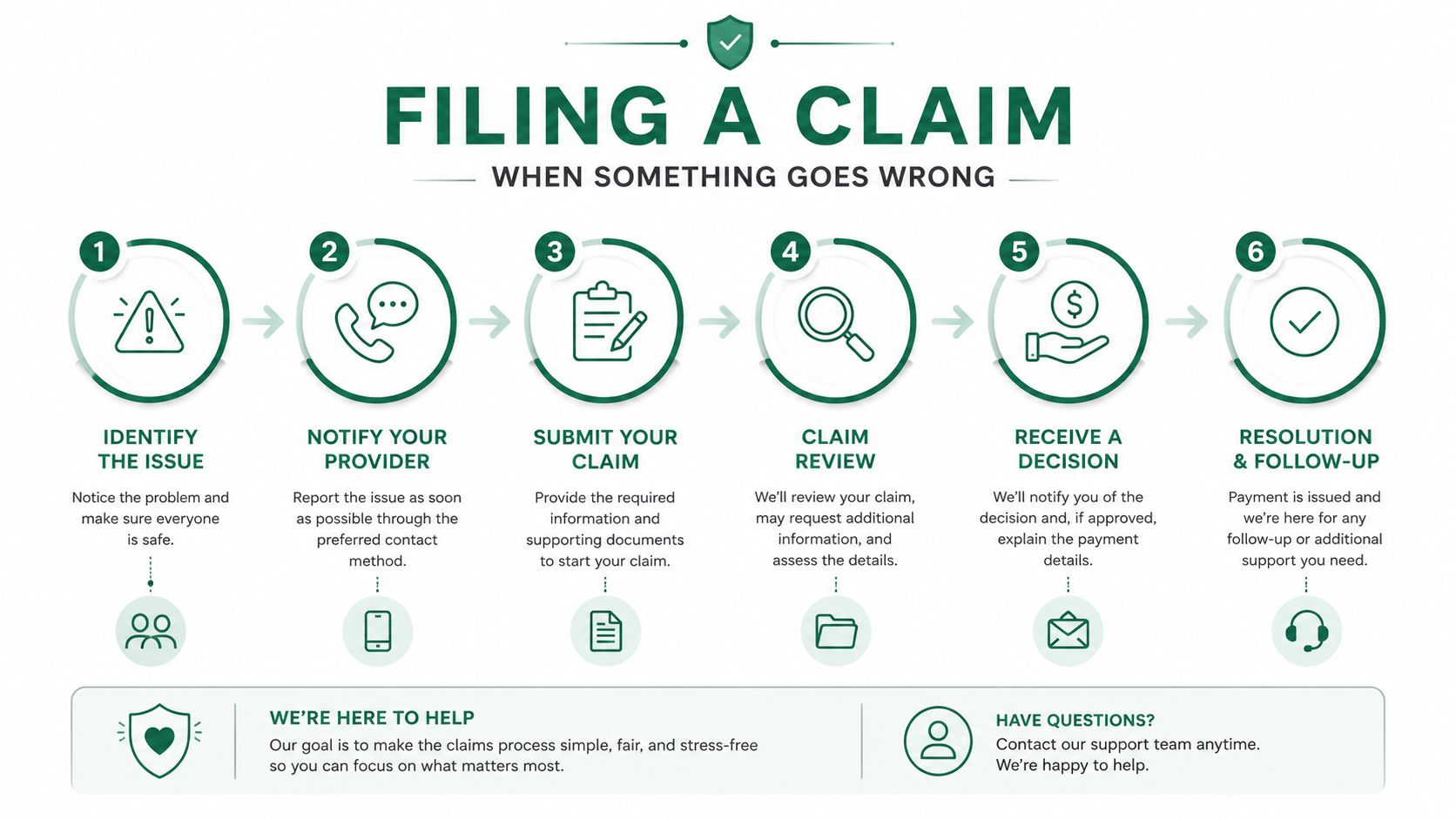
Submit the claim through the carrier's claim process and, if applicable, notify the supplemental insurer separately. Include the pickup and delivery bill-of-lading pages, photographs from both inspections, a written description, repair estimates, and receipts for completed work.
Don't promise a repair amount before the insurer reviews the evidence. The carrier, broker, and insurer may each have a defined role, so ask who assigned the claim number and where all documents must be sent.
After submission, the insurer may evaluate liability, review the condition records, request additional evidence, and decide whether the appropriate resolution is repair, reimbursement, or another settlement. If communication stops or the dispute involves a regulated carrier, the FMCSA consumer complaint process may provide an escalation route. Check the applicable policy and contract before assuming a complaint guarantees payment.
For a visual overview of the process, review the following claim walkthrough.
Smart Ways to Lower Cost Without Losing Protection
Lowering the insurance portion of a shipment doesn't mean choosing the smallest limit. It means matching protection to the vehicle, route, and loss you can realistically absorb.
- Choose open transport for ordinary daily drivers: An open carrier can be a sensible fit when the vehicle doesn't need enclosed handling and minor exposure concerns don't justify the additional equipment.
- Reserve supplemental coverage for a real gap: For an older or lower-value vehicle, compare the add-on price with the declared value, deductible, and exclusions before purchasing it.
- Consider the deductible carefully: A higher deductible can reduce the insurance line item, but only choose it if you can handle that amount after a covered loss.
- Offer flexible pickup dates: Flexible scheduling may help match the vehicle with an available carrier already serving the lane, rather than forcing a more costly dedicated arrangement.
- Document the condition thoroughly: Clear pickup photos and an accurate bill of lading don't lower the quote, but they protect the evidence that supports a valid claim.
- Match equipment to value: Owners of collector, exotic, or heavily modified vehicles should compare enclosed options and cargo limits through resources such as classic car shipping, rather than treating every vehicle as an ordinary sedan.
Puerto Rico customers should also separate shipment coverage from post-arrival registration requirements. A Puerto Rico registration guide says registered vehicles must carry insurance, owners can purchase a private policy or pay compulsory government liability insurance during registration, and registration should occur within three days of arrival (Puerto Rico registration and insurance guidance). That is a separate cost layer from cargo protection during transport.
National Car Transport states that its quotes include baseline carrier liability and can present optional protection according to declared value and lane. Its U.S.-based bilingual English and Spanish agents have more than 20 years of auto transport logistics experience, while the company reports 25+ years in business, an A+ BBB rating, and a network of 25,000+ vetted carriers. Each shipment is different, so a knowledgeable agent can help explain the coverage line, route handoffs, and documentation before you book.
For a quote that separates included carrier liability from optional supplemental protection, visit National Car Transport and provide your vehicle value, pickup and delivery locations, transport type, and preferred dates. Their bilingual U.S.-based agents can help individuals, snowbirds, military families, students, dealerships, and businesses compare the insurance details before handing over the keys.