
If you're arranging a move, buying a car from another state, sending a vehicle to a college student, or trying to get one to or from Puerto Rico without turning it into a second full-time job, auto transport door to door is usually the option that makes the most sense. You hand the logistics to a carrier, meet the truck at pickup, and receive the vehicle as close as safely and legally possible to the destination.
That simplicity matters because those shipping a vehicle are already juggling something else. A home closing. A PCS move. A seasonal relocation. A dealership deadline. The transport itself shouldn't become the hardest part.
Table of Contents
- What Is Door to Door Auto Transport
- How Door to Door Shipping Actually Works
- Choosing Between Door to Door and Terminal Shipping
- What Drives the Cost of Door to Door Shipping
- Shipping Your Car to Puerto Rico Alaska and Hawaii
- How to Prepare Your Vehicle for Transport
- Frequently Asked Questions
What Is Door to Door Auto Transport
Door to door auto transport means a carrier picks up your vehicle from a home, office, dealership, auction, or other agreed location and delivers it to the destination area without requiring you to use a terminal lot. In practice, that means the truck comes as close as access laws, road conditions, and safety allow.
This isn't a fringe service anymore. The North American door-to-door auto transport service market was estimated at $917.8 million in 2025 and is projected to reach $1,096.1 million by 2032, growing at a 2.5% CAGR, according to Liberty Auto Transport's market summary. The useful takeaway isn't the projection by itself. It's that door-to-door shipping now operates at a scale large enough to be a standard logistics model, not a special arrangement.
What customers usually mean by door to door
The phrase "door to door" often brings to mind driveway-to-driveway. Sometimes that's exactly what happens. Sometimes it isn't.
A full-size car hauler still has to deal with low branches, HOA rules, tight cul-de-sacs, weight-restricted roads, parked cars, and city ordinances. So the definition is simpler and more accurate: pickup and delivery as close to your address as a commercial transport truck can safely and legally reach.
Practical rule: If a fire truck or moving semi would struggle on your street, your car carrier may ask to meet at a nearby lot, wide side street, or shopping center entrance.
Why people choose it
The biggest reason is straightforward. It removes extra steps.
You don't have to coordinate rides to and from a terminal. You don't have to store the vehicle at a regional lot. You don't have to build your own last-mile plan on each end of the shipment. For snowbirds, military families, students, online car buyers, and businesses moving inventory, that reduction in friction is often worth more than chasing the cheapest possible quote.
How Door to Door Shipping Actually Works
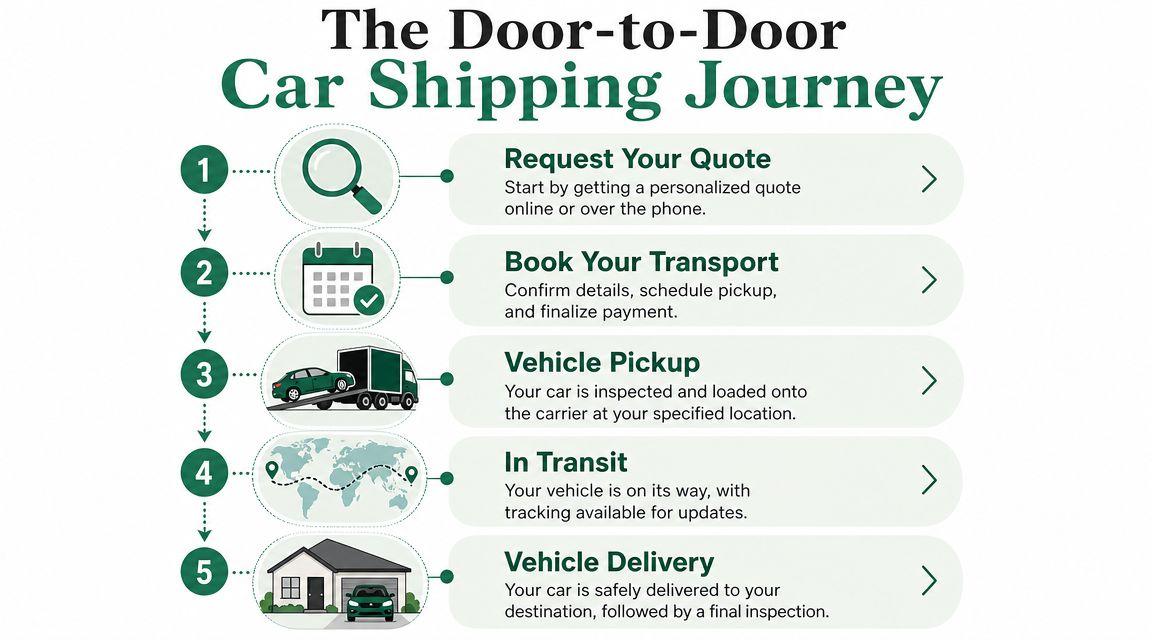
A typical shipment starts with a simple goal. Get the car picked up near your home, keep the paperwork clean, and avoid surprises at delivery. The process is straightforward when the vehicle details are accurate and both addresses are evaluated for truck access early.
Booking and dispatch
Booking starts with the details that determine whether a carrier can price and schedule the move correctly. Origin, destination, first available pickup date, running condition, and vehicle size all affect dispatch. Customers often underestimate the size piece, but carriers use length, width, height, and weight to plan a legal load and avoid problems on pickup day, especially on residential streets, as noted by the ECG Association guidance on transported vehicle information.
If a broker is handling the move, dispatch then matches your shipment with a carrier running that lane. National Car Transport coordinates door-to-door moves through a large carrier network and uses bilingual U.S.-based agents for mainland and Puerto Rico shipments. That matters on port moves, where title documents, booking cutoffs, and Spanish-language communication can affect whether a vehicle clears the handoff on time.
Good dispatch work also includes an early access check. A full-size carrier may not fit under tree limbs, through gated entries, or around tight cul-de-sacs. When that happens, the efficient solution is a nearby meeting point with room to load safely.
Pickup day and inspection
Pickup day is mostly about verification.
The driver usually calls ahead, confirms the meeting spot, and completes a walk-around inspection before loading. Existing dents, scratches, cracked glass, and other visible condition issues go on the Bill of Lading. Review that form carefully before signing it, because it becomes the baseline document used again at delivery.
A clean car helps. So do working keys, a charged battery, and accurate information about whether the vehicle runs. If a car was booked as operable but needs a winch, or if oversized modifications were never disclosed, the truck can be delayed or the order can require a different carrier.
A short video can help if you've never seen the handoff process before.
For Puerto Rico shipments, pickup has one extra layer. The inland carrier is only one part of the job. The file also has to be ready for port intake, which usually means matching the title or lienholder paperwork to the booking record and making sure the owner or authorized shipper has valid identification ready before the vehicle reaches the terminal.
Transit and final delivery
In transit, your car is usually one of several vehicles on the trailer. That is standard for door-to-door service. The benefit is not exclusive transport. The benefit is fewer handoffs between separate storage locations and transfer points.
Delivery follows the same discipline as pickup:
- The driver calls ahead to confirm timing and the best legal meeting location.
- The vehicle is unloaded at your address or a nearby access point that can safely handle the truck.
- A final inspection is completed before any delivery paperwork is signed.
- Any new damage is written on the delivery documents immediately so the record is clear.
This matters even more in Alaska, Hawaii, and Puerto Rico, where final delivery may involve a port release before the last overland leg. On those moves, the smoothest shipments usually have one point of contact who can coordinate the carrier, the port, and the customer in English or Spanish. That cuts down on missed calls, document mismatches, and wasted trips to the terminal.
The process works best when expectations are realistic. Door to door means close to your address when a commercial truck can reach it safely and legally. In dense neighborhoods or older subdivisions, a grocery lot, wide side street, or commercial entrance is often the better delivery plan.
Choosing Between Door to Door and Terminal Shipping
Most customers are really deciding between convenience and extra legwork. Both options can move a car. They just ask different things from you.
The biggest operational advantage of door-to-door shipping is simple. Fewer handling events reduce cumulative risk, and eliminating terminal transfers and intermediate storage also supports more predictable delivery windows, according to A-1 Auto Transport's explanation of door-to-door service.
Door-to-Door vs. Terminal-to-Terminal at a Glance
| Feature | Door-to-Door Transport | Terminal-to-Terminal Transport |
|---|---|---|
| Pickup and delivery | Carrier comes to your area | You drop off and pick up at terminal lots |
| Customer effort | Lower | Higher |
| Vehicle handling | Fewer handoffs | More handoffs are common |
| Scheduling | Built around carrier access and route | Built around terminal hours and storage procedures |
| Best fit | Relocations, busy households, military moves, online purchases | Customers who don't mind extra driving and coordination |
Where door to door wins
If you're managing a relocation, the time savings are obvious. You don't need to arrange a ride after dropping off the vehicle. You don't need to travel to a terminal after the move just to collect it. That matters even more in unfamiliar cities.
It also tends to be the better fit for customers who care about reducing avoidable touchpoints. Every time a vehicle is stored, transferred, repositioned, or checked through another facility, another opportunity opens up for minor damage or paperwork confusion. That's one reason door-to-door has become the default choice for many households and businesses.
A direct route doesn't guarantee a perfect move, but fewer transfers usually mean fewer chances for something small to become a real headache.
When terminal shipping may still fit
Terminal shipping can still make sense for some situations. A customer near a major terminal who has schedule flexibility and wants to manage more of the logistics personally may be comfortable with it.
But there are trade-offs that first-time shippers often underestimate:
- Extra driving: You'll need transportation to and from the terminal.
- More timing constraints: Terminals operate on their own business hours, not yours.
- Storage exposure: Your vehicle may sit before pickup or after arrival.
- More coordination points: More people and places are involved.
For most individuals shipping a personal car, door-to-door is the simpler path. For businesses with regular terminal workflows, it may be worth comparing both.
What Drives the Cost of Door to Door Shipping
Quotes vary because routes vary. A short, high-volume lane is one kind of move. A lifted truck going to a low-access residential street is another.
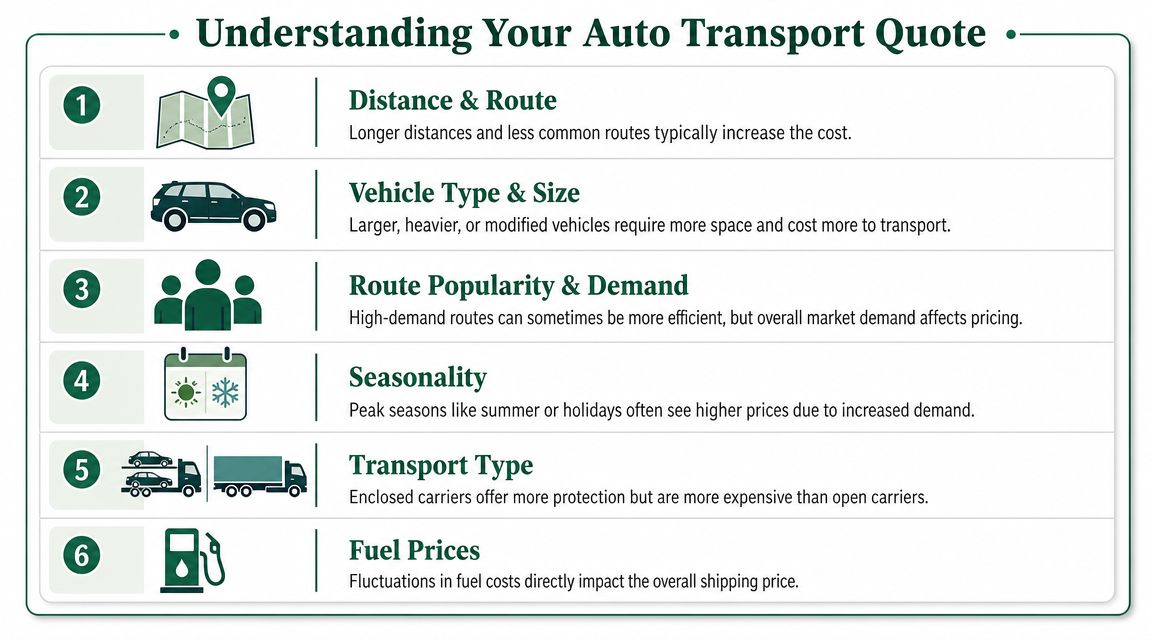
The only useful way to understand pricing is to break it into the variables that change carrier planning.
The quote is built from route and equipment
For a standard sedan on an open carrier over 500 to 1,500 miles, average shipping cost is reported at $800 to $1,500, and enclosed transport typically costs 40% to 60% more, based on the Data Insights Market report on door-to-door auto transport service. That's a useful benchmark, not a universal price card.
Here are the main drivers behind the quote:
- Distance and route shape: Longer trips usually cost more overall. Common interstate corridors are usually easier to schedule than out-of-the-way rural routes.
- Vehicle size and weight: Large SUVs, heavy EVs, long-bed trucks, and modified vehicles take more planning space on the trailer.
- Open or enclosed trailer: Open transport fits most daily drivers. Enclosed is for customers who want a different protection level.
- Operable or inoperable status: If a vehicle doesn't run, the carrier needs equipment and time to load it.
- Pickup and delivery access: Tight urban streets, steep driveways, or rural roads can change how the handoff is arranged.
What changes a quote after booking
Most pricing problems come from mismatched information, not random surprises. If a sedan turns out to be a lifted SUV. If a car was booked as running but won't start. If the pickup location is inaccessible to a large hauler. Those are the details that cause rework.
What works is accuracy from the beginning. What doesn't work is trying to "simplify" the quote request by leaving out modifications, mechanical issues, or access restrictions.
A good quote should account for the actual shipment, not the idealized version of it.
Shipping Your Car to Puerto Rico Alaska and Hawaii
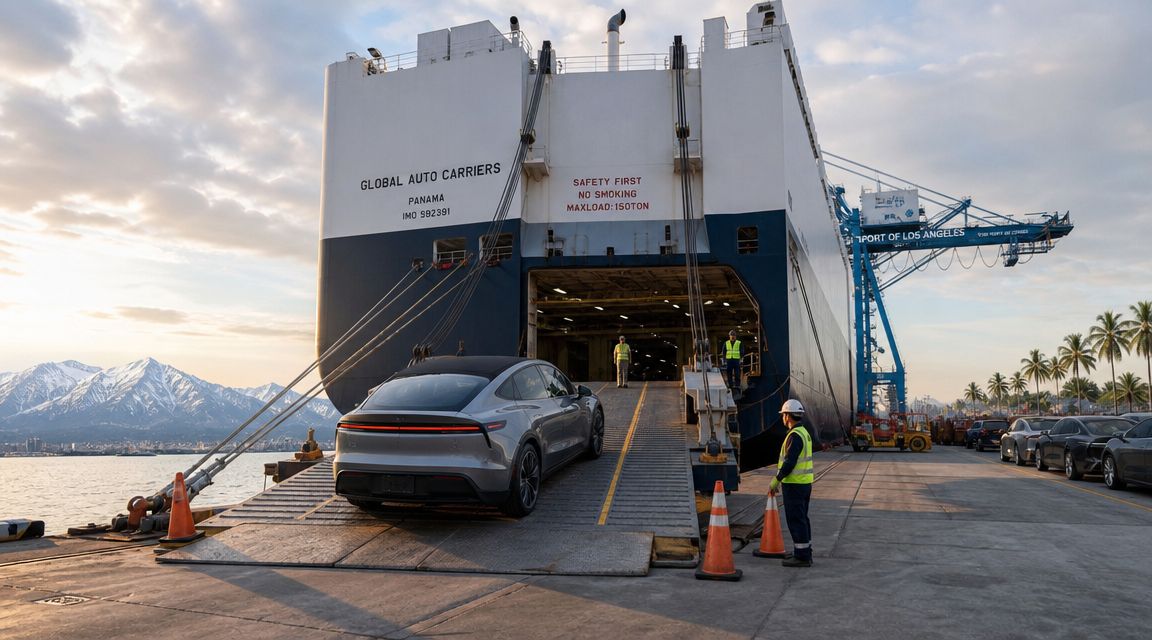
Shipping to Puerto Rico, Alaska, or Hawaii isn't just a longer domestic move. It's usually a multi-leg shipment that combines ground transport with port handling or ocean service. Experience matters, because the vehicle is no longer moving through one simple over-the-road route.
Puerto Rico moves have an extra layer
For Puerto Rico, the shipment commonly involves mainland pickup, transport to a departure port, ocean movement, arrival processing, and release or final delivery on the island. Customers shipping from places like Miami, Orlando, Jacksonville, Houston, New York, Newark, Philadelphia, Chicago, Atlanta, Dallas, Los Angeles, Phoenix, Seattle, or other major mainland markets usually care about one thing most: paperwork mistakes.
The exact document list can vary by carrier, port, and ownership status, but customers commonly need items such as:
- Proof of ownership: Usually the title or current registration, depending on shipment type
- Government-issued identification: The name on the shipment should match the documentation
- Lienholder authorization when applicable: Financed vehicles often require written approval
- Port and local release paperwork: Puerto Rico moves may involve additional port or tax-related forms depending on the transaction
San Juan is the main reference point many customers know, but the main challenge isn't the city name. It's making sure the documents, names, VIN, and release instructions all match before the vehicle ever reaches the port.
Puerto Rico shipments go smoothly when the file is clean before the truck is dispatched. They go badly when customers try to sort out title or lien issues after the vehicle is already moving.
This is also where bilingual support helps. A customer coordinating with family in Puerto Rico, a dealership on the mainland, and a port contact doesn't need more confusion. They need one person who can explain the process clearly in English or Spanish and keep each handoff aligned.
Alaska and Hawaii follow a similar logic
Alaska and Hawaii shipments also involve more than standard overland routing. Alaska may combine highway transport with regional delivery constraints depending on the final destination. Hawaii typically includes port delivery and ocean service before island release.
The practical lesson is the same in all three markets. Door-to-door may still begin at your home or office, but the middle of the shipment includes commercial port procedures that don't exist in a standard lower-48 move. Customers in major cities across the mainland and those shipping into San Juan need a coordinator who catches documentation issues early.
How to Prepare Your Vehicle for Transport
Most pickup-day problems are preventable. Good preparation shortens the handoff, improves the inspection, and reduces the chance of disputes later.
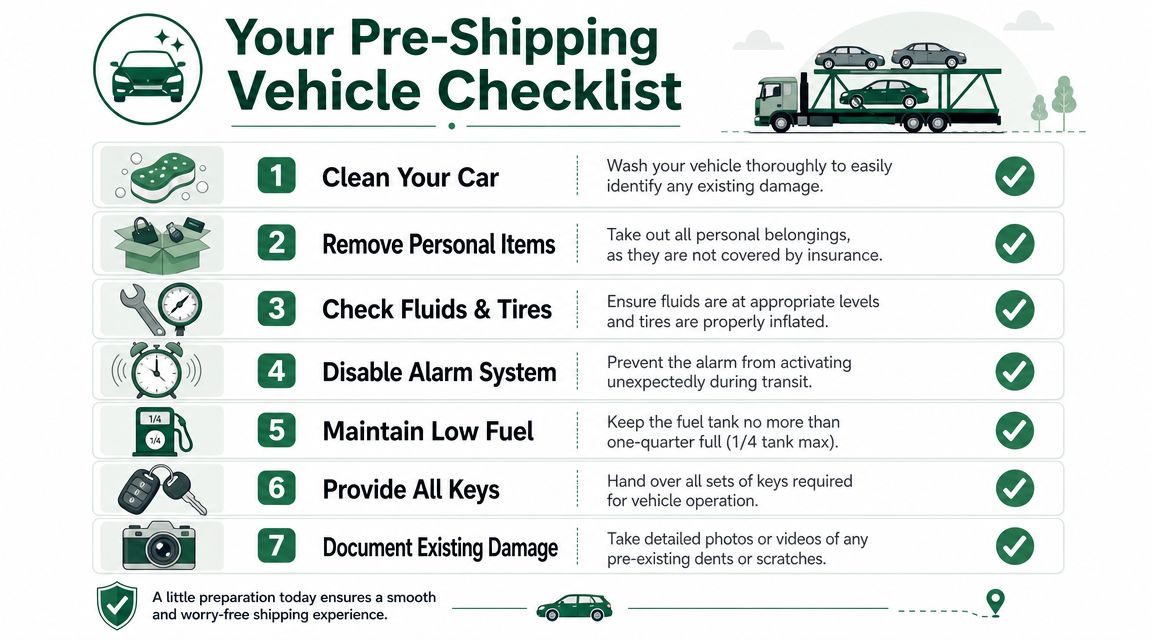
A practical pre-pickup checklist
Use this checklist before the driver arrives:
- Wash the exterior: Dirt hides scratches, chips, and scuffs. A clean car gives both you and the driver a fair inspection baseline.
- Remove personal items: Carriers focus on the vehicle itself. Loose items inside the cabin or trunk can shift, and personal belongings usually aren't treated the same as the vehicle in transport.
- Leave only a small amount of fuel: Keep it at or below a quarter tank. The car needs enough fuel for loading and unloading, not a full tank adding extra weight.
- Secure or remove loose accessories: Bike racks, spoilers, detachable antennas, and custom add-ons can create loading issues.
- Check basic operating condition: Tires should hold air, the battery should be charged, and the car should start if it was booked as operable.
- Turn off alarms if possible: A repeatedly triggered alarm is a nuisance for the driver and everyone around the trailer.
- Photograph the vehicle: Take clear photos from multiple angles right before pickup.
If you're doing a deeper pre-transport cleanup, it's also smart to clean your vehicle's engine carefully before shipping. That isn't required for transport, but it can make it easier to spot fresh leaks or mechanical issues before the carrier arrives.
A final point that helps more than people expect: have all keys ready. Not one key. All keys needed to operate the vehicle, access it, and move it if necessary.
Frequently Asked Questions
Is open or enclosed better
It depends on the vehicle and your risk tolerance. Open trailers are more available and affordable, while enclosed carriers are essential for classic cars, exotics, and low-clearance vehicles that may need a hydraulic lift gate, and the higher price is tied to protection from weather, road debris, and damage risk, as explained by Freedom Auto Transport's enclosed transport guidance.
For a daily driver, open transport is usually the practical choice. For a collector vehicle, exotic, show car, or very low-clearance model, enclosed is often the smarter operational decision.
Do I need to be there in person
Not always. You can usually authorize another adult to meet the driver at pickup or delivery if that person can inspect the vehicle, sign documents, and take possession of the keys.
The mistake to avoid is waiting until the truck is already arriving to make that plan. Set it up in advance and make sure the representative knows exactly what to look for.
What about insurance and inspection records
Ask how the carrier's cargo coverage works and keep your own photos from pickup day. The inspection report matters because it establishes the vehicle's visible condition before transport.
If anything looks different at delivery, note it on the paperwork before signing off. That's standard good practice.
Can you ship from major mainland cities to San Juan
Yes. Customers regularly arrange shipments from large metro areas across the mainland to Puerto Rico, including East Coast, Gulf Coast, Midwest, Southwest, and West Coast origins. The route itself is manageable. The paperwork and port coordination are where people usually need guidance.
If you're comparing providers, ask about island experience, port handling, title requirements, bilingual customer support, and how updates are communicated once the vehicle reaches the port side of the move.
If you're planning an interstate shipment or a Puerto Rico move and want a clear explanation of the options before you book, National Car Transport is one provider to review. It handles door-to-door auto shipping across the U.S., Puerto Rico, Alaska, and Hawaii, offers flat-rate pricing with no upfront charge until a carrier is assigned, and supports customers with experienced bilingual agents based in the U.S. who help keep each shipment simple and organized.