
When a move involves a car, “direct” sounds like a promise of speed. It's really a routing choice, with a price, a schedule, and fewer handoffs to weigh. The extra cost may make sense when timing and careful handling matter. If neither does, paying for a direct route may bring little benefit.
Table of Contents
- What Direct Auto Transport Really Means
- Direct, Terminal and Pooled Routes Side by Side
- What Direct Auto Transport Costs and Why
- Pros, Cons and When Direct Service Is Worth It
- Real Situations Where Direct Service Makes Sense
- Verifying Who Moves Your Car
- Book Direct Service With Clear Terms
What Direct Auto Transport Really Means
Direct auto transport usually means a carrier picks up your vehicle near the origin address and delivers it near the destination address, with few or no intermediate stops for that car. It's like a nonstop flight: you avoid changing planes, but the nonstop option isn't automatically cheaper or faster in every situation.
A terminal route is more like a flight with a connection. The car goes to a regional lot, waits for another truck, then gets reloaded for the trip onward. Pooled shipping is closer to a bus route, with a truck collecting and dropping off vehicles along the way.
The word direct describes the route, not the vehicle or the carrier's quality. It doesn't, by itself, tell you whether the car will travel on an open or enclosed truck, what insurance applies, or whether one company will physically haul the vehicle. Companies also use “direct” differently, so read the quote for the actual service rather than relying on the label.
For example, if you're moving from Chicago to Miami, a direct quote might mean one assigned truck handles pickup and delivery with few stops. Another company might use “direct” to describe door-to-door service even if it coordinates a carrier that makes other pickups on the way. To understand your protection as well as the route, you can compare vehicle transport insurance through Professional Insurance Advisors, LLC.
Direct means fewer handoffs, not automatically faster or cheaper.
Check a quote with three questions: Does it name a single truck for your addresses? Does it list intermediate stops? Is the motor carrier named? A clear answer to each tells you what routing model the quote describes.
Direct, Terminal and Pooled Routes Side by Side
| Criteria | Direct | Terminal | Pooled |
|---|---|---|---|
| Stops before delivery | None, or only stops on your own route | One or more terminal drop-offs, then reload | Several pickups and drop-offs on one truck |
| Handoffs between carriers | Usually one carrier and one truck | Two or more handoffs | Usually one carrier, but many shared stops |
| Pickup timing | Narrower window tied to your route | Drop-off at terminal, then pickup later | Wider window that shifts as stops are added |
| Times the car is loaded and unloaded | Once at pickup and once at delivery | At least twice on each side of the terminal | Once each, with extra days on the truck |
| Date flexibility | Lower, because it needs a scheduled truck | Moderate | Highest |
| Best fit | Fixed deadlines and high-value vehicles | Access to terminal hubs and some budget savings | Flexible dates and tight budgets |
Each extra handoff adds an event to manage. The car is loaded, unloaded, and possibly parked while the next leg is arranged. That creates more opportunities for waiting, miscommunication, or scuffs, though careful handling and inspection still matter with any route.
How the three routes work
Direct: The carrier plans a route around your pickup and delivery, with few or no intermediate stops for your vehicle. This can narrow the pickup window and make it easier to know who is responsible for the car, but you're paying for a more specific routing arrangement. Door-to-door service still has practical limits: a large carrier may not be able to enter a narrow street or gated community. Ask whether the driver can reach your address or whether you'll need to meet at a safe nearby location. See how door-to-door auto transport works when the pickup or delivery point needs coordination.
Terminal: You drop the car at a regional lot, where it waits for a truck traveling toward the destination. It's reloaded for the next leg, which adds handling and can make the schedule less predictable. The trade-off may suit someone who can reach both terminals and doesn't need a narrow delivery window.
Pooled: One truck carries several cars and stops at multiple pickup and delivery points. Your car may stay on the same truck, but the route takes time to serve the other customers. This approach is often a reasonable match if you can accept a wider window in exchange for a lower-cost arrangement.
Treat the table as a guide to typical patterns, not a guarantee for every company or route. If your deadline is fixed, focus on the direct row and get the pickup and delivery windows in writing. If your budget is firm and your dates are flexible, compare pooled quotes first.
What Direct Auto Transport Costs and Why
Direct service often costs more than pooled shipping on the same route because the carrier builds the trip around a more specific pickup and delivery. That doesn't mean every direct quote will be more expensive than every alternative. The vehicle, addresses, schedule, and carrier availability all shape the offer.
| Cost Driver | How It Changes the Price | What to Ask Before Booking |
|---|---|---|
| Distance and route popularity | Long or low-traffic lanes cost more per mile for a dedicated truck | Is this lane run regularly, and is the quote for my exact addresses? |
| Season and peak periods | Snowbird season and holiday moves push rates up | Does the quote change if I move the date by a week? |
| Vehicle size and weight | SUVs, pickups and vans take more space and can cost more | Does the quote assume my vehicle's exact dimensions and weight? |
| Operability | Inoperable vehicles need winching or special handling and often add a fee | Is the fee included in the quote? |
| Open or enclosed carrier | Enclosed service costs more for added protection | Which option fits the vehicle's age and value? |
| Pickup and delivery location | Rural, gated or narrow-street addresses can add time and fees | Can the truck reach the address, or is a nearby meeting point needed? |
| Date flexibility | A fixed date limits which trucks are available | Is a flexible window cheaper, and by how much? |
A rural pickup can take longer to fit into a carrier's schedule than a pickup near a busy highway corridor. A large SUV or pickup also takes up more space than a compact sedan, while an inoperable vehicle may need equipment the assigned truck doesn't normally carry. Share the vehicle's accurate condition and dimensions before comparing prices.
Open carriers are exposed to weather and road debris; enclosed transport offers more protection, which can make sense for a classic, luxury, or otherwise valuable vehicle. That added protection has a cost, so consider the vehicle's needs rather than assuming enclosed service is automatically necessary.
For another way to understand the variables in a quote, review this guide to car shipping costs. Then look closely at what the price promises. FMCSA lists estimates that are much lower than actual charges among common auto-transport complaints, alongside undisclosed cancellation or refund policies and brokers misrepresenting themselves as carriers. Ask whether the quote is guaranteed, whether the final carrier can re-bid the load, what you may owe beyond the initial estimate, and what happens if you cancel.
Compare like with like: the same routing model, vehicle condition, addresses, and service type.
A low number without clear terms isn't a reliable comparison. Get the quote and cancellation policy in writing before paying, and confirm that the final amount still matches the service you agreed to.
Pros, Cons and When Direct Service Is Worth It
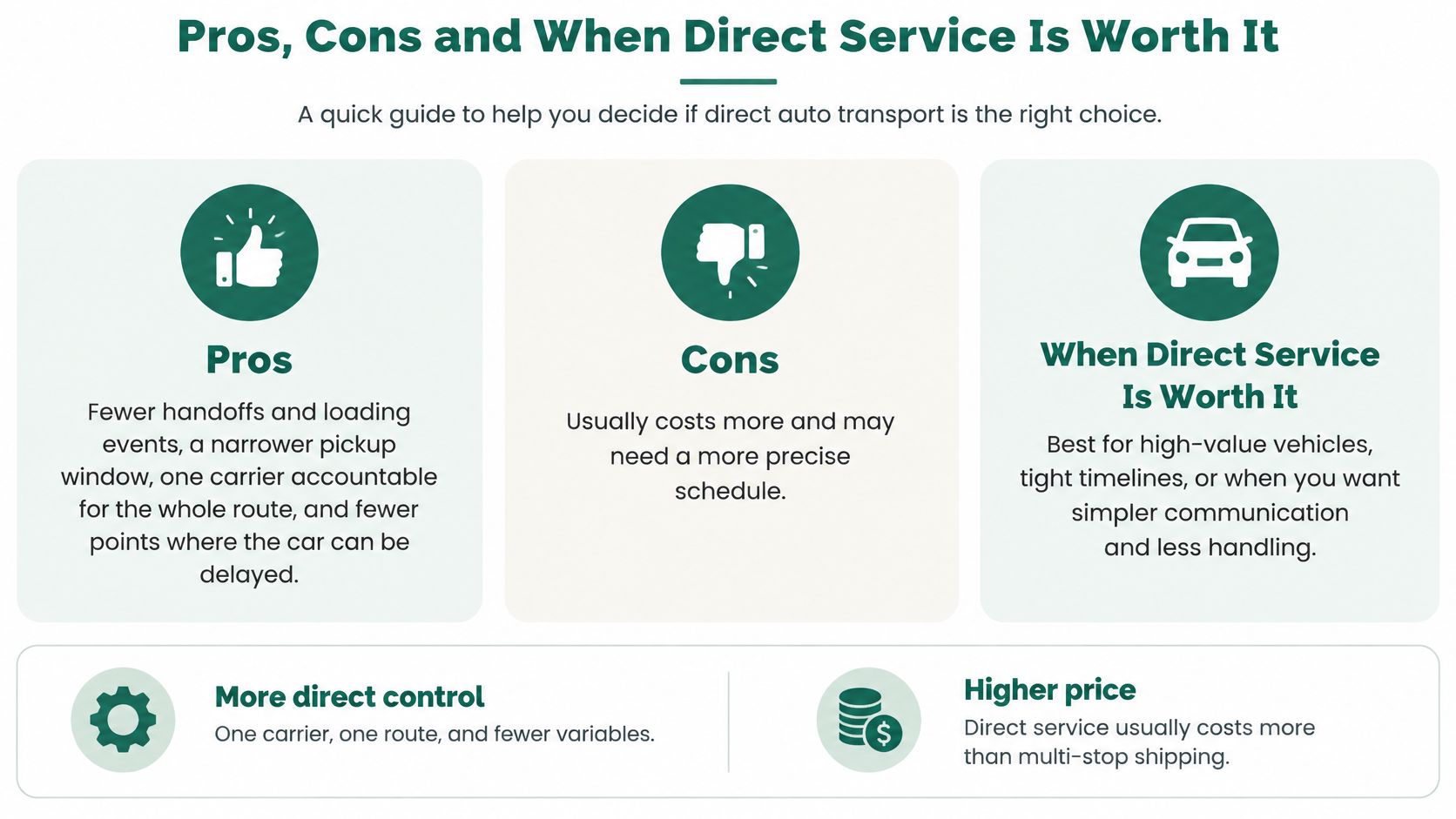
Direct service can simplify a move: fewer handoffs, fewer loading events, a narrower pickup window, and one carrier handling the route. Those features can reduce the number of opportunities for a transfer-related delay or a communication gap. They're particularly useful when you can't easily change your plans or when extra handling is a concern.
The trade-offs are real. Direct service usually costs more, offers less date flexibility, and may involve waiting for an available truck on a low-volume rural route. Some corridors have fewer carriers to choose from. And a direct route doesn't guarantee earlier arrival: traffic, weather, the carrier's schedule, and road conditions still affect delivery.
Use this checklist to see whether the premium buys something you need:
- Is there a hard deadline? A reporting date, flight, or move-in day can make timing valuable.
- Is the vehicle high-value, rare, or hard to move? Fewer handling events may be worth paying for.
- Is your budget a firm ceiling? If so, a pooled option may fit better.
- Can a large truck reach both addresses? If not, a nearby meeting point may be necessary.
- Is the vehicle operable? If it doesn't run, confirm the equipment and handling charges.
- Are your dates flexible by at least a week? More flexibility can open up other routing options.
- Is the route a busy corridor? More carrier activity can give you more scheduling choices.
Count the answers that point to a hard deadline, a high-value vehicle, or limited flexibility. If two or more apply, direct service may be worth the premium. If your answers mostly point to flexible dates and a firm budget, pooled shipping is likely the more practical fit.
Direct and pooled aren't quality rankings. They're different ways to balance price, timing, and handling. Pay for a more specific route when those benefits solve a real problem; otherwise, the extra cost may buy little you'll notice.
Real Situations Where Direct Service Makes Sense
A snowbird heading from a northern home to Florida may need a car ready around the time they arrive. Direct service can make the pickup and delivery window easier to coordinate with a flight, though it cannot promise an exact arrival time. If the trip dates are flexible, pooled transport may cost less without creating a problem.
Military families often have orders and a report-by date to plan around. A narrower pickup window can help coordinate the move, but keep a local transportation backup in case weather or a carrier delay shifts delivery.
For a student, the key question is whether the car must arrive by move-in day. Direct routing may help meet a tight schedule. If the student can get by without the car for a while, compare pooled service and use the savings for other moving costs.
Dealerships, auction buyers, and online vehicle customers should separate the carrier's delivery window from the seller's contractual promise. If the seller changes a promised date, ask for the revised date in writing and keep records of any resulting costs. In March 2025, the FTC announced it was distributing more than $934,000 to 20,361 consumers affected by Vroom's failed delivery promises, including shipment delays, delays without consent, and late refunds, according to the FTC's Vroom refund announcement.
Classic and luxury-car owners may combine direct routing with enclosed shipping to reduce handling and exposure. That added control can justify the cost when the vehicle's value or condition makes avoidable risks expensive. Confirm that the carrier's equipment can accommodate the car's dimensions and ground clearance.
Mainland to Puerto Rico involves more than highway miles
Shipping a vehicle from the mainland to San Juan, Puerto Rico can involve mainland pickup, trucking to a port, vessel or container transport, island-side handling, and final delivery. FMCSA's explanation of interstate commerce and federal requirements explains that transportation between the United States and a U.S. territory can fall within interstate commerce. Separate stages of the journey may still involve different carriers and responsibilities.
Ask which company handles each leg, where its responsibility begins and ends, and what insurance applies at each stage. National Car Transport offers container and ocean shipping for island routes, so ask for the mainland pickup, port transfer, ocean freight, and island delivery to be itemized in the quote.
For a time-sensitive move, ask whether the provider can accommodate your preferred schedule. Same-day pickup may help with the mainland collection, but it does not determine when the ocean portion arrives. Review the same-day auto transport options separately from port handling and vessel timing before agreeing to the plan.
Verifying Who Moves Your Car
A company offering “direct” service may still be a broker. FMCSA describes a property broker as an intermediary that arranges transportation rather than operating the vehicle. Its auto-transport complaint guidance identifies complaints involving brokers presenting themselves as carriers, operating without authority or insurance, hiding cancellation terms, and advertising estimates far below the eventual carrier charge.
Before paying, check the arrangement in this order:
- Ask what role the company will play. Will it physically haul your car as the carrier, arrange another company to haul it, or do both?
- Get the legal name and identifiers. Request the company's USDOT and MC numbers, then check the motor carrier's identity and operating authority in FMCSA records.
- Clarify how the price can change. Ask how the estimate compares with the final carrier charge and what happens if the load is re-bid.
- Match the paperwork to the payment. Confirm the motor carrier named on the transport documents is the carrier assigned to your shipment and that you understand who you're paying.
- Keep a record. Save the quote, contract, payment confirmation, agent's name, and vehicle condition notes and photos from pickup and delivery.
A verified broker still relies on a licensed carrier to move the vehicle. On a Puerto Rico shipment, different companies may handle different legs, so check the carrier and insurance arrangements for each stage rather than assuming one company covers the entire trip. If you're sorting out how commercial coverage differs from other insurance, the PTL Insurance Associates commercial auto guide can provide useful context.
Book Direct Service With Clear Terms
A direct route only helps if the booking terms match the move you need. Give the company the exact pickup and delivery addresses, vehicle condition, access restrictions, and your preferred routing. A quote based on a nearby city or a different vehicle may not match what the assigned carrier can accommodate.
Before paying, confirm who will haul the vehicle and who will arrange the shipment. Get cancellation, refund, and re-bid terms in writing. Pin down pickup and delivery windows, whom to contact during transit, and how the carrier will record the vehicle's condition at pickup and delivery.
If delivery is delayed, request a revised date in writing and check the refund terms rather than relying on a phone promise. Note added costs, such as temporary transportation or storage, and contact the seller, lender, or insurer if the delay affects your arrangements. Puerto Rico routes may involve separate mainland pickup, port transfer, ocean transport, and island delivery. Ask which company handles each leg and what insurance applies.
National Car Transport is one U.S.-based option to compare. The company reports 25+ years of experience, an A+ BBB rating, flat-rate pricing with no upfront charges until your vehicle is matched with a carrier, and a network of 25,000+ vetted, licensed, and bonded drivers. Its bilingual English and Spanish agents can help review the routing, schedule, price, and handoffs for your move. Ask for those details before booking so you can see what the quoted service covers.
Pay extra for direct service when its tighter schedule or simpler handling solves a specific problem, such as limited delivery flexibility. If your dates are flexible and your vehicle is straightforward to move, compare other routes first. Direct routing is a trade-off: the added cost has value only when the timing or handling benefit matters to you.
For domestic and Puerto Rico vehicle shipping, National Car Transport offers open and enclosed transport, door-to-door coordination, and guidance on island routes. Share your addresses, vehicle details, and timing needs with National Car Transport to compare routing options and confirm what the quote includes.