

Shipping a car from Alaska typically costs $1,500 to $4,000 and usually takes 5 to 9 days, but both numbers can swing quite a bit depending on the exact route, vehicle type, and service you choose. If your move involves a smaller mainland lane, a standard port shipment, or a remote Alaska destination, the price and timeline can look very different from the average.
If you're reading this, you're probably trying to solve a real problem fast. Maybe you're leaving Alaska for a military reassignment, heading south for school, relocating your household, or trying to move inventory for a dealership or business. In a lot of cases, the car itself isn't the hard part. The hard part is figuring out which parts of the trip happen by truck, which happen by vessel, and where hidden costs show up.
Auto shipping from Alaska isn't like booking a simple carrier from one city in the lower 48 to another. Most moves involve a door-to-port or port-to-port handoff, weather can disrupt timing, and remote communities introduce a last-mile challenge that many quotes don't explain well up front. That's where customers get surprised.
The good news is that the process is manageable when you understand the route, the handoffs, and the paperwork before your vehicle moves.
Table of Contents
- Your Guide to Shipping a Car from Alaska
- Understanding Your Alaska Shipping Options
- Decoding Auto Shipping Costs and Transit Times
- A Practical Checklist for Vehicle Preparation
- Navigating Documentation and Insurance
- Tips for Remote and Seasonal Alaskan Shipments
- Frequently Asked Questions About Auto Shipping from Alaska
Your Guide to Shipping a Car from Alaska
Moving a vehicle out of Alaska usually starts with one simple question: can this be handled without turning into a weeks-long headache? Yes, it can, but Alaska requires more coordination than a standard state-to-state move.
The biggest reason is geography. Most shipments don't travel by truck alone. They usually involve an overland segment to a major West Coast port, or the reverse, followed by ocean transport. Add winter conditions, port schedules, and vehicle restrictions, and it's easy to see why generic auto shipping advice often falls short here.
For families, students, snowbirds, service members, dealerships, and companies moving units between markets, the practical issue isn't just price. It's knowing exactly where your car is going next, who has it, and what happens if the final destination isn't Anchorage or another main hub.
Practical rule: If your destination is outside the standard port corridor, ask about the final handoff before you book, not after your vehicle is already in transit.
A provider that handles both mainland and non-contiguous routes is usually a better fit for this type of move. That matters not only for Alaska, but also for other complex ocean-based lanes. Puerto Rico is a good example. Shipping from the U.S. mainland to San Juan involves its own port processing, ocean transit, and customs-related timing, with moves from Miami to San Juan taking 9 to 11 days and costing $1,879 to $2,179 based on Puerto Rico car shipping market rates. For mainland-to-island moves, the total Puerto Rico timeline can run 12 to 21 days, including pickup, loading, ocean transit, customs clearance, and final delivery, as outlined in this Puerto Rico transport timeline breakdown.
That kind of coordination is why many customers want a live logistics contact instead of a generic booking portal. National Car Transport is one example of a U.S.-based option that handles Alaska, Puerto Rico, and nationwide auto transport with bilingual English and Spanish agents, transparent flat-rate pricing, and a large vetted carrier network. Not one shipment is exactly alike. Having one experienced person guide the move is often what keeps it simple.
Understanding Your Alaska Shipping Options
Alaska moves are easiest to understand when you think in segments. The car usually travels by truck on the mainland side, then by ocean freight for the Alaska segment. That structure is why the service type matters so much.
How the route usually works
The most common setup is a door-to-port approach. The vehicle moves from its mainland origin to the Tacoma or Seattle area, then continues by vessel. For Alaska-bound freight, ocean transit from Tacoma to Anchorage averages 3 to 5 days, and total door-to-port timing can range from 5 to 21 days depending on where the trip starts on the mainland, according to this Alaska shipping route overview.
That model also works in reverse for auto shipping from Alaska. Once the vehicle reaches the main port leg, the shipment continues to its mainland destination by truck. It sounds straightforward on paper, but handoffs matter. If the carrier and port schedule don't line up, the vehicle can sit and wait.
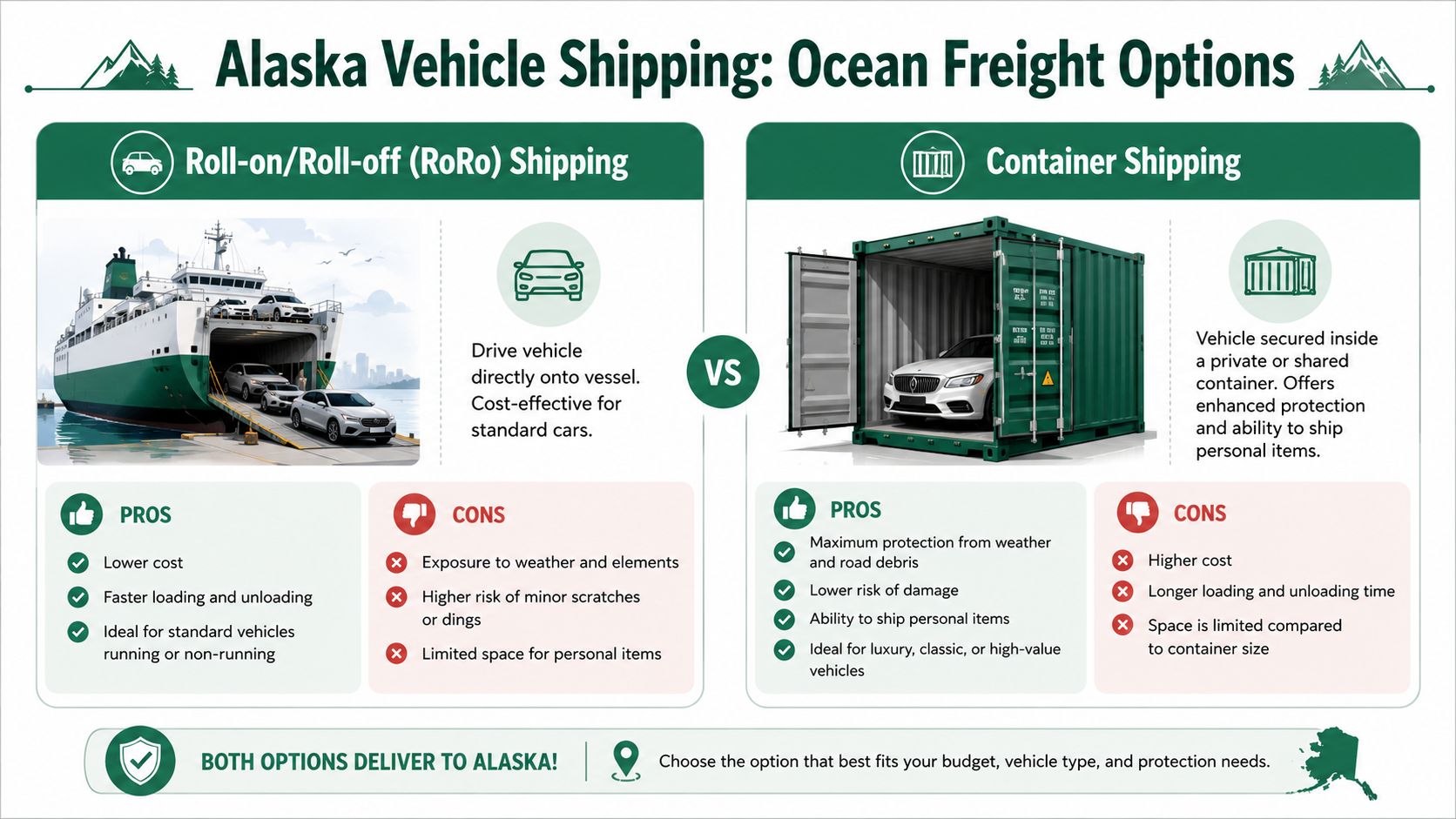
RoRo versus container shipping
For most customers, the decision comes down to RoRo or container service.
RoRo, short for Roll-on/Roll-off, is usually the standard choice for operable vehicles. The car is driven onto the vessel and secured for transit. It's generally the more economical option and works well for routine moves involving sedans, SUVs, and many light trucks.
Container shipping places the vehicle inside a container for the ocean portion of the trip. It offers more protection from the marine environment and is often the better fit for higher-value units, certain specialty vehicles, and situations where extra protection matters more than keeping costs down.
| Method | Cost | Protection Level | Best For |
|---|---|---|---|
| RoRo | Lower-cost option in most cases | Standard protection during vessel transit | Running vehicles, routine relocations, budget-focused shipments |
| Container | Higher than RoRo | Higher protection | Classic cars, premium vehicles, added protection needs |
A few practical trade-offs usually decide it:
- Choose RoRo if: your vehicle runs, your route is standard, and your top concern is cost control.
- Choose container if: your vehicle is high-value, sensitive, or you want a more protected ocean segment.
- Double-check eligibility: not every oversized or modified vehicle fits every vessel or every container setup.
A cheap quote isn't always the better quote if it skips how the vehicle gets from the port to the final address.
For many customers in the lower 48, domestic shipping is simpler because a truck can move the unit directly between major cities in states like California, Texas, Florida, New York, Arizona, Illinois, Georgia, Washington, Colorado, and Nevada. Alaska is different. The ocean leg makes planning more important, especially if your shipment starts or ends beyond a major terminal.
Decoding Auto Shipping Costs and Transit Times
A quote to Anchorage is usually straightforward. A quote to a smaller community can change fast once barge space, port storage, transfer fees, or local delivery are added. That is the part many customers do not see in the first estimate.
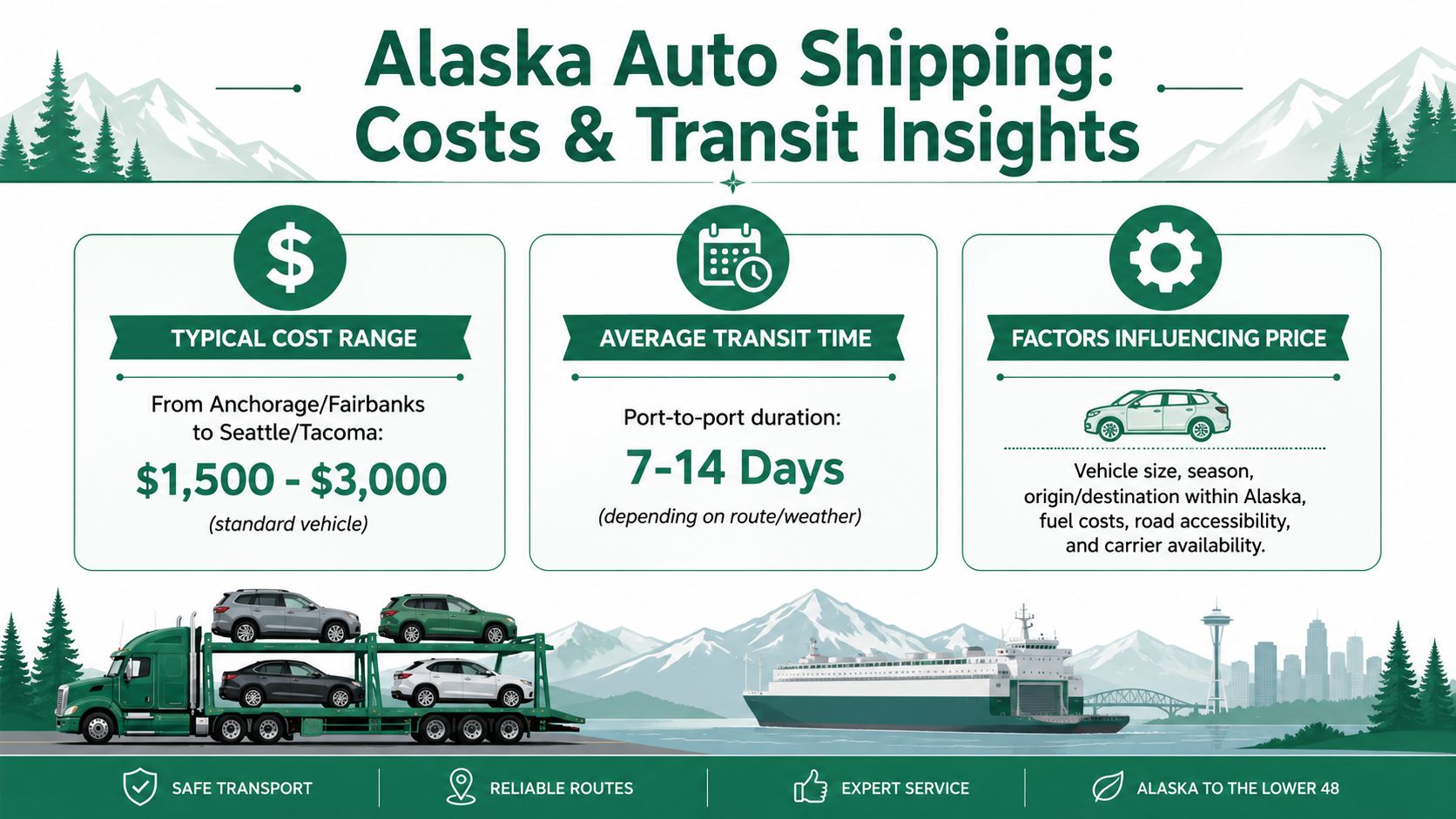
What the real price range looks like
Many Alaska vehicle shipments land in a broad middle range of about $1,500 to $4,000, but the lane only tells part of the story. Port-based moves between major gateways are usually the easiest to price. The total changes once the shipment needs extra storage time, a second transfer, or final delivery beyond a core terminal.
Transit time works the same way. Many standard Alaska moves are often quoted in the 5 to 9 day range, and Montway's Alaska shipping overview notes that timing shifts by route length and origin. In practice, customers should separate line-haul transit from total delivery time. A vehicle can reach the main Alaska port on schedule and still wait for the next available handoff to a remote area.
That distinction matters more than the headline estimate.
Why one Alaska quote can be much higher than another
Distance still drives price, but Alaska adds layers that do not show up on a simple mileage calculator. Vehicle size affects deck space and handling. Modified trucks, oversized SUVs, and units with roof racks or lift kits can create fit issues that change the carrier plan. If the vehicle is not going to Anchorage, Fairbanks, or another common handoff point, the last-mile segment often becomes the most expensive part of the move.
I tell customers to look at Alaska quotes in two parts. First, the vehicle gets to the port or primary hub. Second, it gets from that hub to the actual destination. The second part is where surprise costs usually show up.
These are the factors that move the total most:
- Mainland lane length: West Coast routes usually price better than cross-country pickups.
- Vehicle dimensions and condition: Oversized or non-running vehicles can require different handling and higher fees.
- Port and terminal charges: Storage, missed cutoff dates, and after-hours handling can add cost quickly.
- Remote community delivery: Barge connections, limited schedules, and local transfer work can extend both price and timing.
- Season: Winter weather and peak household-goods shipping periods can tighten capacity.
Ask for a quote that separates port-to-port charges from final-delivery charges. That is the clearest way to spot hidden costs before booking.
For remote Alaska shipments, schedule margin matters as much as budget. The Alaska Marine Highway System publishes changing sailing schedules and service notices at its official route and schedule page, and those shifts can affect handoffs for communities that rely on limited service windows. If the vehicle misses one connection, the next opening may not be immediate.
Booking early helps, but the better move is asking specific questions. Confirm the cutoff date at the port, how many transfers are involved, whether storage is billed after arrival, and who is responsible for arranging the final leg. At National Car Transport, that is usually where we save customers the most stress, because the original quote can look reasonable until the last-mile details are spelled out.
A Practical Checklist for Vehicle Preparation
A vehicle can clear the booking stage and still run into trouble on shipping day because of preventable prep issues. I see it most often with port drops and remote Alaska deliveries, where a missed handoff can mean storage fees, a rescheduled barge leg, or extra local transfer work that was never in the original plan.

What to do before pickup or port drop
Start with the basics early, not the night before. Wash the exterior so existing chips, dents, and scuffs are easy to see. Remove loose items from the cabin, trunk, and cargo area. Personal belongings can shift in transit, and they can also create problems if the vehicle moves through more than one terminal before reaching a smaller community.
Fuel level matters too. Keep about a quarter tank unless your carrier gives different instructions. That is usually enough for loading and unloading without adding unnecessary weight.
Then check whether the car can be handled without delay. Tires should hold air, the battery should be charged, and the vehicle should start, steer, and brake normally unless the carrier already agreed to a non-running unit. If there is a leak, a low front bumper, an intermittent starting issue, or a disabled alarm, disclose it before the vehicle reaches the port. Small mechanical surprises are a common reason a vehicle misses its scheduled loading window.
Use this prep list before the carrier arrives:
- Wash the exterior: A clean vehicle makes the condition report easier to complete accurately.
- Remove loose and personal items: Clear out electronics, toll tags, paperwork, tools, and anything that can slide or break.
- Leave only what the carrier expects: Keep the keys, any required operating instructions, and approved vehicle accessories with the car.
- Check basic operating condition: Confirm tire pressure, battery charge, fluid leaks, and whether the vehicle starts and moves as expected.
- Take detailed photos: Capture all sides, the roof, wheels, bumpers, glass, and close-ups of existing damage in good light.
- Prepare for the last mile: Fold mirrors if needed, note low clearance or oversized dimensions, and confirm who will accept the vehicle at the final destination.
Photos and inspection notes matter most on Alaska routes with multiple handoffs. If a vehicle moves from truck to port, then to vessel, then to a local delivery partner serving a community beyond Anchorage, each transfer adds another point where condition should be documented clearly. Good photos also help if road grime or weather makes delivery-day inspection harder.
What to check at delivery before you sign
Give yourself time to inspect the vehicle properly. Daylight is best. Compare the delivered condition to your pickup photos and the carrier's condition report, and look beyond the door panels. Check the roofline, front lip, lower rocker panels, wheels, mirrors, and bumpers, especially if the vehicle was moved several times before final delivery.
For remote community shipments, ask where the final inspection is supposed to happen. Some customers assume they can sort everything out later, but the cleanest way to record an issue is at the handoff point, before the receipt is signed. If mud, snow, or salt spray is covering the vehicle, note that and inspect as carefully as conditions allow.
The Bill of Lading is the working record for vehicle condition at release and delivery. If you see new damage, missing accessories, or a mechanical issue that was not listed at pickup, write it on that document before signing and keep a copy for your records.
A short visual walkthrough can help if you've never shipped before:
If you're using a brokered network, the inspection is still completed by the actual carrier handling the vehicle. National Car Transport coordinates those assignments, but your own photos, notes, and delivery check remain the strongest backup if a question comes up later.
Navigating Documentation and Insurance
Paperwork worries a lot of customers more than the transport itself. That's understandable. Individuals rarely ship vehicles, and Alaska routes can involve multiple handoffs.
Paperwork that usually matters most
Requirements vary by carrier and route, but a few documents come up again and again. You should be prepared to provide proof that you control the vehicle being shipped, identify yourself, and confirm the booking details tied to the order.
In practical terms, have these ready:
- Photo identification: A government-issued ID is commonly needed to match the booking party.
- Vehicle registration or title copy: Carriers and ports may need proof tied to the VIN and ownership or authorized control.
- Booking confirmation: Keep the signed or accepted shipment details accessible.
- Contact information for release and receipt: If someone else will hand off or accept the vehicle, make that clear in advance.
If your move involves Puerto Rico rather than Alaska, documentation gets more layered because that route includes port processing and tax considerations. For mainland-to-Puerto Rico shipments, an excise tax called Impuesto de Consumo is typically 10% to 20% of the vehicle's book value, while fully electric and plug-in hybrid vehicles are exempt, according to this Puerto Rico vehicle tax reference. That's one reason customers moving to San Juan or shipping from states like Florida, Texas, New Jersey, or Pennsylvania should confirm port and tax requirements early.
Where insurance confusion happens
Carrier cargo insurance and personal auto insurance are not the same thing. People often assume their personal policy automatically covers every stage of a transport move the same way it covers daily driving. That's where misunderstandings start.
A 2025 report from the Alaska Department of Insurance showed a 22% increase in disputed auto shipping claims related to coverage ambiguity, which is why it's smart to review transit coverage before the vehicle moves, as noted in this Alaska insurance coverage discussion.
Ask direct questions before pickup:
- What does the carrier's cargo policy cover during transit?
- Are there exclusions for open transport, weather-related issues, or specific vehicle conditions?
- Does your personal policy treat in-transit damage differently from ordinary vehicle damage?
- What documentation will be needed if a claim has to be filed?
If an insurance explanation feels vague, it probably is. Get the coverage terms clarified before the keys change hands.
For classic, exotic, or unusually valuable vehicles, this conversation matters even more. The route may be routine, but the risk tolerance isn't.
Tips for Remote and Seasonal Alaskan Shipments
Most online guides talk about Anchorage because that's the easiest version of the move. That isn't the version many Alaska customers face.
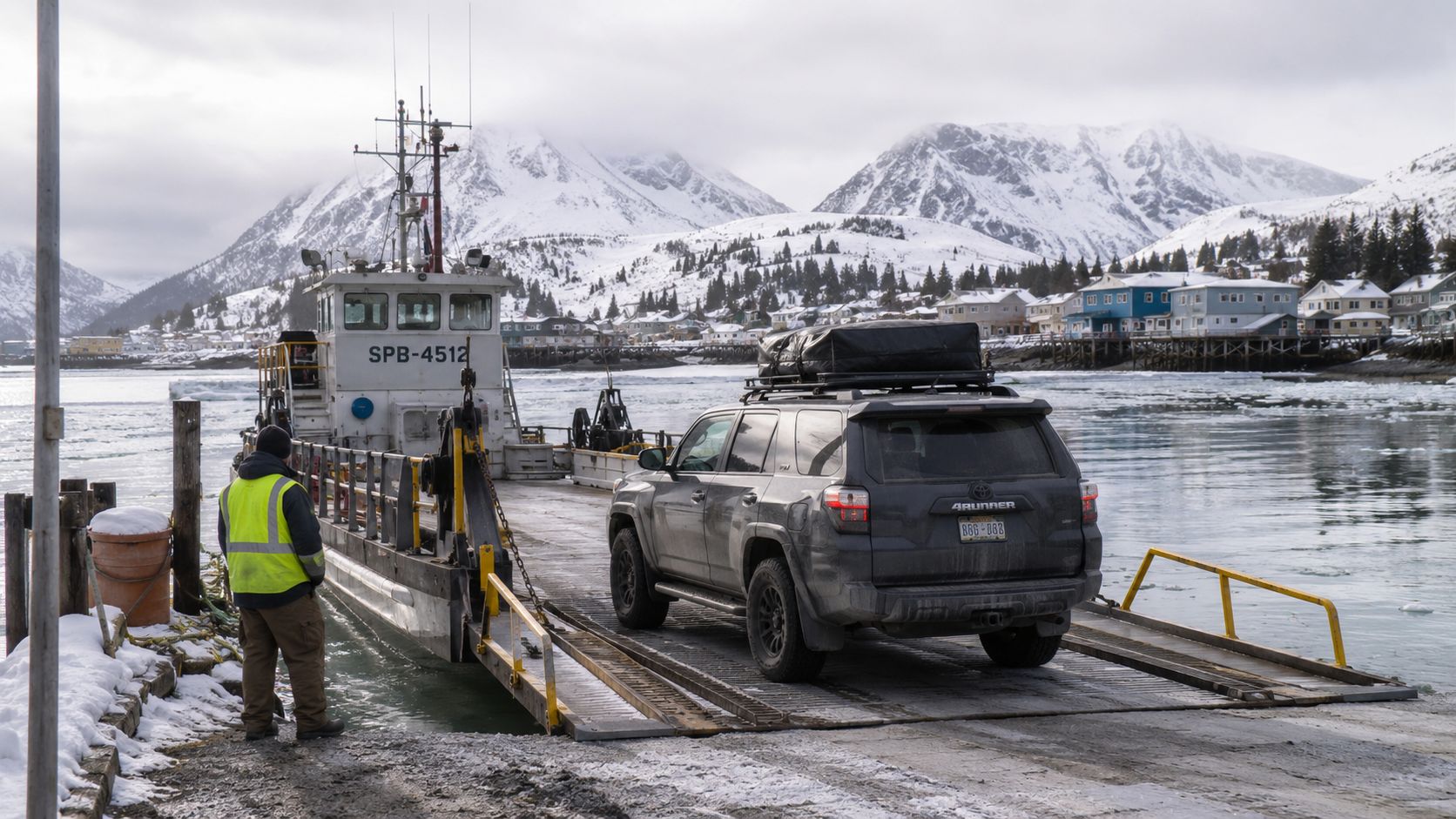
Remote delivery is where quotes often break down
A meaningful share of Alaska lives outside urban centers. 17% of Alaska's population lives in non-urban areas, and last-mile delivery to those communities can require multimodal transport, adding 5 to 8 days and $800 to $1,500 in extra fees, according to this analysis of rural Alaska shipping challenges.
That changes the job completely. A shipment bound for Fairbanks, Nome, or Kotzebue doesn't behave like a simple Anchorage lane. The vehicle may need to move by truck, then barge, and in some cases another specialized handoff follows. That's where inexperienced booking teams miss the true cost.
Ask these questions if your route is outside a main hub:
- Is the quoted price only to Anchorage or to the final community?
- Who arranges the last-mile segment?
- Is the final leg by truck, barge, or another mode?
- What happens if weather delays the handoff between legs?
Customers who don't ask these questions early are the ones most likely to face revised timelines and surprise charges.
Winter changes scheduling
Seasonality matters in Alaska more than in most states. Winter weather can push schedules around, especially when port timing is already tight. The Alaska door-to-port guidance cited earlier notes that winter can add extra time to the schedule. In practice, that means you should leave more room in your planning if you're shipping during cold-weather periods.
A few habits help:
- Book earlier than you would for a lower-48 move: Tight windows are harder to protect in winter.
- Stay flexible on exact pickup and delivery dates: A day of buffer helps more than one might assume.
- Confirm final access conditions: Snow, road limits, and local unloading realities can affect the last leg.
- Keep communication centralized: One point of contact reduces mistakes when the route uses more than one carrier or mode.
Remote Alaska shipping is usually less about the ocean crossing and more about the final miles after the vessel arrives.
Frequently Asked Questions About Auto Shipping from Alaska
Can I ship a non-running vehicle from Alaska?
Yes, but you need to disclose that up front. Non-running units often require different handling equipment and may not fit the same vessel and loading plan as an operable car. If the vehicle can't roll, steer, or brake, say so early so the quote matches the work.
Is open transport always the right choice?
Not always. Open transport is usually the more practical budget option for standard vehicles, but it isn't the only fit. If you're shipping a classic, luxury, or highly sensitive vehicle, more protective service may make sense, especially for a route that includes an ocean leg.
How far in advance should I book?
For Alaska shipments, 2 to 3 weeks in advance is the safer window for availability and scheduling, as noted earlier in the article. If you're moving during winter or to a remote community, give yourself even more lead time.
Can I leave personal items in the car?
You generally shouldn't. Carriers commonly restrict personal belongings, and loose items create both liability and inspection problems. For Alaska lanes, where handoffs are common, keeping the vehicle empty is the cleaner approach.
Do you ship only between Alaska and the West Coast?
No. Many customers move vehicles between Alaska and destinations throughout the mainland United States, including major cities across the lower 48. That can include common relocation and dealership lanes tied to cities such as Los Angeles, San Diego, San Francisco, Phoenix, Denver, Dallas, Houston, Miami, Orlando, Atlanta, Chicago, New York City, Boston, Philadelphia, Seattle, Portland, Las Vegas, Charlotte, Nashville, and San Juan, Puerto Rico for island service.
What if I need help in Spanish?
Ask for a bilingual agent. For many families and businesses, especially those shipping to or from Puerto Rico, clear English and Spanish communication makes the process much easier and reduces mistakes around paperwork, pickup instructions, and delivery contacts.
If you need help planning auto shipping from Alaska, National Car Transport can walk through the route, port handoffs, rural delivery questions, and timing details before you book. Customers across the mainland, Alaska, and Puerto Rico work with U.S.-based bilingual agents who focus only on auto transport logistics, so you get a clear point of contact, flat-rate pricing, and practical guidance for a move that fits your vehicle, route, and schedule.