

You've probably got a move coming up, a vehicle purchase that needs transport, or a Puerto Rico shipment that suddenly feels more complicated than it looked at first. The quote form seems simple until you realize one company wants a deposit, another gives a price that feels suspiciously low, and a third starts talking about ports, title copies, and size restrictions.
That's where many customers get stuck. They think they're comparing prices, but they are evaluating service models, carrier access, paperwork support, timing flexibility, and risk tolerance. Auto service quotes for car shipping only help if the quote reflects the actual services required.
I work from the logistics side of vehicle transport, and the pattern is always the same. The smooth shipments usually start with a detailed quote and a real conversation. The stressful ones usually start with missing details, vague pricing, or a customer who wasn't told what the quote did and didn't include.
Table of Contents
- Decoding Auto Transport Quotes for a Smooth Move
- How to Request an Accurate Car Shipping Quote
- Whats Included in Your Auto Transport Quote
- The Complete Guide to Shipping a Car to Puerto Rico
- Comparing Quotes and Spotting Red Flags
- Your Final Checklist for Choosing a Car Shipping Provider
Decoding Auto Transport Quotes for a Smooth Move
A customer in Phoenix needs a car moved to Miami. A student in Chicago wants a vehicle sent home to San Juan. A military family is relocating from Texas and needs one car on the mainland and another routed through Jacksonville for Puerto Rico. Those all sound like “ship my car” jobs, but they're not the same shipment, and they shouldn't get the same quote.
That's the first thing to understand about auto service quotes in transport. A quote isn't just a number. It's a summary of assumptions. It reflects the route, whether the car runs, whether the truck can access the pickup street, what kind of trailer is needed, how fast the shipment must move, and whether a port handoff is part of the job.
A clean quote should tell you what kind of service you're buying, not just what you're paying. That matters on mainland routes between major cities like Los Angeles, Dallas, Atlanta, Seattle, Denver, Boston, Las Vegas, Orlando, Nashville, Charlotte, and New York. It matters even more when the destination is San Juan, because island moves involve trucking, port scheduling, ocean transport, and local release procedures.
Practical rule: If the quote arrives faster than the questions, it's probably based on guesses.
Many shoppers start with online price checks, which is fine. A quick review of car shipping cost factors can help you understand why one route prices differently from another. But a useful quote only becomes reliable when the transporter has enough detail to price the shipment the way it will move.
The companies that handle this well usually ask more upfront. That's a good sign. They're trying to prevent the two most common problems in transport: dispatch delays and price changes after booking.
How to Request an Accurate Car Shipping Quote
The easiest way to get a bad quote is to leave out details you think don't matter. In car shipping, small details change equipment needs, loading plans, and scheduling options.
What to gather before you ask
Start with the basics, but don't stop there. A transporter needs enough information to match your vehicle to the right carrier and route.
Have these ready before you request pricing:
- Exact pickup and delivery locations: Use full city names and ZIP codes. “Near Houston” or “outside Orlando” isn't enough. A truck that can enter a commercial lot may not be able to enter a tight residential street.
- Vehicle year, make, and model: A Jeep Wrangler, Tesla Model Y, Ford F-250, and Porsche 911 don't load the same way. Dimensions and clearance matter.
- Running condition: Say clearly whether the vehicle starts, steers, rolls, and brakes. A non-running vehicle often needs different handling and more loading time.
- Modifications: Lift kits, oversized tires, roof racks, lowered suspension, bed caps, and aftermarket bumpers can all affect trailer fit.
- Transport type: Open transport works for most daily drivers. Enclosed transport is usually the safer choice for classic, exotic, high-value, or highly customized vehicles.
- Timing window: If your dates are flexible, say so. Flexible scheduling usually gives dispatchers more room to find a strong carrier match.
- Your contact plan: Give a phone number you'll answer. Dispatch and pickup coordination move fast when a truck is in position.
One more point trips people up all the time. If you're buying or selling a car, say that early. Dealer releases, auction pickups, storage lots, and private-party handoffs all involve different coordination.
Choose the service that fits the vehicle
Door-to-door service is what most customers want because it reduces extra driving, terminal confusion, and timing gaps between carrier arrival and vehicle release. A provider that clearly explains door-to-door auto transport is usually easier to work with than one that leaves delivery terms vague.
Here's a practical way to think about service selection:
Daily-use sedan or SUV
Open carrier is usually the practical fit. It's the standard method on most domestic routes.Collector, luxury, or specialty vehicle
Enclosed shipping is worth discussing. You're paying for more protection and often more controlled handling.Puerto Rico shipment
Ask whether the quote covers inland pickup, port delivery, ocean booking support, and release coordination, or only one leg of the move.
A complete quote saves money even when the first number looks higher. Incomplete quotes tend to get “corrected” later.
If you want a quote you can plan around, accuracy starts with your own intake. The shipper can only price the move you describe.
Whats Included in Your Auto Transport Quote
A transport quote should answer a simple question: what exactly am I paying for? If it doesn't, the number isn't doing much work for you.
The parts of a real quote
Most car shipping quotes are built from a few core pieces. The route matters first. Popular corridors between major cities tend to be easier to schedule than remote lanes, mountain towns, island handoffs, or rural addresses far from interstate access.
The vehicle itself is the next layer. Size, weight, and condition change the job. A compact sedan is easier to place than a lifted pickup or an inoperable SUV. The trailer type also matters. Open carrier is standard. Enclosed service adds protection and usually costs more because trailer space is more limited.
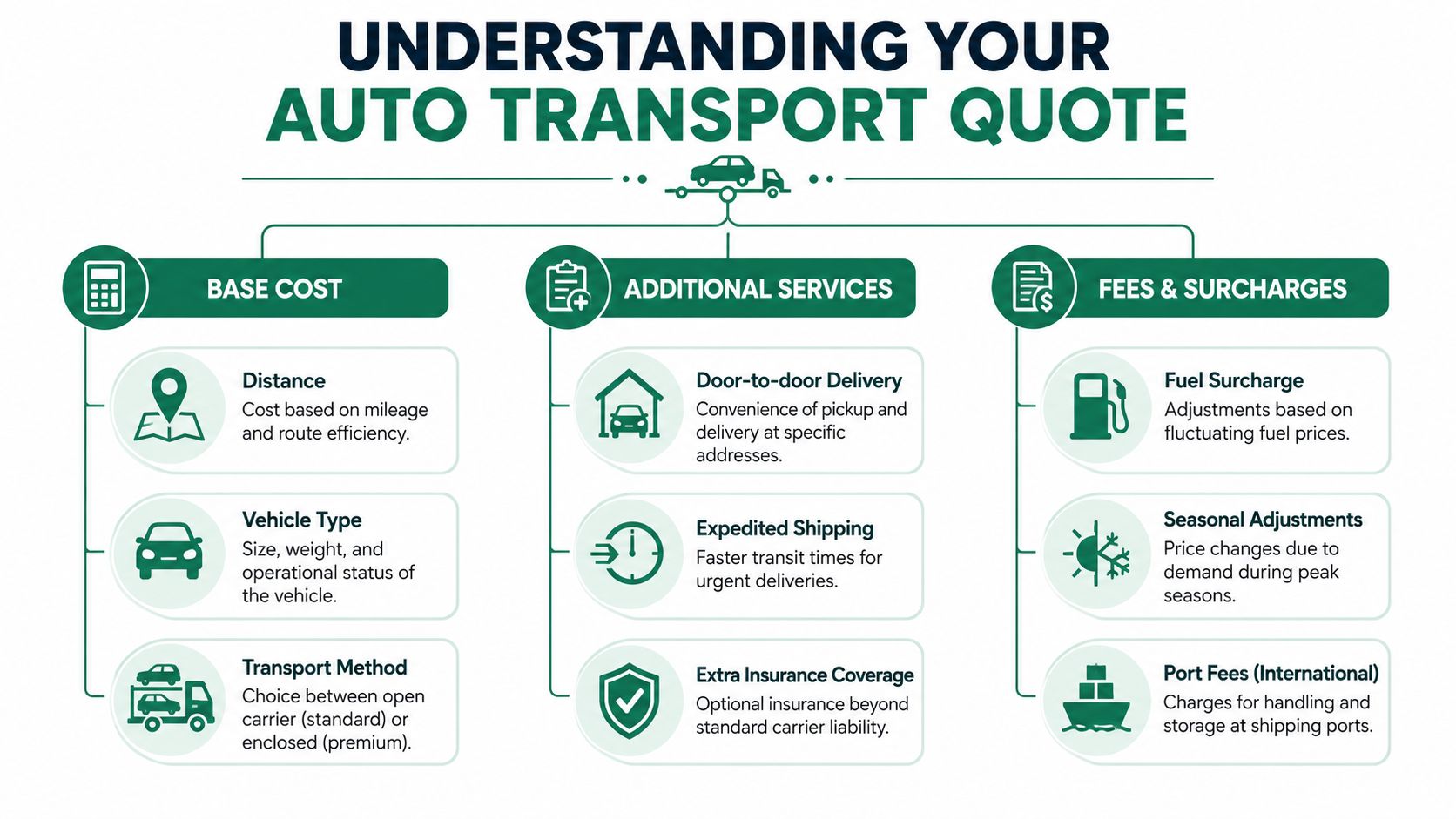
A useful quote should make room for service details such as:
- Pickup and delivery method: Door-to-door, business location, terminal, or port.
- Vehicle condition note: Running or non-running.
- Trailer type: Open or enclosed.
- Scheduling expectation: Standard timing or expedited handling.
- Insurance language: Carrier liability should be acknowledged in writing, not mentioned casually on a phone call.
The cheapest quote on your screen may be the least complete quote in the pile.
This is where transparent flat-rate pricing matters. If a company gives a number but leaves room for later “adjustments” tied to availability, your quote may be more of a placeholder than an actual offer. One practical option in the market is National Car Transport, which operates with transparent flat-rate pricing, an A+ BBB rating, more than 25 years in auto transport, a network of 25,000+ vetted carriers, and U.S.-based bilingual agents in English and Spanish who have over 20 years of experience in auto transport logistics. That model fits customers who want a direct explanation of what the shipment includes and who need help on mainland and Puerto Rico routes.
Where Puerto Rico quotes get more complicated
Puerto Rico quotes often combine more than one service leg. A vehicle may move from Denver, Charlotte, Newark, Tampa, or Los Angeles to a mainland port, then continue by ocean carrier to San Juan. If the quote doesn't separate those moving parts clearly, the customer can mistake a port quote for a full-service quote.
RoRo pricing is one place where vehicle size matters in a very specific way. TOTE Maritime rate guidance summarized here notes that vehicles exceeding 82 inches in width or 76 inches in height face higher RoRo rates, with Jacksonville-to-Puerto Rico pricing at $1,224 for standard-sized vehicles and $1,324 for oversized units up to 100 inches in height.
That doesn't mean every Puerto Rico quote should match those figures. It does mean oversized vehicles need to be disclosed before booking. If you ship a lifted truck and only mention the oversize after dispatch, the quote will need to be revised because the ocean leg changed.
A solid quote also makes clear whether port fees, handling steps, and local coordination are included or handled separately. That's where many low online estimates fall apart.
The Complete Guide to Shipping a Car to Puerto Rico
Mainland transport is mostly about route planning and truck availability. Puerto Rico adds port operations, ocean schedules, release documents, and local import costs. If you know that at the beginning, the move becomes manageable.
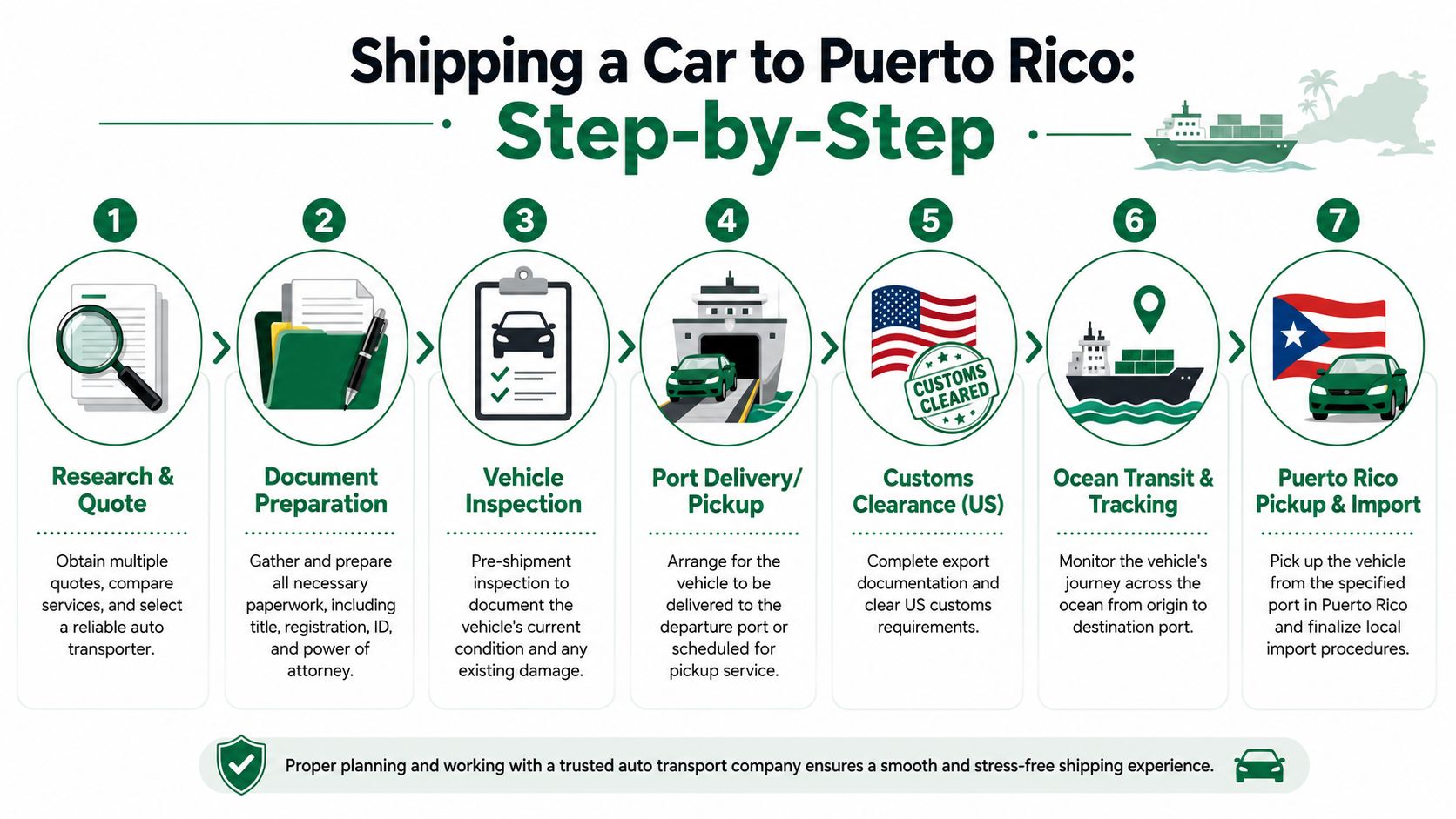
A visual overview helps before the paperwork starts.
How the process usually works
Most Puerto Rico shipments start with inland transport from your mainland location to a departure port, often Jacksonville. If you're in California, Arizona, Nevada, Texas, Illinois, Georgia, Virginia, or anywhere else in the lower 48, the first leg is usually standard domestic trucking. After that, the vehicle is checked in for ocean transport and loaded according to the service booked.
For the ocean leg, RoRo shipping typically costs between $1,200 and $1,500, while a 20-foot container usually ranges from $1,800 to $2,200 depending on the origin port and vehicle dimensions. RoRo is commonly used for standard operable vehicles. Container service may make more sense when the routing or vehicle type calls for a different level of handling.
The ocean segment isn't the whole move, though. Someone still has to coordinate the mainland pickup, confirm document readiness, track the handoff at the port, and make sure the customer knows what happens at arrival in San Juan. That's why customers often benefit from working with a provider familiar with car shipping to Puerto Rico instead of treating it like a simple domestic route.
After the vehicle lands, the final stage is release and import processing in Puerto Rico. That stage is where hidden confusion shows up if no one explained the sequence in advance.
To see the process in motion, this walkthrough gives a helpful visual reference.
Documents and costs that catch people off guard
Puerto Rico shipments require more than a driver's license and a credit card. In practice, customers should be ready with ownership documents, identification, and any authorization forms required for handling or release.
The common document set includes:
- Vehicle title or lienholder documentation: Ownership has to be clear.
- Registration: This helps confirm vehicle identity and status.
- Government-issued photo ID: The names need to match the shipping file.
- Power of attorney when required: Some shipments need signed authorization for processing steps.
- Booking and release instructions: Keep copies handy, especially if another person will receive the vehicle.
The part many people underestimate is the import side. Puerto Rico imposes an excise tax of 11.5% on the vehicle's fair market value, plus registration fees of $200 to $500 and inspection costs of $50 to $100, bringing total import costs for a standard vehicle to roughly $4,600 to over $15,000 including shipping and taxes. Those charges sit outside the simple idea of “what does the truck cost,” which is exactly why Puerto Rico quotes need closer review.
Puerto Rico moves go smoothly when the paperwork is prepared before the truck is dispatched, not while the vehicle is already heading to port.
Timing and coordination
Timing on Puerto Rico moves depends on two calendars, not one. You have the inland truck schedule and the vessel schedule. A delay on either side can change the overall handoff.
For individuals, snowbirds, students, military families, dealerships, and commercial accounts, the practical move is to build extra room into pickup and release plans. Don't schedule your only transportation around the most optimistic estimate. Give yourself a buffer, especially if you need the vehicle for work, campus move-in, or family travel after arrival.
That advice matters whether the origin is Miami, Orlando, Jacksonville, Atlanta, Dallas, Houston, Nashville, Washington, Philadelphia, Newark, Boston, Cleveland, Detroit, Minneapolis, Kansas City, Phoenix, or San Diego. Puerto Rico shipments reward planning.
Comparing Quotes and Spotting Red Flags
A good quote comparison isn't a race to the lowest number. It's a side-by-side check of what each company is promising, what they're leaving out, and how they handle risk.
How to compare quotes side by side
Start with four questions. Is the route the same? Is the service type the same? Is the vehicle listed correctly? Is the timeline described the same way? If any of those differ, the quotes aren't really comparable.
Use a simple comparison grid:
| Provider | Route details clear | Price format clear | Insurance explained | Puerto Rico experience clear | Human contact available |
|---|---|---|---|---|---|
| Quote A | Yes or no | Flat rate or vague | Written or unclear | Yes or no | Yes or no |
| Quote B | Yes or no | Flat rate or vague | Written or unclear | Yes or no | Yes or no |
| Quote C | Yes or no | Flat rate or vague | Written or unclear | Yes or no | Yes or no |
If you're also preparing the vehicle itself, it helps to understand related ownership costs. For example, detailing cost information for Seattle car owners can help someone budget post-transport cleanup or sale prep before or after shipping.
For Puerto Rico routes, timing claims deserve extra scrutiny. Transit from East Coast ports such as Jacksonville to San Juan averages 7 to 14 business days, and expedited options can reduce that to 5 to 7 days at an added cost of $500 or more. If one company promises much faster delivery without explaining how, ask what leg of the move they're describing.
Red flags that usually lead to problems
Some warning signs are consistent across the industry.
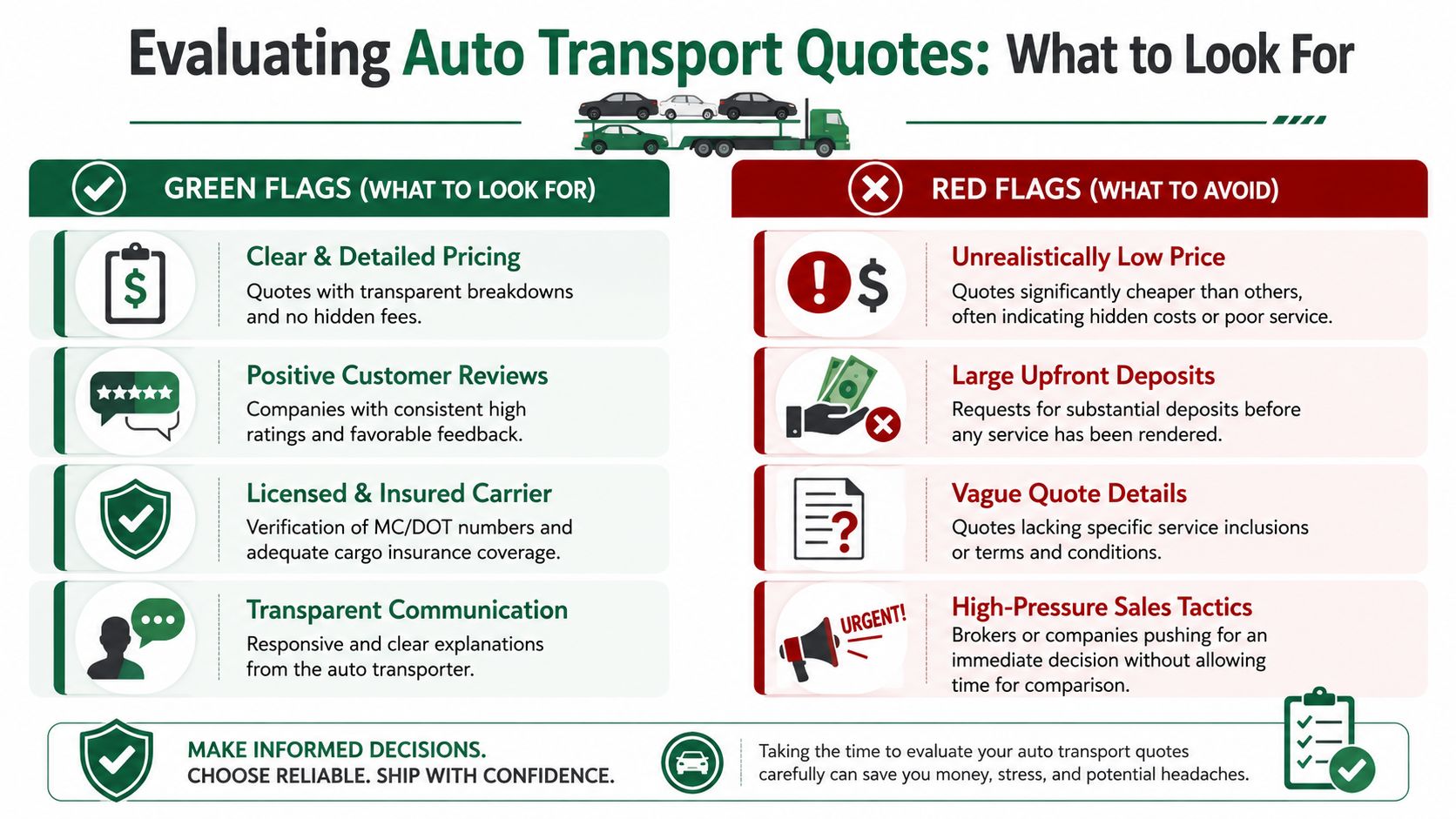
- A quote that's dramatically lower than the rest: That often means something has been omitted, usually timing realism, route difficulty, or service scope.
- Large upfront payment before carrier assignment: That puts risk on the customer before the shipment is lined up.
- Vague insurance answers: If the representative can't explain coverage clearly, you may find out the details too late.
- No physical business identity: A company should be reachable by phone and easy to verify.
- Pressure to book immediately: Strong operators answer questions. Weak ones push urgency.
“Low quote first, explanation later” is one of the oldest patterns in car shipping.
Green flags are less flashy, but they matter more. Look for companies that answer with specifics, explain dispatch timing clearly, acknowledge route limitations, and don't hide behind generic sales language. If the representative can explain the difference between a mainland delivery and a Puerto Rico port release in plain language, that's usually a good sign you're dealing with someone who understands the work.
Your Final Checklist for Choosing a Car Shipping Provider
By the time you're ready to book, you don't need more sales language. You need a clean final check.
First, confirm the quote reflects the actual shipment. That means the right vehicle, the right origin and destination, the right transport type, and the right timing expectations. If the route includes Puerto Rico, confirm who handles the port leg, who explains release requirements, and what charges are separate from transport.
Second, test communication before you commit. Call with one practical question. See how the company responds. A knowledgeable U.S.-based agent who can explain the process in English or Spanish is often the difference between a smooth move and a week of confusion. No two vehicle shipments are exactly alike, and having an experienced agent guide the process is often what makes it feel simple and quick.
Third, check reputation and operating habits. Longevity matters. So does whether the company is easy to verify, easy to reach, and willing to put key terms in writing. For Puerto Rico moves, this is especially important because import-side costs can be substantial. As noted earlier in the article, Puerto Rico applies excise tax, registration, and inspection costs that can push total import expense much higher than the shipping line item alone.
Provider Vetting Checklist
| Check | Verification Point | Why It Matters |
|---|---|---|
| ☐ | The quote lists the correct vehicle and route | Small errors lead to dispatch problems and revised pricing |
| ☐ | Pricing is presented clearly as a flat rate or clearly defined estimate | You need to know whether the number is stable |
| ☐ | Pickup and delivery method are identified | Door-to-door, port, and business-location service are not interchangeable |
| ☐ | Open or enclosed transport is stated in writing | Trailer type changes both handling and price |
| ☐ | The company explains insurance clearly | Vague answers create risk during claims situations |
| ☐ | A real person is available by phone | Logistics issues get solved faster when someone can act on them |
| ☐ | The provider has a long-standing reputation and verifiable business presence | Stability matters when your vehicle is in transit |
| ☐ | Puerto Rico procedures are explained if applicable | Island shipments involve extra paperwork and release steps |
| ☐ | The company explains when payment is due | Payment structure says a lot about business practices |
| ☐ | You understand what is not included | That's where most “surprise” costs start |
Use that checklist before you approve any booking link or hand over documents. A good transport decision usually feels calm, not rushed. The quote makes sense, the paperwork matches the job, and the person helping you can explain the next step without dodging the hard questions.
If you want a clear quote for mainland car shipping or a Puerto Rico route, National Car Transport is one option to consider. They handle door-to-door transport across the U.S., support Puerto Rico shipments, work with a nationwide carrier network, and provide U.S.-based bilingual agents who can walk through the details before you book.