
You clicked “buy,” the invoice landed in your inbox, and the adrenaline wore off fast. Now the main work starts. The car is sitting in an auction yard, the pickup window is tighter than most first-time buyers expect, and the lot won't release anything just because a transporter is “on the way.”
That gap between winning the bid and getting the vehicle home is where most auction problems happen. It's also where good coordination matters most. The global vehicle auction market processes an estimated 40 million vehicles annually, and North America alone accounts for $22.6 billion of that activity, which is why auction lots run on strict procedures and transport timing has to be precise, not casual (global vehicle auction market data).
For private buyers, dealerships, students, military families, snowbirds, and businesses moving vehicles across the lower 48, Alaska, Hawaii, or Puerto Rico, auction vehicle transport isn't just booking a truck. It's paperwork, release timing, equipment matching, inspection discipline, and knowing when a standard carrier won't work.
Table of Contents
- You Won the Auction Now What
- Preparing Your Vehicle and Paperwork for Pickup
- Choosing the Right Transport Method for Your Vehicle
- Securing a Reliable Flat Rate Quote
- Coordinating the Auction Pickup and Inspection
- Shipping a Car to Puerto Rico Alaska or Hawaii
- Avoiding Common and Costly Transport Mistakes
You Won the Auction Now What
The first move is simple. Stop thinking like a bidder and start thinking like a dispatcher.
Auction yards care about release status, lot rules, and removal timing. They don't care that you live in Dallas, Miami, Los Angeles, Phoenix, Chicago, Atlanta, Charlotte, Denver, Seattle, San Juan, or a smaller market in between. Once payment and release are in motion, the vehicle needs a transport plan that fits the lot's procedures.
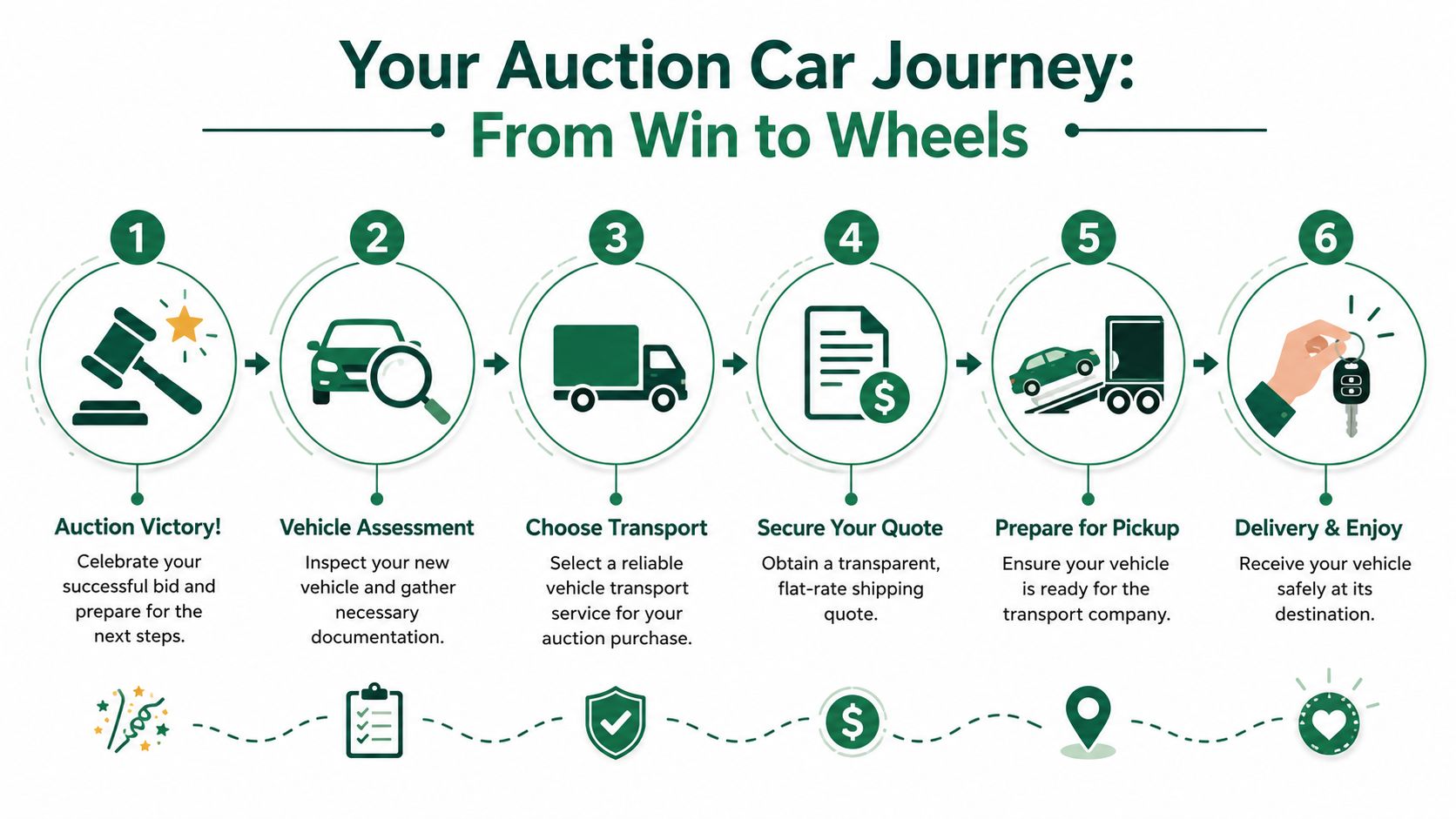
Some buyers assume shipping starts when the truck arrives. It doesn't. It starts when you confirm four things: the vehicle's exact location, whether it runs, what documents release it, and how quickly the lot expects removal. If even one of those is wrong, pickup can fail.
The first decisions that matter
A strong start usually comes down to a short checklist:
- Confirm release status: Make sure the auction has cleared the vehicle for pickup.
- Verify operable condition: Don't guess. “Starts” and “drives” are not the same as “easy to load.”
- Get the lot details: Exact yard address, business hours, and any gate or buyer release requirements.
- Choose your destination plan: Dealer lot, residence, repair shop, campus housing area, military base area, or port.
- Book early: Auction vehicle transport gets harder when you wait until the storage clock is already working against you.
Practical rule: The best time to arrange transport is right after the sale is secured, not when storage pressure starts.
That applies whether you're moving one daily driver from a sale in Houston to Orlando or relocating purchased inventory from several auction points into New Jersey, California, Ohio, or Puerto Rico. The process is manageable, but only if the handoff from auction to carrier is treated like a logistics job, not an afterthought.
Preparing Your Vehicle and Paperwork for Pickup
Most delayed pickups have nothing to do with the driver. They happen because the file isn't clean.
What to collect from the auction first
Before any carrier is dispatched, collect every document the lot may request at release. In practice, that usually means your bill of sale, invoice or paid receipt, title paperwork or release paperwork if available, and whatever pickup authorization the auction uses. Some lots also require a gate pass, buyer release, or transporter authorization.
If a third party is receiving the vehicle for you, put that in writing early. Auction staff won't improvise at the gate, and drivers can't argue a unit out of a secure yard.
A good buyer packet should include:
- Proof of purchase: Your paid invoice or bill of sale.
- Ownership or release paperwork: Whatever the auction requires to prove the vehicle is cleared.
- Transport contact details: Driver name, company name, and dispatch phone when available.
- Special authorization: Needed when someone other than the buyer is handling pickup.
Missing paperwork doesn't usually create a small delay. It often burns the whole pickup slot.
How to get the vehicle pickup-ready
Auction cars aren't always stored the way retail buyers imagine. Some are dusty, battery-drained, blocked in, or missing small but important items like keys or lug covers. That's why condition notes matter before the transporter arrives.
Take clear photos if the auction provides access or if you've received condition images through the platform. Remove any expectation that personal items will travel with the vehicle unless the carrier has agreed to that in advance. Keep fuel low enough for safe transport handling. If the vehicle needs seasonal prep for a cold-weather destination, it also helps to review practical guidance on protecting vehicles and homes from cold, especially when a car is heading into a freeze-prone area right after purchase.
A disciplined prep routine looks like this:
Check keys and running status If the car has no keys, say so before booking. If it rolls but won't start, say that too.
Document visible condition Capture dents, bumper damage, cracked glass, wheel damage, missing mirrors, or loose trim.
Clear personal property Auction vehicles should move as vehicles, not storage containers.
Confirm release timing Don't send a carrier before the lot is ready to release the unit.
Share all of it with dispatch The more accurate the file, the smoother the pickup.
A lot of first-time buyers often get tripped up. They think the auction knows what the transporter needs and the transporter knows what the auction means. Usually, neither side has the full picture unless the buyer supplies it.
Choosing the Right Transport Method for Your Vehicle
Not every auction purchase belongs on the same type of equipment. The right method depends on condition, value, route, and destination access.
Auction Transport Options Compared
| Transport Type | Cost | Protection Level | Best For |
|---|---|---|---|
| Open transport | Typically the most cost-effective option | Standard road exposure | Daily drivers, dealer inventory, most operable auction cars |
| Enclosed transport | Higher than open transport | Highest protection from weather and road debris | Classics, luxury cars, specialty vehicles, delicate finishes |
| Container or RoRo shipping | Route-dependent and equipment-dependent | Varies by method and port handling | Puerto Rico, Hawaii, Alaska, and specialized island or ocean routes |
Open transport is what most buyers use across the continental U.S. If the car is a normal sedan, crossover, or pickup and the goal is efficient movement from auction lot to home, dealership, or repair facility, open usually makes sense.
Enclosed transport fits a different profile. If the vehicle is rare, freshly restored, unusually low to the ground, or too valuable to expose to weather and road grit, enclosed is the better call.
Which option fits which buyer
A dealership moving mainstream inventory from sale lanes in places like Dallas, Nashville, Las Vegas, or Indianapolis usually leans open because speed and lane availability matter. A collector moving a vintage coupe into a private garage in Scottsdale or Naples usually chooses enclosed because condition matters more than price.
Puerto Rico changes the equation again. Ocean routes add port coordination, documentation, and dimensional considerations. For those shipments, the mainland pickup leg and the ocean leg need to fit together cleanly.
Here's the fundamental trade-off buyers should think about:
- Open wins on efficiency: Best when the vehicle is standard, operable, and not especially sensitive.
- Enclosed wins on protection: Best when exposure risk matters more than cost.
- Ocean methods win on route necessity: If the destination is Puerto Rico, Hawaii, or parts of Alaska, inland transport alone won't finish the job.
Insurance understanding also matters here. Buyers comparing providers should know what carrier cargo coverage is designed to do and where limits may apply. A practical outside reference is this insurance guide for commercial carriers, which helps explain why equipment type and declared vehicle condition affect risk.
The cheapest method isn't the best method if it causes a second move, extra handling, or condition disputes.
One more point that gets missed. Some auction vehicles technically “run,” but shouldn't be treated like easy-drive units if they have mechanical warnings, body damage affecting clearance, or leaking issues. In those cases, choosing the safer equipment from the start is usually cheaper than fixing a bad decision later.
Securing a Reliable Flat Rate Quote
A quote is only useful if it matches the actual job. Auction vehicle transport quotes go wrong when the buyer leaves out the hard parts.
What a quoting team needs from you
The most accurate quote starts with complete shipment details. That means the exact auction location, the delivery city, whether the car is operable, whether it has keys, whether it has major damage, and how quickly the lot needs it removed.
If you ask, “How much to ship my auction car to Florida?” you'll get a soft estimate at best. If you say, “It's at a salvage auction outside Chicago, it doesn't start, it rolls, and it needs to go to Jacksonville,” that's a real dispatchable file.
Provide these details up front:
- Auction lot address: Not just the auction brand name.
- Vehicle year, make, and model: Needed for size and carrier fit.
- Running condition: Operable, non-operable, or partially operable.
- Key status: Missing keys changes loading strategy.
- Destination type: Residence, dealer, port, business, or repair facility.
- Timing: Flexible schedule or urgent release window.
What flat-rate should actually mean
A flat-rate quote should be understandable without a decoder ring. You should know what's included, whether insurance is included, whether the route includes normal fuel and carrier costs, and what could still change if the original vehicle description was inaccurate.
The best flat-rate conversations sound plain:
- This is the route.
- This is the equipment type.
- This is whether the vehicle is being quoted as operable or inoperable.
- This is what happens if the lot requires special access or the vehicle turns out to be different than described.
Be careful with quotes that look attractively low but leave room for later add-ons. Auction transport is especially vulnerable to surprise charges when the vehicle turns out to be non-running, oversized, blocked in, or not yet released.
For buyers who want a cleaner booking experience, National Car Transport is known for transparent flat-rate pricing, zero upfront charges until the vehicle is matched with a carrier, and access to 25,000+ vetted carriers. Those details matter because the quality of the quote usually reflects the quality of the dispatch process behind it.
Coordinating the Auction Pickup and Inspection
Auction pickups don't behave like residential pickups. The driver doesn't just pull up, call you, and load the car.
What happens at the lot
A typical auction pickup starts with the carrier checking in during the lot's operating hours, presenting the required release details, and waiting for the yard to stage the vehicle. Sometimes that goes quickly. Sometimes the lot is backed up, short-staffed, or moving several units at once.
That's why timing and communication matter more at auctions than at private homes. The carrier needs the release information to match exactly, and the buyer or broker needs to be reachable if the lot has a discrepancy.
The key document during this handoff is the Bill of Lading, often shortened to BOL. It serves as the transport receipt and the condition record created at pickup. If there's visible damage, missing parts, or obvious transport concerns, that needs to be reflected before the unit is loaded.
Why the inspection matters before loading
Digital inspections have made this part of the job much stronger. The adoption of digital vehicle inspections at auto auctions has been shown to reduce dispute rates by an average of 30%, because they create clear, time-stamped evidence of the vehicle's condition before loading (digital auction inspection data).
That matters for buyers and carriers alike. If the front bumper was already cracked, the wheel was already scraped, or the rocker panel was already bent, the pickup record should show it.
A clean auction inspection usually follows this order:
Locate and verify the unit Match VIN or stock information to the release.
Walk the vehicle before loading Check body panels, glass, tires, mirrors, roofline, and obvious underbody risks if visible.
Record condition on the BOL Notes matter. Photos matter more.
Load with the right equipment Clearance, tire condition, and steering response all affect this step.
Good pickup inspections protect honest buyers and honest carriers at the same time.
The operations side has also improved because more transport teams now rely on tools that document handoffs and cut delivery delays through better proof-of-delivery workflows. That doesn't replace attention at the lot, but it does make condition tracking and delivery confirmation much tighter.
One practical habit helps more than people realize. Ask for confirmation once the vehicle is loaded, not just once the order is “scheduled.” Scheduled means a plan exists. Loaded means the hard part is done.
Shipping a Car to Puerto Rico Alaska or Hawaii
Island and non-contiguous routes require a different kind of coordination. The inland leg is only one part of the move.
Puerto Rico paperwork and port planning
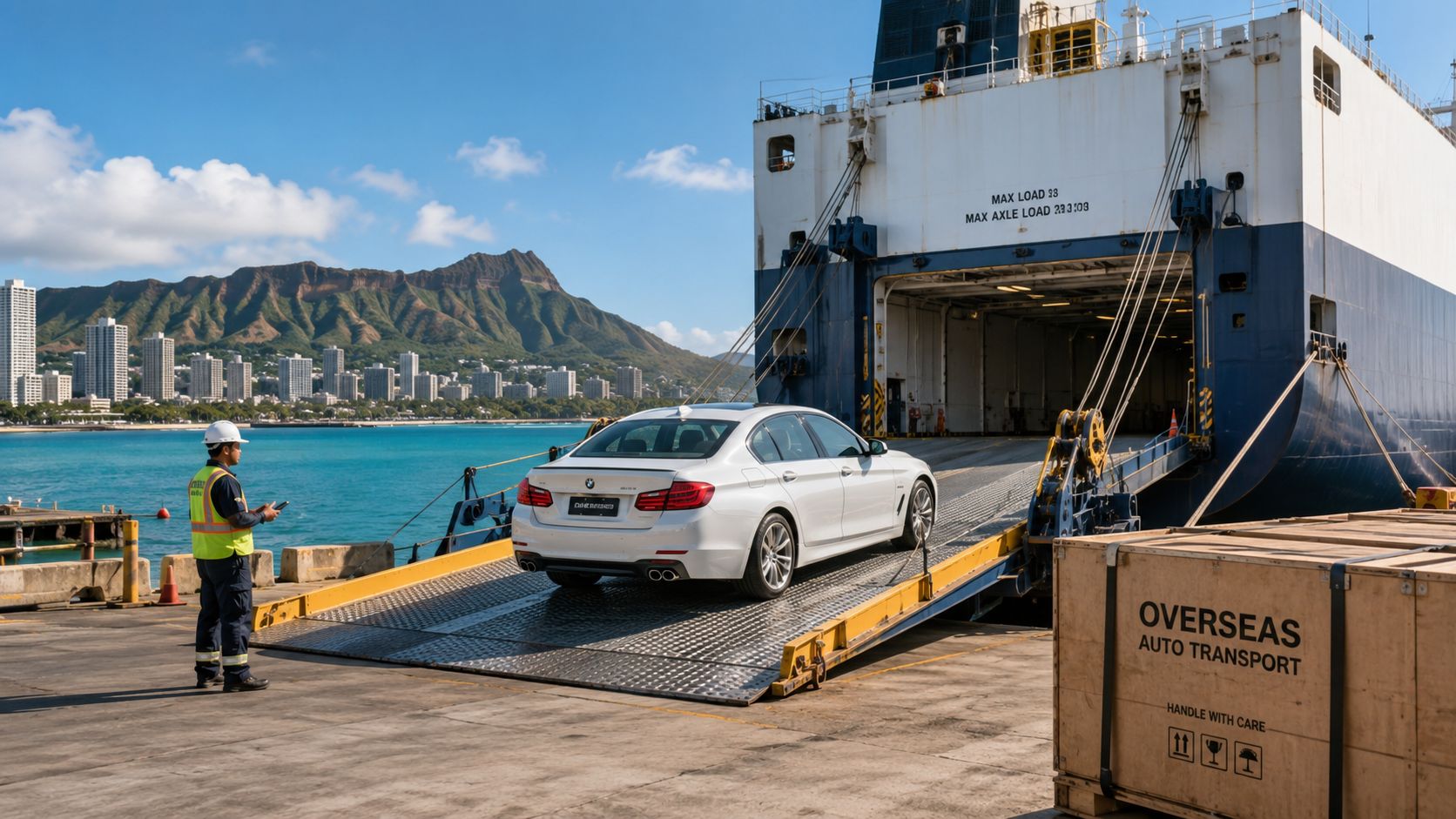
Puerto Rico is one of the most common specialized routes in U.S. auto transport, and it's where sloppy paperwork causes expensive headaches. When shipping a car to Puerto Rico, no customs duties apply, but an excise tax called Impuesto de Consumo does apply, and shippers need the original title, vehicle registration, ID, and a notarized power of attorney if a third party is handling the transport (Puerto Rico shipping paperwork and tax requirements).
Cost depends on route, dimensions, and port handling. Shipping a car from the U.S. mainland to Puerto Rico typically costs between $1,200 and $3,000, with standard-sized vehicles under 82 inches wide and 76 inches high priced at $1,202 from Jacksonville to Puerto Rico, while units exceeding 76 inches in height up to 100 inches cost $1,302 (Puerto Rico car shipping cost ranges).
A few practical points matter here:
- Florida and Texas port access helps: Inland pickups can add ground transport complexity before the ocean leg even begins.
- Vehicle size matters: Taller trucks and SUVs often cost more and may limit method options.
- Third-party handling needs authorization: Don't wait until port intake to realize a signature is missing.
Later in the process, buyers should also expect port-related charges and current shipping conditions to reflect fuel and terminal requirements. Tote notes that Puerto Rico vehicle shipping includes mandatory bunker and environmental fuel fees, TAC fees, and insurance coverage, with containerized shipping generally more affordable for standard vehicles that fit within 82 inches width and 76 inches height (Puerto Rico personal vehicle shipping details).
For a quick visual overview of how the port side works, this walkthrough helps:
For families, students, service members, and dealerships shipping to or from San Juan, having bilingual support makes a real difference. Paperwork questions move faster when English and Spanish support are both available and handled by U.S.-based agents who know port logistics.
Alaska and Hawaii require a different mindset
Alaska and Hawaii shipments also need inland plus ocean coordination, but the planning usually revolves around port scheduling, receiving procedures, and delivery type more than auction release rules alone. The biggest mistake on these routes is treating them like standard domestic car hauling.
For these jobs, ask early whether the quote covers only the mainland leg, only the port-to-port segment, or the full move. Buyers moving vehicles from auction sites in California, Washington, Texas, Georgia, or New Jersey into Alaska or Hawaii need all parties aligned on where responsibility changes hands.
Avoiding Common and Costly Transport Mistakes
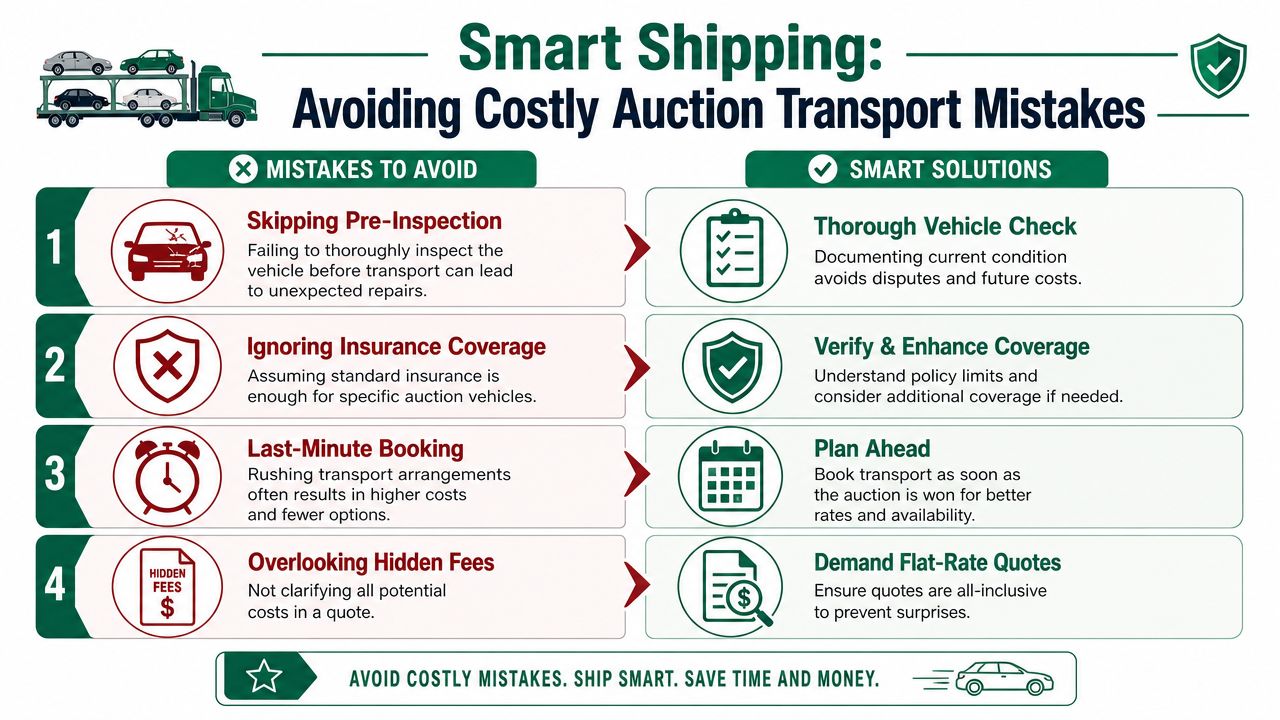
The biggest auction transport mistakes don't look dramatic at first. They look like small omissions. Then they turn into failed pickups, storage pressure, and second-dispatch costs.
The mistake that causes the most failed pickups
The most common hidden problem is misreporting the vehicle as operable when it needs special loading. A frequently overlooked detail is that non-operational vehicles require carriers with winch equipment, and failure to disclose that often leads to failed pickups and additional handling fees ranging from $75 to $150, since most standard carriers aren't equipped for winch loading (winch-loading requirements for non-operational auction vehicles).
That's not a minor technicality. It changes which carrier can do the job.
Other avoidable problems
A few more mistakes show up constantly:
- Waiting too long to book: Buyers burn valuable time and end up working around the lot's clock instead of their own.
- Assuming every destination is easy for a carrier: Tight residential streets, gated communities, campuses, and military-adjacent access points can require alternate meeting locations.
- Ignoring inspection records: If pickup notes are vague, delivery disputes get harder to resolve.
- Treating Puerto Rico paperwork like standard domestic shipping: Port moves require cleaner documentation and tighter coordination.
If a vehicle doesn't start, steer, brake, or roll normally, say it before the carrier is assigned. That one detail can save the whole shipment.
The easiest way to avoid most of these issues is to communicate like a fleet manager even if you're only shipping one car. Be exact. Be early. Assume the lot won't bend the rules for anyone.
If you need help moving an auction purchase across the mainland U.S. or on specialized routes to Puerto Rico, Alaska, or Hawaii, National Car Transport is a reliable option to consider. The company is U.S.-based, has 25+ years of experience, an A+ BBB rating, transparent flat-rate pricing, and a network of 25,000+ vetted carriers. Their bilingual English and Spanish agents are based in the USA, with over 20 years of experience focused specifically on auto transport logistics, which matters because no two auction shipments are alike. For individuals, snowbirds, students, military families, dealerships, and businesses, having an experienced advisor guide the paperwork, scheduling, and delivery details can make the process much simpler and faster at a solid value.